Our Lady of the Rocks: The Island Church Built by Sailors
Rising from the still waters of the Bay of Kotor near Perast, Our Lady of the Rocks (Gospa od Škrpjela) is a small Roman Catholic church built on an artificial island over several centuries. It holds an extraordinary collection of votive offerings, silver tablets, and oil paintings, making it far more interesting inside than its modest exterior suggests.
Quick Facts
- Location
- Bay of Kotor, opposite Perast, Montenegro
- Getting There
- Boat taxi from Perast waterfront (approx. 5-minute crossing)
- Time Needed
- 45 minutes to 1.5 hours including boat transit
- Cost
- Boat taxi (small fee per person, negotiated at the dock); church entry by donation
- Best for
- History lovers, photography, day-trippers from Kotor
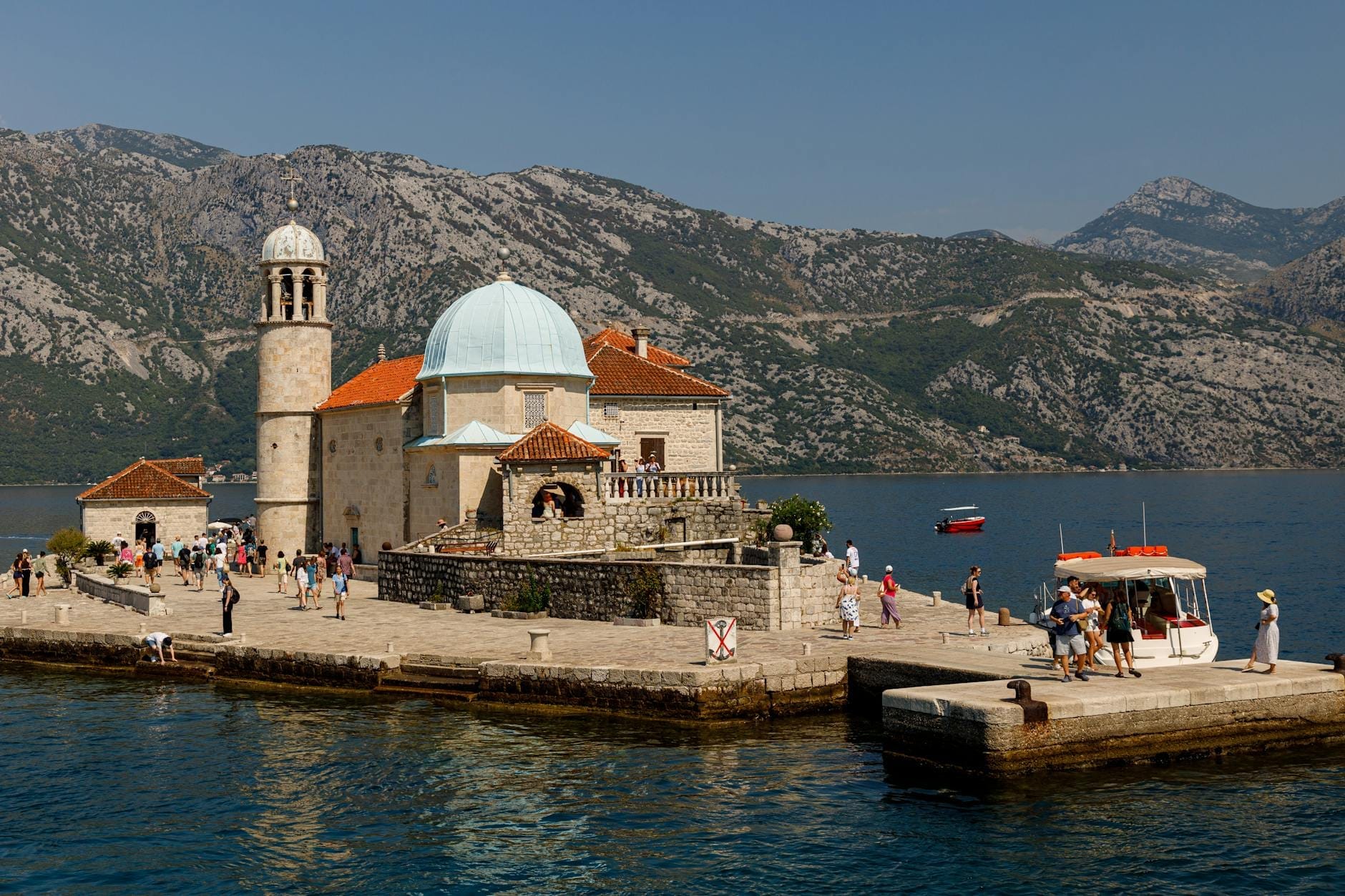
What Is Our Lady of the Rocks?
Our Lady of the Rocks (Gospa od Škrpjela) is a Roman Catholic church sitting on a small artificial island in the Bay of Kotor, just offshore from the town of Perast. It is one of only two man-made islands in the Adriatic (the other, also near Perast, is the natural islet of Saint George). The island was constructed over centuries by local sailors who, following a tradition established in 1452, sank old ships laden with rocks on the feast day of the Virgin Mary each year. The practice continued for nearly 400 years, gradually raising the island to its current form.
The tradition holds that two sailors from Perast found an icon of the Virgin on a rock in the sea on July 22, 1452, and that successive miracles prompted the local community to build a chapel on the site. What began as a modest shrine evolved into the current baroque church, completed in the late 17th century, with a collection of art and artifacts that would look at home in a well-funded urban museum.
ℹ️ Good to know
The island is accessible only by boat. Boat taxis depart from the Perast waterfront, and the crossing takes roughly five minutes each way. There is no bridge or ferry service.
The Crossing and First Impressions
The approach by boat gives you the photograph that ends up in every Bay of Kotor travel article: a small, rust-red domed church and a leaning campanile reflected in calm green water, with the steep slopes of Mount Orjen as a backdrop. In morning light, the reflection is nearly perfect. By midday, the glare off the water flattens the scene, and the island is at its most crowded with cruise day-trippers from Kotor. Late afternoon, after the tour groups have cleared, the island takes on a different quality — quieter, the light warmer, the water darker.
The boat taxis are small wooden vessels operated from the Perast quay. The crossing itself is part of the experience: the bay is extraordinarily calm at almost any hour, and the five-minute ride gives you an uninterrupted view of both the island ahead and the Perast waterfront behind. Agree on a return time with your boatman or confirm he will wait, particularly during busy summer months when demand can be unpredictable.
💡 Local tip
Visit before 10:00 or after 16:00 to avoid the concentrated wave of cruise passengers. Groups from large ships tend to arrive mid-morning and clear out by early afternoon.
Tickets & tours
Hand-picked options from our booking partner. Prices are indicative; availability and final rates are confirmed when you complete your booking.
Montenegro Canyons private tour from Kotor
From 68 €Instant confirmationFree cancellationLovćen national park and Budva city full-day private tour
From 150 €Instant confirmationFree cancellationDubrovnik walking tour from Kotor
From 59 €Instant confirmationFree cancellationBudva private tour from Kotor
From 58 €Instant confirmationFree cancellation
Inside the Church: What You Actually See
The interior of Our Lady of the Rocks is the main reason to make the crossing. The church holds 68 oil paintings by the Venetian-influenced Baroque artist Tripo Kokolja (1661–1713), a native of Perast. The paintings cover the walls and ceiling in a densely layered visual programme depicting scenes from the life of the Virgin and the life of Christ. Kokolja worked on the commission for much of his career, and the quality is consistent throughout, which is not always the case with commissions of this scale and duration.
On the main altar stands the original icon of the Virgin with Child, painted on leather by an unknown artist. Tradition holds this is the very icon found by the two sailors in 1452, though the iconographic style places it somewhat later. Around the altar and along the walls hang over 2,500 silver and gold votive tablets (ex-votos), left by sailors seeking protection before voyages or giving thanks for survival. They range from crude, roughly hammered shapes to finely worked panels with inscribed dedications. The sheer accumulation of them, covering surface after surface, communicates something about the relationship between this community and the sea that no historical text fully conveys.
One votive tablet merits particular attention: an embroidery created by a local woman named Jacinta Kunić over 25 years, waiting for her sailor husband to return from sea. The textile incorporates gold and silver thread alongside strands of the artist's own hair, which turned from dark to grey as the years passed and the husband never came back. It is displayed in a small side case and is easy to miss — ask the attendant to point it out.
💡 Local tip
The church interior is relatively small and poorly lit. If you are interested in the details of Kokolja's paintings, bring a small torch or use your phone's flashlight to see the ceiling panels clearly.
Historical and Cultural Context
Perast during the 17th and 18th centuries was a significant maritime power under Venetian suzerainty, producing naval captains of sufficient reputation that Peter the Great of Russia sent young officers there to train. The wealth and ambition visible in both the church's art collection and the palaces lining the Perast waterfront date from this period. Our Lady of the Rocks was not a peripheral chapel: it was a civic and religious centre, a repository of the community's gratitude and fear in relation to the sea.
The tradition of sinking stone-laden boats on the Feast of the Assumption (August 15) continues to this day in a ceremony called Fašinada, in which residents of Perast row out to the island and throw stones into the water. The event draws visitors from across the region and is the best time to see the island in the context of living tradition rather than as a museum exhibit. For more on the surrounding area, the town of Perast itself rewards a few hours of walking, with its baroque palaces, waterfront promenade, and church towers.
Our Lady of the Rocks sits in the innermost part of the Bay of Kotor, one of the most sheltered natural harbours in the Adriatic. The topography of this area, a drowned river canyon that resembles a fjord, creates the still water conditions that make the island's reflection so photogenic. For context on the broader bay, the Bay of Kotor boat tour guide covers organised excursions that include the island as part of a longer circuit.
Photography: Getting the Best Shots
The iconic wide shot of the church and campanile reflected in the bay requires calm water and good light. Early morning (before 09:00) offers both: the boat traffic is minimal, wind hasn't yet disturbed the surface, and the low sun catches the ochre and red tones of the facade. Shoot from the boat during your approach rather than from the island itself, as you lose the reflection the moment you step onto the dock.
Inside the church, photography is generally permitted, but flash is typically discouraged given the age of the paintings. The dark interior and elaborate gold votive tablets respond well to a slightly wider aperture if shooting with a camera rather than a phone. A tripod is impractical given the small space and other visitors, so brace against a wall or pew for slower exposures.
⚠️ What to skip
The island can be extremely small and busy between 10:00 and 14:00 during summer. If you arrive alongside a large group, the interior of the church becomes difficult to move through and nearly impossible to photograph with any care.
Practical Information: Getting There and Planning Your Visit
To reach Our Lady of the Rocks, you first need to reach Perast. From Kotor, Perast is approximately 12 kilometres northwest along the bay coast. Local buses on the Kotor–Herceg Novi route stop in Perast, and the journey takes around 20 minutes. Taxis from Kotor old town take roughly 15 minutes. Once in Perast, boat taxis for the island depart from the main waterfront, clearly signposted. The boats are informal and frequent during summer, less so in the shoulder season. The getting around Kotor guide covers regional transport options in detail.
Most visitors combine a visit to the island with a few hours in Perast itself, or incorporate it into a day-trip from Kotor. The day trips from Kotor guide outlines several itineraries that include Perast and the surrounding bay towns, which is the most efficient way to see this part of Montenegro if your time is limited.
Dress modestly for the church interior — shoulders and knees covered. The island itself is very small, with no café, no toilet, and almost no shade. There is a small souvenir stand near the entrance. In summer, carry water and apply sunscreen before boarding the boat, since there is no shelter from the sun once you are on the water or on the island.
Accessibility is limited. The boat embarkation requires stepping into a small vessel from a stone quay, and the island surface is uneven stone. The church has a small step at the entrance. Visitors with significant mobility limitations should assess the practicalities before making the trip.
Is It Worth the Trip?
The short answer is yes, but with a condition: the experience is only as good as the timing. Arrive when the island is crowded and you get a perfunctory circuit of a small, dark church filled with other people's elbows. Arrive when it is quiet and the same space becomes genuinely absorbing, the kind of place where a single object (those votive tablets, that embroidery) stays with you long after you have left.
Visitors who travel primarily for scenery and photography will get what they need in 20 minutes. Those interested in material culture, religious history, or the social history of maritime communities could spend an hour here and still want more. If baroque art churches are not your interest and you are short on time, the Perast old town itself offers architecture and views that require no boat crossing. That said, the island adds something that Perast's palaces and waterfront cannot replicate: an intimate encounter with the beliefs and anxieties of a community that lived entirely by the sea.
Who should skip it: travellers who are boat-averse, those with serious mobility limitations, and anyone visiting solely on the basis of the exterior photograph. The appeal of this site is overwhelmingly interior and contextual. If you aren't willing to spend time inside the church, the boat crossing is a large proportion of the experience for a short payoff.
Insider Tips
- Ask the church attendant to show you Jacinta Kunić's embroidery — the textile incorporating the artist's own hair as it greyed over 25 years of waiting for her sailor husband. It is displayed in a side case and most visitors walk past it.
- The boat crossing is very short, but sitting in the bow of the boat on the approach gives you the best unobstructed angle for the classic reflection shot. Bring your camera ready before you board.
- The Fašinada ceremony on July 22 involves Perast residents rowing to the island and dropping stones into the water to continue the island-building tradition. Attending it is a rare chance to see the site as a living cultural event rather than a historical exhibit.
- Combine the island with a walk along the Perast waterfront and a climb of St. Nicholas Church's campanile for a comprehensive half-day. The campanile offers the best elevated view of the island from land.
- In September and October, crowds thin significantly, the water remains warm enough to enjoy the crossing, and the afternoon light over the bay is better than in high summer. These are arguably the best weeks of the year to visit.
Who Is Our Lady of the Rocks (Gospa od Škrpjela) For?
- History and religious art enthusiasts who will engage with the church's interior collection
- Photographers targeting the Bay of Kotor's most iconic reflection shot
- Day-trippers from Kotor combining the island with a Perast waterfront visit
- Travellers interested in Adriatic maritime culture and Venetian-era heritage
- Couples and small groups looking for a calm, scenic excursion away from the Kotor old town crowds
Nearby Attractions
Other things to see while in Perast:
- Perast Old Town
Perast is a single-street Baroque village on the Bay of Kotor that once rivaled Venice for maritime wealth. Today it offers stone palaces, waterfront cafes, and direct boat access to two island churches — all within an hour of Kotor.