The Wallace Collection: London's Most Overlooked World-Class Art Museum
Tucked behind Manchester Square in London's West End, The Wallace Collection packs around 5,500 objects — Old Master paintings, European armour, Sèvres porcelain, and 18th-century French furniture — into a Georgian townhouse that feels more like a private palace than a public museum. Entry to the permanent collection is free, and the crowds rarely match the quality on display.
Quick Facts
- Location
- Hertford House, Manchester Square, London W1U 3BN
- Getting There
- Bond Street (Central & Jubilee lines) or Baker Street (Jubilee, Metropolitan, Circle, District & Hammersmith & City lines) — both around 5–10 min walk
- Time Needed
- 1.5–3 hours for permanent collection; longer if a temporary exhibition is running
- Cost
- Free (permanent collection); ticketed temporary exhibitions priced separately in GBP
- Best for
- Art lovers, history enthusiasts, couples, and anyone seeking a quiet alternative to London's larger museums
- Official website
- www.wallacecollection.org
What The Wallace Collection Actually Is
The Wallace Collection is a UK national museum housed in Hertford House, a 17th-century townhouse on Manchester Square in Marylebone. It holds approximately 5,500 objects accumulated across four generations of the Marquesses of Hertford and their heir Sir Richard Wallace, and was bequeathed to the British nation by Lady Wallace in 1897. The museum opened to the public in 1900, and the collection remains intact as a bequeathed national collection. What you see today is precisely what was gathered, bought, and occasionally obsessed over by a series of wealthy Francophiles with exceptional taste and very deep pockets.
That constraint — a fixed, un-lendable collection — is part of what makes the Wallace Collection so compelling. Unlike larger institutions that rotate their holdings, many of the collection's objects are always on display. Velázquez's portrait of a Spanish nobleman, Frans Hals's 'The Laughing Cavalier', and one of the finest collections of European arms and armour outside a royal armoury are all simply there, waiting, in rooms that still feel like the private house they once were.
💡 Local tip
Entry to the permanent collection is free. No booking required for general admission. For temporary exhibitions, check the official website for ticket prices and availability before you visit.
The Experience: Room by Room
The ground floor sets the tone immediately. The entrance hall is calm and unhurried — you are handed a floor plan, not a timed ticket. There are no vast crowds shuffling through in queued lines. On weekday mornings, particularly before 11:30, you may find yourself nearly alone in galleries containing paintings worth tens of millions of pounds. That quiet is not accidental; the building's scale (around 25 galleries across two floors) keeps visitor density low even on busier weekend afternoons.
The ground floor galleries are arranged around a central courtyard that was glassed over in the 1990s to create a light-filled atrium, now home to the museum's café. The surrounding rooms contain the arms and armour collection, which is far more impressive than its brief description suggests. Several hundred pieces of European and Oriental armour are displayed in dense, beautifully lit cases — decorated swords, wheel-lock pistols with ivory and gilt inlay, and full suits of field armour that look purpose-built for ceremonially terrifying an enemy. Even visitors with no particular interest in military history tend to linger here longer than expected.
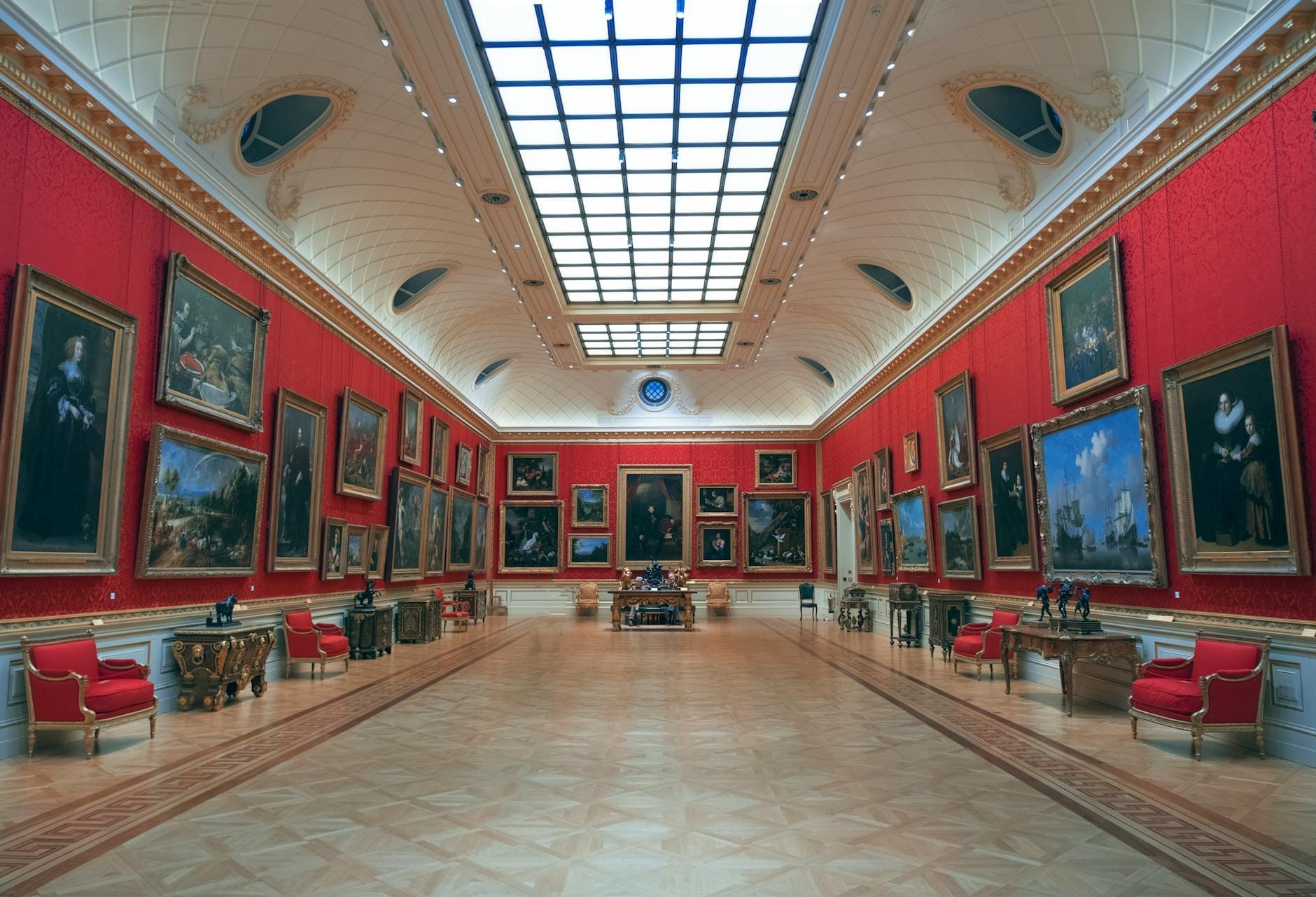
Upstairs, the picture galleries along the south and east sides of the house contain the paintings most people come for. The great room — the Large Gallery — runs the full length of the piano nobile and is hung floor-to-ceiling with Dutch, Flemish, Spanish, and Italian paintings from the 17th and 18th centuries. Natural light comes from skylights and tall windows, meaning the paintings look noticeably different depending on the time of day and season. A morning visit in summer, when diffused light fills the room without glare, gives the Rembrandt portraits a warmth that no artificial lighting replicates.
Tickets & tours
Hand-picked options from our booking partner. Prices are indicative; availability and final rates are confirmed when you complete your booking.
Soho Instagram a self-guided walking tour to top photo spots
From 6 €Instant confirmationFree cancellationTootbus London by Night: Bus tour
From 32 €Instant confirmationFree cancellationIFS Cloud Cable Car Ride and Uber Boat Hop-on Hop-off 1 Day Ticket
From 38 €Instant confirmationFree cancellationThe Making of Harry Potter Guided Tour of London Warner Bros. Studio
From 201 €Instant confirmationFree cancellation
The Highlights Worth Seeking Out
'The Laughing Cavalier' by Frans Hals (1624) is the collection's most famous painting and somewhat unfairly its most reduced — the nickname, which came centuries after Hals painted it, has made it feel like a mascot rather than the extraordinary piece of bravura brushwork it actually is. Stand close and look at the embroidery on the sleeve: the paint handling there is among the finest of the period. The subject's expression, incidentally, is not quite laughing — it is closer to self-satisfied amusement, which may be more accurate to the era.
Velázquez's equestrian portrait 'Don Baltasar Carlos', Titian's 'Perseus and Andromeda', Poussin's 'Dance to the Music of Time' — these are works that would be centrepieces in most European museums, but here they share wall space with dozens of other significant paintings. The French 18th-century decorative arts collection on the ground and first floors is equally serious: Sèvres porcelain, Boulle marquetry furniture, and objects made for the French royal household appear throughout, giving the house a coherent sense of a collecting ambition that stretched across media.
If you are drawn to the Rococo sensibility running through the French rooms, the Sir John Soane's Museum in Holborn offers a similarly intimate experience of an obsessive Victorian-era collector's private world — though the aesthetic is entirely different.
When to Visit and How the Experience Changes
The Wallace Collection is open daily from 10:00 to 17:00, closing on 24, 25, and 26 December. Weekday mornings between opening and around noon are consistently the quietest periods. School groups occasionally visit on weekday mornings during term time, which can create brief congestion in the ground floor galleries, though the size of the house means this rarely becomes a problem.
Weekend afternoons attract more visitors, but the collection's relative obscurity among international tourists means the gallery never reaches the saturation levels of the National Gallery or the British Museum. If you are visiting on a Saturday, arriving at opening time is a reasonable precaution, particularly if a ticketed temporary exhibition is running concurrently — those draws can bring in a different and larger crowd.
The indoor courtyard café is a pleasant place to break between gallery floors. The glazed roof creates a conservatory atmosphere that is particularly appealing in winter, when the contrast between the cold street and the warm, pale interior is most noticeable. The café serves lunch as well as coffee and cakes, and tables are rarely hard to find outside peak Saturday lunch hours.
ℹ️ Good to know
Parts of the museum may close at short notice due to events or maintenance. Visitors with specific accessibility requirements should check current arrangements on the official website before arriving, as the historic building has been adapted but may have limitations.
Getting There and the Surrounding Area
The museum sits on Manchester Square, a quiet residential garden square in Marylebone that most visitors pass through without recognising it. Bond Street station (Central and Jubilee lines) is a convenient approach — from the Tube, it is a roughly 5–10 minute walk north through the side streets between Oxford Street and the square. Baker Street station (served by the Jubilee, Metropolitan, Circle, District, and Hammersmith & City lines) is slightly further away.
The neighbourhood around the museum is worth walking slowly. The area between Baker Street, Marylebone High Street, and Oxford Street contains some of London's better independent food shops, cafés, and bookshops — Daunt Books on Marylebone High Street, in particular, is one of the more architecturally beautiful bookshops in the city. A visit to the Wallace Collection slots naturally into a half-day in this part of the West End.
The museum is also well-positioned for continuing east into the West End or south to Oxford Street if you are combining cultural and shopping stops. For a longer day out, the National Gallery in Trafalgar Square offers complementary Old Master paintings at a larger scale, and makes a logical pairing for serious art visitors.
Photography and Practical Logistics
Photography of the permanent collection is permitted for personal, non-commercial use. Flash photography is not allowed. The Large Gallery upstairs benefits from natural light but can produce glare on varnished canvases in direct afternoon sun during summer — if you are specifically trying to photograph the paintings without glare, a morning visit on an overcast day gives the most even results. The arms and armour rooms are more reliably lit with consistent artificial lighting throughout the day.
The museum has a cloakroom for larger bags and coats, and a shop near the entrance selling catalogues, prints, and gifts related to the collection. There is no dedicated car park, and street parking in the immediate area is restricted; public transport or walking from the Tube is the practical approach for most visitors. The museum is free to enter, so there is no financial penalty for a short visit — it is a perfectly reasonable stop for 45 minutes if you want to see just the principal paintings, without feeling obliged to see everything.
⚠️ What to skip
The Wallace Collection is a fixed, un-lendable national collection — no object can leave the building on loan. This means the experience is consistent year-round, but it also means the permanent galleries change little over time. Repeat visitors primarily return for temporary exhibitions.
Who Should Skip This, and Who Will Love It
Visitors who find pre-20th-century European painting and decorative arts unengaging will not find much here to shift that view — the collection is entirely focused on that world, and there is nothing contemporary, no interactive technology, and no attempt to be something other than a serious art museum. Children are welcome, and the arms and armour collection has obvious appeal for younger visitors, but this is not a designed family attraction in the way that the Natural History Museum or the Science Museum are.
Visitors primarily motivated by ticking off London's famous sights may feel the Wallace Collection is not prominent enough on the standard tourist circuit to justify time — though that is precisely what makes it appealing to others. If your schedule is tight and heavily focused on landmarks, the 3-day London itinerary might help you prioritise where to spend your limited hours. For travellers with a genuine interest in European art history, however, this is one of the few places in London where you can stand in front of a Velázquez without being jostled.
Insider Tips
- The Large Gallery upstairs is the headline room, but the ground-floor Oriental and European arms galleries are frequently deserted even when the picture galleries are busy — spend time there and the quality of the objects will likely surprise you.
- The museum occasionally holds free late-evening events and talks; check the official website events calendar before your visit, as these offer a very different atmosphere to a daytime visit.
- If you are visiting with a particular painting in mind, download the collection map from the website beforehand — the room numbering system in the printed floor plan is not always intuitive on a first visit.
- The courtyard café is a pleasant stop during a visit to the museum, which is useful on busy days when you want a quiet table.
- Temporary exhibitions at the Wallace Collection tend to be smaller and more focused than at major London institutions, which means shorter viewing times and less fatigue. They are often underattended relative to their quality — Grayson Perry's exhibition being a recent example.
Who Is The Wallace Collection For?
- Art and cultural history enthusiasts looking for serious Old Master paintings without the crowds of larger institutions
- Couples after a quiet, unhurried afternoon that combines world-class art with a good café and a walkable neighbourhood
- First-time London visitors who have already covered the major free museums and want to go deeper
- Photography enthusiasts interested in European portraiture and decorative arts in a well-lit, intimate setting
- Travellers combining a morning in Marylebone with browsing independent shops on Marylebone High Street
Nearby Attractions
Other things to see while in West End:
- British Library
The British Library holds over 170 million items spanning thousands of years of human thought, from the Magna Carta to Beatles lyrics. Entry to the building and permanent collection galleries is free, making it one of the most rewarding stops in central London for curious travellers.
- British Museum
The British Museum holds one of the world's great collections of human history and culture, spanning two million years across more than 60 free galleries. Entry to the permanent collection is free, but knowing how to navigate the scale of it makes the difference between a rewarding visit and an overwhelming one.
- Carnaby Street
Carnaby Street is the pedestrianised shopping district in Soho that defined the look of 1960s London and continues to draw fashion lovers, food hunters, and curious walkers today. Free to explore and five minutes from Oxford Circus, it rewards those who slow down and wander its connecting lanes.
- Coal Drops Yard
Coal Drops Yard is a redeveloped Victorian industrial estate in King's Cross, now home to independent retailers, restaurants, and bars set beneath strikingly restored brick vaults. The public outdoor spaces are free to enter and a short walk from King's Cross St Pancras station.