Carnaby Street: London's Most Stylish Pedestrian Quarter
Carnaby Street is the pedestrianised shopping district in Soho that defined the look of 1960s London and continues to draw fashion lovers, food hunters, and curious walkers today. Free to explore and five minutes from Oxford Circus, it rewards those who slow down and wander its connecting lanes.
Quick Facts
- Location
- Carnaby, Soho, London W1F
- Getting There
- Oxford Circus Tube (Central, Bakerloo, Victoria lines) – about a 5-minute walk; Piccadilly Circus also walkable
- Time Needed
- 1–3 hours depending on how much you shop or eat
- Cost
- Free to enter (public street); shops, bars, and restaurants priced individually
- Best for
- Fashion, street photography, independent retail, West End food stops
- Official website
- www.carnaby.co.uk
What Carnaby Street Actually Is
Carnaby Street is a fully pedestrianised shopping street running north-south through Soho, parallel to Regent Street and just east of it. The street itself is short, roughly 250 metres end to end, but the Carnaby area managed by the same estate includes a cluster of connecting lanes: Kingly Court, Newburgh Street, Foubert's Place, and Kingly Street. Together, they form a compact district that is denser in retail, food, and atmosphere than the main strip alone suggests.
The street is accessible from Great Marlborough Street to the north and Beak Street to the south, both of which branch off Regent Street. It sits between two of London's great commercial arteries without being overwhelmed by them, which is part of what gives it its distinct character. You can duck in from the Oxford Street crowd and find yourself in a narrower, calmer world within two minutes.
💡 Local tip
Carnaby is a public street with no admission charge. The area is open around the clock, though shops typically open Monday to Saturday 10:00–19:00 and Sunday 12:00–18:00. Restaurants generally run until 23:00 on weekdays and 22:00 on Sundays.
A Street That Shaped a Decade: The History
The street was laid out in the 17th century but remained unremarkable for most of its early life. What changed everything was the 1960s. Carnaby Street became the commercial heart of what journalists at the time called 'Swinging London', a shorthand for the cultural explosion of fashion, music, and art that made the city briefly feel like the centre of the world. Boutiques like John Stephen's mod menswear shops attracted musicians and designers. The street's name became internationally recognised as a symbol of youth culture and sartorial rebellion.
That era faded, and by the 1980s the street had slipped into souvenir-shop mediocrity. The revival came gradually through the 1990s and accelerated in the 2000s, when the Carnaby estate began curating its tenant mix more deliberately, favouring independent brands, lifestyle retailers, and food concepts over generic chains. The result today is a street that references its history without being trapped by it.
For a fuller picture of the West End's retail and cultural landscape, the West End neighbourhood guide gives useful context on how Carnaby fits into the wider area around Soho and Oxford Street.
Tickets & tours
Hand-picked options from our booking partner. Prices are indicative; availability and final rates are confirmed when you complete your booking.
Soho Instagram a self-guided walking tour to top photo spots
From 6 €Instant confirmationFree cancellationTootbus London by Night: Bus tour
From 32 €Instant confirmationFree cancellationIFS Cloud Cable Car Ride and Uber Boat Hop-on Hop-off 1 Day Ticket
From 38 €Instant confirmationFree cancellationThe Making of Harry Potter Guided Tour of London Warner Bros. Studio
From 201 €Instant confirmationFree cancellation
How the Street Changes Through the Day
In the morning, before shops open, Carnaby has an almost residential quiet. Delivery vehicles still access the outer streets, and staff open shutters and arrange window displays. This is the best time for photography: the decorative overhead installations that span the street year-round, along with the painted shopfronts and signage, catch early light without crowds blocking the frame.
Late morning to early afternoon is when the street fills steadily. The mix at this hour is roughly equal parts tourists and Londoners on lunch breaks or shopping errands. The narrow width of the street means it reads as busy even with moderate footfall. By mid-afternoon on Saturdays, it is packed and harder to enjoy at a relaxed pace.
Early evening on weekdays is arguably the most pleasant window. Shops are still open, restaurants are coming alive, and the office crowd from nearby Soho adds energy without the weekend volume. Kingly Court, the three-storey courtyard tucked behind the main street, is particularly atmospheric after dark, with its upper-floor restaurants looking down onto a covered outdoor space that feels like a small piazza.
💡 Local tip
For photography: arrive before 10:00 on a weekday morning for clear shots of the street's overhead installations and shopfronts. The light from the south-facing end is best in the morning. By midday, the narrow street is in shade for much of the year.
What to Do Here: Shopping, Eating, and Looking Around
The retail mix at Carnaby leans toward fashion and lifestyle. You will find independent streetwear labels, sneaker boutiques, vintage-inspired brands, and concept stores alongside well-known names that have chosen Carnaby specifically for its positioning. The connecting street of Newburgh Street has some of the more interesting independent fashion shops, while Foubert's Place hosts a mix of food and retail.
Kingly Court is the food destination within the estate. Three floors of independent restaurants and bars are arranged around an open courtyard, offering a range of cuisines from Japanese to Caribbean to Middle Eastern. It is a reliable place to eat at most hours, though the upper floors fill quickly on weekend evenings and booking ahead is advisable for sit-down meals at popular spots.
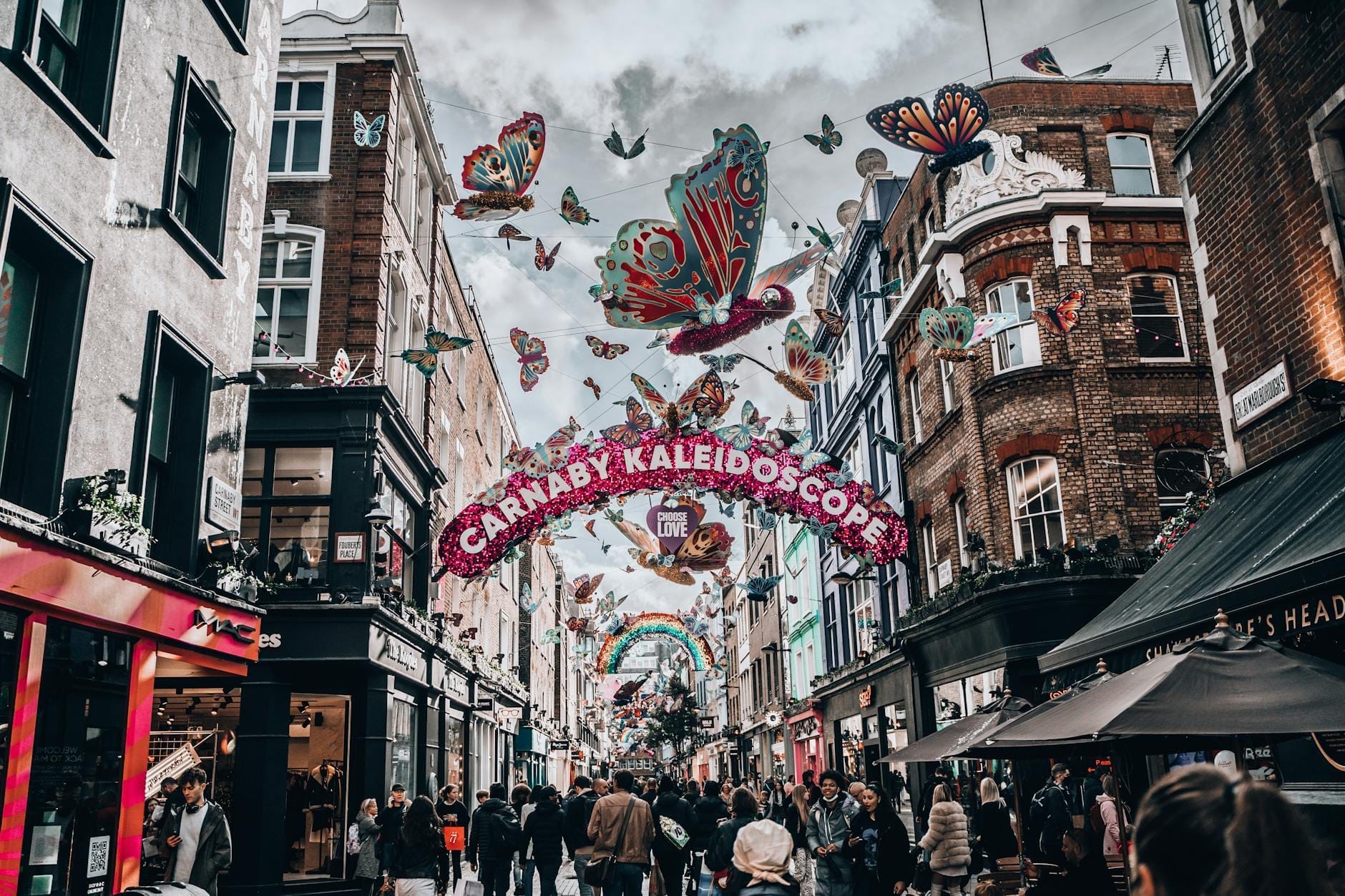
Beyond shopping and eating, the street itself is visually engaging. The estate commissions large-scale seasonal decorations that span the street overhead, which change multiple times per year. These vary in quality and ambition, but at their best they turn the street into a genuine spectacle, particularly around Christmas and Halloween. Whether a given installation justifies a special trip is debatable; as part of a wider West End walk, they add something worth noticing.
If you are building a wider West End itinerary, Soho is immediately adjacent and pairs naturally with a Carnaby visit. Covent Garden is a 15-minute walk east and offers a complementary atmosphere.
Getting There and Getting Around
Oxford Circus is the closest Underground station, served by the Central, Bakerloo, and Victoria lines, and the walk to Carnaby Street takes about five minutes heading south. Piccadilly Circus, on the Bakerloo and Piccadilly lines, is equally walkable from the southern end. Neither station requires a transfer from most parts of central London.
Buses on Regent Street stop within a minute's walk. If you are coming from further afield or arriving with luggage, the Q-Park Soho car park on Poland Street off Great Marlborough Street offers lift access, making it the practical driving option for those who need it.
For step-free Tube access, note that Oxford Circus does not currently have step-free access throughout. The nearest step-free Underground stations are Bond Street, Tottenham Court Road, and Green Park. From any of these, the walk to Carnaby Street is under 15 minutes and largely flat. The street itself is fully pedestrianised and presents no significant surface obstacles.
ℹ️ Good to know
Wheelchair users: Carnaby Street and most of its connecting lanes are pedestrianised and flat. Many individual shops and restaurants are accessible, but layouts vary by building. The AccessAble website has detailed venue-by-venue accessibility information for the Carnaby area.
Worth Knowing: Who This Is For and Who It Is Not
Carnaby Street works best for people who enjoy fashion retail, are curious about the cultural layer beneath the shopping, or are simply connecting points on a West End walk. The area has moved well beyond its souvenir-tat nadir of the 1980s and 1990s, and the retail and food offer is better than most tourist-facing streets in London.
However, it is worth being straightforward: if you are not interested in shopping or eating, there is limited reason to spend more than 20 minutes here. The street's historical significance is real but not particularly visible in the current environment. There are no museums, no major monuments, and no viewpoints. The 1960s legacy is present in reputation and spirit more than in preserved fabric.
Visitors expecting a quiet, off-the-tourist-track experience will be disappointed. Carnaby is well-known and visibly marketed. On busy Saturdays in summer or during the Christmas period, the crowds can make the narrow street uncomfortable. Those sensitive to noise and density are better served by visiting early on a weekday morning.
If you are trying to decide how Carnaby fits into a wider London itinerary, the 3-day London itinerary and the London shopping guide both address how to sequence the West End's retail areas efficiently.
Seasonal Events and the Christmas Period
The Carnaby estate invests visibly in seasonal events and decorations. The Christmas installation in particular draws significant crowds and is one of the more photographed displays in the West End, typically unveiled in November and running through early January. The Halloween decoration is also increasingly ambitious. Dates and themes change annually, so checking the official Carnaby website before visiting during a holiday period is worthwhile.
The area also hosts pop-up events, brand activations, and occasional street performers, particularly on weekends. These can add to the experience or simply add to the congestion, depending on your perspective and the timing of your visit.
For a broader view of what London looks like across the year, the best time to visit London guide covers seasonal trade-offs in useful detail.
Insider Tips
- Kingly Court fills quickly on Friday and Saturday evenings. If you want a table at one of the upper-floor restaurants, either book in advance or arrive before 18:30 to beat the main rush.
- The seasonal overhead installations are best photographed from the southern end of the street looking north, where the perspective compresses the decorations effectively. A wide-angle lens or phone camera in portrait mode works well in the narrow space.
- Newburgh Street, running parallel one block west, has some of the area's more interesting independent fashion shops and is noticeably less crowded than the main Carnaby strip at peak times.
- Weekday mornings between 10:00 and 11:30 offer the best combination of open shops and manageable crowds. By noon on any weekend, the narrow street becomes difficult to move through at a relaxed pace.
- The Carnaby estate publishes an events calendar on its official website at carnaby.co.uk. Checking this before a visit can reveal pop-ups, sample sales, or seasonal activations that are worth timing around.
Who Is Carnaby Street For?
- Fashion and streetwear shoppers looking for independent labels alongside well-curated brands
- First-time visitors to London wanting a quick immersion in West End culture beyond Oxford Street
- Food-focused travellers using Kingly Court as a flexible, no-reservation lunch stop
- Photographers interested in street-level London and seasonal architectural installations
- Travellers building a full West End walking day that connects Soho, Regent Street, and Covent Garden
Nearby Attractions
Other things to see while in West End:
- British Library
The British Library holds over 170 million items spanning thousands of years of human thought, from the Magna Carta to Beatles lyrics. Entry to the building and permanent collection galleries is free, making it one of the most rewarding stops in central London for curious travellers.
- British Museum
The British Museum holds one of the world's great collections of human history and culture, spanning two million years across more than 60 free galleries. Entry to the permanent collection is free, but knowing how to navigate the scale of it makes the difference between a rewarding visit and an overwhelming one.
- Coal Drops Yard
Coal Drops Yard is a redeveloped Victorian industrial estate in King's Cross, now home to independent retailers, restaurants, and bars set beneath strikingly restored brick vaults. The public outdoor spaces are free to enter and a short walk from King's Cross St Pancras station.
- Covent Garden
Covent Garden is a pedestrianised piazza and entertainment district in London's West End, free to enter and open all day. From street performers and the Apple Market to world-class theatres and restaurants, it rewards visitors at almost any hour.