The British Library: London's Treasure House of Human Knowledge
The British Library holds over 170 million items spanning thousands of years of human thought, from the Magna Carta to Beatles lyrics. Entry to the building and permanent collection galleries is free, making it one of the most rewarding stops in central London for curious travellers.
Quick Facts
- Location
- 96 Euston Road, London NW1 2DB — near King's Cross St Pancras
- Getting There
- King's Cross St Pancras (4 min walk); Euston (6 min walk)
- Time Needed
- 1.5 to 3 hours for casual visitors; half a day for exhibition-goers
- Cost
- Free (building and permanent displays); special exhibitions charge separately — check bl.uk for current prices
- Best for
- History lovers, architecture enthusiasts, literature fans, curious travellers on a budget
- Official website
- www.bl.uk
What the British Library Actually Is
The British Library is the national library of the United Kingdom, and by most measures one of the largest libraries on earth, holding in excess of 170 million items. That figure covers everything from ancient manuscripts and Gutenberg Bibles to 19th-century newspapers, 20th-century sound recordings, patents, maps, and the handwritten lyrics John Lennon scrawled on the back of a birthday card. The collection grows by around three million items every year, thanks in part to legal deposit requirements that mean publishers must send a copy of virtually every item published in the UK to the Library.
The Library was created by the British Library Act 1972 and formally established on 1 July 1973, drawing together the British Museum Library and a number of other national collections. Its current home near St Pancras, designed by architect Sir Colin St John Wilson, opened between 1997 and 1998 after a notoriously protracted construction period of more than 25 years. The result is a building that sharply divides opinion — but nobody disputes that what is inside it is extraordinary.
The Building: Architecture Worth Paying Attention To
Arriving from Euston Road, the first thing you notice is the plaza. It is wide, paved in creamy limestone, and anchored by Eduardo Paolozzi's oversized bronze sculpture of Isaac Newton crouching over a set of compasses. The scale of the man-made figure against the red brick facade gives you a sense of the building's ambition before you step inside. The exterior, clad in hand-made red brick, was highly controversial when it opened — the architectural critic for The Times famously compared it to a Babylonian ziggurat — but it has aged remarkably well and sits with surprising confidence between the Gothic extravagance of St Pancras station next door and the more utilitarian blocks of Euston Road.
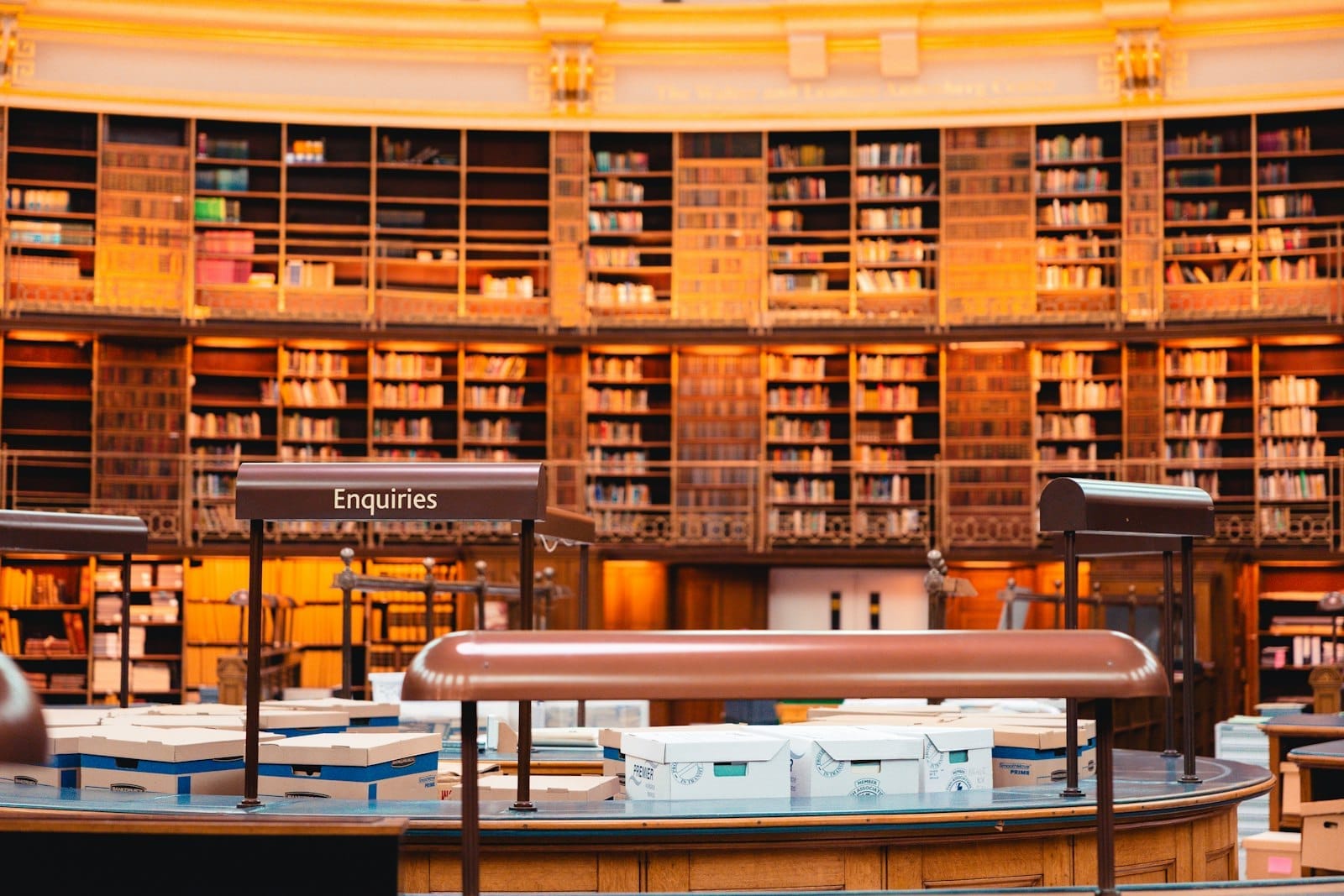
Inside, the entrance hall opens into a sequence of light-filled atria that feel generous and calm despite handling large numbers of visitors. The centrepiece is the King's Library Tower, a six-storey glass-enclosed repository at the heart of the building containing around 65,000 volumes collected by King George III and gifted to the nation in 1823. The tower is visible through the glass as you cross the building's main axis, and it functions as a kind of secular reliquary: the books inside are too fragile and valuable to be read by most visitors, but they glow with reflected daylight in a way that makes a quiet point about the relationship between knowledge and light.
💡 Local tip
The building has several café and restaurant options, a well-stocked bookshop, and free Wi-Fi throughout. Bag sizes are restricted in some gallery areas, so if you are carrying a large rucksack, pick up a locker key from the front of house staff near the entrance.
Tickets & tours
Hand-picked options from our booking partner. Prices are indicative; availability and final rates are confirmed when you complete your booking.
The British Royalty Tour with Changing of The Guard Ceremony
From 30 €Instant confirmationFree cancellationBritish Museum and National Gallery Semi-Private Guided Tour
From 125 €Instant confirmationFree cancellationLondon British Museum Ticket and In-App Audio Tour in German
From 15 €Instant confirmationBritish Museum self-guided audio tour
From 5 €Instant confirmation
The Treasures Gallery: The Main Draw for Most Visitors
For the majority of visitors who are not here to use the reading rooms, the Sir John Ritblat Treasures Gallery is the essential stop. Entry is free. The gallery is a single long, dimly lit room with display cases containing items that represent some of the most significant surviving documents in human history. Among them: one of the four surviving copies of Magna Carta (1215), the Codex Sinaiticus (one of the oldest complete manuscripts of the Christian Bible, dating to the 4th century), the Lindisfarne Gospels (produced by monks on the island of Lindisfarne around 715 AD), Lewis Carroll's handwritten and hand-illustrated original manuscript of Alice's Adventures Underground, and a Gutenberg Bible.
The lighting is kept deliberately low to protect the manuscripts, which means you lean in close to the cases and read by the glow of the displays. There is a specific quality of silence in this room that is different from the rest of the building. People move slowly. The cases holding Shakespeare's First Folio and handwritten scores by Handel tend to draw lingering crowds. Allow at least 45 minutes here if you want to read the accompanying text panels properly — they are well-written and add real context.
The gallery sits alongside temporary exhibition spaces that rotate throughout the year, covering topics from maps and photography to literature and music. These exhibitions do carry admission charges, which vary by show; current prices are listed at bl.uk. If you are planning a visit around a specific exhibition, booking ahead is recommended, particularly for weekend slots.
How the Experience Changes by Time of Day
The Library opens at 09:30 Monday through Thursday, which is the best time to arrive if you want the Treasures Gallery relatively to yourself. By 11:00 on weekdays, school groups begin to arrive, and the ground floor fills with the low roar of organised tours. Weekday afternoons are generally manageable, with a steady but not overwhelming flow of visitors. Fridays the Library closes at 18:00, Saturday at 17:00, and Sunday the doors open later, at 11:00, and close at 17:00.
The café terrace on the ground floor gets morning sun from the east, and on mild days it is a pleasant place to sit with a coffee before the crowds arrive. The plaza outside is usually quiet by 09:30, though the area around King's Cross becomes substantially busier as the morning progresses. On summer evenings, the plaza functions as an informal meeting point, and the Library's public spaces feel more relaxed and social. If you are visiting in winter, the interior is warm and well-lit, and the contrast between the grey Euston Road outside and the amber glow of the atrium is one of the better arguments for the building's design.
ℹ️ Good to know
Opening hours: Mon–Thu 09:30–20:00, Fri 09:30–18:00, Sat 09:30–17:00, Sun 11:00–17:00. Hours for reading rooms and some gallery spaces may differ. Verify at bl.uk before visiting, particularly around public holidays.
Getting There and Getting Around the Neighbourhood
King's Cross St Pancras is one of London's most accessible transport hubs, served by six Underground lines (Circle, Hammersmith and City, Metropolitan, Northern, Piccadilly, and Victoria), National Rail, and St Pancras International for Eurostar services. From the King's Cross exit on Euston Road, the Library entrance is roughly a four-minute walk west. From Euston station the walk takes about six minutes east along Euston Road.
The neighbourhood itself is worth exploring. St Pancras station's Victorian Gothic facade, designed by Sir George Gilbert Scott, is immediately adjacent and one of the most spectacular pieces of railway architecture in Europe. The area around the West End is easily walkable to the south, and the redeveloped King's Cross area, including Granary Square and Coal Drops Yard, sits a short walk north of the Library through the station.
If you are planning a broader day around this part of central London, the Granary Square development north of King's Cross is worth 30 minutes of your time for the canal-side setting and independent food options. The Coal Drops Yard shopping precinct, with its distinctive Thomas Heatherwick-designed arched roof, is a five-minute walk further on.
Reading Rooms and Research Access
The reading rooms are not open to casual visitors. To use them you need a free Reader Pass, which requires proof of identity and an explanation of your research purpose. The application process can be completed online in advance or in person at the Library's Reader Registration area. The reading rooms themselves are serious working environments used by academics, journalists, authors, and independent researchers. If you do qualify and gain access, the experience of ordering a 500-year-old printed book and having it delivered to your desk is remarkable.
For most travellers, the reading rooms are not a realistic option during a short visit, and the publicly accessible galleries, bookshop, and cafés offer more than enough to fill two to three hours comfortably. The Library's collection is also extensively digitised, with large portions of the newspaper archive, manuscript collection, and sound archive accessible online for free.
Worth Knowing: Who Will Love It, Who Won't
The British Library rewards visitors with genuine curiosity about history, literature, science, or ideas. The Treasures Gallery in particular delivers a density of authentic, historically significant objects that very few institutions anywhere can match. It does this for free, which makes it one of the strongest arguments for a detour from the more obvious London sights.
If your interest in London runs more toward visual spectacle, contemporary culture, or interactive experiences, the Library may not hold your attention for long. It is not a hands-on space, and the Treasures Gallery is quiet and text-heavy. Families with young children will find less here than at, say, the Natural History Museum or the Science Museum London, though the plaza and café are perfectly child-friendly. It also sits slightly outside the main tourist circuits of Westminster and the South Bank, which means it does not slot into most half-day itineraries without deliberate planning.
That said, if you are working from a three-day London itineraryand looking for somewhere different from the standard sights, the British Library is one of the city's most underused major attractions. The combination of free entry, world-class objects, and a calm, well-designed interior makes it worth the slight detour north of the main tourist corridor.
Insider Tips
- The Ritblat Treasures Gallery is free and requires no booking, but it gets busy after 11:00 on weekdays and from opening time on weekends. Arriving at 09:30 on a weekday gives you the room almost to yourself.
- The Library's bookshop stocks a unusual range of titles — exhibition catalogues, facsimiles of manuscripts, and academic publications that are hard to find elsewhere. It is worth browsing even if you are not a committed book buyer.
- The café on the upper level, overlooking the atrium, is generally quieter than the ground-floor café and has better views of the King's Library Tower.
- Photography is permitted in most public areas of the Library, including the Treasures Gallery, but flash and tripods are not allowed. The glass cases reflect overhead light at certain angles, so positioning slightly to the side of a case rather than directly in front typically produces cleaner images.
- If you are visiting with a specific research interest, check the Library's What's On page before you go: curator-led talks, reading groups, and free public events run regularly throughout the year and can add real depth to a visit.
Who Is British Library For?
- History and literature enthusiasts who want to see original manuscripts and documents up close
- Travellers on a tight budget looking for free, high-quality cultural experiences
- Architecture admirers interested in late 20th-century British public buildings
- Researchers and academics looking to access the reading rooms with a Reader Pass
- Anyone wanting a calm, unhurried alternative to London's busier tourist attractions
Nearby Attractions
Other things to see while in West End:
- British Museum
The British Museum holds one of the world's great collections of human history and culture, spanning two million years across more than 60 free galleries. Entry to the permanent collection is free, but knowing how to navigate the scale of it makes the difference between a rewarding visit and an overwhelming one.
- Carnaby Street
Carnaby Street is the pedestrianised shopping district in Soho that defined the look of 1960s London and continues to draw fashion lovers, food hunters, and curious walkers today. Free to explore and five minutes from Oxford Circus, it rewards those who slow down and wander its connecting lanes.
- Coal Drops Yard
Coal Drops Yard is a redeveloped Victorian industrial estate in King's Cross, now home to independent retailers, restaurants, and bars set beneath strikingly restored brick vaults. The public outdoor spaces are free to enter and a short walk from King's Cross St Pancras station.
- Covent Garden
Covent Garden is a pedestrianised piazza and entertainment district in London's West End, free to enter and open all day. From street performers and the Apple Market to world-class theatres and restaurants, it rewards visitors at almost any hour.