Science Museum London: What to See, When to Go, and How to Get the Most From Your Visit
The Science Museum on Exhibition Road is one of the world's great science institutions, housing more than 300,000 objects across seven floors in the heart of South Kensington. Entry is free, the collections span centuries of human ingenuity, and it rewards visitors who arrive with a plan.
Quick Facts
- Location
- Exhibition Road, South Kensington, London SW7 2DD
- Getting There
- South Kensington Underground (Circle, District, Piccadilly lines), buses 14, 49, 70, 74, 345, 360, 414, 430 and C1
- Time Needed
- 2–4 hours minimum; full-day if travelling with children
- Cost
- Free general admission; some special exhibitions and IMAX screenings charge separately
- Best for
- Families with curious children, science enthusiasts, space and technology fans, rainy-day visits
- Official website
- www.sciencemuseum.org.uk
What the Science Museum Actually Is
The Science Museum on Exhibition Road is not a quiet, reverential place. On most days, it hums: children crowd around buttons, school groups spill through the Energy Hall, and adults who thought they were just accompanying their kids end up transfixed by a replica of Watson and Crick's DNA model or the original Apollo 10 command module. That tension between serious scholarship and genuine accessibility is what makes this institution unusual among the world's great museums.
Founded in 1857 as part of the South Kensington Museum, the science collections were formally separated in 1909 and the institution adopted the name Science Museum in 1913. It now holds over 300,000 objects, though only a fraction are on public display at any one time. The building sits on Exhibition Road in the Royal Borough of Kensington and Chelsea, surrounded by a cluster of major cultural institutions that grew from the profits of the Great Exhibition of 1851.
The location matters. The Natural History Museum is next door. The Victoria and Albert Museum is directly across the street. Together they form one of the densest concentrations of free museum space in Europe. If you're planning a wider cultural day, see our guide to the Natural History Museum and the Victoria and Albert Museum to combine the trip efficiently.
The Collections: What You'll Actually Encounter
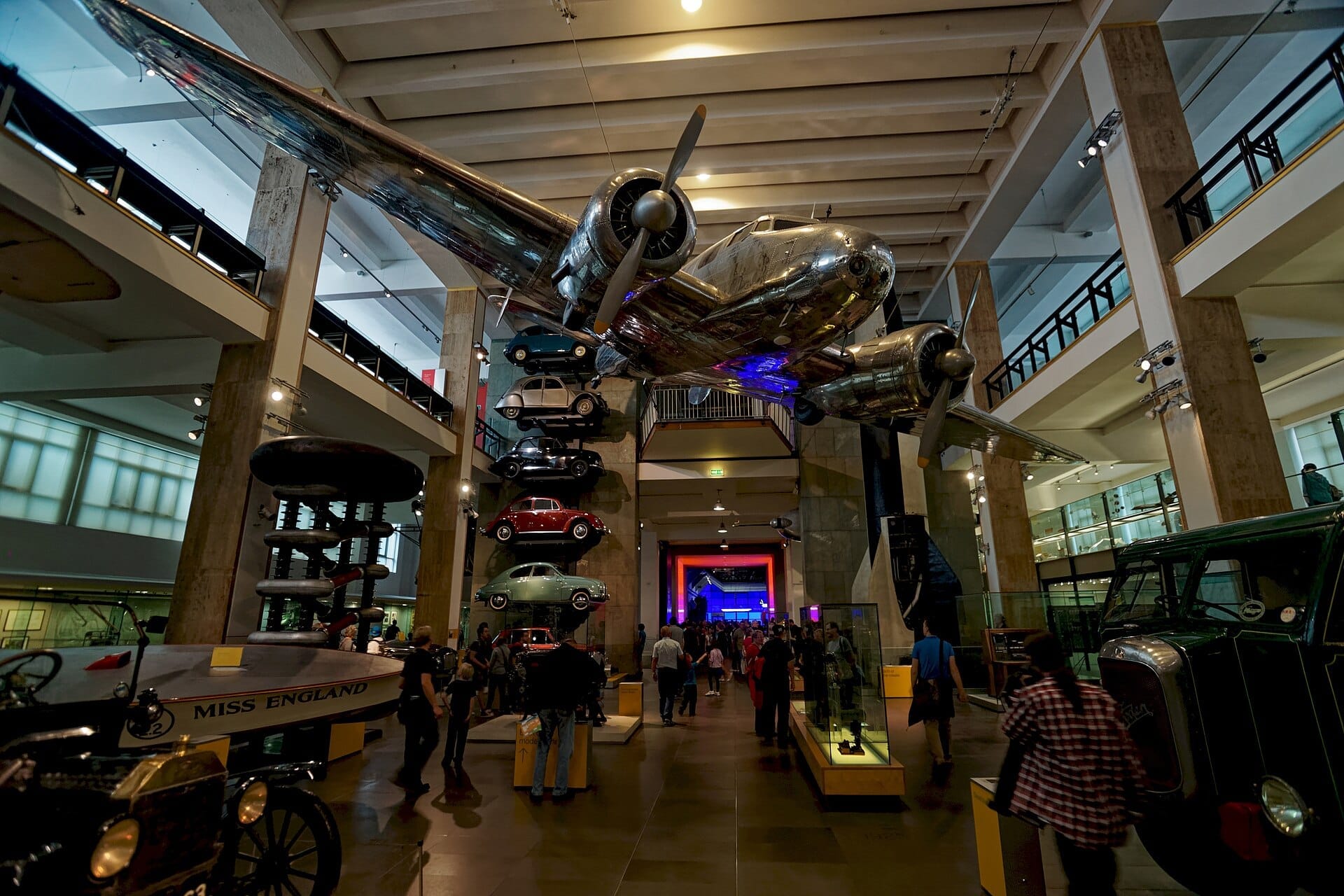
The ground floor is where most visitors start and, for many, where they spend the longest time. The Energy Hall, a cavernous Victorian space, anchors this floor with enormous steam engines that once powered mills across Britain. The centrepiece is a working Boulton and Watt rotative steam engine from 1797, a machine that contributed directly to the industrialisation of Britain. Its scale is harder to appreciate in photographs than in person: the flywheel alone is taller than most adults.
Space exploration occupies a dedicated gallery that draws consistently large crowds. The Apollo 10 command module, which carried astronauts around the Moon in 1969, sits within touching distance behind minimal barriers. The surface of the craft is scorched and dented from re-entry, which photographs never quite capture. Nearby, a timeline of rocketry spans from early experimental designs to the present era of commercial spaceflight.
The medicine galleries on the upper floors tend to be overlooked by visitors focused on ground-floor spectacle, which is a shame. The collection tracing the history of surgery, anaesthesia and medical imaging is illuminating, and the Wellcome Collection-era items — donated by pharmaceutical entrepreneur Sir Henry Wellcome — include objects that are strange, occasionally disturbing, and historically significant in equal measure.
💡 Local tip
Plan your visit before you arrive. The museum publishes a floor-by-floor gallery map on its website. Without one, it's easy to miss entire floors or double back unnecessarily — the building is deeper and more complex than it appears from the entrance.
Tickets & tours
Hand-picked options from our booking partner. Prices are indicative; availability and final rates are confirmed when you complete your booking.
Tootbus London by Night: Bus tour
From 32 €Instant confirmationFree cancellationThe Making of Harry Potter Guided Tour of London Warner Bros. Studio
From 201 €Instant confirmationFree cancellationWarner Bros. Studio Tour London - The Making of Harry Potter and Oxford guided tour
From 157 €Instant confirmationFree cancellationLondon's Harry Potter themed self-guided walking tour on a mobile app
From 9 €Instant confirmation
How the Experience Changes by Time of Day
Arriving at 10:00 when the doors open gives you roughly 45 minutes before the first school groups arrive in volume. That window is worth using. The Energy Hall, the space gallery, and the ground-floor Making the Modern World exhibition are noticeably calmer in that first hour. The acoustics in the Energy Hall, in particular, carry noise efficiently, and by 11:00 on a typical weekday the ambient sound level rises considerably.
Midday to 14:00 is the busiest window. Lunch crowds and peak school-visit hours overlap. The cafes on the lower ground floor fill up quickly, and queues form for the IMAX cinema and some ticketed special exhibitions. If you arrive during this window, consider heading directly to the upper floors where the medicine, mathematics, and computing galleries tend to be quieter regardless of time.
By 15:30, school groups begin to leave and the crowds thin noticeably. The final 90 minutes before 18:00 closing are among the most pleasant for unhurried exploration. Light through the upper gallery windows is better in the afternoon, which matters if you are photographing exhibits. The museum rarely feels empty, but it does become manageable.
⚠️ What to skip
The museum is closed from 24 to 26 December inclusive. Bank holidays and school holidays bring significantly higher visitor numbers across all hours. If visiting during half-term or summer, pre-booking timed entry for any paid special exhibitions is advisable.
Getting There and Getting In
South Kensington Underground station is the obvious approach, served by the Circle, District, and Piccadilly lines. A covered pedestrian tunnel runs from the station directly toward the museum cluster on Exhibition Road, so rain is less of a concern walking from the Tube than it appears on a map. The walk from the tunnel exit to the museum entrance takes under five minutes.
Buses 14, 74, and C1 stop nearby if you are coming from a direction not well served by the Tube. Cycling is feasible; there are bike racks outside. Driving is not recommended: parking in South Kensington is both expensive and scarce. The neighbourhood has a Controlled Parking Zone covering most residential streets.
General admission is free, but a free timed-entry ticket must be booked in advance to enter the main museum. However, some temporary exhibitions carry a separate admission charge, and the IMAX cinema requires a paid booking. These are clearly signed at the entrance and listed on the museum website. The ground floor Welcome Wing sometimes hosts large-scale ticketed exhibitions that benefit from pre-booking, particularly on weekends.
South Kensington sits within the broader Kensington and Chelsea neighbourhood, which has enough to fill a full day. Factor in the surrounding area when planning your schedule.
Visiting With Children
The museum is specifically designed to hold the attention of younger visitors, and it largely succeeds. The Wonderlab on the lower ground floor is the most hands-on space in the building: interactive exhibits let children experiment with forces, light, electricity, and sound with minimal adult intervention required. Expect this area to be busy during school holidays; it is popular and the noise level reflects that.
Pattern Pod is aimed at children under eight, with low-level interactive displays about patterns in nature and mathematics. It is a calmer space than Wonder Lab and tends to be less crowded, though it does fill up during peak hours. For older children with a serious interest in technology or science, the computing and mathematics galleries offer depth that most children's science museums do not.
Families with pushchairs should be aware that most of the museum is accessible by lift, but some areas involve narrow gangways or stepped displays where full visibility requires lifting children. The ground floor and lower ground floor are the most pushchair-friendly. Staff are generally helpful with directions, and accessibility information is available at the main information desk near the entrance.
If you're planning a wider family trip to London, the London with kids guide covers the Science Museum alongside other family-friendly options across the city.
Photography, Practical Details, and What to Bring
Photography is permitted throughout the general galleries without flash. The lighting conditions vary significantly by floor. Ground-floor displays are generally well-lit, but the upper-floor medicine and history galleries tend to use dimmer, more atmospheric lighting that makes handheld photography difficult without adjusting ISO settings. Phone cameras perform adequately in the Energy Hall and space gallery; for the upper floors, a camera with good low-light capability produces better results.
There are cloakrooms and lockers near the entrance if you are carrying bags from other parts of the city. The museum's cafes serve standard museum-quality food at predictable prices. Better options exist along Exhibition Road and in the surrounding streets of South Kensington, and leaving for lunch and returning is straightforward given free entry.
Comfortable shoes are not optional. The museum covers seven floors and considerable horizontal distance. Visitors who underestimate the scale regularly report fatigue by mid-afternoon. There are benches and seating areas throughout, but less than one might expect given the building size.
ℹ️ Good to know
The museum shop near the main entrance stocks a good range of science-oriented books, games, and gifts that are not the usual tourist merchandise. It is worth browsing on the way out even if you arrive without any intention to buy.
Insider Tips
- The Dana Research Centre and Library, located off-site at the Science and Industry Museum in Manchester rather than in the main London building, is open to visitors with a specific research interest by appointment, but the upper-floor public galleries near it are often quiet even when the rest of the building is crowded. If you need to escape the noise, head up.
- The free demonstrations in the Energy Hall (typically scheduled on most days, but not guaranteed daily) (check the museum website or information desk for current schedule) are timed short sessions that explain how specific machines work. They are aimed at families but informative for adults who lack an engineering background.
- The IMAX cinema shows a mix of science documentaries and mainstream films. The science-specific screenings are the better use of the space; mainstream films are available at any cinema. Check the programme before you go rather than deciding at the door.
- If you visit on a weekend, the museum's Lates events (held periodically in the evenings for adults only) offer the rare experience of exploring the galleries without children, often with themed programming and a licensed bar. Dates are published on the official website.
- The tunnel from South Kensington station is not just weather protection: it is also lined with occasional exhibition displays and is a useful orientation point. Exiting the tunnel onto Exhibition Road, the Natural History Museum is directly ahead on your left, the Victoria and Albert Museum is on your right, and the Science Museum lies further up Exhibition Road on the left.
Who Is Science Museum For?
- Families with children aged 5 and up looking for interactive, educational engagement that holds attention for a full morning or afternoon
- Adults with an interest in the history of technology, medicine, or space exploration who want depth rather than spectacle
- Visitors in London on rainy days seeking a free, large-scale indoor experience that takes several hours without feeling rushed
- First-time London visitors combining the South Kensington museum cluster into a single cultural day
- School-aged children studying science or technology who would benefit from seeing original historical artefacts rather than replicas
Nearby Attractions
Other things to see while in Kensington & Chelsea:
- Chelsea Physic Garden
Founded in 1673 by the Worshipful Society of Apothecaries, Chelsea Physic Garden is a four-acre walled enclosure in the heart of Chelsea containing over 4,500 medicinal, edible, and historically significant plants. It is the second-oldest botanic garden in Britain and one of the quietest places you will find in central London.
- The Design Museum
Housed in the dramatically restored former Commonwealth Institute building on Kensington High Street, the Design Museum is one of Europe's most respected institutions dedicated to design, architecture, fashion, and product innovation. Entry to the permanent collection is free, while rotating exhibitions draw on names from global creative culture.
- Harrods
Founded in 1849 and occupying over a million square feet in Knightsbridge, Harrods is as much a London spectacle as it is a shop. Whether you're browsing the Food Halls or shopping the designer floors, here's exactly what to expect.
- Hyde Park
Hyde Park is one of London's eight Royal Parks, covering 142 hectares in the heart of the city. Free to enter, open until midnight, and rich in history stretching back to a Tudor hunting ground, it rewards visitors who pace themselves and explore beyond the obvious.