Natural History Museum London: What to Expect Before You Go
The Natural History Museum is one of London's most visited institutions, home to 80 million specimens and housed in an extraordinary Victorian Romanesque building in South Kensington. General admission is free, but knowing when to go and what to prioritise makes a significant difference to the experience.
Quick Facts
- Location
- Cromwell Road, South Kensington, London SW7 5BD
- Getting There
- South Kensington (District, Circle, Piccadilly lines) – 5-minute walk. Gloucester Road also nearby.
- Time Needed
- 2–4 hours for a focused visit; a full day if you plan to cover most galleries
- Cost
- Free (permanent galleries). Special exhibitions charged separately – from around £15. Book a free timed-entry ticket online in advance.
- Best for
- Families with children, science and natural history enthusiasts, architecture lovers, rainy-day visits
- Official website
- www.nhm.ac.uk
Why This Museum Deserves More Than a Casual Visit
The Natural History Museum is not simply a collection of old bones and pressed plants. It is one of the most significant scientific research institutions in the world, holding around 80 million specimens spanning botany, entomology, mineralogy, palaeontology, and zoology. For most visitors the research dimension stays invisible, but it shapes everything on display: the depth of labelling, the quality of curation, and the calibre of temporary exhibitions.
The museum opened at its South Kensington site on 18 April 1881, designed by Alfred Waterhouse in a Romanesque Revival style that draws on both German Romanesque cathedrals and natural motifs. Look up at the terracotta facade as you approach: the carvings are not decorative filler. Living species appear on the western wing, extinct species on the eastern wing. The building itself is an argument about the order of the natural world.
If your broader London itinerary is still taking shape, this museum fits logically into a 3-day London itinerary alongside the nearby Victoria and Albert Museum, which sits directly adjacent on Exhibition Road.
The Hintze Hall: First Impressions Matter Here
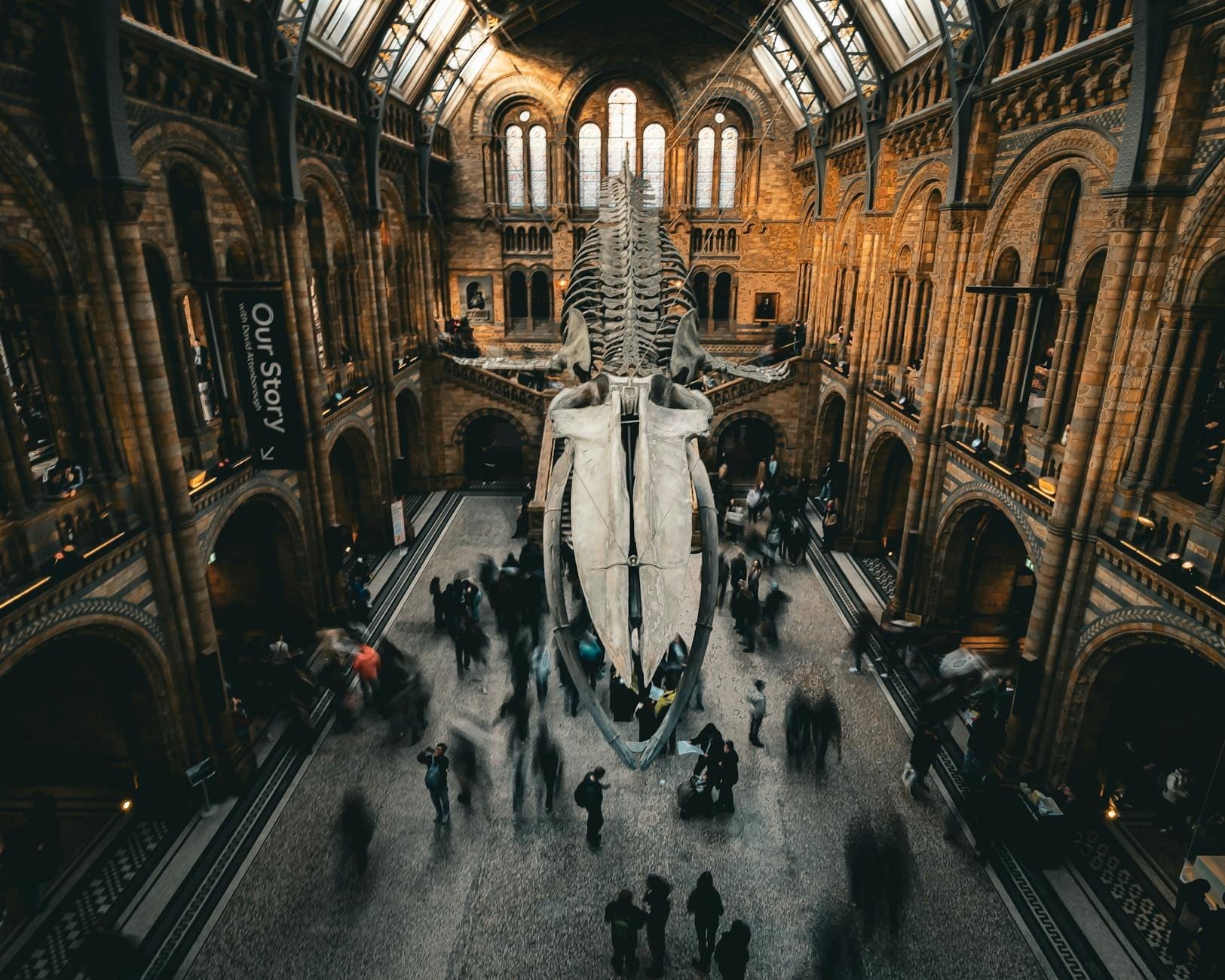
You enter through the Central Hall, now called Hintze Hall, and the effect is reliably dramatic regardless of how many times you have seen photographs. The vaulted ceiling rises 22 metres above the ground floor. The air smells faintly of old stone and something drier underneath, a barely perceptible note that belongs to very old collections. Natural light filters through the upper windows in the morning, catching dust motes above the heads of the crowd below.
Since 2017, the centrepiece of this hall has been Hope, a 25-metre blue whale skeleton suspended from the ceiling in a diving posture. The previous centrepiece, Dippy the Diplodocus cast, has toured UK museums. Hope is the more powerful choice: blue whales are alive today, making the skeleton both a scientific specimen and a conservation statement. Children often stop in the middle of the entrance ramp and simply stare upward.
💡 Local tip
Arrive as close to the 10:00 opening as possible, especially on weekends and school holidays. Hintze Hall fills up quickly by mid-morning, and the whale is much easier to appreciate without a crowd pressing around you. Weekday mornings between Tuesday and Thursday are consistently quieter.
Tickets & tours
Hand-picked options from our booking partner. Prices are indicative; availability and final rates are confirmed when you complete your booking.
London Natural History Museum reserved entry and audio tour
From 9 €Instant confirmationFree cancellationNatural History Museum of London guided tour
From 69 €Instant confirmationFree cancellationLondon Natural History Museum Ticket and In-App Audio Tour in Spanish
From 7 €Instant confirmationLondon Natural History Museum Ticket and In-App Audio Tour in French
From 7 €Instant confirmation
Gallery by Gallery: How to Navigate 80 Million Specimens
The museum is divided into colour-coded zones. The Blue Zone is the most popular and covers dinosaurs, mammals including the blue whale hall, and the Earth Lab. The Green Zone holds the Vault (minerals and gems), the Fossil Marine Reptiles gallery, and the Creepy Crawlies exhibition. The Red Zone focuses on Earth sciences: volcanoes, earthquakes, and a simulated earthquake experience in the Restless Surface section. The Orange Zone, reached via a separate entrance on Exhibition Road, contains the Darwin Centre cocoon, a climate science gallery, and rotating exhibitions.
The Dinosaur gallery in the Blue Zone draws the longest queues. The animatronic Tyrannosaurus rex near the end of the gallery still provokes a genuine reaction from younger visitors even decades after its installation. More rewarding for older visitors is the fossil marine reptiles section in the Green Zone, where a nearly complete Ichthyosaurus with fossilised soft tissue outlines sits alongside Pliosaur skulls of alarming scale.
The Vault in the Green Zone is often overlooked and worth your time. It is a small, dimly lit room displaying the museum's most precious geological specimens, including the Latrobe gold nugget and the Aurora collection of coloured diamonds. Entry is free. The contrast between the enormous public galleries and this jewel-box of a room is one of the more unexpected pleasures of the visit.
ℹ️ Good to know
The Darwin Centre Cocoon, a seven-storey white pod structure inside the Orange Zone, offers a rare look at behind-the-scenes research through glass-walled laboratories. Scientists can sometimes be seen working during opening hours. Book the free tour in advance if you want a guided explanation.
Timing, Crowds, and What the Museum Feels Like at Different Hours
Between 10:00 and 11:30 on weekday mornings, the museum is at its most manageable. Light enters the hall at an angle that makes the architecture particularly legible, and the galleries are quiet enough to read labels without being jostled. School groups tend to arrive from around 10:30, moving in organised clusters through the Blue Zone.
By midday on weekends, Hintze Hall can feel crowded. The queues for the Dinosaur gallery stretch back toward the entrance. If you arrive at this time, the practical move is to go directly to the Red or Green Zones, which thin out considerably after lunch. The late afternoon, particularly the 16:00 to 17:30 window, often sees a second crowd drop-off as family groups head home before dinner.
Weather matters more than most guides acknowledge. The museum sits behind a courtyard and its building absorbs summer heat, making the upper galleries warm in July and August. Wear a light layer you can remove. In winter, the building retains warmth well and makes for a comfortable refuge from cold or wet days, which is one reason visitor numbers actually spike during school holidays in December.
South Kensington as a neighbourhood rewards a slow exploration before or after your museum visit. The Kensington and Chelsea area has some of London's most architecturally coherent Victorian streetscapes, and the walk from South Kensington station through the pedestrian tunnel that emerges near the museum entrance is itself a pleasant detail.
Special Exhibitions and Events: When to Pay
The museum runs paid temporary exhibitions alongside its free permanent galleries. These rotate throughout the year and can focus on anything from deep-sea creatures to meteorites to wildlife photography. The quality is consistently high, and they are generally worth considering if the subject interests you. Exhibition fees run from around £15 per adult; members enter free. Check the website before your visit as exhibition schedules change seasonally.
The Wildlife Photographer of the Year exhibition is one of the most popular annual events and typically runs from October through to the following spring. The photographs are displayed in the museum's dedicated exhibition spaces and draw visitors who would not normally prioritise natural history content. If your visit overlaps with this exhibition's dates, it is worth building into your itinerary.
Families planning a wider London day out should note that the Science Museum is immediately adjacent, sharing the same street. You can practically walk between the two front doors. If you have children with broad curiosity, both museums in a single day is a reasonable ambition, though tiring.
Practical Details: Getting Here, Accessibility, and What to Bring
The museum's address is Cromwell Road, London SW7 5BD. The most direct Underground route is South Kensington station on the District, Circle, and Piccadilly lines. From the station, a pedestrian tunnel runs directly toward the museum complex, emerging on Exhibition Road roughly a five-minute walk from the main entrance. Gloucester Road station is slightly further but also walkable in around six to eight minutes.
Several buses serve Cromwell Road directly, including routes 14, 49, 70, 74, 345, 414, and 430. If you are coming from central London, the bus is often faster than it looks on the map and avoids a Tube transfer. Cycling is an option via the Santander Cycles hire scheme, with docking stations on Exhibition Road and on Cromwell Road itself.
The museum has step-free access from Exhibition Road through the side entrance, and wheelchair-accessible routes cover the main galleries. Accessible toilets are available across the building. Baby-changing facilities are on all floors. Bring water, particularly in summer months: the in-museum cafes charge accordingly and the nearest supermarket requires a walk back toward Old Brompton Road.
⚠️ What to skip
Pre-booking a free timed-entry ticket online is strongly recommended, particularly for weekend visits and school holidays. Walk-up visitors can enter but may face waiting times. The museum is closed on 24, 25, and 26 December each year.
For a fuller picture of what free admission gets you across London's major institutions, the best museums in London guide covers the top options and helps you plan a logical sequence across multiple days.
Worth Knowing: Limitations Worth Knowing
Visitors expecting an immersive, technology-heavy experience may find some of the permanent galleries dated. The Blue Zone in particular has an early-1990s aesthetic in places, with older interactive displays that no longer function particularly well. The curation prioritises scientific accuracy over spectacle, which is the right call for a research institution but can feel dry if you are visiting primarily for entertainment.
The sheer scale of the building can also be disorienting. Without a plan, it is easy to spend forty minutes walking between galleries and feel like you have seen everything without actually absorbing much. The museum map available at the entrance is useful; pick one up, identify two or three galleries that match your interests, and treat everything else as a bonus.
Visitors with no particular interest in natural history or science, and who are mainly looking for a cultural or arts experience in Kensington, might find the nearby Victoria and Albert Museum a better fit. Those seeking London's most dramatic views or outdoor experiences are better served elsewhere in the city.
Insider Tips
- The museum's Spirit Collection in the Darwin Centre contains 22 million preserved specimens in jars of alcohol, including the giant squid on public display. It is viewable from a walkway on the tour route and one of the stranger sights in London.
- If you want a photograph of Hope the blue whale without crowds beneath it, position yourself on the upper balcony level of Hintze Hall rather than the ground floor. The view from above gives you the full length of the skeleton against the Romanesque arches.
- The museum's garden on the west side is largely unknown to most visitors. In summer it hosts late-night events and occasional outdoor exhibitions, but even on a regular day it provides a quiet bench and a view of the building's exterior detail away from the crowds.
- Members get free entry to all paid exhibitions, priority booking for events, and access to the members' room with its own cafe. If you are visiting London for a week and plan multiple visits, a day membership is available, though annual membership pays off from two paid exhibitions.
- The Cromwell Road entrance is the main entrance but is also the most crowded. The Exhibition Road entrance on the building's east side often has a shorter security queue, particularly on weekend mornings.
Who Is Natural History Museum For?
- Families with children aged 5 to 14, for whom the dinosaur and mammal galleries deliver genuine excitement
- Science and natural history enthusiasts who will appreciate the depth of the permanent collections beyond the headline exhibits
- Architecture-focused visitors who want to study one of London's finest examples of Victorian Romanesque design in detail
- Rainy day or cold weather visits, when the museum provides a warm, stimulating alternative to outdoor sightseeing
- Travellers on a tight budget seeking a full-day attraction with no admission charge for the core experience
Nearby Attractions
Other things to see while in Kensington & Chelsea:
- Chelsea Physic Garden
Founded in 1673 by the Worshipful Society of Apothecaries, Chelsea Physic Garden is a four-acre walled enclosure in the heart of Chelsea containing over 4,500 medicinal, edible, and historically significant plants. It is the second-oldest botanic garden in Britain and one of the quietest places you will find in central London.
- The Design Museum
Housed in the dramatically restored former Commonwealth Institute building on Kensington High Street, the Design Museum is one of Europe's most respected institutions dedicated to design, architecture, fashion, and product innovation. Entry to the permanent collection is free, while rotating exhibitions draw on names from global creative culture.
- Harrods
Founded in 1849 and occupying over a million square feet in Knightsbridge, Harrods is as much a London spectacle as it is a shop. Whether you're browsing the Food Halls or shopping the designer floors, here's exactly what to expect.
- Hyde Park
Hyde Park is one of London's eight Royal Parks, covering 142 hectares in the heart of the city. Free to enter, open until midnight, and rich in history stretching back to a Tudor hunting ground, it rewards visitors who pace themselves and explore beyond the obvious.