Harrods: Inside Europe's Largest Department Store
Founded in 1849 and occupying over a million square feet in Knightsbridge, Harrods is as much a London spectacle as it is a shop. Whether you're browsing the Food Halls or shopping the designer floors, here's exactly what to expect.
Quick Facts
- Location
- 87–135 Brompton Road, Knightsbridge, London SW1X 7XL
- Getting There
- Knightsbridge (Piccadilly line) — 1 min walk
- Time Needed
- 1.5–3 hours depending on interest
- Cost
- Free to enter and browse. Taxi pick-up/drop-off on Basil Street (Door 3). Car park: SW3 1QE, about a 2-min walk.
- Best for
- Window shoppers, food lovers, architecture fans, luxury shoppers
- Official website
- www.harrods.com/en-gb
What Harrods Actually Is (and Isn't)
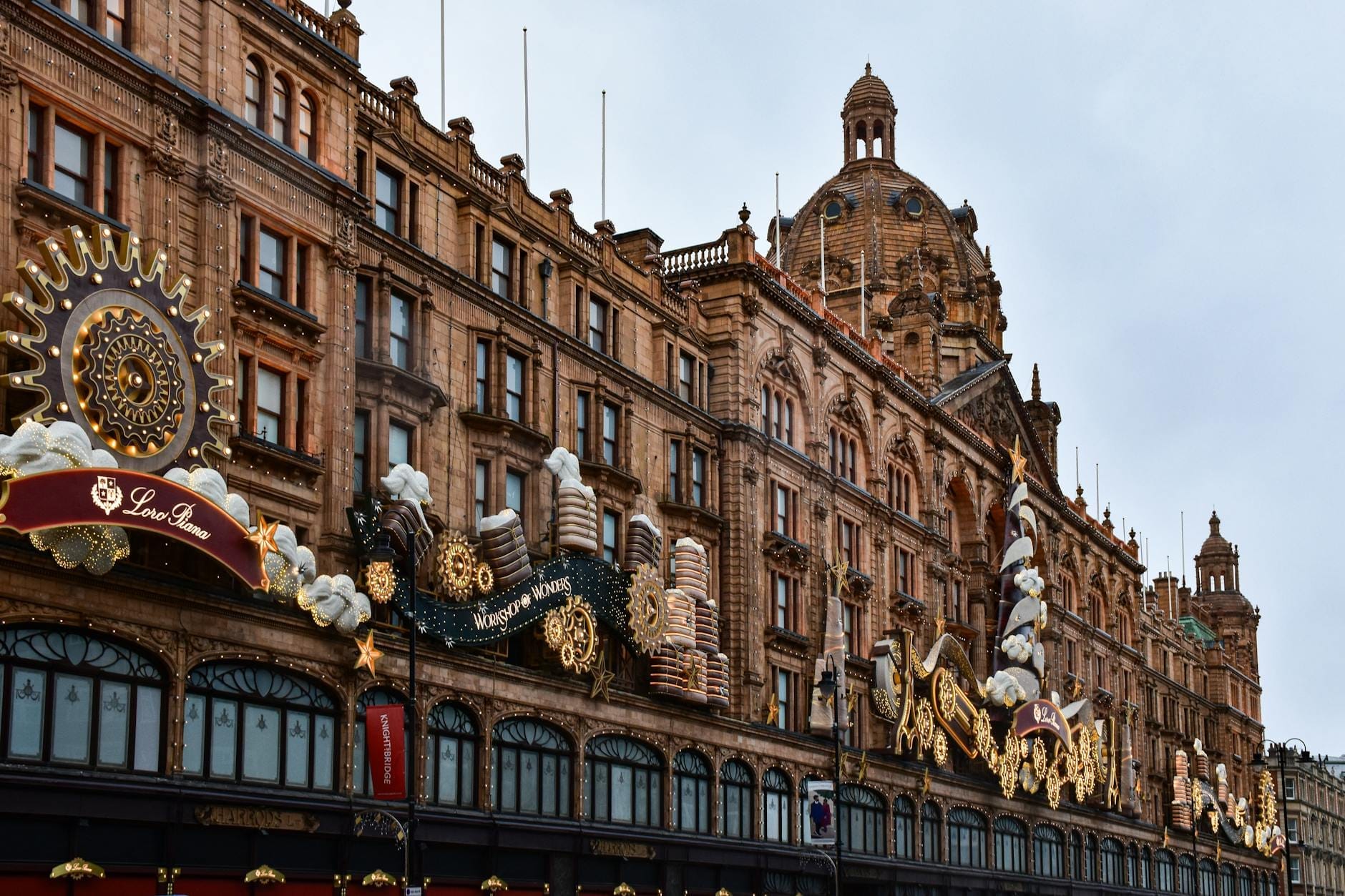
Harrods is not a typical department store and has not been for a long time. Spread across approximately 1,100,000 square feet of selling space on Brompton Road in Knightsbridge, it is the largest department store in Europe and one of the most recognisable retail buildings in the world. The terracotta baroque facade, designed by architect C. W. Stephens and completed in 1905, dominates an entire city block. By night, the building is outlined in thousands of bulbs that make it look less like a shop and more like a palace dropped into west London.
Yet for all its grandeur, Harrods divides opinion cleanly. Regulars from the neighbourhood treat the Food Halls as a useful grocer. Tourists treat the whole building as a sightseeing destination. Luxury shoppers treat it as a serious retail stop. All three groups are correct, and all three groups coexist, sometimes awkwardly, across its seven floors.
ℹ️ Good to know
Entry is completely free. Harrods is a shop, not a ticketed attraction. You can walk in, browse every floor, and leave having spent nothing — though the atmosphere is designed to make that difficult.
The Building and Its History
Charles Henry Harrod relocated his grocery business to this site in 1849, at a time when Knightsbridge was a considerably less fashionable address than it is today. The business grew steadily through the Victorian era, surviving a fire in 1883 that destroyed the original premises, and expanded into the grand Edwardian structure that stands today. The current building was designed by C. W. Stephens and opened in 1905, its facade a study in pale terracotta Doulton ware arranged across five storeys of Portland stone columns.
Inside, the Egyptian Hall and Egyptian Escalator — installed in the 1990s and decorated with hieroglyphic friezes, sphinx heads, and gilded reliefs — remain among the most photographed interior spaces in London retail. They were commissioned during the ownership of Mohamed Al Fayed and are theatrical to a degree that makes the surrounding merchandise feel almost incidental. Whether you find them spectacular or absurd depends largely on your appetite for maximalism.
Tickets & tours
Hand-picked options from our booking partner. Prices are indicative; availability and final rates are confirmed when you complete your booking.
Soho Instagram a self-guided walking tour to top photo spots
From 6 €Instant confirmationFree cancellationTootbus London by Night: Bus tour
From 32 €Instant confirmationFree cancellationIFS Cloud Cable Car Ride and Uber Boat Hop-on Hop-off 1 Day Ticket
From 38 €Instant confirmationFree cancellationThe Making of Harry Potter Guided Tour of London Warner Bros. Studio
From 201 €Instant confirmationFree cancellation
The Food Halls: The Best Reason to Visit
For many visitors, the Food Halls on the lower ground and ground floors justify the entire trip. The tiled meat and fish halls date to the original Edwardian fit-out and remain beautiful rooms: ornate ceiling panels, butchers' cases arranged like museum displays, and counters stocked with produce sourced from across the UK and Europe. The smell shifts noticeably as you move between sections — from the clean cold of the fish counter to the warm, faintly sweet atmosphere of the cheese room to the sharp citrus notes of the produce section.
The chocolate and confectionery section alone draws visitors who have no intention of buying a suit or a handbag. Shelves are stacked with Harrods-branded boxes, but also with sourced chocolates, preserved foods, teas, and spirits that represent a wider selection than most specialist shops carry. The bakery produces items on-site. At peak weekend hours, the Food Halls become crowded, and the narrow tile-lined corridors can feel claustrophobic near the cheese and charcuterie counters.
💡 Local tip
If you arrive early on a weekday, the Food Halls are calm enough to actually browse at your own pace. By 1pm on a Saturday, navigating the deli counters requires real patience.
Floor by Floor: What's Where
Harrods operates across seven floors plus a lower ground level. The layout is not especially intuitive, and the store changes its department arrangements periodically, so the map available at the main entrances is worth picking up on arrival.
- Lower Ground / Ground: Food Halls, bakery, chocolates, wine and spirits, Beauty Bazaar
- First Floor: Designer womenswear, shoes, accessories, fine jewellery
- Second Floor: Womenswear brands, lingerie, beauty services
- Third Floor: Menswear, sportswear
- Fourth Floor: Children's clothing, toys, technology
- Fifth Floor: Restaurants and cafés
- Sixth Floor: Harrods Estates, travel, services
The toy department on the fourth floor draws families with younger children and is worth a visit even without a purchase in mind: the scale and presentation are unusual, with display areas designed for interaction. The technology department is less distinctive and largely replicates what you would find in a flagship brand store nearby.
How the Experience Changes by Time of Day
Harrods opens at 10:00am Monday to Saturday (with occasional 11:00am openings on some midweek days; check current hours before visiting), and this first hour is when the building feels most like the store it aspires to be. Staff are fully attentive, the floors are quiet enough to hear the ventilation system and the soft music piped through the departments, and the light through the Brompton Road windows falls clearly across the display counters. The Egyptian Escalator is almost entirely yours in these early moments.
By midday on any day of the week, the character shifts. Coach tours and general tourist traffic fill the Food Halls and ground floor significantly. The upper floors remain manageable. By 3pm on a Saturday in summer, the store is at its most compressed — queues form at the busier food counters, the lifts fill quickly, and the experience becomes more about navigating than absorbing. If you are visiting specifically for the atmosphere or the architecture, a weekday morning is categorically better.
Sunday hours are reduced: the store opens for browsing-only at 11:30am, with sales beginning at 12pm in line with UK Sunday trading laws. This is a meaningful restriction if you are hoping to make purchases early in the day.
⚠️ What to skip
On Sundays, Harrods operates browsing-only from 11:30am to 12pm. You can walk the floors, but no purchases can be made during this window. Sales begin at 12pm.
Photography, Dress Code, and Practical Notes
Harrods does not enforce a formal dress code for entry, though the clientele across most floors leans toward smart casual, and on the designer floors you will encounter the full range from jeans to formalwear. The Egyptian Hall and Escalator photograph well from almost any angle; wider shots benefit from arriving before crowds gather on the lower floors. Flash photography is generally discouraged in certain departments.
The store is fully wheelchair accessible, with lifts connecting all floors and disabled parking available for permit holders on Basil Street, to the rear of the building (postcode SW3 1QE). Taxis can drop off and pick up on Basil Street at Door 3. If you are driving, paid parking is available at Brompton Place (postcode SW3 1QE), approximately a two-minute walk from the main entrance.
Knightsbridge Tube station sits directly outside the store on the Piccadilly line, making it straightforward to combine a visit with nearby attractions. The Victoria and Albert Museum is a 10-minute walk, and the Natural History Museum is slightly further along Exhibition Road. The neighbourhood of Kensington and Chelsea rewards a longer afternoon if you have time to explore beyond the store itself.
Is the Hype Warranted?
Harrods occupies a peculiar position in London's visitor landscape. It is simultaneously one of the most visited destinations in the city and one of the most frequently disappointing for people who arrive expecting something they cannot quite name. The Food Halls are excellent and hold up to any standard of comparison. The architectural interiors — particularly the tiled halls and the Egyptian Escalator — are worth seeing once. The retail floors, outside the Food Halls, are more variable.
Many of the brand boutiques within Harrods have standalone flagships elsewhere in London or online. Prices reflect the real estate and positioning rather than any particular discount or exclusive stock. If you are a serious luxury shopper with specific purchases in mind, Harrods is a credible destination. If you are a curious visitor who wants to experience a famous London institution and browse something extraordinary in the food and architecture departments, the visit pays off.
Travelers with very limited time in London may want to consider whether Harrods fits their priorities. If you are working through a first visit to the city, the essential first-timer's guide to London will help you weigh Harrods against the landmarks that are harder to replicate elsewhere. And if budget is a factor, it is worth noting that browsing Harrods costs nothing — a useful quality for anyone tracking free things to do in London.
Who May Not Enjoy This
Visitors who find heavily commercial environments stressful, or who prefer London experiences tied to history or green space, will likely find Harrods more exhausting than rewarding after the first 30 minutes. The store is designed, at every level, to encourage spending, and the sensory intensity of the Food Halls combined with weekend crowds can feel overwhelming. Travelers on a tight schedule may also find that the time cost of navigating seven floors does not justify the return.
Insider Tips
- The Georgian Restaurant on the fifth floor serves afternoon tea, but booking well in advance is essential for weekend sittings. For a less formal option, the Harrods Dining Hall on the same floor allows walk-ins and covers a wider range of cuisines under one roof.
- If you are after Harrods-branded gifts — the famous green carrier bags, biscuit tins, or chocolate boxes — the dedicated gift section near the ground floor entrances is more efficient to navigate than working through the full Food Halls.
- The Beauty Bazaar, located separately on the lower ground floor, stocks a broader range of beauty and fragrance brands than the main beauty counters and tends to be less pressured in terms of sales attention.
- The store's own Harrods credit card and rewards scheme are marketed heavily at the checkouts. There is no obligation to engage with either, and standard payment methods including contactless are accepted throughout.
- Weekday mornings in January and July coincide with Harrods sale periods, which draw significant crowds. If the sale is not your reason for visiting, avoid these windows for a calmer experience.
Who Is Harrods For?
- Food lovers who want to browse one of the best-stocked gourmet halls in London
- Architecture and interiors enthusiasts interested in Edwardian commercial design
- Families with children who will enjoy the scale and spectacle of the toy department
- Luxury shoppers looking to cover multiple designer brands in a single building
- Curious visitors who want to experience a famous London institution without spending money
Nearby Attractions
Other things to see while in Kensington & Chelsea:
- Chelsea Physic Garden
Founded in 1673 by the Worshipful Society of Apothecaries, Chelsea Physic Garden is a four-acre walled enclosure in the heart of Chelsea containing over 4,500 medicinal, edible, and historically significant plants. It is the second-oldest botanic garden in Britain and one of the quietest places you will find in central London.
- The Design Museum
Housed in the dramatically restored former Commonwealth Institute building on Kensington High Street, the Design Museum is one of Europe's most respected institutions dedicated to design, architecture, fashion, and product innovation. Entry to the permanent collection is free, while rotating exhibitions draw on names from global creative culture.
- Hyde Park
Hyde Park is one of London's eight Royal Parks, covering 142 hectares in the heart of the city. Free to enter, open until midnight, and rich in history stretching back to a Tudor hunting ground, it rewards visitors who pace themselves and explore beyond the obvious.
- Kensington Palace
Kensington Palace is a working royal residence and public attraction set within Kensington Gardens. From its origins as a 17th-century country house to Queen Victoria's birthplace and home to the Princess of Wales today, it offers a more intimate royal experience than Buckingham Palace — with state rooms, fashion exhibitions, and one of London's finest garden approaches.