Kensington Palace: Inside London's Most Personal Royal Residence
Kensington Palace is a working royal residence and public attraction set within Kensington Gardens. From its origins as a 17th-century country house to Queen Victoria's birthplace and home to the Princess of Wales today, it offers a more intimate royal experience than Buckingham Palace — with state rooms, fashion exhibitions, and one of London's finest garden approaches.
Quick Facts
- Location
- Kensington Gardens, London W8 4PX (Royal Borough of Kensington and Chelsea)
- Getting There
- High Street Kensington (Circle/District lines) or Queensway (Central line) — both approx. 10-min walk. Buses 9, 49, 52, 70, 452 along Kensington High Street.
- Time Needed
- 2–3 hours for the palace; allow extra time to walk Kensington Gardens
- Cost
- Adult £20.60 / Child (under 16) £10.30 / Free for Historic Royal Palaces members. Verify current prices before visiting.
- Best for
- Royal history enthusiasts, architecture lovers, families, fashion and design fans
- Official website
- www.hrp.org.uk/kensington-palace
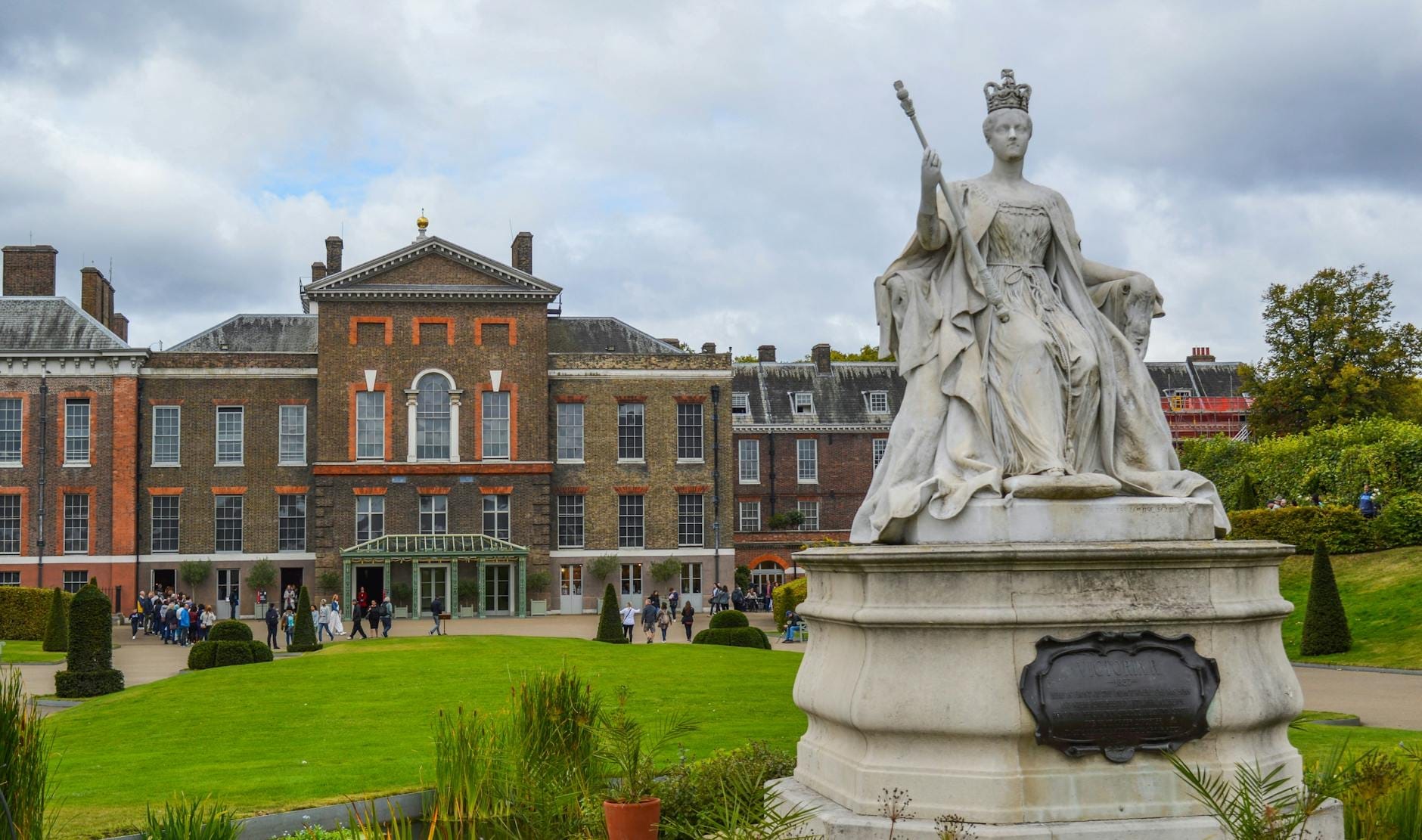
What Kensington Palace Actually Is
Kensington Palace is not a museum that happens to look like a palace. It is a working royal residence — several apartments within the building are currently home to members of the royal family, including the Prince and Princess of Wales and their children. The portion open to the public is managed by Historic Royal Palaces, the independent charity that also oversees the Tower of London and Hampton Court. That distinction matters: visiting Kensington Palace feels less like a heritage attraction and more like stepping into a house that is still in use, which gives it an atmosphere quite different from purely ceremonial sites.
The palace sits within Kensington Gardens in west London, part of the broader stretch of parkland that connects to Hyde Park. The approach from the garden side, past the Round Pond and along tree-lined paths, is one of the better introductions to any London attraction. On a clear morning, the pale brick facade catches the low sun and the fountains in the formal garden to the east are often running, making the first impression pleasant rather than overwhelming.
⚠️ What to skip
The Queen's State Apartments are scheduled to close for major conservation works from 15 June 2026. If this is a priority for your visit, plan accordingly and check the Historic Royal Palaces website for the latest information on which rooms are open.
A Palace Built in Six Months (and What Came After)
The building began as Nottingham House, a Jacobean property purchased by King William III in 1689. William suffered from asthma and found Whitehall Palace — then the main royal residence — too damp and smoggy beside the Thames. He commissioned Sir Christopher Wren to transform Nottingham House into a proper royal palace, a job completed remarkably quickly: William and Mary moved in on 24 December 1689, roughly six months after work began. Wren's additions were practical rather than theatrical, which is part of why the exterior reads as stately rather than ostentatious compared to Continental baroque palaces of the same era.
The palace's most consequential occupant was Queen Victoria, who was born here in 1819 and lived at Kensington until she acceded to the throne in 1837. The room where she was woken at dawn to be told she was queen is preserved and interpreted as part of the visitor experience. Victoria's childhood at Kensington was not a happy one — she was raised under the restrictive 'Kensington System' imposed by her mother and the ambitious Sir John Conroy, which kept her isolated from other children and under near-constant supervision. That backstory adds a layer of genuine human drama to rooms that might otherwise feel like decorated boxes.
More recent history connects Kensington Palace to Princess Diana, who lived here from her marriage in 1981 until her death in 1997. The palace became a focal point for public grief in the days that followed, a moment that changed how the monarchy engaged with public emotion. Today, the royal connections are interpreted thoughtfully rather than exploitatively, with some of Diana's iconic fashion pieces displayed in the dedicated exhibition spaces.
Tickets & tours
Hand-picked options from our booking partner. Prices are indicative; availability and final rates are confirmed when you complete your booking.
Kensington Palace Tour with Guard Change and Afternoon Tea
From 126 €Instant confirmationFree cancellationKensington Gardens guided tour and high tea
From 114 €Instant confirmationGuided walking tour of three royal palaces with high tea
From 114 €Instant confirmationPrivate London Sightseeing Taxi Tour & Kensington Palace
From 550 €Instant confirmationFree cancellation
What You Actually See Inside
The visitor route moves through several distinct zones, and it is worth understanding each before you arrive. The King's State Apartments are the most formally grand spaces: the Cupola Room, where Victoria was baptised, features gilded ionic columns, blue-and-gold painted walls, and a spectacular trompe-l'oeil ceiling that creates an illusion of height the actual room does not have. The proportions feel deliberately theatrical, designed to impress courtiers and foreign dignitaries rather than to be lived in.
The King's Gallery runs along the south side of the palace and was originally used to display royal art collections. The ceiling paintings by William Kent, commissioned in the 1720s under George I, are among the best-preserved examples of early 18th-century decorative painting in Britain. The light in this room changes throughout the day: in the morning it catches the gilding warmly from the east-facing windows; by afternoon the room can feel slightly dim, so morning visits reward those interested in the painted details.
The fashion and dress exhibitions have become a signature part of the Kensington offer. The palace has a long tradition of displaying royal ceremonial dress, and recent years have seen more dynamic, curatorially ambitious shows drawing on the royal collection and beyond. These rotate periodically, so the exact content will differ visit to visit — check the Historic Royal Palaces website before you go if this is your primary reason for coming.
💡 Local tip
Pick up the free floor plan at the entrance and note the one-way route. The visitor circuit is not immediately intuitive, and doubling back wastes time. The Sunken Garden to the east of the palace is free to view from outside and worth ten minutes even if you are not paying for entry.
The Gardens: Free, Underused, and Worth Your Time
Kensington Gardens surrounding the palace are free to enter and often less crowded than the palace itself. The Sunken Garden immediately east of the palace — a formal Edwardian parterre with brick pathways, a central pond, and dense seasonal planting — became widely known after floral tributes were placed nearby following Princess Diana's death. The adjacent Hyde Park connects seamlessly to the west, and many visitors drift between the two without noticing the boundary.
The bronze statue of Prince Albert near the palace is a less-visited but historically interesting piece. Further into the gardens, the Albert Memorial on the southern edge is one of Victorian London's most exuberantly decorated monuments, often missed by visitors focused on getting to the palace entrance. From the north side of the gardens, the views back toward the palace across the Long Water give some of the best exterior photography angles, particularly in late afternoon when the western light is behind the camera.
Timing Your Visit
The palace opens at 10:00 with last entry at 17:00 and usually closes at 18:00, though hours can vary on certain dates. Weekday mornings between 10:00 and 12:00 are reliably the quietest period. School holidays and weekends, particularly in July and August, bring significant crowds and queue times for pre-booked tickets can still run to 20 minutes at peak periods. Booking online in advance is strongly recommended — it saves time and often money.
The interior is climate-controlled, which makes Kensington a reasonable choice on rainy days. However, arriving in poor weather means you miss the garden approach, which is a genuine part of the experience. If rain is forecast, plan to spend the full two to three hours inside rather than splitting time between palace and gardens.
Winter visits have their own character: the gardens are quieter, and the state rooms feel more appropriate in atmospheric grey light. For a wider view of how to plan time around London's seasons, see the best time to visit London guide.
Getting There and Practical Details
High Street Kensington station (Circle and District lines) is roughly a ten-minute walk east through Kensington Gardens. Queensway station (Central line) approaches from the north and is a similar distance. Neither walk is arduous; both pass through pleasant parkland. Bus routes 9, 49, 52, 70, and 452 serve Kensington High Street. If arriving from Paddington by foot, allow around 20 minutes through the park — it is a pleasant walk rather than a slog.
The palace is a historic building and some areas have restricted access. Historic Royal Palaces provides detailed accessibility information on their website, including step-free routes and hearing loop availability. Given that some areas may be closed for conservation works, checking accessibility-specific information before arriving is advisable for visitors with mobility requirements.
Photography is permitted throughout most of the public areas, though tripods are generally not allowed. For palace exterior shots, the view from the Round Pond looking southwest is a classic composition. If you are working through a wider London photography itinerary, combine Kensington with the adjacent gardens in one visit.
Is Kensington Palace Worth It?
Honestly, it depends on what you want from a royal attraction. Kensington Palace is more intimate and more historical than Buckingham Palace's State Rooms (which open only in summer and feel more ceremonially hollow). If the 17th and 18th-century court history, the Victoria story, or the fashion exhibitions appeal, the ticket price represents fair value. Two to three hours is enough to do it properly without fatigue.
If your primary interest is royal spectacle — guards, grand facades, the Changing of the Guard — you would be better served by Buckingham Palace or Horse Guards Parade. Kensington rewards curiosity and a tolerance for slower, more contemplative engagement with interiors rather than photo-opportunity spectacle.
Visitors who find royal history abstract or who prioritise outdoor activity over interior spaces may find the ticket hard to justify, given that the gardens themselves are free. Children under 16 pay half price, and the mixture of costumed interpretation and interactive displays in the Victoria sections holds younger visitors' attention reasonably well — though it is not primarily designed as a children's attraction.
Insider Tips
- The Orangery restaurant on the north side of the palace traditionally serves afternoon tea in a beautiful early 18th-century room, but it books up quickly when operating. Reserve in advance if you plan to eat there — walking in on a weekend is rarely successful.
- The Sunken Garden is freely accessible from Kensington Gardens even without a palace ticket. It is best in late spring (May and June) when the bedding planting is at its most colourful.
- If you hold a Historic Royal Palaces membership (which also covers the Tower of London, Hampton Court, Banqueting House, and others), free entry makes Kensington an easy drop-in on any visit to this part of London — the membership pays for itself quickly if you plan to visit multiple HRP sites.
- The gift shop is accessible without buying a palace ticket. The range of prints and books related to Victoria, the royal dress collection, and Kensington's history is better curated than most royal attraction shops.
- The Round Pond, a few minutes' walk east of the palace, is a favourite spot for model boat enthusiasts on weekend mornings. It offers a calmer, local-flavoured experience that contrasts nicely with the tourist activity inside the palace gates.
Who Is Kensington Palace For?
- History enthusiasts interested in the 17th to 19th-century British court and the early life of Queen Victoria
- Fashion and design fans drawn to the rotating royal dress and costume exhibitions
- Families with children aged 7 and above who respond well to story-led interpretation
- Visitors combining the palace with a long walk through Kensington Gardens and Hyde Park
- Photographers seeking formal garden compositions and classic palace exteriors without the crowds of Buckingham Palace
Nearby Attractions
Other things to see while in Kensington & Chelsea:
- Chelsea Physic Garden
Founded in 1673 by the Worshipful Society of Apothecaries, Chelsea Physic Garden is a four-acre walled enclosure in the heart of Chelsea containing over 4,500 medicinal, edible, and historically significant plants. It is the second-oldest botanic garden in Britain and one of the quietest places you will find in central London.
- The Design Museum
Housed in the dramatically restored former Commonwealth Institute building on Kensington High Street, the Design Museum is one of Europe's most respected institutions dedicated to design, architecture, fashion, and product innovation. Entry to the permanent collection is free, while rotating exhibitions draw on names from global creative culture.
- Harrods
Founded in 1849 and occupying over a million square feet in Knightsbridge, Harrods is as much a London spectacle as it is a shop. Whether you're browsing the Food Halls or shopping the designer floors, here's exactly what to expect.
- Hyde Park
Hyde Park is one of London's eight Royal Parks, covering 142 hectares in the heart of the city. Free to enter, open until midnight, and rich in history stretching back to a Tudor hunting ground, it rewards visitors who pace themselves and explore beyond the obvious.