The Design Museum: London's Home of Contemporary Design
Housed in the dramatically restored former Commonwealth Institute building on Kensington High Street, the Design Museum is one of Europe's most respected institutions dedicated to design, architecture, fashion, and product innovation. Entry to the permanent collection is free, while rotating exhibitions draw on names from global creative culture.
Quick Facts
- Location
- 224–238 Kensington High Street, London W8 6AG
- Getting There
- High Street Kensington (Circle & District lines); buses 9, 23, 27, 28, 49, C1
- Time Needed
- 1.5–3 hours (2–4 hours if a major exhibition is on)
- Cost
- Free (permanent collection); paid tickets for temporary exhibitions — prices vary
- Best for
- Design enthusiasts, architecture lovers, curious creatives, and fans of fashion history
- Official website
- designmuseum.org
What the Design Museum Actually Is
The Design Museum is the UK's leading institution dedicated to contemporary and modern design across every discipline: product, graphic, fashion, architecture, and digital. Founded by retailer and restaurateur Sir Terence Conran and opened in 1989 at a converted banana-ripening warehouse on Shad Thames near Tower Bridge, it relocated in 2016 to Kensington High Street and has occupied its current home ever since. In 2018, it won the European Museum of the Year Award, a recognition that reflects both its curatorial ambition and its success in making design feel accessible rather than rarefied.
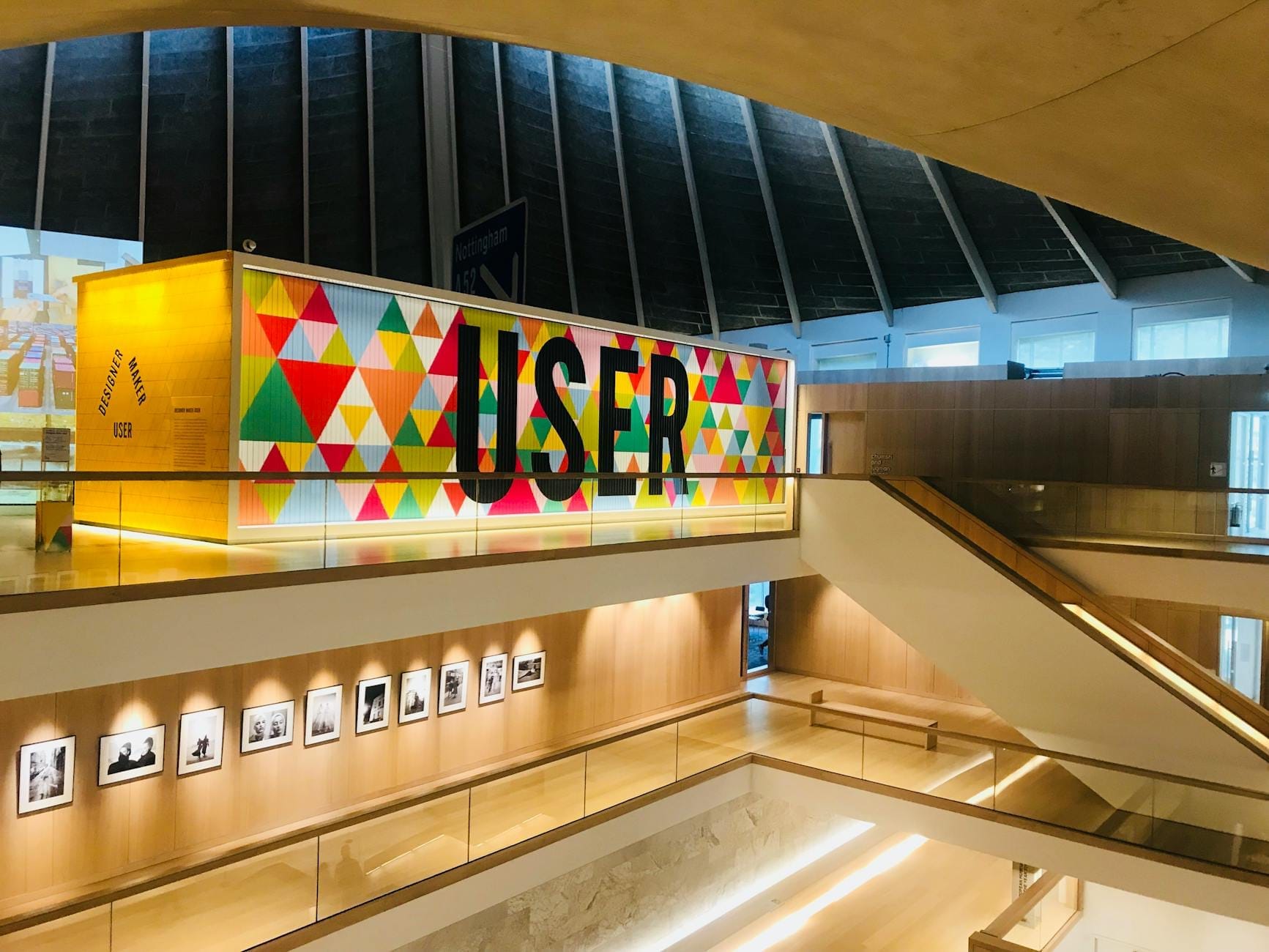
The building itself is as much the attraction as what is inside it. The former Commonwealth Institute, built in 1962 and designed by Robert Matthew, Johnson-Marshall and Partners, features a distinctive hyperbolic paraboloid copper roof that curves and swoops above Holland Park. Inside, London-based architecture studio John Pawson oversaw the refurbishment, stripping back decades of alterations to reveal a luminous top-lit atrium at the core of the building. Walking in from Kensington High Street, the volume of that central space stops most visitors in their tracks.
💡 Local tip
Entry to the permanent collection on Level 2 is free and requires no ticket or booking (except for self-guided learning groups). If you are coming mainly for a temporary exhibition, pre-booking tickets online is strongly recommended to avoid queues, especially at weekends.
The Building: Architecture Worth Arriving Early For
Arrive before 11am on a weekday and the atrium is almost hushed. Light falls through the roof in flat, diffuse sheets that shift as cloud cover changes outside. The original 1960s copper roof has been preserved, and its geometric curves read differently depending on where you stand in the building. From the upper levels you can look down into the atrium and see the full geometry of the interior all at once.
John Pawson's approach throughout was one of disciplined restraint: white surfaces, carefully proportioned openings, and an emphasis on natural light. For visitors interested in how interior architecture functions as an experience rather than just a container, the building itself provides an object lesson. It is one of the relatively few places in London where mid-century architecture and contemporary minimalist design coexist without tension.
The surrounding area adds further interest. The museum backs onto Holland Park, one of west London's most quietly appealing green spaces. Immediately adjacent is the former Commonwealth Institute grounds, now the setting for a residential development by Allies and Morrison. For a broader afternoon in this part of the city, the Kensington Palace and its grounds are a ten-minute walk east, and the stretch of Kensington High Street between the museum and the palace is entirely walkable.
Tickets & tours
Hand-picked options from our booking partner. Prices are indicative; availability and final rates are confirmed when you complete your booking.
Soho Instagram a self-guided walking tour to top photo spots
From 6 €Instant confirmationFree cancellationTootbus London by Night: Bus tour
From 32 €Instant confirmationFree cancellationIFS Cloud Cable Car Ride and Uber Boat Hop-on Hop-off 1 Day Ticket
From 38 €Instant confirmationFree cancellationThe Making of Harry Potter Guided Tour of London Warner Bros. Studio
From 201 €Instant confirmationFree cancellation
The Permanent Collection: Designer Maker User
The permanent display, titled 'Designer Maker User', occupies Level 2 and is free to enter. It traces the relationship between the people who create objects, the people who manufacture them, and the people who ultimately use them. The collection spans industrial machinery, domestic appliances, protest graphics, sports equipment, furniture, and digital interfaces.
Highlights include a section on transport design that puts aircraft seating next to racing car components, and a consistently strong display of graphic design that covers everything from wartime propaganda to digital typography. What sets this collection apart from similar design histories elsewhere is its refusal to treat 'good design' as purely aesthetic. Functionality, material choice, production method, and cultural context all feature explicitly in the labelling.
Children tend to engage well with this floor because many objects are recognisable from everyday life, and the layout is open enough to allow movement without the gallery feeling chaotic. That said, it is not an especially hands-on experience. Families expecting the interactivity of a science museum may find the permanent collection more observational than participatory.
Temporary Exhibitions: The Main Draw for Return Visitors
The Design Museum has built a reputation for mounting temporary exhibitions that attract audiences well beyond the usual design-world audience. Past shows have examined the work of individual designers such as Dieter Rams and Virgil Abloh, explored fashion design across decades, and tackled large thematic questions about the future of housing, transport, or technology. The quality is consistently high and the curatorial voice tends to be clear without being didactic.
Paid exhibitions typically occupy Gallery 1 on the ground floor and Gallery 2 on Level 1. The ticketed shows are where most of the critical attention falls, and they are the primary reason visitors plan a specific trip rather than dropping in. If you are travelling to London and there is an exhibition that interests you, it is worth booking before you leave home. Sold-out dates do occur for high-profile shows.
ℹ️ Good to know
Opening hours differ by day: Monday to Thursday 10:00–17:00; Friday to Sunday 10:00–18:00. The museum closes on Christmas Eve, Christmas Day, and Boxing Day. Special exhibitions occasionally extend evening hours on specific days — check the museum's website before visiting.
If the Design Museum's programme is full on the day you visit, the Victoria and Albert Museum is around a fifteen-minute walk east and consistently has multiple free and paid exhibitions running simultaneously, making the two a natural pairing for a full day focused on design and decorative arts.
Practical Walkthrough: What to Expect on Arrival
The main entrance is on Kensington High Street. There is a High Street Shop immediately outside before you enter the building, stocking design books, prints, and objects. Inside the main entrance, the ground floor atrium contains the Atrium Shop and the Design Cafe, which serves food and drink throughout opening hours. There is also an Exhibition Shop near Gallery 1.
The museum operates a cashless payment policy throughout: cards and contactless payments only, no cash accepted anywhere on site. This applies to the shops, the cafe, and ticket desks. It is worth knowing before you arrive, particularly if you are travelling with children who carry cash.
Level 2 contains both the permanent 'Designer Maker User' collection and the Design Kitchen cafe. If you are visiting with children or planning a longer stay, the Level 2 cafe is slightly less crowded than the ground floor one at peak times, typically weekend afternoons.
⚠️ What to skip
The museum can become noticeably crowded on Saturday afternoons, particularly when a major exhibition is running. Weekday mornings, especially Tuesday to Thursday before noon, offer a significantly calmer experience with shorter queues for temporary exhibitions.
Photography is generally permitted in the permanent collection for personal use. Temporary exhibitions often restrict photography depending on the exhibitor's terms, so check at the entrance to each gallery. If you are interested in photographing design spaces and architecture more broadly, the nearby Serpentine Galleries in Hyde Park offer another architecturally distinctive venue less than a kilometre away.
Getting There and Getting the Most From the Area
High Street Kensington Underground station (Circle and District lines) is the most straightforward approach, placing you directly on Kensington High Street with a five-minute walk west to the museum entrance. The station exit is clearly signposted. Several bus routes also stop on Kensington High Street, including the 9, 23, 27, 28, 49, and C1.
By bicycle, the museum is accessible via the TfL Cycle Hire docking station on Kensington High Street. If you are spending a full day in west London, the Kensington and Chelsea area packs a notable concentration of cultural institutions into a walkable strip: the Natural History Museum, the Science Museum, the V&A, and the Design Museum can all be combined in a single day if you are selective about how long you spend in each.
There is no dedicated car park at the museum. Kensington High Street has limited on-street parking and nearby NCP facilities, but driving is not recommended given the quality of public transport connections. If arriving by taxi or rideshare, the drop-off point on Kensington High Street directly in front of the entrance is straightforward.
Is It Worth Your Time?
For visitors with a specific interest in design, architecture, or fashion history, the Design Museum is one of the most rewarding stops in London regardless of what exhibitions are on. The building alone justifies a visit, and the free permanent collection provides a substantive experience.
For visitors with no particular connection to design, the case is weaker unless a temporary exhibition touches on something they care about. The permanent collection, while well curated, is relatively compact. It does not have the encyclopaedic scale of the British Museum or the V&A, and visitors expecting a half-day of content from the free galleries alone may find themselves done in ninety minutes.
If you are building a broader London itinerary, the Design Museum fits most naturally into a day anchored in west London. A practical structure is to start at the Design Museum when it opens, move through Holland Park, then walk or take the tube to the V&A for the afternoon. Alternatively, for those focused specifically on creative London, pairing the Design Museum with a visit to Somerset House in the evening makes for a coherent day across the city's design and arts institutions.
Insider Tips
- The museum's free permanent collection is worth visiting even if you have no interest in the paid exhibitions. It is one of the more intellectually rigorous free museum experiences in London and tends to be far less crowded than the ground floor galleries.
- If you plan to visit multiple paid London museums and galleries over several days, check whether the London Pass or a combined ticket offers savings on Design Museum admission alongside other paid attractions before buying individual tickets.
- The High Street Shop outside the main entrance is accessible without entering the museum and stocks a well-curated selection of design books and objects. It is one of the better design bookshops in west London and worth browsing even on a day when you are not going inside.
- Weekday mornings between opening and noon are the calmest period. If you are specifically visiting for a major temporary exhibition and want the space largely to yourself, Tuesday or Wednesday morning is the optimal window.
- Holland Park, directly adjacent to the museum, has a Japanese Kyoto Garden inside it that most visitors walking between Kensington High Street and the museum entirely miss. It takes less than ten minutes to walk through and is a useful decompression after the museum.
Who Is The Design Museum For?
- Design and architecture professionals or students wanting access to well-contextualised collections and current exhibition programming
- Culturally curious travellers who want to see how London engages with contemporary ideas beyond fine art
- Fans of mid-century and modernist architecture who will find the refurbished Commonwealth Institute building itself a significant draw
- Families with older children (typically 9 and above) who have some appetite for design history in an approachable format
- Visitors combining a day of west London cultural institutions and wanting a focused, manageable museum that complements a longer visit to the V&A or Natural History Museum
Nearby Attractions
Other things to see while in Kensington & Chelsea:
- Chelsea Physic Garden
Founded in 1673 by the Worshipful Society of Apothecaries, Chelsea Physic Garden is a four-acre walled enclosure in the heart of Chelsea containing over 4,500 medicinal, edible, and historically significant plants. It is the second-oldest botanic garden in Britain and one of the quietest places you will find in central London.
- Harrods
Founded in 1849 and occupying over a million square feet in Knightsbridge, Harrods is as much a London spectacle as it is a shop. Whether you're browsing the Food Halls or shopping the designer floors, here's exactly what to expect.
- Hyde Park
Hyde Park is one of London's eight Royal Parks, covering 142 hectares in the heart of the city. Free to enter, open until midnight, and rich in history stretching back to a Tudor hunting ground, it rewards visitors who pace themselves and explore beyond the obvious.
- Kensington Palace
Kensington Palace is a working royal residence and public attraction set within Kensington Gardens. From its origins as a 17th-century country house to Queen Victoria's birthplace and home to the Princess of Wales today, it offers a more intimate royal experience than Buckingham Palace — with state rooms, fashion exhibitions, and one of London's finest garden approaches.