Somerset House: London's Grand Cultural Courtyard
Somerset House is a magnificent neoclassical complex on the Strand that blends 250 years of history with a forward-looking arts programme. Entry to the courtyards is free, while ticketed exhibitions, the Courtauld Gallery, and seasonal events fill the calendar year-round.
Quick Facts
- Location
- Somerset House, Strand, London WC2R 0RN — south side of the Strand, overlooking the Thames
- Getting There
- Temple (District/Circle lines) is the closest Tube stop; also walkable from Covent Garden, Holborn, and Blackfriars. Buses 6, 26, 59, 76, 87, 139, 168, 171, 172, 176 and others stop nearby along the Strand and Aldwych.
- Time Needed
- 1–2 hours for the courtyard and a single exhibition; half a day if combining with the Courtauld Gallery
- Cost
- Courtyard and common spaces: free. Exhibitions and special events: ticketed (prices vary). Courtauld Gallery: separate admission — check the Courtauld website for current prices.
- Best for
- Art lovers, architecture enthusiasts, couples, culture-seeking visitors, and anyone wanting a free landmark that rewards a slow walk
- Official website
- www.somersethouse.org.uk
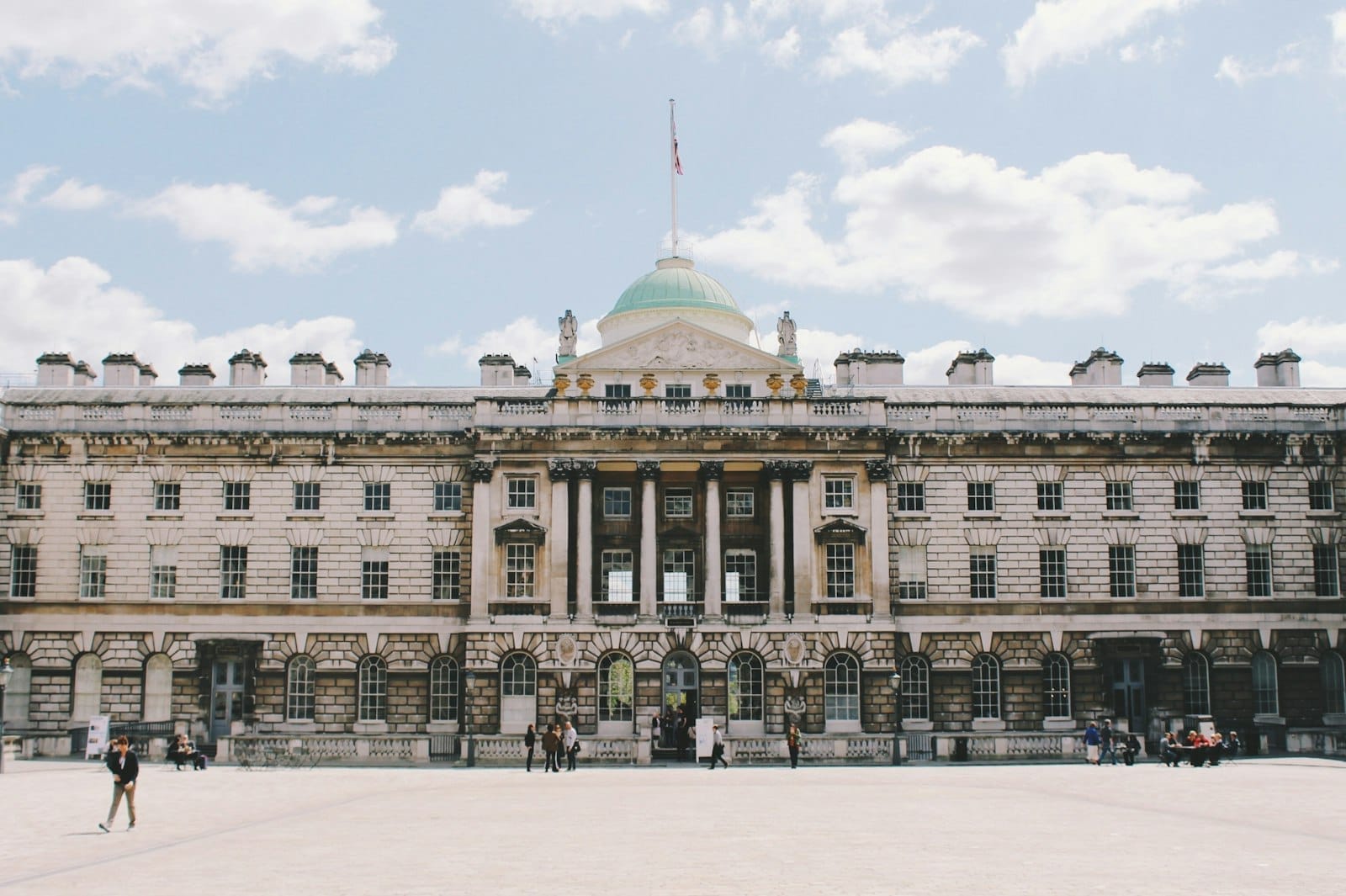
What Somerset House Actually Is
Somerset House is a working arts campus housed inside one of London's most impressive pieces of Georgian civic architecture. The scale surprises first-time visitors: the building wraps around a vast enclosed courtyard, opens onto a broad riverside terrace, and contains multiple gallery spaces, a string of restaurants, studios, and the Courtauld Gallery, one of Europe's finest collections of Impressionist and Post-Impressionist painting.
The courtyard, the Edmond J. Safra Fountain Court, is free to enter and generally open daily except 25 December, though access can be restricted during major events or installations. Most people arrive expecting something modest and leave impressed by the geometry of the space: three neoclassical wings framing a rectangle of stone paving, with 55 fountains flush with the ground at its centre. On a dry day, the fountains are switched on and children run through them while adults eat lunch on the low steps. The whole scene has a civic ease that is increasingly rare in central London.
💡 Local tip
Entry to the main courtyard and riverside terrace is free with no booking required. Arrive before 10:30 on a weekday and you will often have the fountain court largely to yourself — the lunch crowd arrives sharply at noon and the atmosphere changes completely.
History and Architecture: Why the Building Matters
The site has been significant since the mid-sixteenth century. Edward Seymour, Duke of Somerset and Lord Protector during the early reign of Edward VI, began construction of a large Tudor palace here in 1549, demolishing several existing buildings in the process to clear the land. That original Somerset House passed through royal hands and served as a residence for queens consort before falling into disrepair.
The present building is an entirely different structure, one of the most important neoclassical public buildings in Britain. Sir William Chambers designed the central block, constructed between 1776 and 1796, intended from the start as a grand government office complex rather than a private residence. The scale is deliberate: Chambers wanted to create a building that projected institutional authority along the Thames, at a time when the river was the primary approach to the city for many visitors. The south facade, visible from the water, is particularly considered in its proportions.
For much of the nineteenth and twentieth centuries, Somerset House functioned as a bureaucratic engine room. The General Register Office (responsible for registering births, marriages, and deaths in England and Wales) operated here, as did the Inland Revenue. The Courtauld Institute of Art has been based in the building since 1989. The broader conversion into a public arts centre took shape through the late 1990s and 2000s, opening the courtyard to the public for the first time in its history.
Tickets & tours
Hand-picked options from our booking partner. Prices are indicative; availability and final rates are confirmed when you complete your booking.
Guided tour inside Westminster Abbey and outside the Houses of Parliament
From 103 €Instant confirmationFree cancellationHouses of Parliament and Westminster Abbey guided tour
From 149 €Instant confirmationFree cancellationLondon Main Sights Guided Tour with Visit to The Houses of Parliament
From 110 €Instant confirmationFree cancellationHouses of Parliament and Westminster Walking Tour
From 110 €Instant confirmationFree cancellation
The Experience by Time of Day
Somerset House reads differently depending on when you visit. In the morning, particularly on weekdays, the courtyard has an almost contemplative quality. The stone stays cool, the fountains catch whatever light is available, and the main noise is pigeons and distant Strand traffic. It is one of the calmer open spaces in this part of central London, which is saying something given that the West End is a short walk in every direction.
By midday the mood shifts. Office workers from the surrounding buildings and arts organisations based in the complex fill the courtyard. The cafe terraces under the arcades get busy. The fountain court becomes a social space, not an architectural one. If you are visiting primarily to photograph the building, morning is significantly better.
Evenings, especially in summer, bring a different dimension again. Somerset House runs outdoor film screenings, concerts, and cultural events in the courtyard through the warmer months. The building is lit at night, and the riverside terrace — looking out toward Waterloo Bridge and the South Bank — offers one of the quietly underrated views of the Thames. It is not the obvious panorama tourists seek, but it has a particular quality at dusk.
In winter, the fountain court is transformed into a skating rink, typically running from November through to January. It is one of London's more atmospheric winter settings, though tickets sell quickly and the rink is always crowded. If you are visiting during this period, check what else London offers in December alongside the skating.
The Courtauld Gallery: The Main Reason to Buy a Ticket
Inside the north wing of Somerset House, the Courtauld Gallery holds one of the most concentrated collections of great painting in the world relative to its size. The Impressionist and Post-Impressionist holdings are exceptional: Manet's A Bar at the Folies-Bergere, Van Gogh's Self-Portrait with Bandaged Ear, Cezanne's The Card Players, Renoir, Modigliani, Degas. These are not secondary works — they are major canonical pieces, and seeing them in a relatively uncrowded gallery (it is rarely as busy as the National Gallery) is a different experience to most London museum visits.
The Courtauld reopened in 2021 after a significant renovation, and the rehang gives each room more breathing space than the previous arrangement. Admission is charged separately from general Somerset House entry — check the Courtauld's own website for current prices before visiting. For context on how it compares to other London collections, the guide to the best museums in London places it alongside the city's major institutions.
ℹ️ Good to know
The Courtauld is a separate institution with its own admission fees and hours. Somerset House galleries and the Courtauld Gallery are distinct — buying an exhibition ticket for one does not include the other. Check both websites before you visit.
Exhibitions, Events, and the Broader Programme
Beyond the Courtauld, Somerset House runs its own exhibition programme in the Embankment Galleries and other spaces throughout the building. The focus tends toward contemporary art, design, fashion, and digital culture, with programming that skews towards younger or more experimentally-minded audiences than the traditional museum circuit. Tickets are required for these exhibitions, and the quality varies considerably between shows — checking current listings on the official website before your visit is useful rather than just a formality.
The events calendar is a significant part of Somerset House's identity. Film4 Summer Screen (outdoor cinema in the courtyard), London Fashion Week events, music performances, and design fairs all take place here across the year. The building's flexible relationship with commercial and cultural events gives it a liveness that purely public institutions sometimes lack, though it also means the courtyard is occasionally closed or restricted during set-up. Checking the what's on page at somersethouse.org.uk before planning a specific visit is advisable. If your trip involves multiple cultural stops, the 3-day London itinerary suggests how to combine Somerset House with other nearby landmarks efficiently.
Getting There and Practical Logistics
The nearest Underground station is Temple on the District and Circle lines, about a five-minute walk along the Embankment and up to the Strand. Covent Garden (Piccadilly line) and Holborn (Central and Piccadilly lines) are also walkable at around ten minutes each, and both routes pass through streets worth exploring. Blackfriars (District, Circle, and Thameslink) is another option if you are coming from the south.
Somerset House is also accessible from the river: Embankment Pier is a short walk away, served by Uber Boat by Thames Clippers. Arriving by river on a clear day, with the building's south facade coming into view from the water, gives a sense of the original intention behind Chambers' design. For a broader understanding of river-based travel around London, the Thames river travel guide covers piers, routes, and ticketing in detail.
Accessibility varies across the site. The main fountain court is step-free from the Strand entrance, and lift access exists to gallery levels, but the building's age means some routes are more straightforward than others. Visitors with specific mobility requirements should contact Somerset House directly or consult the detailed accessibility section on their official website before visiting.
⚠️ What to skip
Gallery opening hours differ by day: for many exhibitions, Monday, Tuesday, Saturday, and Sunday typically open from 10:00; Wednesday, Thursday, and Friday from 11:00, but individual shows and partner institutions may vary. Hours vary by exhibition and event. Always check the official website for current times before visiting, especially around public holidays and during major events when the courtyard may have restricted access.
Photography, Setting, and Worth Knowing
The fountain court photographs exceptionally well. The symmetry of the space works from almost any angle, and the fountains at ground level create interesting foreground texture. The south wing and the view toward the Thames from the riverside terrace are both strong compositions. Early morning in spring or autumn gives the cleanest light and the fewest people in frame.
As an overall destination, Somerset House sits in a different category from London's headline attractions. It does not have the crowd-pulling immediacy of Tate Modern or the encyclopaedic scale of the British Museum. What it offers instead is a layered, often underestimated space: remarkable architecture, free access to a genuine landmark, the Courtauld's outstanding permanent collection, and a programme that keeps changing. For visitors who want more than a checklist of famous sights, it rewards time and return visits in a way that many bigger institutions do not.
Who might want to skip it: anyone on a very tight schedule whose primary goal is London's iconic visual landmarks will find Somerset House competes poorly for attention with the Tower of London or Westminster. The building is impressive but not immediately readable as a tourist attraction from the street — the Strand entrance is relatively modest and gives little sense of what lies behind it. Visitors with no interest in art or architecture, particularly families with young children looking for interactive experiences, may find the courtyard pleasing but the overall visit brief.
Insider Tips
- The riverside terrace on the south side of the building is accessible during most opening hours and offers a quiet, relatively uncrowded Thames view that most visitors miss entirely because the main courtyard draws attention away from it.
- The fountain court's 55 jets are flush with the paving and designed to be safe for people to walk through — on warm days from late spring onward, children use them freely, which makes the space feel unusually alive for central London.
- Free guided tours of the historic fabric of the building run periodically — check the Somerset House website for current offerings, as they grant access to rooms and staircases not otherwise open to casual visitors.
- Several of the cafes and restaurants under the courtyard arcades are operated by independent businesses rather than large chains, and the quality is noticeably higher than the average London tourist-area option. The covered arcade seating is also sheltered from rain, making it a practical stop in typical London weather.
- During London Fashion Week (held twice a year in February and September), Somerset House acts as a hub for shows and presentations. The building takes on a different energy entirely, and parts of the courtyard may be closed to the general public — worth knowing if your dates coincide.
Who Is Somerset House For?
- Art enthusiasts who want to see major Impressionist works at the Courtauld without fighting large crowds
- Architecture and history visitors interested in Georgian civic design and the evolution of London's public buildings
- Couples looking for a free, photogenic central London space with good food and a riverside terrace
- Cultural visitors building a day around the West End who want a landmark with genuine substance rather than just a photo opportunity
- Return visitors to London who have covered the major headline sites and want something with more depth
Nearby Attractions
Other things to see while in West End:
- British Library
The British Library holds over 170 million items spanning thousands of years of human thought, from the Magna Carta to Beatles lyrics. Entry to the building and permanent collection galleries is free, making it one of the most rewarding stops in central London for curious travellers.
- British Museum
The British Museum holds one of the world's great collections of human history and culture, spanning two million years across more than 60 free galleries. Entry to the permanent collection is free, but knowing how to navigate the scale of it makes the difference between a rewarding visit and an overwhelming one.
- Carnaby Street
Carnaby Street is the pedestrianised shopping district in Soho that defined the look of 1960s London and continues to draw fashion lovers, food hunters, and curious walkers today. Free to explore and five minutes from Oxford Circus, it rewards those who slow down and wander its connecting lanes.
- Coal Drops Yard
Coal Drops Yard is a redeveloped Victorian industrial estate in King's Cross, now home to independent retailers, restaurants, and bars set beneath strikingly restored brick vaults. The public outdoor spaces are free to enter and a short walk from King's Cross St Pancras station.