Tate Modern: The Complete Visitor Guide to London's Landmark Art Gallery
Housed in the colossal former Bankside Power Station on the South Bank, Tate Modern is one of the world's most visited galleries for modern and contemporary art. Entry to the permanent collection is free, the architecture alone is worth the trip, and the Thames-facing views from the upper floors are among the finest in London.
Quick Facts
- Location
- Bankside, London SE1 9TG (South Bank, Borough of Southwark)
- Getting There
- Blackfriars (National Rail & London Underground) is one of the closest stations; Southwark (Jubilee line) is also walkable
- Time Needed
- 2–4 hours for the permanent collection; allow a full day if visiting a special exhibition
- Cost
- Permanent collection: free. Special exhibitions: paid tickets (book in advance); concessions available
- Best for
- Contemporary art lovers, architecture enthusiasts, families, rainy-day visits, Thames views
- Official website
- www.tate.org.uk/visit/tate-modern
What Is Tate Modern, and Why Does It Matter?
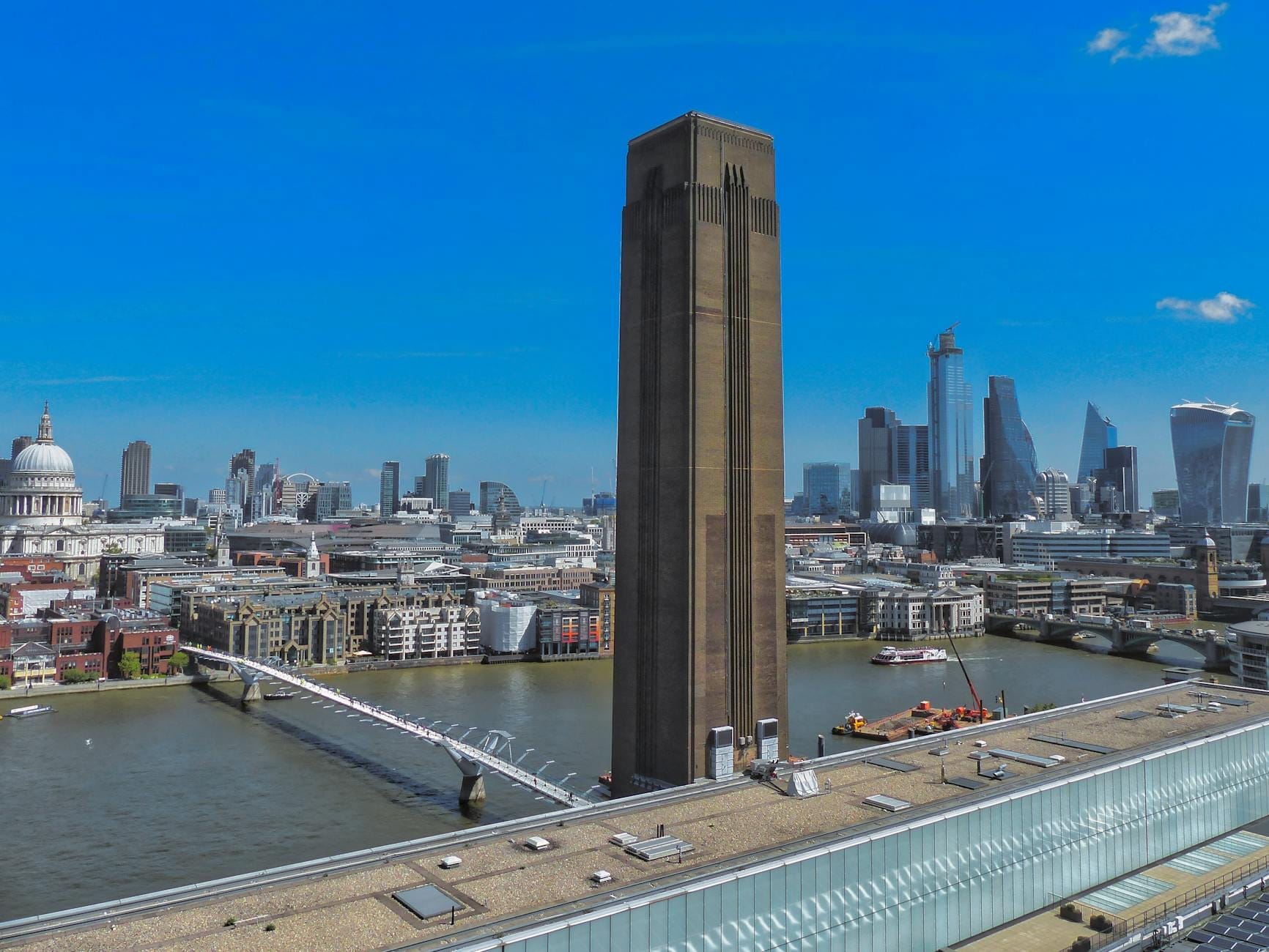
Tate Modern is the United Kingdom's national museum of modern and contemporary art, and one of the most-visited art galleries in the world. It opened in May 2000 inside the decommissioned Bankside Power Station, a monumental brick structure designed by Sir Giles Gilbert Scott — the same architect responsible for the red telephone box and Battersea Power Station. The building's 99-metre chimney stack is a South Bank landmark visible from the north side of the Thames, and the interior retains the raw industrial scale that makes it unlike any conventional gallery anywhere.
The collection spans modern and contemporary art from 1900 to the present day, with works by Picasso, Rothko, Bourgeois, Warhol, Hepworth, Beuys, and dozens of others across two interconnected buildings: the original Boiler House (formally the Natalie Bell Building) and the newer Blavatnik Building, which opened in 2016. The two are linked by underground passages and share the vast Turbine Hall — a 35-metre-high, 152-metre-long central nave that has hosted some of the most ambitious public art installations ever commissioned.
💡 Local tip
The permanent collection is free. You do not need to book in advance for it. For paid special exhibitions, booking online ahead of time is strongly recommended — popular shows sell out, and walk-up availability is not guaranteed.
The Building: From Power Station to Cultural Landmark
Bankside Power Station was built in two phases between 1947 and 1963. At its peak it generated electricity for central London, but it was shut down in 1981 as part of a wider rationalisation of the national grid. The building sat empty for nearly two decades before architects Herzog and de Meuron were appointed to convert it into a gallery — a project that became one of the most celebrated adaptive reuse conversions of the 20th century.
The genius of the conversion is what was kept as much as what was added. The Turbine Hall, where the massive electricity-generating turbines once stood, was stripped back but retained its cathedral-like proportions — a raw, echoey space with a gently sloping ramp leading visitors down from street level into the heart of the building. The brick exterior was preserved almost intact. Standing outside on the river-facing terrace, the building still reads as a power station. That tension between industrial past and cultural present is part of what gives Tate Modern its particular atmosphere.
The Blavatnik Building (the newer pyramid-shaped extension designed by the same architects) adds several more floors of gallery space and a dramatically different spatial experience: airy, lighter, with zigzagging staircases and large windows framing views across the Thames. Together, the two buildings cover approximately 34,500 square metres of gross floor area across eleven levels.
The building sits directly on the Thames, connected to the north bank by the Millennium Bridge — the pedestrian-only steel suspension bridge designed by Norman Foster. Walking across it toward the power station chimney on a clear morning is one of those simple London moments that photographs well and stays with you.
Tickets & tours
Hand-picked options from our booking partner. Prices are indicative; availability and final rates are confirmed when you complete your booking.
Tate Modern Official Discovery Tour
From 23 €Instant confirmationFree cancellationBuckingham Palace State Rooms and Royal Walking Tour
From 80 €Instant confirmationFree cancellationSoho Instagram a self-guided walking tour to top photo spots
From 6 €Instant confirmationFree cancellationTootbus London by Night: Bus tour
From 32 €Instant confirmationFree cancellation
Inside the Gallery: What to Expect
The permanent collection is organised thematically rather than chronologically, which can feel disorienting at first but rewards exploration. Rooms group works by ideas and dialogues rather than by period or nationality, so a Matisse might hang near a contemporary African artist whose work it influenced, or a Surrealist canvas might sit alongside a recent video piece that references the same imagery. Signage explains the curatorial logic, but the experience is richer if you let yourself wander rather than following a fixed route.
Stand-out permanent works include Louise Bourgeois's spider sculptures (often positioned in or near the Turbine Hall), Mark Rothko's Seagram Murals — large-scale canvases in a dedicated, dimly lit room that feels almost meditative — and a strong collection of Surrealist works including pieces by Salvador Dalí, René Magritte, and Max Ernst. Joseph Beuys, Carl Andre, and Donald Judd represent the minimalist and conceptual traditions, while the contemporary floors regularly rotate with new acquisitions.
The Turbine Hall itself is a different kind of experience. Tate commissions major artists each year to create site-specific works for the space, and these installations are always free to see. Past commissions have ranged from Olafur Eliasson's artificial sun (2003) to Carsten Höller's giant slides (2006) to Kara Walker's sugar-coated sphinx (2014). Whatever is showing when you visit is worth checking before you go — the Turbine Hall commissions are often culturally significant moments.
ℹ️ Good to know
The Turbine Hall is accessible from both the Bankside main entrance (via the sloped ramp) and the Blavatnik Building. If you enter from the Bankside side, walking down the ramp as the full scale of the space reveals itself is one of the better arrival experiences in London.
How the Experience Changes by Time of Day
Tate Modern opens at 10:00 every day. The first hour tends to be the quietest, with natural light at its most flattering in the upper gallery floors and the Turbine Hall relatively uncrowded. If you plan to photograph artwork or simply want space to think in front of a painting, arriving just after opening on a weekday is the practical choice.
By midday, particularly on weekends and during school holidays, the gallery becomes significantly busier. The Turbine Hall fills with noise — voices, children running, the echo of the vast space amplifying everything. The café and restaurant floors can have long queues. The experience is not ruined, but it is fundamentally different. The Rothko room, which relies on hushed contemplation, is especially affected by crowding.
Friday and Saturday evenings are worth knowing about: the gallery currently stays open until 21:00, and the late hours after around 18:30 attract a different crowd — fewer tourists, more local visitors, a quieter atmosphere. The South Bank Terrace and the restaurant on Level 9 are particularly good on Friday evenings, with the Thames lights reflecting on the water and St Paul's Cathedral illuminated across the river. If you're trying to combine a gallery visit with dinner in the area, arriving at 17:00, spending two hours in the collection, and then watching the city lights come on from the terrace is a satisfying evening itinerary.
💡 Local tip
Level 10 of the Blavatnik Building has a viewing area with one of the best panoramic views in London — and unlike the Sky Garden or the Shard, it is free. On clear days you can see St Paul's Cathedral, the City skyline, Tower Bridge, and far down the Thames in both directions.
Getting There and Getting Around Once Inside
The most straightforward approach from central London is to take the London Underground or National Rail to Blackfriars station, cross the Thames on Blackfriars Bridge heading south, and walk east along the riverside path for about eight minutes. The chimney is visible most of the way, making it hard to miss. Southwark station (Jubilee line) is also within walking distance — roughly ten minutes through the backstreets of Bankside.
If you are coming from the north side of the river, walking across the Millennium Bridge from the steps near St Paul's Cathedral takes around ten minutes and is itself a worthwhile walk, with the gallery framed at the far end of the bridge the entire way.
Inside, the building's layout can be confusing on a first visit. The two buildings (Natalie Bell and Blavatnik) are connected but have different floor numbering systems, and the gallery levels do not always align between the two. Free maps are available at the information desks near both entrances, and staff are generally helpful with orientation. The Turbine Hall is your most reliable reference point — if you are lost, find your way back to the Hall and reorient from there.
Accessibility is well considered. The Turbine Hall ramp provides step-free access from street level into the main gallery. The Blavatnik Building entrance is also step-free. Lifts connect all gallery floors in both buildings. Disabled visitors receive a concessionary rate on paid exhibitions, and their companion enters free.
Special Exhibitions and Events
Tate Modern runs several paid special exhibitions per year, typically occupying the dedicated exhibition galleries on Level 2 and Level 3 of the Natalie Bell Building. These shows range from major retrospectives of individual artists to thematic surveys. Past exhibitions have covered figures including Paul Gauguin, Henri Matisse, Cézanne, and Zanele Muholi. They are reliably serious, well-researched, and often accompanied by substantial printed catalogues if you want to go deeper.
Exhibition ticket prices are not fixed and vary by show; concession pricing is available, and Tate Collective offers £5 tickets for visitors aged 16 to 25. Tate members and supporters enter all exhibitions free without advance booking, which makes membership worth calculating against entry costs if you plan to visit more than two or three paid shows per year. Booking in advance online is strongly recommended regardless — popular exhibitions in the final weeks of their run are frequently sold out for walk-ups.
Tate Modern is also worth checking for evening talks, family workshops, and events that are not part of the main exhibition calendar. If you are planning a broader South Bank itinerary, the gallery pairs naturally with Shakespeare's Globe to the west and Borough Market a short walk to the east, making for a full day in Bankside without needing to cross the river.
Worth Knowing: Who Will Love It and Who Might Not
Tate Modern suits visitors who are comfortable with art that requires effort. Much of the collection — particularly the conceptual and minimalist works — offers little immediate visual pleasure and rewards engagement with wall text and curatorial context. If you prefer clearly representational art, detailed narrative paintings, or Old Masters, you may find the permanent collection underwhelming. The National Gallery on Trafalgar Square or the Courtauld Gallery would serve you better.
For visitors who enjoy contemporary art, photography, or the architectural spectacle of the building itself, Tate Modern is hard to fault as a free experience. Even on a poor day, the Turbine Hall installation and the views from the upper floors justify the trip. Children often respond strongly to the large-scale works and the physical drama of the space, making this a reasonable family visit — though very young children will not engage with much of the collection specifically.
The South Bank location is also a significant part of the appeal. For more context on what surrounds the gallery, the South Bank neighbourhood guide covers the full stretch of riverside attractions from Waterloo to London Bridge.
If Tate Modern is part of a broader museum itinerary, the best museums in London guide gives a useful framework for prioritising your time across the city.
Insider Tips
- The Level 10 viewing platform in the Blavatnik Building is free when open and offers a 360-degree panorama of central London. Most visitors miss it entirely because it is not prominently signposted. Take the lifts in the Blavatnik Building all the way to the top.
- The Rothko Seagram Murals room is intentionally darkened and acoustically separated. Visit it first thing in the morning before the crowds arrive — the difference in atmosphere between an empty room and a full one is enormous with these paintings.
- Friday and Saturday evenings after 18:30 are arguably the best time to visit the permanent collection. The gallery is open until 21:00, crowds thin out, and the river views from the terrace are exceptional as the city lights come on.
- The free maps available at the information desks include a 'highlights' trail that takes roughly 90 minutes and covers the most significant works in the collection. This is useful for first-time visitors who feel intimidated by the scale of the building.
- Tate Modern has a dedicated children's room and regularly runs free family-focused activities, especially on weekends and during school holidays. Check the Tate website's 'What's On' section before visiting with children — many of these events do not require pre-booking.
Who Is Tate Modern For?
- Contemporary and modern art enthusiasts who want serious depth alongside the permanent collection
- Architecture lovers interested in industrial adaptive reuse and 20th-century power station design
- Families looking for a free, large-scale indoor experience with enough visual spectacle to hold children's attention
- Travellers on a budget who want world-class culture without an entry fee
- Evening visitors combining a gallery trip with dinner on the South Bank and views across the Thames
Nearby Attractions
Other things to see while in South Bank:
- Battersea Park
Battersea Park is a 200-acre Victorian park on the south bank of the River Thames, offering free entry, formal gardens, a children’s zoo, riverside paths, and a notable Buddhist Peace Pagoda. Less crowded than Hyde Park yet surprisingly rich in things to do, it rewards a slow, unhurried visit at any time of year.
- Battersea Power Station
Once derelict for nearly three decades, Battersea Power Station reopened in October 2022 as one of London's most dramatic mixed-use destinations. Entry to the main building and public spaces is free, while the glass chimney lift, Lift 109, offers one of the city's most unusual viewpoints. Here is everything you need to plan a visit.
- Borough Market
Borough Market has stood near London Bridge for around 1,000 years, making it one of the oldest food trading sites in Britain. Today it draws traders selling everything from aged cheeses and cured meats to freshly baked bread and street food from around the world. Entry is free, and the Victorian market buildings add a sense of occasion that most food halls simply cannot match.
- Imperial War Museum London
The Imperial War Museum London is one of the city's most thoughtfully constructed free attractions, covering conflict from the First World War to the present day. Housed in a former psychiatric hospital, it combines large-scale hardware, deeply personal testimony, and unflinching Holocaust galleries into an experience that is hard to shake.