Borough Market: London's Greatest Food Market
Borough Market has stood near London Bridge for around 1,000 years, making it one of the oldest food trading sites in Britain. Today it draws traders selling everything from aged cheeses and cured meats to freshly baked bread and street food from around the world. Entry is free, and the Victorian market buildings add a sense of occasion that most food halls simply cannot match.
Quick Facts
- Location
- 8 Southwark Street, SE1 1TL, South Bank
- Getting There
- London Bridge (Jubilee & Northern lines, National Rail) — 2-minute walk
- Time Needed
- 1.5–3 hours
- Cost
- Free entry; budget £10–20 for food and drinks
- Best for
- Food lovers, slow mornings, local produce, people-watching
- Official website
- boroughmarket.org.uk
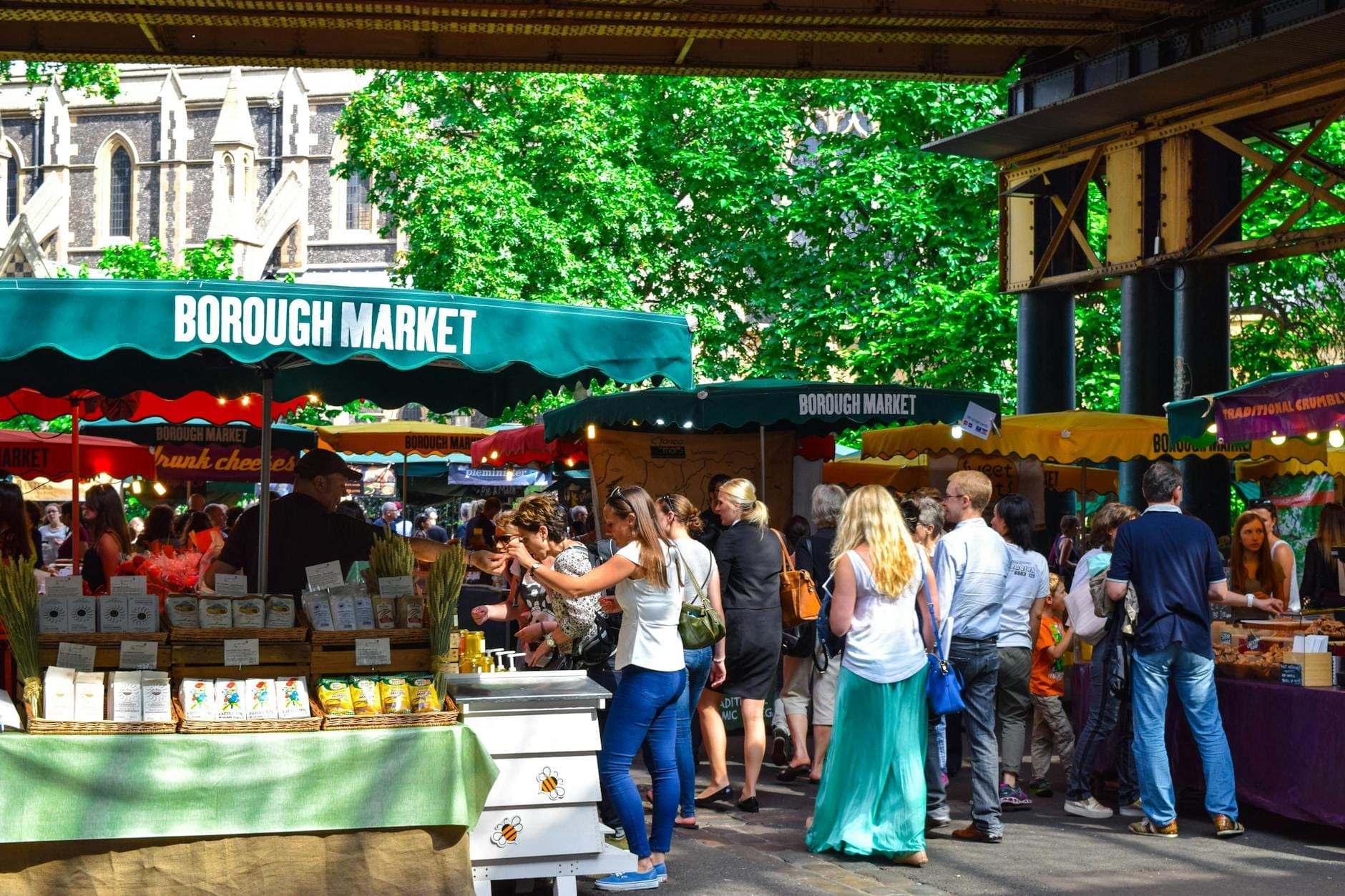
What Borough Market Actually Is
Borough Market is not a tourist market that happens to sell food. It is a working wholesale and retail food market with a trading history documented as far back as 1276 and a presence near London Bridge for close to 1,000 years. The current site has been in continuous use for over 250 years, and the iron-and-glass market buildings standing today date from the 1850s. That combination of genuine trading heritage and Victorian architecture gives Borough Market a character that feels earned rather than manufactured.
On any given trading day, you will find independent traders selling fresh fruit and vegetables, artisan cheeses, charcuterie, freshly milled flour, sourdough loaves still warm from the oven, British and international charcuterie, sustainable fish, rare-breed meat, and a wide spread of hot street food. The range is serious. Traders here are specialists, and it shows in the quality of what they bring.
💡 Local tip
Borough Market is free to enter. You pay only for what you buy. There are no booking requirements, no timed entry slots, and no queues at the gates.
The Buildings and the Atmosphere
Walking into the market from Southwark Street, the first thing that registers is the smell: coffee, frying onions, smoked fish, and fresh bread all at once. The Victorian wrought-iron framework overhead filters the light into a diffused grey-green on overcast London days, and into bright shafts on clearer mornings. The floor is uneven in places, worn smooth by generations of foot traffic. It feels like a working space, not a set.
The market spreads across several interconnected areas, including the Green Market area near Stoney Street and the covered sections beneath the railway arches. The railway lines running overhead are a constant presence — you will hear the rumble of trains at intervals, which adds to rather than detracts from the atmosphere. Southwark Cathedral sits directly adjacent to the northern edge of the market, its medieval stonework visible between the stalls, and it provides a quietly extraordinary backdrop for a Saturday breakfast.
The surrounding streets, particularly Stoney Street and Park Street, are lined with restaurants and cafes that draw on the same supplier network as the market itself. This part of the South Bank is dense with food culture, and Borough Market sits at its centre.
Tickets & tours
Hand-picked options from our booking partner. Prices are indicative; availability and final rates are confirmed when you complete your booking.
Borough Market and South Bank food tasting tour
From 103 €Instant confirmationFree cancellationDevour London: Borough Market & Leadenhall Food Tour with Wine
From 90 €Instant confirmationFree cancellationBorough Market Exclusive Secret Food Tour
From 148 €Instant confirmationFree cancellationBest food travel spots in Borough Market a self-guided walking tour
From 6 €Instant confirmationFree cancellation
How the Market Changes Through the Day
Saturday mornings between 9:00 and 10:30 represent Borough Market at its most rewarding for visitors who want space to actually look at things. Traders are setting out their stalls, the light is at its best, and the ratio of browsers to buyers is more comfortable. You can ask questions, taste samples without feeling rushed, and have a proper conversation with the person selling you a piece of aged Comté or a bottle of cold-pressed rapeseed oil.
By midday on Saturday, the crowds reach their peak. The main thoroughfares become difficult to navigate, particularly around the street food vendors where queues form quickly. If crowd-free browsing is your priority, this is not the time to arrive. That said, the energy is undeniable — the noise, the smells, and the sheer volume of produce on display create something closer to a festival than a shopping trip.
Weekday visits, especially Wednesday and Thursday, offer a substantially quieter experience. The full range of traders may not be present on every weekday, but the atmosphere is more relaxed, prices at some stalls are occasionally lower later in the day, and you can actually stop and eat your food without elbowing your way to a ledge. Friday afternoons attract a noticeable after-work crowd from the nearby financial offices.
⚠️ What to skip
Borough Market is closed every Monday. Opening hours are Tue–Fri 10:00–17:00 and Saturday 09:00–17:00; on Sundays only the surrounding restaurants and shops open, not the main market. Check the official website before visiting on Bank Holidays, as some exceptions apply.
What to Eat and Drink
The hot food options alone justify a visit. Depending on the day and the traders present, you might find salt beef bagels, freshly made raclette scraped over boiled potatoes, Venezuelan arepas, Ethiopian injera with slow-cooked stews, Spanish tortilla, or whole roasted hog rolls. The quality ceiling is high, and the variety reflects London's food culture more accurately than almost any restaurant.
For drinks, several traders and cafes sell specialty coffee, and there are wine merchants who will open bottles for tasting. The Monmouth Coffee stand near the market entrance consistently draws a queue, and justifiably so. If you want a proper sit-down meal, the restaurants and wine bars on the surrounding streets are good options, particularly for lunch after browsing the stalls.
If you are buying produce to take home — cheese, charcuterie, bread, olive oil, fresh pasta — bring a canvas bag or a small cool bag in warmer months. Packaging at many stalls is minimal by design, and paper wrapping does not hold up well in a crowded bag over a long journey.
Getting There and Getting Around
London Bridge Station is the most straightforward arrival point. It is served by the Jubilee Line, Northern line, and National Rail, and the market entrance on Southwark Street is roughly a two-minute walk from the station exit. Bus routes 17, 21, 35, 47, 133, 343, and 381 serve nearby stops. Cycling is possible, with several bike docking stations nearby, though the market itself is not manageable on a bike once inside.
Borough Market makes an easy pairing with Southwark Cathedral, which is directly adjacent, or with a walk along the Thames path toward Tate Modern and the Shakespeare's Globe. The riverside walk west from London Bridge takes about ten minutes on foot to reach both.
Accessibility at the market is reasonably well managed. The main trading areas are at street level, and fully fitted accessible WCs with emergency pull strings are available in four locations during trading hours. The Borough Market Store near the main entrance is fully accessible for wheelchair users. Note that the market floor can be uneven in sections, and on busy days the crowd density makes navigation in a wheelchair more challenging — earlier weekday visits are considerably easier for this reason.
Who Should Think Twice
Borough Market has genuine weaknesses that a lot of coverage glosses over. Saturday lunchtime crowds are significant by any measure, and if you are easily overwhelmed in tight spaces, a midday Saturday visit will not be enjoyable. The market is not cheap. Hot food portions are generous but prices reflect central London and a premium food positioning, so budget travellers should plan accordingly. People expecting supermarket-style convenience — fixed prices, easy returns, clear labelling — will find the experience unfamiliar and potentially frustrating.
If your priority is bargain food shopping rather than quality browsing, Old Spitalfields Market or other neighbourhood markets may serve you better. Borough Market rewards visitors who come with time and curiosity rather than a specific shopping list.
Weather does not affect the core market experience in the same way it affects outdoor markets, since much of Borough Market is covered. However, rain does make the perimeter stalls and the approaches from the station less pleasant, and the covered sections become significantly more crowded when everyone takes shelter simultaneously. A weekday dry-weather visit remains the most comfortable option overall.
Insider Tips
- Arrive at 9:00 on Saturday — the first half-hour after opening is the single best window for unhurried browsing, warm light for photography, and actual conversations with traders who have time to talk.
- Many traders offer free samples without any obligation to buy. Do not be shy about asking. Tasting is understood as part of the culture here, not an imposition.
- The market's perimeter restaurants and wine bars serve produce sourced directly from market traders. A lunch at one of these — rather than eating standing up at a stall — gives you a different angle on the same ingredients.
- Bring cash as a backup. Most traders now accept contactless payment, but a handful of smaller or newer stalls remain cash-only, and card readers occasionally fail on busy days.
- Wednesday and Thursday see the fewest visitors of any full market day. If you are in London mid-week and want to shop rather than spectate, this is the version of the market worth knowing about.
Who Is Borough Market For?
- Food enthusiasts who want to engage with producers and traders, not just browse
- Travellers building a self-catered picnic or wanting quality provisions for their stay
- Visitors pairing a morning market visit with the riverside cultural corridor toward Tate Modern
- Photographers drawn to Victorian market architecture, food textures, and candid crowd scenes
- Families with older children who have genuine food curiosity — the diversity of produce is educational
Nearby Attractions
Other things to see while in South Bank:
- Battersea Park
Battersea Park is a 200-acre Victorian park on the south bank of the River Thames, offering free entry, formal gardens, a children’s zoo, riverside paths, and a notable Buddhist Peace Pagoda. Less crowded than Hyde Park yet surprisingly rich in things to do, it rewards a slow, unhurried visit at any time of year.
- Battersea Power Station
Once derelict for nearly three decades, Battersea Power Station reopened in October 2022 as one of London's most dramatic mixed-use destinations. Entry to the main building and public spaces is free, while the glass chimney lift, Lift 109, offers one of the city's most unusual viewpoints. Here is everything you need to plan a visit.
- Imperial War Museum London
The Imperial War Museum London is one of the city's most thoughtfully constructed free attractions, covering conflict from the First World War to the present day. Housed in a former psychiatric hospital, it combines large-scale hardware, deeply personal testimony, and unflinching Holocaust galleries into an experience that is hard to shake.
- London Bridge
London Bridge is the oldest river-crossing site in London, with roots stretching back to Roman times. Free to walk, open to traffic and pedestrians at all hours, and flanked by some of the city's best riverside attractions, it rewards those who pause long enough to understand what they're standing on.