London Bridge: The Thames Crossing That Built a City
London Bridge is the oldest river-crossing site in London, with roots stretching back to Roman times. Free to walk, open to traffic and pedestrians at all hours, and flanked by some of the city's best riverside attractions, it rewards those who pause long enough to understand what they're standing on.
Quick Facts
- Location
- Between the City of London (north) and Southwark (south), SE1 / EC4R
- Getting There
- London Bridge Station (Jubilee & Northern lines, Elizabeth line, National Rail)
- Time Needed
- 15–30 minutes to cross and pause; 1–2 hours with riverside exploration
- Cost
- Free – no ticket or admission required
- Best for
- History enthusiasts, photographers, walkers, and first-time visitors orienting themselves along the Thames
- Official website
- www.cityoflondon.gov.uk/things-to-do/architecture/bridges
What London Bridge Actually Is (and Isn't)
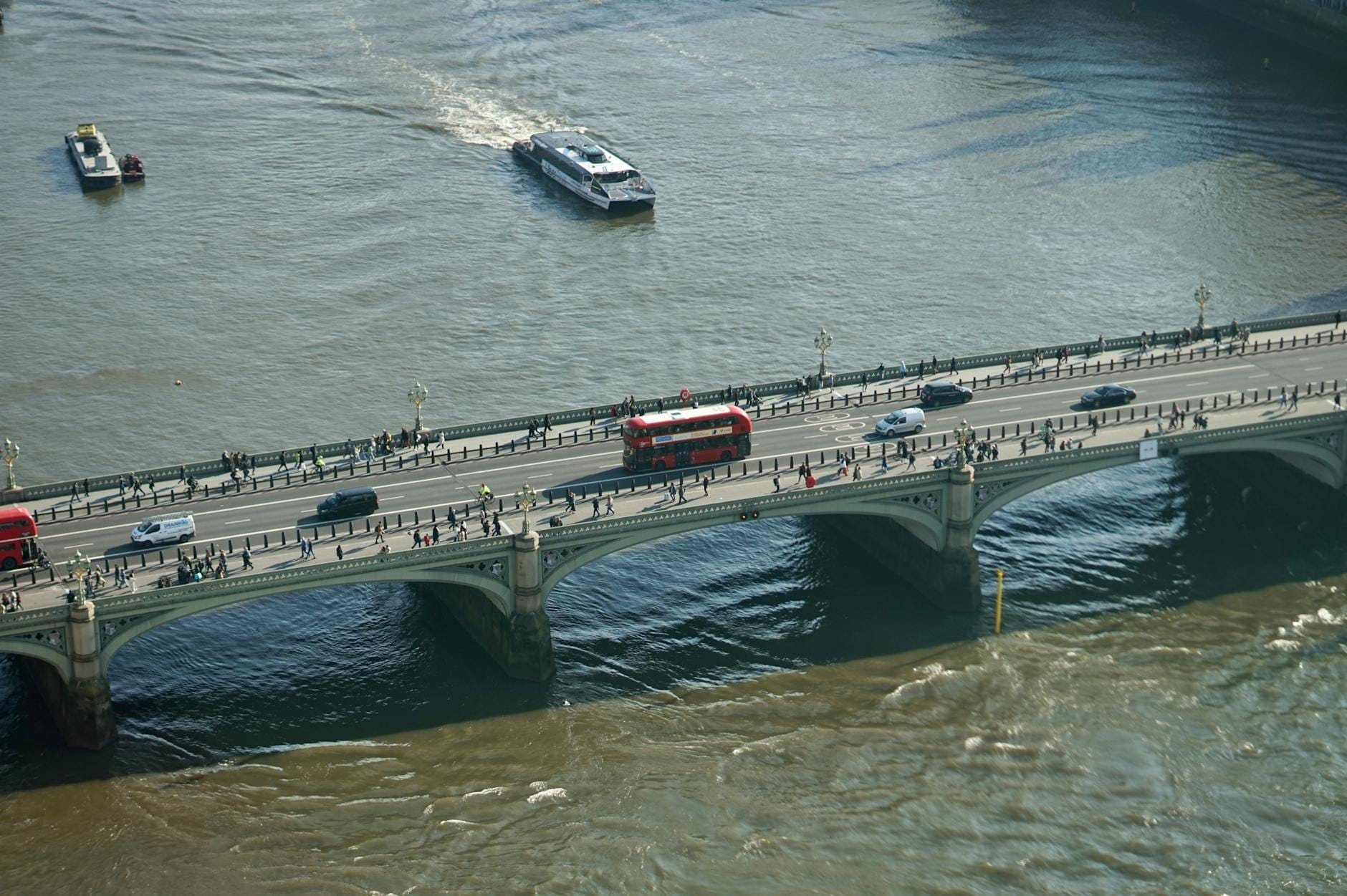
London Bridge is, without question, one of the most name-checked landmarks in the English language. It is also, just as certainly, one of the most misidentified. The plain concrete structure carrying traffic and pedestrians across the River Thames between the City of London and Southwark draws regular confusion with its far more photogenic neighbour, Tower Bridge, roughly 800 metres to the east. If you came looking for the Gothic towers and suspended walkway, that is Tower Bridge. London Bridge is the understated one, and that understatement is, in its own way, the whole point.
The current bridge, a prestressed concrete and steel box-girder structure, was built between 1967 and 1972 and officially opened to traffic by Queen Elizabeth II on 17 March 1973. At 254 metres (833 ft) long with three main spans, it carries one of the busiest road and pedestrian routes across the Thames. Its design is functional, deliberately so, but the views from its wide footways and the two millennia of history beneath your feet make it worth a deliberate stop rather than a hurried crossing.
ℹ️ Good to know
Common mix-up: the famous drawbridge with Gothic towers that appears on postcards is Tower Bridge. London Bridge is the plain concrete crossing just upstream. Both are worth visiting, but they offer completely different experiences.
Two Thousand Years on the Same Crossing
The site of London Bridge is the oldest river-crossing point in London. Roman engineers almost certainly established a timber bridge here after the founding of Londinium around AD 43, placing their settlement on the north bank at the first point upstream where the Thames narrowed enough to be bridged. For most of the city's history, this was the only fixed crossing of the tidal Thames in central London, a monopoly it held until Westminster Bridge opened in 1750.
The most storied version is the medieval stone bridge built between 1176 and 1209, which stood for over 600 years and became one of the most densely inhabited structures in Europe. Houses, shops, a chapel, and even a palace were built directly on top of it. The heads of executed traitors, including Sir Thomas More and Thomas Cromwell, were displayed on spikes at the Southwark gate. The bridge's narrow arches created such a powerful tidal surge that shooting the rapids beneath became a perverse local sport, and several people drowned attempting it.
That medieval bridge was eventually demolished and replaced in 1831 with a granite structure designed by John Rennie. When that version too showed signs of structural strain in the 1960s, it was sold to American entrepreneur Robert McCulloch and dismantled stone by stone, with the granite blocks shipped to Lake Havasu City, Arizona, where a reassembled version still stands. A persistent urban legend claims McCulloch thought he was buying Tower Bridge. He did not, the sale was fully documented, but the story has proved too good to die.
Tickets & tours
Hand-picked options from our booking partner. Prices are indicative; availability and final rates are confirmed when you complete your booking.
Tower of London and Tower Bridge private half-day guided tour
From 452 €Instant confirmationFree cancellationLondon Castles and Bridges Southbank Walking Tour
From 48 €Instant confirmationFree cancellation2-hour doughnut tour of London's downtown with Tower Bridge
From 56 €Instant confirmationFree cancellationWonders of London Bridge, online exploration game
From 10 €Instant confirmationFree cancellation
What the Crossing Feels Like at Different Times of Day
On a weekday morning between roughly 8 and 9:30am, London Bridge becomes a human river. Thousands of commuters stream north from London Bridge Station toward the City, heads down, pace brisk, coffee cups in hand. The sound is a low, collective shuffle punctuated by the rumble of black cabs and buses. This is not a meditative crossing at this hour. The footways are wide but feel compressed when the flow is at its peak. If you want to stop for photographs, stand to one side or come back later.
By mid-morning, the bridge opens up considerably. Tourists begin appearing, often pausing at the low stone balustrades to look east toward the glass spike of The Shard and the raised bascules of Tower Bridge, or west toward Southwark Cathedral and the dome of St Paul's Cathedral rising on the north bank. The Thames at this hour, if the tide is running, moves with surprising speed. The smell is brackish and vaguely industrial, a reminder that this is a working tidal estuary, not a decorative waterway.
In the early evening, particularly in summer, the bridge takes on a different character entirely. The light on the Thames turns amber and pink. Joggers weave between slower pedestrians. Boat horns echo from river traffic below. The Shard's upper floors catch the last light while the rest of the city darkens around them. This is the best hour for photography from the bridge, and worth planning for if you have the flexibility.
💡 Local tip
For the best riverside light and photographs, aim for the hour before sunset. Face east for Tower Bridge and The Shard; face west for Southwark Cathedral and the St Paul's skyline.
The Views: What You Can See from the Bridge
The bridge's footways sit low over the water compared to, say, the upper walkway of Tower Bridge, which gives the views an immediacy rather than a panoramic sweep. Looking east, you get a clean sightline toward Tower Bridge, framed by the glass facades of More London and the riverfront towers of the South Bank. The Shard rises sharply behind and to the right. Looking west, Southwark Cathedral's medieval tower anchors the south bank, and on a clear day the dome of St Paul's appears above the north bank roofline with satisfying symmetry.
Below, the Thames moves fast on an outgoing tide, dark olive-green and opaque. Occasional Uber Boat Thames Clipper services pass beneath the spans, and in summer you might see paddle boarders or rowing eights navigating the tidal current. The pylons of the bridge itself are wide and solid, and the sound of water moving against them is audible in quieter moments, particularly early morning or at night.
The bridge sits at the heart of one of London's most walkable riverside corridors. The South Bank stretches west from the Southwark bridgehead, connecting to Borough Market, Tate Modern, and the Southbank Centre within a comfortable walk. The north end deposits you a short stroll from the Monument, the column commemorating the Great Fire of London, and the dense network of lanes in the City of London.
Getting There and Practical Logistics
London Bridge Station is directly adjacent to the south end of the bridge and is served by both the London Underground (Jubilee and Northern lines) and National Rail services from across southeast England. It is one of the busiest stations in London, so during peak commuting hours the exits and surrounding streets fill up quickly. If arriving by Tube, allow a few extra minutes to clear the station concourse.
From the north, the bridge is a short walk from Monument Station (District and Circle lines), roughly five to eight minutes on foot via King William Street. Borough Market and Bermondsey Street attractions on the south bank are walkable from the Southwark end without needing to re-board any transport.
The bridge is generally accessible, with level footways on both sides and no steps on the crossing itself. London Bridge Station has step-free access on certain routes; check the TfL website before travel if step-free access throughout is essential. For a broader orientation of how the bridge fits into a longer Thames walk, the River Thames guide covers the full riverside route from Hampton Court to Greenwich.
⚠️ What to skip
London Bridge carries live road traffic as well as pedestrians. Both footways are on the outer edges of the roadway. Keep clear of the road, particularly when stopping to take photographs.
Combining London Bridge with the Surrounding Area
The bridge's south end puts you within a two-minute walk of Borough Market, London's oldest and most celebrated food market, which operates Thursday through Saturday with reduced trading on Mondays to Wednesdays. The smell of coffee, spices, and hot street food drifts up from under the railway arches and makes the immediate area one of the more sensory corners of the South Bank.
Head west along the riverfront and within ten minutes you reach Tate Modern and the Shakespeare's Globe, the reconstructed Elizabethan theatre that performs on an open stage between April and October. The Millennium Bridge is the next crossing upstream, a pedestrian-only steel suspension bridge with a direct line north to St Paul's Cathedral.
If you have a full afternoon, the area rewards slow walking. The lanes between the bridge and Bermondsey contain independent restaurants, Victorian railway viaducts converted to café and market units, and the occasional quiet churchyard. It is not an area that requires a checklist. The pleasure is in the density of things that accumulate when 2,000 years of city-building happen in one place.
Worth Knowing: Is It Worth Your Time?
On its own terms, as a piece of architecture or a ticketed attraction, London Bridge does not compete with the Tower of London, the Tate Modern, or even its own near-neighbour Tower Bridge. If you are standing on it hoping for a dramatic experience, you will find a functional road bridge with good views in both directions. That is the straightforward version.
The case for making it a deliberate stop, rather than just a crossing en route to somewhere else, rests on context. This is the site where London effectively began, where Roman engineers planted the first infrastructure of what became a world capital. Standing on the current bridge while knowing that, makes the view across the Thames feel different. It is a good bridge for thinking in, not for photographing to Instagram.
Visitors expecting a photogenic drawbridge should know they are looking at the wrong crossing. Those who appreciate urban history, want a free and central point to begin a South Bank walk, or are simply orienting themselves across the Thames for the first time will find it exactly right.
Insider Tips
- The best photographic angle of Tower Bridge uses London Bridge as the foreground: stand on the eastern footway, near the centre of the span, and shoot east at golden hour. The composition places the drawbridge towers in mid-distance with the Thames in the foreground.
- If you want to understand the layered history, look for the information panels on the south bridgehead near Southwark Cathedral. They include a diagram of successive bridge sites and brief notes on the medieval bridge.
- The north end of the bridge deposits you almost directly onto King William Street, which feeds into the heart of the City of London financial district. Early on a Sunday morning, this area is almost entirely deserted, an unusual and eerie version of one of the world's most active financial zones.
- Borough Market's busiest period is Saturday midday. If you are combining a bridge crossing with a visit to the market, go Thursday morning or Friday early for significantly fewer crowds and a more manageable experience.
- The bridge is not lit dramatically at night in the way that Tower Bridge is. If night photography is the goal, Tower Bridge or the view of it from the south bank near City Hall will serve you better.
Who Is London Bridge For?
- First-time visitors to London orienting themselves along the Thames and South Bank
- History and architecture enthusiasts with an interest in Roman and medieval London
- Walkers building a longer riverside route from the City to Tate Modern or Borough Market
- Photographers shooting Tower Bridge from across the water at golden hour
- Travellers on tight budgets who want a high-context London experience at zero cost
Nearby Attractions
Other things to see while in South Bank:
- Battersea Park
Battersea Park is a 200-acre Victorian park on the south bank of the River Thames, offering free entry, formal gardens, a children’s zoo, riverside paths, and a notable Buddhist Peace Pagoda. Less crowded than Hyde Park yet surprisingly rich in things to do, it rewards a slow, unhurried visit at any time of year.
- Battersea Power Station
Once derelict for nearly three decades, Battersea Power Station reopened in October 2022 as one of London's most dramatic mixed-use destinations. Entry to the main building and public spaces is free, while the glass chimney lift, Lift 109, offers one of the city's most unusual viewpoints. Here is everything you need to plan a visit.
- Borough Market
Borough Market has stood near London Bridge for around 1,000 years, making it one of the oldest food trading sites in Britain. Today it draws traders selling everything from aged cheeses and cured meats to freshly baked bread and street food from around the world. Entry is free, and the Victorian market buildings add a sense of occasion that most food halls simply cannot match.
- Imperial War Museum London
The Imperial War Museum London is one of the city's most thoughtfully constructed free attractions, covering conflict from the First World War to the present day. Housed in a former psychiatric hospital, it combines large-scale hardware, deeply personal testimony, and unflinching Holocaust galleries into an experience that is hard to shake.