Battersea Park: London's Most Underrated Thames-Side Escape
Battersea Park is a 200-acre Victorian park on the south bank of the River Thames, offering free entry, formal gardens, a children’s zoo, riverside paths, and a notable Buddhist Peace Pagoda. Less crowded than Hyde Park yet surprisingly rich in things to do, it rewards a slow, unhurried visit at any time of year.
Quick Facts
- Location
- Battersea Park, London SW11 4NJ — south bank of the River Thames, between Chelsea Bridge and Albert Bridge
- Getting There
- Battersea Park rail station (~10 min walk) or Queenstown Road rail station (~10 min walk); buses 44, 137, 156, 319, 344, 345, 452
- Time Needed
- 1.5 to 3 hours for a relaxed visit; half a day if you include the zoo or Go Ape
- Cost
- Free entry to the park; paid on-site attractions (zoo, Go Ape, mini-golf) charge separately
- Best for
- Families, joggers, picnickers, and anyone wanting a quieter alternative to the Royal Parks
- Official website
- enablelc.org/parks/battersea-park
What Kind of Place Is Battersea Park?
Battersea Park sits on a 200-acre stretch of the Thames riverfront in southwest London, roughly opposite Chelsea and near the redeveloped Battersea Power Station. Built between 1854 and 1870, it was one of Victorian London's most ambitious public works projects: a deliberate transformation of marshy, often lawless land into formal parkland for the city's working classes. Today it carries that democratic spirit forward. On a Saturday morning you will find runners completing their fifth kilometre beside parents wheeling prams, teenagers practising tricks on the skate park, and older residents reading on benches near the Sub-Tropical Garden. It does not try to be grand. It just works.
By comparison with Hyde Park or Regent's Park, Battersea is noticeably quieter on weekdays and outside summer. That is partly its appeal. Paths are wide, the riverfront promenade is well maintained, and there is genuine variety in a relatively compact space: formal gardens, woodland walks, sports facilities, an art gallery, a children's zoo, and a Japanese Peace Pagoda that appears almost unexpectedly along the riverbank. First-time visitors often underestimate how much there is to see.
💡 Local tip
Park gates open by approximately 06:30. If you arrive before 08:00 on a weekday, you will have most of the riverside promenade to yourself — a noticeably different experience from the midday crowd.
The Riverside Walk and the Peace Pagoda
The northern edge of the park follows the Thames for roughly a mile, and this is where Battersea makes its strongest impression. The tidal river here is wide and restless. On an overcast morning the water is the colour of slate, and the Albert Bridge — painted in cream and pink, hung with fairy lights at night — frames the view toward Chelsea on the opposite bank. It is one of the quieter stretches of the Thames accessible on foot in central London.
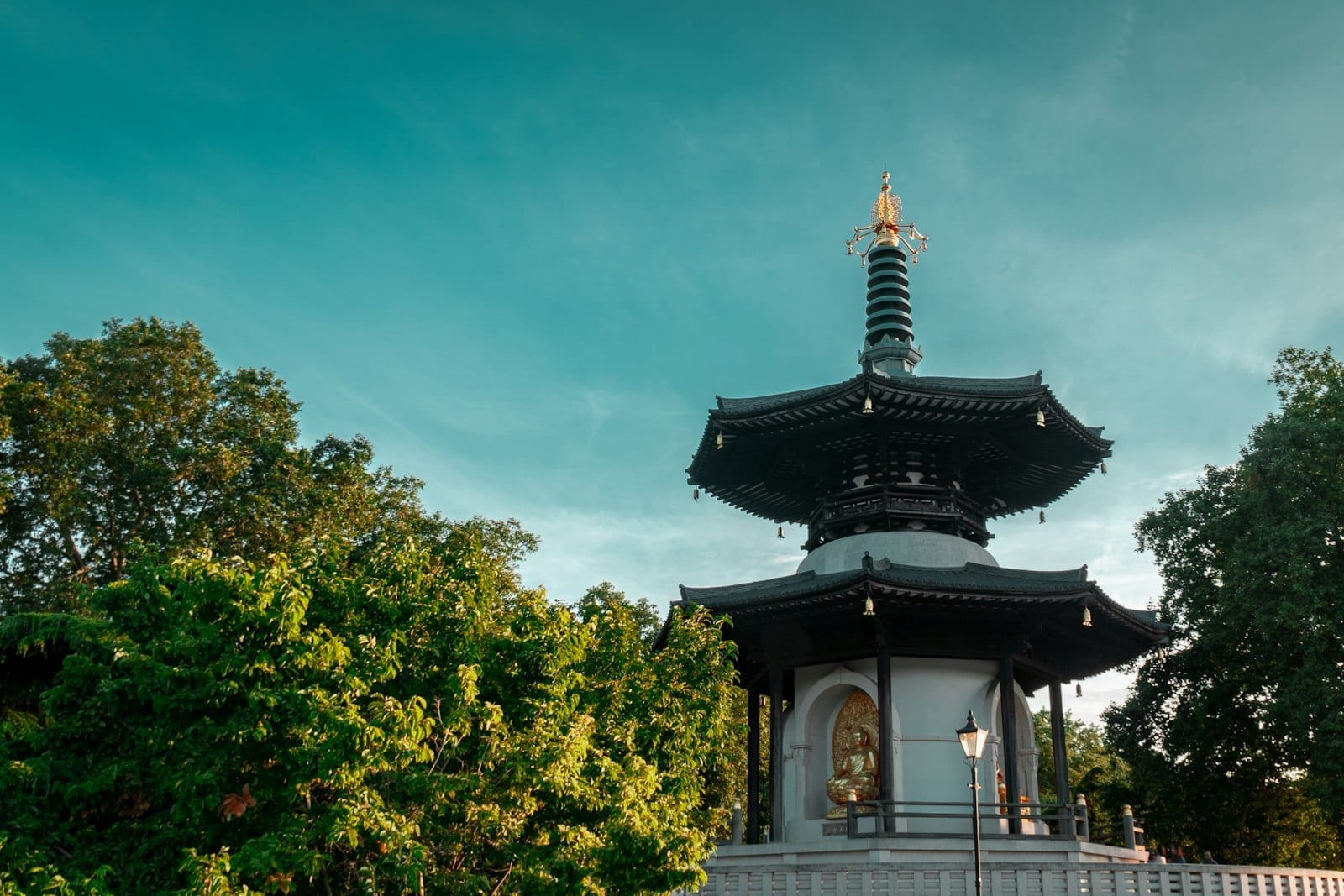
About halfway along the riverbank stands the Battersea Park Peace Pagoda, a gift from the Japanese Buddhist organisation Nipponzan-Myohoji, consecrated in 1984. The structure is built in white stone with gilded bronze Buddha figures at each cardinal point and a tiered, curving roof typical of Japanese stupa architecture. It was one of a series of peace pagodas built globally in the late twentieth century. In the park, it sits elevated on a small rise just back from the Thames path, visible from the river and from Chelsea Bridge Road. Early morning is the best time to visit: before the joggers congregate and before tour groups arrive, the pagoda is peaceful, the sound of the river carrying across the lawns.
Photography tip: the pagoda photographs best in the hour after sunrise when the stone catches warm light, or in the blue hour after sunset when the gilded figures hold colour. For the Albert Bridge itself at night, the best vantage point is from within the park near Chelsea Gate. See also: most Instagrammable spots in London for more riverfront photography locations.
Tickets & tours
Hand-picked options from our booking partner. Prices are indicative; availability and final rates are confirmed when you complete your booking.
Battersea Power Station chimney lift experience
From 0 €Instant confirmationDark Comedy and Pizza Night on the Iconic Battersea Barge
From 11 €Instant confirmationFree cancellationBattersea Power Station chimney lift experience
From 0 €Instant confirmationBattersea Power Station chimney lift experience
From 0 €Instant confirmation
Gardens, Landscape, and What Grows Here
The Sub-Tropical Garden, established in 1864 by John Gibson, was designed to demonstrate that plants from warmer climates could survive an English winter in sheltered conditions. It remains one of the more unusual features of any London park: dense, slightly theatrical planting of large-leaved cannas, gingers, palms, and cordylines that makes the area feel briefly like somewhere south of Bordeaux rather than the Thames. The effect is strongest in late July and August when the planting is at full height.
The English Garden and the Old English Garden offer a contrasting formality: clipped hedges, rose beds, and mixed herbaceous borders arranged around a small ornamental pond. These sections of the park are at their best in June when the roses are in full bloom and bees are audible from several metres away. In October the borders shift into muted copper and rust tones that suit the autumn light along the river.
For a longer green escape from the city, Battersea pairs naturally with other Thames-adjacent parks. If you have more than a day to spare, the contrast between Battersea's Victorian formality and the wilder heathland further west is worth exploring.
Practical Walkthrough: Getting In and Getting Around
The park has several pedestrian gates: Albert Bridge Road (north side, closest to Albert Bridge), Prince of Wales Drive (south side), and Queenstown Road (southeast). For first-time visitors coming from central London, the Albert Bridge Gate is the most logical entry point. Cross Albert Bridge on foot from Chelsea and you enter the park directly at the northwest corner, with the riverside promenade and Peace Pagoda immediately to your right.
If you are arriving by rail, both Battersea Park station and Queenstown Road station are around a 10-minute walk from the park. Neither is on the London Underground; both are served by National Rail services (Southern and South Western Railway) from London Victoria and London Waterloo. Sloane Square, Victoria, and Pimlico are the nearest Tube stations, each requiring a bus connection or a 20-25 minute walk across one of the Thames bridges. Bus routes 44, 49, 137, 156, 319, 344, 345, and 452 all pass close to the park.
Three pay-and-display car parks (Chelsea Gate, Rosery Gate, Albert Bridge Gate) are available for drivers. Payment is via pay-and-display machines and cashless options; check current methods, as machines may not give change. Blue Badge holders park free. Cycling is permitted on designated paths within the park, and the area is part of several cycle route networks connecting it to Chelsea and Clapham.
ℹ️ Good to know
Opening hours: park gates open by approximately 06:30 and close by 22:30 daily. Public toilets have seasonal hours ranging from 08:00-17:00 in winter to 08:00-22:00 in summer. Facilities can close without notice.
Families, Activities, and On-Site Attractions
Battersea Park Children's Zoo is a small but well-regarded collection focused on meerkats, otters, lemurs, marmosets, and farm animals. It is compact enough for toddlers to manage without becoming exhausted and detailed enough to interest older children. Separate admission applies; check current prices directly with the zoo before visiting, as they are updated periodically.
Go Ape operates a treetop rope course within the park, aimed at ages 10 and above. It requires advance booking and is popular enough in school holidays that weekend slots can sell out days ahead. Mini-golf, tennis courts, a boating lake, a skate park, and a pump track for cyclists round out the activity offer. The park also has a bandstand that hosts free summer concerts.
For families planning a broader London day, Battersea connects well to the surrounding area. The Battersea Power Station development is a short walk north along the river, with food, shops, and a lift to the chimney viewing platform. Across the river, the Chelsea Embankment leads eastward toward the broader South Bank cultural corridor.
⚠️ What to skip
School holiday weekends (particularly August and October half-term) bring significant crowds to the zoo and Go Ape. Arrive by 09:30 or plan around the midday peak between 11:00 and 14:00.
How the Park Changes Through the Day and the Seasons
Early morning, especially before 08:00, belongs to runners and dog walkers. The quality of light on the river at this hour — particularly in spring and autumn — is among the better things about visiting London's parks: long shadows, mist sometimes lying low over the Thames, geese moving across the grass. The sound of the city is muted. This is when the park feels closest to what its Victorian designers imagined.
By midday on weekends in summer the park fills significantly but never reaches the density of Hyde Park or St James's Park. The boating lake gets busy; the cafés develop queues. Afternoons in the Pumphouse Gallery, a Victorian pump house converted into an exhibition space within the park grounds, offer a cooler, quieter alternative if the sun becomes too strong.
Winter visits are underrated. The Sub-Tropical Garden loses its drama but the formal gardens take on a stark geometric quality. The Peace Pagoda in particular looks striking under a grey February sky, when the park is largely empty and the Thames is at its most elemental. Wrap up: temperatures in London's winter average 8-9°C during the day and can drop below freezing overnight.
For the broader context of how Battersea fits into a London itinerary, the guide to London's best parks covers how this park compares with Regent's Park, Victoria Park, and the Royal Parks in terms of atmosphere and what each suits best.
Who Might Not Enjoy This
If your priority is iconic London sightseeing, Battersea Park will not tick that box on its own. There are no world-class collections, no UNESCO-listed structures, and no single dominant reason to visit unless you specifically want green space near the Thames. Visitors with very limited time in London who are choosing between parks will find that St James's Park offers more concentrated Royal London scenery, or that Hyde Park provides more central positioning.
Accessibility for wheelchair users is reasonable on the main paths but uneven on grass areas and some garden sections. The riverside path is paved and flat. The car parks are accessible and Blue Badge parking is free, but the uneven terrain away from main routes may be challenging. Check the AccessAble guide for Battersea Park before visiting if this is a consideration.
Insider Tips
- The boating lake in the centre of the park is often overlooked by visitors who head straight for the river. It is quieter than the Thames promenade, and the rowing boats available for hire provide an unusual angle for photographs of the park's Victorian infrastructure.
- The Pumphouse Gallery hosts free contemporary art exhibitions inside the park's original Victorian pump house building. It costs nothing to enter and provides a useful 20-minute pause on a hot or wet afternoon — most visitors walk past it entirely.
- The Albert Bridge has a notice dating from its construction era requesting that troops break step when crossing, to avoid resonance damage to the structure. It is worth reading if you walk in from Chelsea: an odd, specific piece of London history in plain sight.
- For the best unobstructed view of the Battersea Power Station chimneys from within the park, walk to the northwestern corner near Chelsea Gate and look back across the grass toward the north. The power station fills the skyline in a way that is surprisingly dramatic at dusk.
- Weekday lunchtimes between September and April are the least crowded times in the park overall. The Sub-Tropical Garden in particular is almost always quiet outside summer weekends.
Who Is Battersea Park For?
- Families with children aged 3-12, particularly for the children's zoo and the open play areas
- Runners and cyclists looking for a Thames-adjacent route away from the denser crowds of the central Royal Parks
- Visitors spending time near Chelsea, Pimlico, or the new Battersea Power Station development who want green space within easy walking distance
- Photographers interested in river light, Victorian park architecture, and the Peace Pagoda
- Travellers on a budget: the park itself is free, the riverside walk costs nothing, and the gardens are open all day
Nearby Attractions
Other things to see while in South Bank:
- Battersea Power Station
Once derelict for nearly three decades, Battersea Power Station reopened in October 2022 as one of London's most dramatic mixed-use destinations. Entry to the main building and public spaces is free, while the glass chimney lift, Lift 109, offers one of the city's most unusual viewpoints. Here is everything you need to plan a visit.
- Borough Market
Borough Market has stood near London Bridge for around 1,000 years, making it one of the oldest food trading sites in Britain. Today it draws traders selling everything from aged cheeses and cured meats to freshly baked bread and street food from around the world. Entry is free, and the Victorian market buildings add a sense of occasion that most food halls simply cannot match.
- Imperial War Museum London
The Imperial War Museum London is one of the city's most thoughtfully constructed free attractions, covering conflict from the First World War to the present day. Housed in a former psychiatric hospital, it combines large-scale hardware, deeply personal testimony, and unflinching Holocaust galleries into an experience that is hard to shake.
- London Bridge
London Bridge is the oldest river-crossing site in London, with roots stretching back to Roman times. Free to walk, open to traffic and pedestrians at all hours, and flanked by some of the city's best riverside attractions, it rewards those who pause long enough to understand what they're standing on.