Imperial War Museum London: What to Expect, What to See, and Why It's Worth Your Time
The Imperial War Museum London is one of the city's most thoughtfully constructed free attractions, covering conflict from the First World War to the present day. Housed in a former psychiatric hospital, it combines large-scale hardware, deeply personal testimony, and unflinching Holocaust galleries into an experience that is hard to shake.
Quick Facts
- Location
- Lambeth Road, London SE1 6HZ (London Borough of Southwark, just south of the South Bank)
- Getting There
- Lambeth North (Bakerloo line) – 5-min walk; Elephant & Castle (Bakerloo, Northern) – 10-min walk
- Time Needed
- 2–4 hours minimum; full-day if covering all permanent and special exhibitions
- Cost
- Free entry (verify current hours and any paid special exhibitions at iwm.org.uk before visiting)
- Best for
- History lovers, school groups, families, independent travellers seeking depth over spectacle
- Official website
- www.iwm.org.uk/visits/iwm-london
What the Imperial War Museum Actually Is
Imperial War Museum London, known widely as IWM London, is not a museum that glorifies warfare. That distinction matters. Founded while the First World War was still being fought, and officially opened in 1920 before moving to its current Lambeth Road site in 1936, the museum was always intended as a record of sacrifice and experience, not a showcase of military triumph. Today, its scope stretches from the trenches of 1914 to 21st-century conflicts, and its approach is consistently human rather than triumphalist.
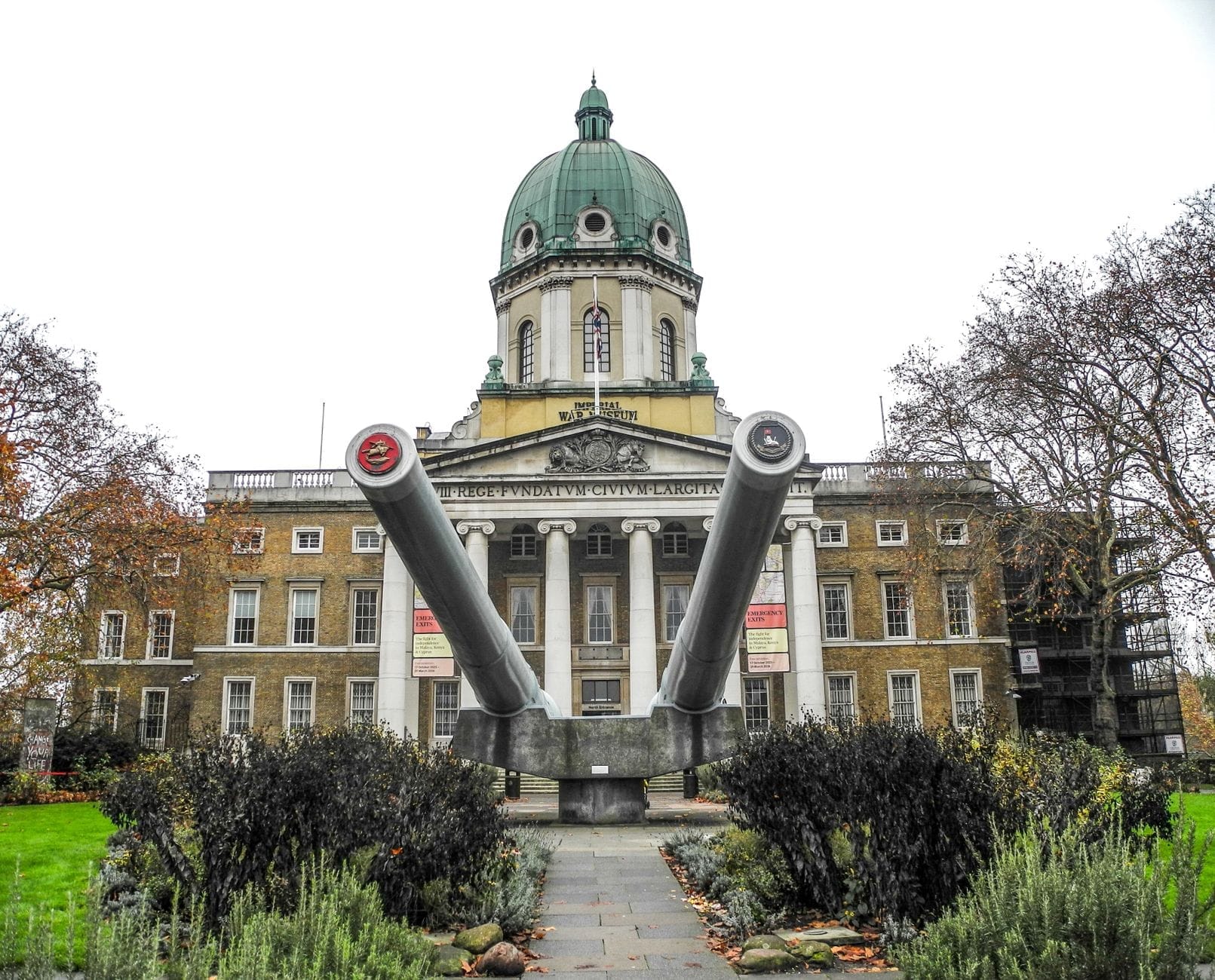
The building itself carries history. The central block once formed part of the Bethlem Royal Hospital, popularly known as Bedlam, one of the oldest psychiatric institutions in the world. The two large naval guns that flank the main entrance were added later, but the curved neoclassical facade with its grand dome announces a serious institution, not a theme park. Walking up the broad approach from Geraldine Mary Harmsworth Park, the scale hits you before you even reach the door.
ℹ️ Good to know
Admission to the permanent galleries is free. Some special exhibitions carry a separate ticket charge. Always check iwm.org.uk for current opening hours before visiting, as hours can vary seasonally.
The Atrium: First Impressions and Orientation
The central atrium is where most visitors stop moving for a moment. Suspended from the ceiling and arranged across multiple levels are full-scale aircraft, including a Spitfire and a German V2 rocket, alongside a Mark V tank on the ground floor and various large weapons systems. The effect is disorienting in the best way: objects you've only seen in photographs are suddenly overhead, actual and enormous.
The acoustics in the atrium pick up every footstep and conversation, which means mornings, particularly midweek, offer a calmer, more contemplative start. By mid-afternoon on weekends and school holidays, the ground-floor area around the large exhibits fills with children running between objects and families consulting maps. Neither experience is wrong, but they are different.
Use the atrium to orient yourself before committing to a route. The museum spans multiple floors, and the permanent galleries include the First World War galleries on the lower ground floor, the Second World War galleries, the Holocaust galleries, and rotating special exhibitions. Trying to cover everything in one pass is exhausting. Pick your priority floors and return if you have the time.
Tickets & tours
Hand-picked options from our booking partner. Prices are indicative; availability and final rates are confirmed when you complete your booking.
The Making of Harry Potter Guided Tour of London Warner Bros. Studio
From 201 €Instant confirmationFree cancellationWarner Bros. Studio Tour London - The Making of Harry Potter and Oxford guided tour
From 157 €Instant confirmationFree cancellationThe Making of Harry Potter - Warner Bros. London tickets and transfer
From 0 €Instant confirmationFree cancellationChurchill War Rooms tickets and political London audio tour
From 53 €Instant confirmationFree cancellation
The First World War Galleries
The First World War galleries, which occupy the lower ground floor, are among the most considered history museum spaces in London. The design immerses you in the texture of the conflict without relying on spectacle: trench reconstructions, original equipment, uniforms stained and worn, letters home, gas masks, shell casings. The air feels heavier down here, partly by design. Lighting is deliberately low in places.
What distinguishes these galleries from older-style military museums is the attention to individual experience. Objects are consistently anchored to specific people: a man from Yorkshire, a nurse from Edinburgh, a German infantryman. That specificity prevents the numbers from overwhelming the reality. Casualty figures here are always connected to names.
💡 Local tip
The WWI galleries can feel emotionally heavy. If you're visiting with children, allow time to pause and talk between rooms rather than moving through quickly.
The Holocaust Galleries
IWM London's Holocaust galleries are among the most important spaces in the city for understanding 20th-century history. Redesigned and reopened in 2021, they take a chronological approach that begins with Jewish life in Europe before the Nazi rise to power, and proceeds through persecution, deportation, and the machinery of genocide to the liberation of the camps and the aftermath. The scale of individual testimony is extraordinary: letters, photographs, personal possessions, video recordings.
These galleries require time and emotional readiness. There are designated rest areas within the space, and the design acknowledges that visitors will need to pause. Photography policies vary within this section, so observe the signage. It is not a gallery to rush through on a schedule.
For visitors exploring wider London history, the British Museum and the National Portrait Gallery both offer related historical contexts, but neither covers this specific period with the same depth as IWM London.
The Second World War Galleries and Other Permanent Displays
The Second World War galleries cover both the European and Pacific theatres, with strong sections on the Home Front that often resonate with British visitors who have family memories of rationing, evacuation, and the Blitz. For international visitors, the Home Front material provides a civilian dimension to the war that is easy to overlook when focusing on battlefield accounts.
Higher floors address more recent conflicts: the Falklands, Northern Ireland, the Gulf Wars, Afghanistan. These are more contested histories, and the museum handles them with notable care, presenting multiple perspectives and acknowledging ongoing debate. The displays do not offer comfortable resolutions, which is precisely why they are worth seeing.
Getting There, Timing, and Practical Logistics
The museum sits on Lambeth Road in the London Borough of Southwark, within about a 5–7 minute walk of Lambeth North station on the Bakerloo line and about a 10–15 minute walk of Elephant and Castle station, which is served by both the Bakerloo and Northern lines. Bus routes also stop nearby on Lambeth Road and St George's Road. Cycling infrastructure in the area is improving, and the museum has cycle parking.
There is no on-site public car park, and street parking in the surrounding area is limited and controlled. If travelling by car, use a nearby paid car park and walk or use public transport for the final stretch. The museum's West Entrance provides step-free access for wheelchair users and those with mobility requirements.
IWM London sits just south of the main South Bank cultural corridor. After your visit, the walk north across Lambeth Bridge connects you to Westminster, or heading east along the South Bank takes you toward Tate Modern, Borough Market, and Southwark Cathedral within 20–30 minutes on foot.
💡 Local tip
Arrive when the museum opens if you want the Holocaust galleries and WWI galleries with space to think. These sections draw sustained attention and feel different without crowds pressing from behind.
Photography, Facilities, and What to Bring
Photography is permitted in many areas of the museum, but it is not allowed in some galleries, including parts of the Holocaust galleries, so always check onsite signs. Use your judgment and observe posted signage. The atrium's hanging aircraft and large hardware make for striking photographs in morning light when the space is less crowded.
The museum has a café on the ground floor, with additional refreshment options available during peak times and special events. Food quality is reasonable for a major London attraction, and there is outdoor seating available in Geraldine Mary Harmsworth Park when weather permits. The museum shop, positioned near the exit, carries a serious range of books, including academic histories alongside popular accounts, which makes it worth browsing even if you rarely buy in museum shops.
The museum has accessible toilets, baby-changing facilities, and a cloakroom for larger bags. Backpacks above a certain size may need to be stored. Given the volume of material on display, comfortable shoes make a real difference.
If you're building a South Bank day itinerary, IWM London pairs naturally with Tate Modern and a walk along the Thames. For a fuller London museum day, see our guide to the best museums in London for a ranked breakdown by type and visitor profile.
Worth Knowing: Who This Museum Is and Is Not For
IWM London rewards curiosity and patience. Visitors who come expecting an action-oriented experience with quick, dramatic highlights may find the pacing slow. The museum asks you to read, to reflect, and to sit with discomfort. That is its strength, not a flaw, but it is worth knowing in advance.
Families with younger children can have a positive visit, particularly in the atrium with the large hardware and aircraft. The WWI and Holocaust galleries, however, contain material that parents should preview or discuss before visiting with children under ten. The museum offers learning resources for school groups and families, which can help structure the experience.
Visitors with limited time in London who need a fast, visually spectacular attraction should understand that IWM London offers depth, not pace. If you have two hours and need to feel you've covered the highlights, plan your floor in advance rather than wandering. If you have a full morning or afternoon with genuine interest in 20th-century history, very few free attractions in any city offer this quality.
Insider Tips
- The lower ground floor WWI galleries are frequently quieter than the upper floors even during busy periods, because many visitors start at ground level and work upward. If the Holocaust galleries are your priority, head there first before the mid-morning school group peak.
- The park surrounding the museum, Geraldine Mary Harmsworth Park, has benches and open grass, which is useful for taking a break mid-visit. The museum's intensity benefits from pauses outside.
- The museum shop carries serious military history titles that are harder to find in general bookshops. If you're after primary accounts or specialist histories, it's worth 10 minutes of browsing.
- Special exhibitions at IWM London, which carry a separate ticket charge, often focus on under-covered conflicts or contemporary war photography and are generally less crowded than the permanent galleries.
- Step-free access is via the West Entrance on Lambeth Road. If you arrive from Lambeth North station, the main entrance is the most direct route, but it involves steps. Plan accordingly if you need the accessible entrance.
Who Is Imperial War Museum London For?
- Independent travellers with a serious interest in modern history and 20th-century conflict
- Families with children aged 10 and above who can engage with historical narrative
- First-time visitors to London who want a free, substantive cultural experience beyond the obvious sights
- School groups and students on curriculum-related visits
- Visitors building a South Bank walking day between Lambeth and Bankside
Nearby Attractions
Other things to see while in South Bank:
- Battersea Park
Battersea Park is a 200-acre Victorian park on the south bank of the River Thames, offering free entry, formal gardens, a children’s zoo, riverside paths, and a notable Buddhist Peace Pagoda. Less crowded than Hyde Park yet surprisingly rich in things to do, it rewards a slow, unhurried visit at any time of year.
- Battersea Power Station
Once derelict for nearly three decades, Battersea Power Station reopened in October 2022 as one of London's most dramatic mixed-use destinations. Entry to the main building and public spaces is free, while the glass chimney lift, Lift 109, offers one of the city's most unusual viewpoints. Here is everything you need to plan a visit.
- Borough Market
Borough Market has stood near London Bridge for around 1,000 years, making it one of the oldest food trading sites in Britain. Today it draws traders selling everything from aged cheeses and cured meats to freshly baked bread and street food from around the world. Entry is free, and the Victorian market buildings add a sense of occasion that most food halls simply cannot match.
- London Bridge
London Bridge is the oldest river-crossing site in London, with roots stretching back to Roman times. Free to walk, open to traffic and pedestrians at all hours, and flanked by some of the city's best riverside attractions, it rewards those who pause long enough to understand what they're standing on.