Millennium Bridge: London's Most Dramatic Thames Crossing
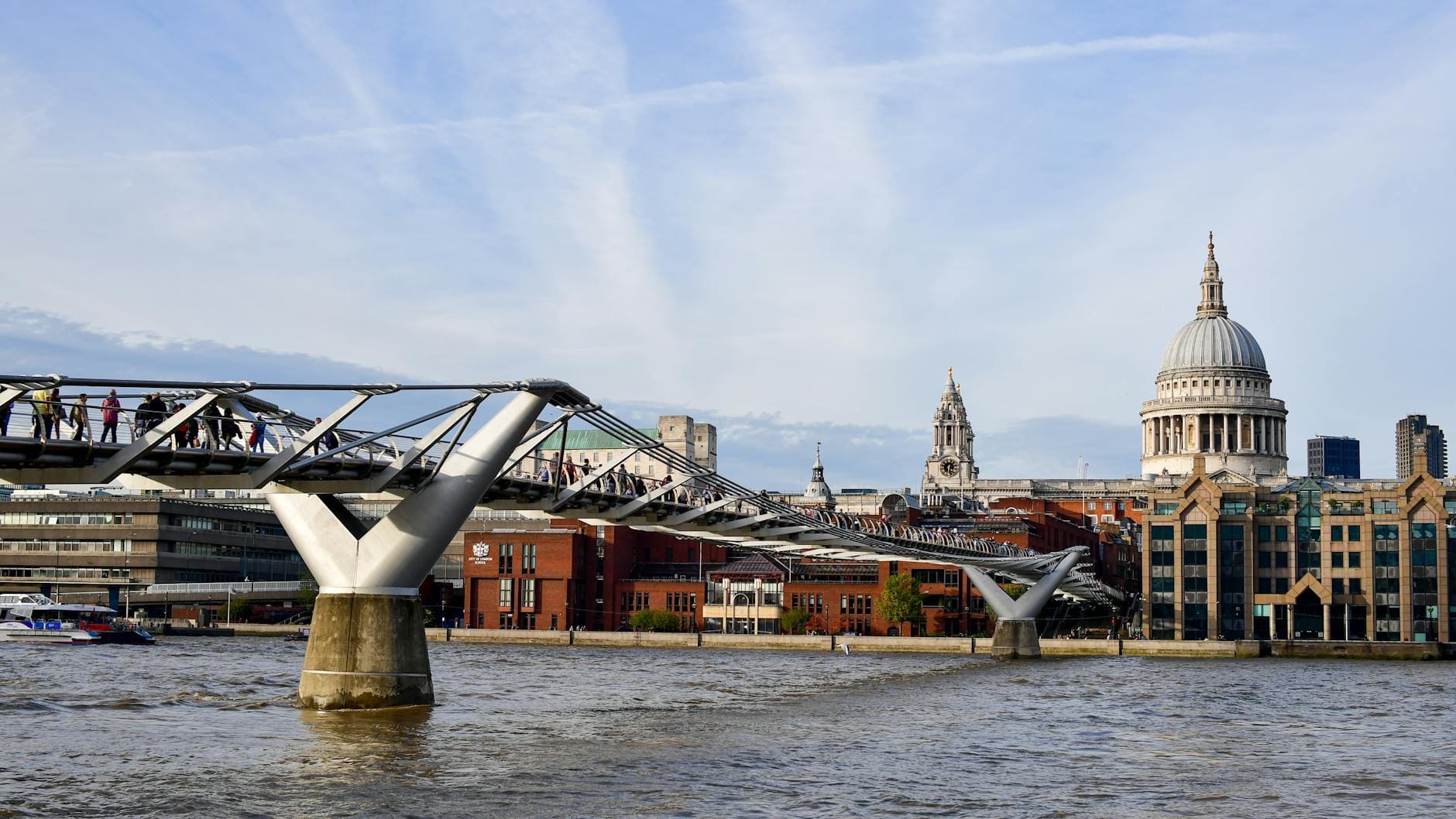
The London Millennium Footbridge is a sleek steel pedestrian span linking the City of London to Bankside, connecting St Paul's Cathedral on the north bank to Tate Modern and Shakespeare's Globe on the south. Free to cross at any hour, it offers some of the most photographed views of the Thames and a front-row look at two of London's most contrasting skylines.
Quick Facts
- Location
- between St Paul’s Cathedral and Tate Modern, London — between Blackfriars and Southwark bridges
- Getting There
- Blackfriars (District, Circle line, National Rail) ~5 min walk; Mansion House (District, Circle line) ~6 min walk; St Paul's (Central line) ~8 min walk
- Time Needed
- 15–30 minutes to cross and linger; 1–2 hours if combining with Tate Modern and St Paul's
- Cost
- Free — open 24 hours, 7 days a week, no ticket required
- Best for
- Architecture fans, photographers, first-time visitors, walkers connecting the City to the South Bank
- Official website
- www.citybridgefoundation.org.uk/
What the Millennium Bridge Actually Is
The London Millennium Footbridge is a pedestrian-only suspension bridge spanning the River Thames between the City of London and Bankside in Southwark. At roughly 325 metres long and just 4 metres wide, it is a narrow, low-slung ribbon of steel and aluminium that sits only a few metres above the waterline, making it feel unusually close to the river compared with the tall arches of neighbouring bridges.
What makes it architecturally distinctive is its shallow cable profile. Most suspension bridges use tall towers with cables that droop significantly between them. The Millennium Bridge uses a different approach: the suspension cables run nearly horizontally, kept under tension by the weight of the deck rather than a pronounced catenary curve. The result is a bridge that almost disappears against the skyline, letting the view of St Paul's Cathedral dome to the north and the brick chimney of Tate Modern to the south dominate the frame.
The bridge was designed by a collaboration of three firms: Arup Group handled the structural engineering, Tate Modern's neighbourhood gained an architectural statement in its own right, with Foster + Partners responsible for the architecture and sculptor Sir Anthony Caro shaping the aesthetic details. Construction began in November 1998, and the bridge was opened to the public on 10 June 2000, dedicated by Queen Elizabeth II.
ℹ️ Good to know
The bridge is owned and maintained by the City Bridge Foundation (formerly Bridge House Estates), a charitable body overseen by the City of London Corporation. All five Thames bridges managed by the Foundation are free to cross, funded by the Foundation's own endowment rather than by public taxation.
The Wobbly Bridge: Its Famous Engineering Failure
The Millennium Bridge's most well-known story is not its opening but its closing. Within two days of the public debut, the bridge had to be shut down because it swayed noticeably when large numbers of pedestrians walked across it. Around 90,000 people crossed on opening day alone, and the lateral oscillation was enough to make walkers feel unsteady. Engineers quickly identified the cause: a phenomenon called synchronous lateral excitation, where pedestrians unconsciously adjust their footfall to match a bridge's natural sway frequency, which in turn amplifies the movement. The bridge had been tested for vertical loads and wind, but this particular mode of resonance had not been fully anticipated.
The bridge remained closed for nearly two years while Arup designed and installed a damping system: 37 fluid-viscous dampers working horizontally and 52 tuned mass dampers working vertically, totalling 89 devices distributed along the structure. The bridge reopened in February 2002 and has been stable ever since. The engineering solution became a case study taught in universities around the world, and the bridge earned the affectionate nickname 'the Wobbly Bridge' that Londoners still use today, long after the wobble was fixed.
💡 Local tip
If you want to understand the engineering story in more detail, there are information panels on the bridge itself, and the Museum of London's online collections include detailed documentation of the closure and repair.
Tickets & tours
Hand-picked options from our booking partner. Prices are indicative; availability and final rates are confirmed when you complete your booking.
Tower of London and Tower Bridge private half-day guided tour
From 452 €Instant confirmationFree cancellationLondon Castles and Bridges Southbank Walking Tour
From 48 €Instant confirmationFree cancellationMatilda the musical ticket for the Cambridge Theatre
From 151 €Instant confirmation2-hour doughnut tour of London's downtown with Tower Bridge
From 56 €Instant confirmationFree cancellation
The Views: What You See from Each Bank and Midspan
The Millennium Bridge's real draw for most visitors is not the bridge itself but what it frames. From the north approach, as you descend from St Paul's Cathedral along Peter's Hill, the bridge funnels your gaze directly at Tate Modern's converted Bankside Power Station, its single rectangular chimney rising behind the low steel cables. It is one of the more satisfying composed views in central London: old and new architecture on the same axis, the river in between.
From the midpoint of the bridge, you can see upstream toward Southwark Bridge and the dome of St Paul's to your northeast, and downstream toward Blackfriars Railway Bridge with its distinctive red ironwork and, further west on clear days, the outline of the City's cluster of towers. At water level, the Thames looks different than it does from higher vantage points: you notice the tidal pull in the colour and texture of the water, the working barges passing below, and occasional ripples from Thames Clipper services running their route.
The south bank approach drops you directly outside Tate Modern's main entrance and within a five-minute walk of Shakespeare's Globe. If you continue east along the Thames Path, you reach Borough Market in about ten minutes on foot, making the bridge a natural starting point for a South Bank walk.
💡 Local tip
For the clearest view of St Paul's from the bridge, position yourself slightly south of the midpoint and look north-northeast. On overcast days the dome stands out more clearly against a pale sky than on bright sunny days when the southern light creates heavy shadows on the facade.
How the Bridge Changes by Time of Day
Early morning, particularly before 8am on weekdays, the Millennium Bridge belongs almost entirely to City workers and joggers. The light from the east comes up behind St Paul's at this hour, backlighting the dome and turning the water a deep pewter. There are few tourists at this time, and the bridge has an unexpectedly quiet quality given its central location. The Thames smell is stronger at low tide, a mineral, slightly brackish odour that sharpens in the morning air.
By mid-morning the tourist flow picks up considerably, especially in summer when the bridge becomes one of the more congested pedestrian routes between the City and South Bank. The 4-metre width is adequate for normal flow but can feel pinched during peak hours when guided tour groups stop to photograph St Paul's. If you are carrying a tripod or want to stand still and observe, weekday mornings before 9am or weekday evenings after 7pm are considerably more comfortable.
After dark, the bridge is part of the Illuminated River project, a long-term public art initiative that lights multiple Thames bridges with colour schemes designed by artist Leo Villareal. The Millennium Bridge's lighting is subtle rather than spectacular: warm white LEDs track along the cables and deck edges, giving the structure a defined presence without overwhelming the river. The reflections in the water at night, with Tate Modern's lit windows and the golden dome of St Paul's floodlit behind you, make this one of the better places in central London for evening photography.
Getting There and Moving On
The most direct approach from the Underground is Blackfriars station (District and Circle lines, plus National Rail services), from which the north end of the bridge is roughly a five-minute walk east along the Thames Path or Queen Victoria Street. Mansion House station (District and Circle lines) is slightly further, around six minutes. From the north, St Paul's station on the Central line puts you at the cathedral's south steps, from which Peter's Hill leads directly to the bridge's north entrance in about five minutes on foot.
From the south bank, the bridge is easily reached on foot from London Bridge station (about 15 minutes along the Thames Path westward) or by walking east from Waterloo along the South Bank riverside walkway. The Thames Path is level and fully paved on both sides, making this a comfortable route for prams and wheelchair users, though specific step-free access at tube stations should be verified via TfL before travel.
The bridge itself is step-free with no raised thresholds or kerbs. It is pedestrian-only with no cycling permitted, though cyclists frequently dismount to walk across. The 4-metre width means it is not especially wide, and during busy periods there is an informal two-lane flow of people moving in each direction.
⚠️ What to skip
The bridge has no shelter from rain or wind. In wet weather the deck surface can become slippery, particularly near the metal grilles at each end. Flat-soled shoes or trainers are more practical than smooth-soled dress shoes or heeled footwear on a wet day.
Photography Notes
The Millennium Bridge appears in more London photographs than almost any other crossing, largely because of the St Paul's axis. The standard shot, taken from the south bank looking north along the bridge toward the cathedral, works at almost every hour of the day and in most weather conditions. It is also the view used in several major films, including a memorable scene in Harry Potter and the Half-Blood Prince where the bridge is shown being attacked.
For wider compositions, the view from the north bank embankment to the west of the bridge includes the bridge, Tate Modern's chimney, and the South Bank in a single frame. The St Paul's Cathedral steps provide an elevated viewpoint looking south over the bridge toward the river, especially effective at blue hour when the sky matches the steel tones of the cables.
Smartphone photographers will find the midpoint of the bridge offers symmetrical cable compositions. Look straight down the centre line of the deck toward either bank: the cables converge to vanishing point, which is a compositional structure that works in both directions. At night, a slow shutter speed on a supported camera will capture light trails from passing river traffic below.
Worth Knowing: Limitations and Who Might Not Enjoy It
The Millennium Bridge is, at its core, a way to get from one side of the river to the other. As a standalone attraction it lasts perhaps fifteen minutes before you have seen everything there is to see. Visitors who come specifically to cross it and then turn back often feel it did not warrant a special trip. Its value comes almost entirely from combining it with what sits at either end: St Paul's Cathedral and the City of London to the north, Tate Modern and the South Bank cultural cluster to the south.
People with a strong fear of heights or of suspension structures may find the low, open-sided design mildly uncomfortable in high winds, though the bridge is structurally stable and has no issues with sway since the 2002 damping retrofit. Anyone expecting grand Victorian ironwork or dramatic engineering theatre will find it understated. The Millennium Bridge rewards those who appreciate minimal modernist design; it is not a bridge that announces itself.
If dramatic river views are what you are after, the Tower Bridge walkway offers glass-floor panels 42 metres above the Thames, which is a considerably more intense experience. For panoramic London skylines, The Shard's viewing gallery or the Sky Garden provide height that the Millennium Bridge cannot match.
Insider Tips
- The north embankment path just west of the bridge's entrance has a low river wall and a clear sightline along the water toward Blackfriars Bridge. This spot, rather than the bridge midpoint, gives a wider compositional frame for photography including the bridge in context.
- On weekday mornings between 7am and 8:30am, the south-bank approach to the bridge has several small coffee carts near the Tate Modern entrance. This is a useful stop before or after crossing, as options directly on the bridge are nonexistent.
- The Illuminated River lighting scheme activates at dusk year-round. In winter this means the bridge is lit from around 4pm, giving a longer window for evening photography before the late crowds arrive.
- If you are crossing with a bicycle, note that cycling on the bridge is not permitted. Dismount before the entrance ramps, as enforcement by bridge staff does occur during busier periods.
- The Peter's Hill pedestrian route on the north bank, which connects the bridge directly to St Paul's Cathedral, is a formal civic axis designed as part of the Millennium project. The paving, steps, and planting are all part of the same design scheme — worth noticing as you approach rather than treating as just a pavement.
Who Is Millennium Bridge For?
- First-time London visitors wanting to connect St Paul's Cathedral to the South Bank on foot in a single logical route
- Photographers at any level, particularly at blue hour and after dark when the Illuminated River lighting is active
- Architecture and engineering enthusiasts interested in contemporary structural design and the bridge's famous damping retrofit
- Walkers building a longer Thames Path itinerary between Blackfriars and London Bridge
- Visitors with limited mobility who need a flat, step-free river crossing in central London
Nearby Attractions
Other things to see while in The City of London:
- Leadenhall Market
Leadenhall Market is a Grade II-listed Victorian covered market in the heart of the City of London, built in 1881 over a site used for commerce since Roman times. With its ornate wrought-iron and glass roof, cobbled walkways, and mix of wine bars, restaurants, and independent shops, it's one of the Square Mile's most atmospheric stops — and it won't cost you a penny to walk through.
- Sky Garden
Perched 155 metres above the City of London inside the Walkie Talkie building, Sky Garden offers panoramic views across the Thames, St Paul's, and the surrounding skyline — at no cost to visitors. The catch: tickets must be booked in advance, and they go fast.
- St Bartholomew the Great
Founded in 1123 by a courtier of King Henry I, St Bartholomew the Great in Smithfield is London's oldest surviving parish church. It offers free entry, extraordinary Norman architecture, and an atmosphere of genuine antiquity that few places in the capital can match.
- St Dunstan in the East
St Dunstan-in-the-East Church Garden is one of the City of London's most quietly extraordinary spaces: a free public garden growing inside the roofless ruins of a medieval church, framed by a surviving Christopher Wren steeple and walls draped in ivy and climbing plants. It takes less than an hour to visit, costs nothing to enter, and offers a rare kind of stillness in one of the world's densest financial districts.