St Dunstan in the East: The City's Most Atmospheric Garden
St Dunstan-in-the-East Church Garden is one of the City of London's most quietly extraordinary spaces: a free public garden growing inside the roofless ruins of a medieval church, framed by a surviving Christopher Wren steeple and walls draped in ivy and climbing plants. It takes less than an hour to visit, costs nothing to enter, and offers a rare kind of stillness in one of the world's densest financial districts.
Quick Facts
- Location
- St Dunstan's Hill, London EC3R 5DD (City of London, between London Bridge and Tower of London)
- Getting There
- Monument (Circle/District) or Tower Hill (Circle/District) — both under 5 minutes' walk
- Time Needed
- 20–45 minutes
- Cost
- Free, no booking required
- Best for
- Quiet escapes, photography, architecture lovers, history enthusiasts
What Is St Dunstan in the East?
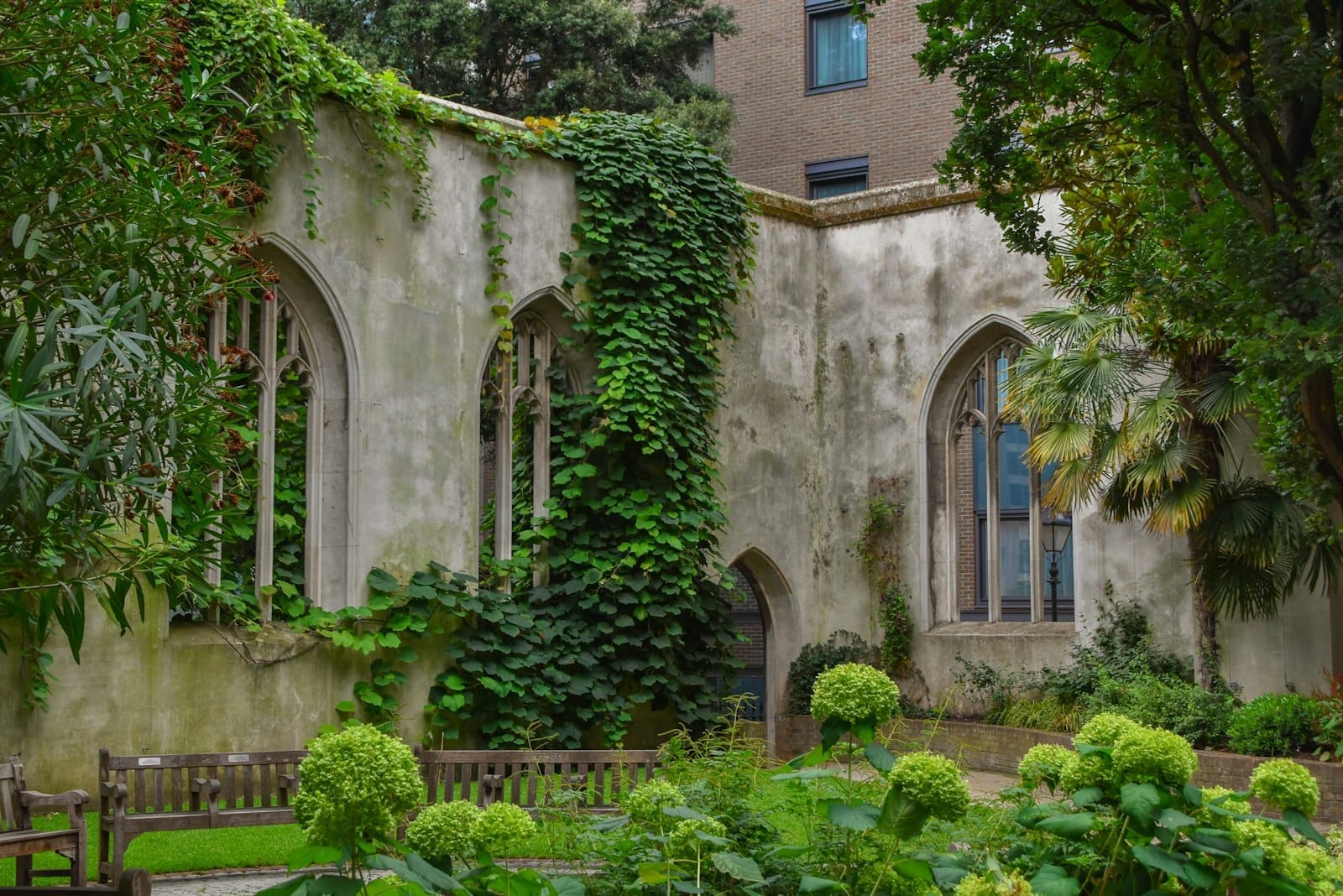
St Dunstan-in-the-East is a Grade I listed public garden occupying the shell of a medieval parish church that was gutted during the Blitz in 1941. Rather than rebuild, the City of London Corporation made the unusual decision to preserve the bombed-out nave as an open garden, planting it with ivy, fig trees, climbing hydrangeas, and a variety of ferns that now cloak the surviving stone walls. The result is a space that functions simultaneously as a ruin, a garden, a piece of architectural history, and an accidental sanctuary in the middle of one of the most commercially intense square miles on earth.
The tower and distinctive Gothic-style steeple, added by Sir Christopher Wren between 1695 and 1701, survived both the Great Fire of 1666 and the Second World War largely intact. They still stand above the surrounding office buildings today, forming the vertical anchor of the entire composition. The garden opened to the public in 1971 and has been managed as a City of London garden ever since.
💡 Local tip
Opening hours are typically 08:00–19:00 daily (or dusk, whichever is earlier), but hours can vary seasonally. Check the City of London's official garden page before visiting, particularly in winter when daylight closes in early.
A Very Brief History: From 1100 to the Blitz
The original church on this site dates to around 1100, making St Dunstan-in-the-East one of the oldest ecclesiastical foundations in the City. It survived most of London's great calamities until the Great Fire of 1666 heavily damaged it. Rather than demolish the structure entirely, the congregation chose to patch the main body of the church back together while commissioning Wren's elegant Portland stone tower — his only Gothic steeple in London — as an addition completed by 1701.
The main body was later rebuilt more substantially between 1817 and 1821, retaining Wren's tower. That Victorian reconstruction stood until the German bombing raids of December 1941 destroyed the roof and interior completely, leaving only the perimeter walls, the Wren steeple, and fragments of decorative stonework. Post-war planners decided against a second full reconstruction, and in 1967 the decision was formalised to convert the ruins into a garden. The transformation gives the site its present character: a kind of architectural elegy, where nature has been invited to take partial possession.
St Dunstan-in-the-East is named for Dunstan of Canterbury, a 10th-century archbishop and patron saint of goldsmiths. The surrounding City of London was, for centuries, the heart of London's medieval trade and craft guilds, and the church's long history is woven into that context. If you want to understand how the financial district sits on top of almost a thousand years of layered urban history, visiting this garden alongside sites like The Monument to the Great Fire gives you a powerful sense of that continuity.
Tickets & tours
Hand-picked options from our booking partner. Prices are indicative; availability and final rates are confirmed when you complete your booking.
Self-guided Discovery Walk in London's South East - a riverside history
From 24 €Instant confirmationFree cancellationLondon East End food and market tour
From 99 €Instant confirmationFree cancellationJack the Ripper's London and East End Crime tour
From 260 €Instant confirmationFree cancellationLondon's East End street art guided walking tour
From 59 €Instant confirmationFree cancellation
What the Visit Actually Feels Like
You approach St Dunstan-in-the-East down a narrow lane off St Dunstan's Hill, and for a moment the surrounding office towers give way entirely. The entrance through the Gothic archway marks a threshold that is almost theatrical in its effect. Inside, the open sky replaces what would have been a vaulted ceiling. The surviving arches frame views upward to the steeple and outward to patches of sky. Ivy and climbing plants cover much of the interior stonework, softening the burnt-out edges with a dense, dark green that is at its fullest from late spring through autumn.
A central stone fountain provides a low, constant sound of running water that does remarkable work in muffling the ambient noise of the City. Benches are placed throughout. On a dry weekday morning, you can often sit here in near-silence, which feels almost surreal given that you are surrounded by some of London's busiest streets.
The textures are what stay with you: rough pale Portland stone, carved Gothic tracery now partly obscured by moss, and the specific quality of light that comes through former window openings filtered by leaves. In summer, the canopy of vegetation creates a tunnel-like coolness that makes the garden feel different from the pavement outside. In winter, the bare branches reveal more of the architectural skeleton, and the space reads more clearly as a ruin.
Best Times to Visit
Early morning on a weekday is the most reliably quiet time. Between roughly 08:00 and 09:00, the City workers who pass through are usually moving quickly, and the garden itself is often occupied by just a few people eating breakfast or reading. By midday, particularly in good weather, office workers from the surrounding buildings use it heavily for lunch. It is still pleasant at that time, but the atmosphere shifts from contemplative to social.
Weekends sit in an interesting middle ground. The City empties of its weekday population, and St Dunstan-in-the-East attracts a noticeably different crowd: photographers, tourists exploring the neighbourhood, and people who have specifically come for the garden. It rarely feels overcrowded, but the meditative quality of a Tuesday morning is harder to replicate on a Saturday afternoon in July.
Spring (April to May) and autumn (September to October) offer the best combination of foliage, light, and moderate visitor numbers. In summer, the greenery is at its most extravagant, but the garden also attracts its largest crowds. In December and January, the bare stone and skeleton branches create a stark, almost Romantic atmosphere that serious photographers often prefer.
⚠️ What to skip
The garden is exposed to rain and has stone paving that can be slippery when wet. Wear shoes with grip if visiting after rainfall, and note there is no shelter inside the ruins.
Photography: What Works Here
St Dunstan-in-the-East is one of the more photogenic spots in London, but the photography requires patience. The best light enters the eastern archways in the morning and creates long shafts across the stone floor. By midday, overhead light flattens the texture of the stonework. The Wren steeple photographs best from inside the ruins looking upward, framed by the Gothic arches, rather than from street level outside.
The ivy-covered walls are a reliable subject in any season, but the window openings — arched, tracery-edged frames with open sky or foliage behind them — are the image most visitors leave with. A wide-angle lens or smartphone in portrait orientation handles this well. For people-free shots, arrive within the first 20 minutes of opening.
If photography is a priority throughout your trip, St Dunstan-in-the-East pairs well with a wider walk through the City of London. The nearby Leadenhall Market offers a very different but equally atmospheric architectural subject, and both can be done in a single morning.
Getting There and Practical Details
The garden is located on St Dunstan's Hill, EC3R 5DD, in the City of London. The two most convenient Underground stations are Monument on the Circle and District lines (roughly a 3-minute walk north along Fish Street Hill and then east) and Tower Hill on the same lines (roughly a 5-minute walk west along Great Tower Street). Both stations are well-served throughout the day.
The garden is free to enter and no booking is required. Typical opening hours are 08:00 to 19:00 daily (or dusk, whichever is earlier), though the City of London recommends checking their official garden page for the most current times before visiting. There is no entrance kiosk, no visitor centre, and no ticket to buy: you simply walk in through one of the archway entrances.
Accessibility information is limited on the official City of London page. The garden has stone paving and benches, but visitors with specific mobility requirements may want to contact the City of London Corporation in advance to confirm access arrangements, as detailed step-free access information is not publicly available.
St Dunstan-in-the-East sits between Tower Bridge and the Monument, making it an easy addition to any walk through the eastern City. If you are planning a full day in this part of London, the 3-day London itinerary includes several other sites in this area that work well as a combined half-day.
Is It Worth Your Time?
For the right kind of traveller, St Dunstan-in-the-East is one of the most rewarding 30-minute stops in London. The combination of genuine architectural history, atmospheric decay, and the unusual quietness it creates in a very noisy city is hard to replicate elsewhere. It costs nothing, requires no planning beyond checking the opening hours, and sits conveniently between several other major City attractions.
Who should skip it: if you are travelling with young children who need space to run, the garden is small and the stone surfaces are unforgiving. If you are visiting London on a tight itinerary focused on major landmarks, this is a supplementary stop rather than an anchor attraction. And if you are visiting during a wet winter lunchtime hoping for solitude, be aware that City workers still use covered areas of the ruins as shelter.
The City of London has several other free and often overlooked spaces worth combining with this visit, including St Bartholomew the Great further north. For those drawn to the area's layered history, our guide to the City of London neighbourhood covers the broader context.
Insider Tips
- Enter from the St Dunstan's Hill side (rather than from Great Tower Street) for the most dramatic first impression through the main Gothic archway.
- The fountain at the centre of the garden is easy to miss if you only glance in from the entrance. Walk all the way through to appreciate the full spatial layout.
- The interior walls are thickest with vegetation on the north and west sides, which get less direct sun. If you want dense ivy coverage in your photographs, orient yourself accordingly.
- On a clear day, looking straight up from the centre of the garden gives you a framed view of the sky through the open roof that works particularly well at blue hour in summer, around 20:00 in June and July — though the garden may be locked by then; check hours and arrive before closing.
- The garden is small enough that two or three other visiting groups will feel like a crowd. If you arrive and it feels busy, a 10-minute wait — or a short walk to Leadenhall Market and back — usually clears it out.
Who Is St Dunstan in the East For?
- Architecture and history enthusiasts interested in Wren's London and Blitz history
- Photographers looking for an atmospheric City of London location with genuine character
- Travellers wanting a free, off-the-main-drag pause between Tower Bridge and the Monument
- Anyone who values quiet urban spaces and wants a unexpected find in a major capital
- Writers and readers: this is a bench-and-fountain garden well suited to sitting with a book during off-peak hours
Nearby Attractions
Other things to see while in The City of London:
- Leadenhall Market
Leadenhall Market is a Grade II-listed Victorian covered market in the heart of the City of London, built in 1881 over a site used for commerce since Roman times. With its ornate wrought-iron and glass roof, cobbled walkways, and mix of wine bars, restaurants, and independent shops, it's one of the Square Mile's most atmospheric stops — and it won't cost you a penny to walk through.
- Millennium Bridge
The London Millennium Footbridge is a sleek steel pedestrian span linking the City of London to Bankside, connecting St Paul's Cathedral on the north bank to Tate Modern and Shakespeare's Globe on the south. Free to cross at any hour, it offers some of the most photographed views of the Thames and a front-row look at two of London's most contrasting skylines.
- Sky Garden
Perched 155 metres above the City of London inside the Walkie Talkie building, Sky Garden offers panoramic views across the Thames, St Paul's, and the surrounding skyline — at no cost to visitors. The catch: tickets must be booked in advance, and they go fast.
- St Bartholomew the Great
Founded in 1123 by a courtier of King Henry I, St Bartholomew the Great in Smithfield is London's oldest surviving parish church. It offers free entry, extraordinary Norman architecture, and an atmosphere of genuine antiquity that few places in the capital can match.