Leadenhall Market: The City's Victorian Arcade With 2,000 Years of History
Leadenhall Market is a Grade II-listed Victorian covered market in the heart of the City of London, built in 1881 over a site used for commerce since Roman times. With its ornate wrought-iron and glass roof, cobbled walkways, and mix of wine bars, restaurants, and independent shops, it's one of the Square Mile's most atmospheric stops — and it won't cost you a penny to walk through.
Quick Facts
- Location
- Gracechurch Street, London EC3V 1LT — City of London
- Getting There
- Monument (District & Circle lines, 4-min walk); Bank (Central, Waterloo & City, Northern lines, 5-min walk)
- Time Needed
- 30–60 minutes to explore; longer if you stop for lunch or a drink
- Cost
- Free entry. Individual shops and restaurants priced separately (GBP)
- Best for
- Architecture lovers, Harry Potter fans, weekday lunches, photography
- Official website
- leadenhallmarket.co.uk
What Leadenhall Market Actually Is
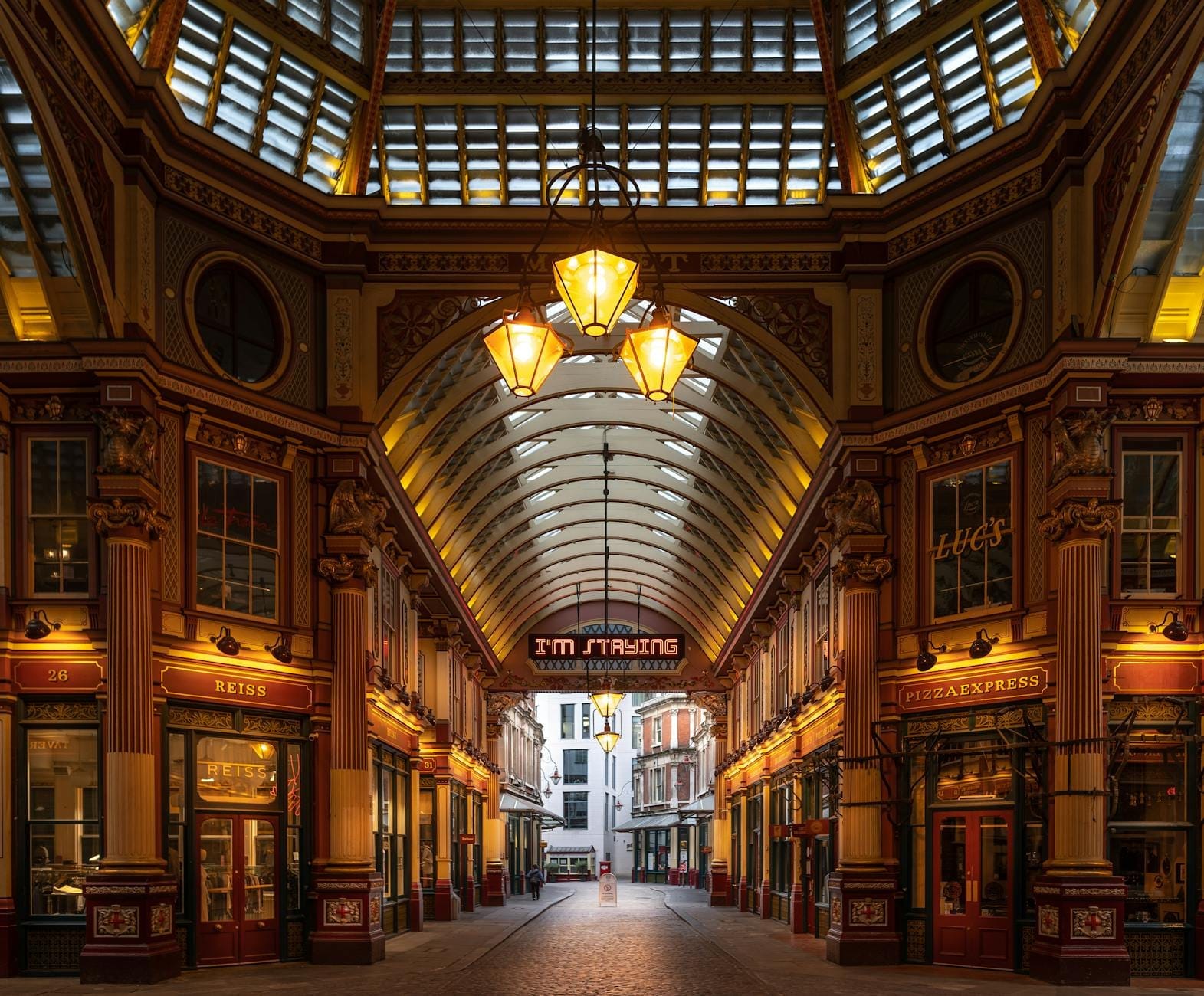
Leadenhall Market is a covered Victorian arcade tucked between the glass towers of the City of London financial district. Designed by Sir Horace Jones — the same architect responsible for Tower Bridge — and completed in 1881, it is a Grade II-listed structure of painted wrought-iron and glass that creates a coloured canopy over cobbled walkways below. The result is something that feels out of place in one of the world's most forward-looking financial centres, which is exactly what makes it worth seeing.
The public areas are open around the clock, every day of the week, but the market trades primarily on weekdays between roughly 10:00 and 18:00. If you arrive at the weekend, you'll find a largely quiet arcade with shuttered shopfronts — atmospheric in its own right, but not the full picture. The market is fundamentally a creature of the working week, shaped by the appetite of tens of thousands of City workers.
💡 Local tip
Visit on a weekday between 12:00 and 14:00 to see Leadenhall at full energy — wine bars spill onto the cobbles, lunch crowds fill the restaurants, and the light through the glass roof is at its most flattering for photographs.
Two Thousand Years on One Corner
The ground beneath Leadenhall Market is among the most historically significant in London. The site sits over what was once the forum and basilica of Roman Londinium, the administrative and commercial heart of the city founded around AD 43. That makes this location a trading site in some form for nearly two millennia, a continuity almost nowhere else in London can match.
Documentary records of a market here stretch back to 1321, when it was known as a place selling poultry, cheese, and butter. By the medieval period it had become one of London's principal food markets, and the name itself likely derives from a lead-roofed mansion that once stood nearby. The Victorian rebuilding of 1881 was not the first major overhaul of the site — previous markets had occupied the space for centuries before Jones's design gave it the form visitors see today.
Jones's design uses cream, burgundy, and green paintwork on the ironwork columns and arched roof — colours chosen with deliberate Victorian confidence. The detail is worth looking up at: ornamental bosses, fanlight glazing, and decorative ironwork that would look extravagant in almost any other context. For a deeper look at Victorian commercial architecture in London, the Sir John Soane's Museum in Holborn provides useful historical context for what London's 19th-century builders were attempting.
Tickets & tours
Hand-picked options from our booking partner. Prices are indicative; availability and final rates are confirmed when you complete your booking.
Devour London: Borough Market & Leadenhall Food Tour with Wine
From 90 €Instant confirmationFree cancellationSoho Instagram a self-guided walking tour to top photo spots
From 6 €Instant confirmationFree cancellationTootbus London by Night: Bus tour
From 32 €Instant confirmationFree cancellationIFS Cloud Cable Car Ride and Uber Boat Hop-on Hop-off 1 Day Ticket
From 38 €Instant confirmationFree cancellation
How the Market Changes Through the Day
Arriving before 9:00 on a weekday, the market is quiet enough to hear your own footsteps on the cobbles. The smell of fresh coffee drifts from a handful of early-opening cafes, and the painted ironwork catches the grey morning light through the glass panels above. Delivery workers and a few early commuters cutting through are the main traffic. It's the best time to photograph the architecture without crowds or obstructions.
By midday the atmosphere shifts completely. The narrow walkways fill with City workers in suits, the wine bars open their doors onto the cobbles, and the sound of conversation and clinking glasses rises under the vaulted roof. Several of the restaurants do a brisk trade in set lunches. The energy is specific to this kind of place — professional, quick, and sociable in the compressed way that City of London dining tends to be.
By 17:00, a different crowd appears: after-work drinks, longer conversations, and a slightly more relaxed pace. Some evenings, the market is used for private events, and lighting transforms the ironwork into something closer to a stage set. By 19:00 most of the food shops are closed, though several bars continue trading. At the weekend, the silence is nearly complete.
ℹ️ Good to know
Retailer opening hours vary significantly. Most shops open Monday to Friday, approximately 10:00–18:00. Always check directly with individual venues before making a special trip for a specific shop or restaurant.
The Harry Potter Connection
Leadenhall Market appeared in the first Harry Potter film, Harry Potter and the Philosopher's Stone, as the location used to represent the entrance to the Leaky Cauldron and Diagon Alley. The Bull's Head Passage — a narrow lane running off the main arcade — was the specific spot filmed, though significant set dressing transformed it for the screen. The market also appeared in Harry Potter and the Goblet of Fire.
The filming connection draws a steady stream of visitors who arrive specifically with that scene in mind. In practice, the market itself looks nothing like the finished film — the visual transformation was substantial — but for fans it remains a recognisable pilgrimage point. If the Harry Potter geography of London is a priority, the Platform 9¾ at King's Cross is a more directly recognisable filming location, while the Harry Potter London guide covers the full circuit of locations across the city.
Practical Walkthrough
The market has four main entrances, accessible from Gracechurch Street, Leadenhall Street, Lime Street, and Whittington Avenue. The interior is a cruciform layout — two crossing covered walkways — so it is straightforward to navigate. The cobbled floors are level, and the covered central area is fully protected from rain, making this a useful stop on a wet City day. However, the cobbles themselves may present difficulty for wheelchairs or pushchairs; visitors with specific access needs should check conditions in advance directly with the market.
The mix of tenants skews toward food and drink: wine bars, coffee shops, a butcher, a cheesemonger, and several restaurants occupy most of the units. There is some retail, but this is not primarily a shopping destination in the way that, say, the West End's covered arcades are. If you're looking for independent retail in a comparable historic setting, Borough Market to the south serves a different but complementary purpose.
From Leadenhall, it's a short walk to several other significant City landmarks. The Monument to the Great Fire of London is roughly five minutes west, and St Paul's Cathedral is around 15 minutes on foot. The Sky Garden at 20 Fenchurch Street is a 10-minute walk and offers a free, elevated view across the City — worth booking in advance.
Photography, Weather, and What to Expect Visually
The glass roof means the quality of light inside shifts with the weather outside. On overcast days — common in London for much of the year — the diffused light is actually more flattering than bright sunshine, which creates harsh contrasts between the lit sections and shadowed corners. A wide-angle lens or a phone camera's ultrawide setting captures the full scale of the ironwork better than a standard focal length.
The painted surfaces — cream, burgundy, green — photograph well without any filter adjustments. The cobbles can be slippery when wet, so footwear with some grip is practical. If you are coming primarily to photograph the architecture, a pre-9:00 visit on a weekday or a weekend morning gives you the clearest shots without people filling the frame.
⚠️ What to skip
Leadenhall Market is a working commercial space embedded in one of the world's busiest financial districts. On weekday lunchtimes the walkways become crowded. If you find busy, narrow spaces uncomfortable, a morning or late-afternoon visit is significantly more relaxed.
Is It Worth Your Time?
Leadenhall Market is not a destination that will occupy most of a day. It is, however, one of the most intact examples of Victorian market architecture in London, and its position at the centre of the City gives it a context that a relocated or converted structure could never replicate. The fact that it functions — as a real market serving real workers — rather than existing purely as a heritage exhibit, is part of what makes it feel alive rather than curated.
Visitors who expect an extensive food market in the style of Borough Market may be disappointed — the tenant mix here is smaller and more restaurant-focused than market-stall-focused. Equally, those hoping to spend an afternoon shopping will find the offer limited. But as a 30-minute architectural and historical detour, folded into a broader City of London walk, it earns its place confidently.
The City of London rewards walkers who pay attention to the layers between the modern towers: Roman foundations, medieval street plans, Wren churches, and Victorian commercial buildings all coexist in close proximity. For anyone building a route through this area, the City of London neighbourhood guide provides a useful framework for connecting Leadenhall with other nearby sites.
Insider Tips
- The Bull's Head Passage, running off the main arcade toward Lime Street, is the specific lane used in the Harry Potter filming. It's easy to miss if you stay only in the main cruciform walkways.
- Weekday mornings before 9:00 offer the best combination of good light and near-empty walkways — the only reliable window for unobstructed architectural photography on a working day.
- Several of the wine bars operate a standing-room outdoor setup on the cobbles during lunch, which fills fast. If you want a seat, either arrive before noon or after 13:30.
- The market sits almost directly above the remains of the Roman forum of Londinium. The Museum of London Docklands has exhibits on this layer of the City's history if that context interests you.
- On days when the City has public events or major financial conferences, the surrounding streets can become significantly more congested than usual. Check the City of London Corporation's events calendar if timing is sensitive.
Who Is Leadenhall Market For?
- Architecture and history enthusiasts who want to see a functioning Victorian market in its original setting
- Harry Potter fans tracing filming locations across London
- City workers and visitors looking for a quality weekday lunch stop with atmosphere
- Photographers seeking Victorian ironwork and coloured paintwork without paying an entry fee
- Travellers building a walking route through the Square Mile who want to understand the City's layered history
Nearby Attractions
Other things to see while in The City of London:
- Millennium Bridge
The London Millennium Footbridge is a sleek steel pedestrian span linking the City of London to Bankside, connecting St Paul's Cathedral on the north bank to Tate Modern and Shakespeare's Globe on the south. Free to cross at any hour, it offers some of the most photographed views of the Thames and a front-row look at two of London's most contrasting skylines.
- Sky Garden
Perched 155 metres above the City of London inside the Walkie Talkie building, Sky Garden offers panoramic views across the Thames, St Paul's, and the surrounding skyline — at no cost to visitors. The catch: tickets must be booked in advance, and they go fast.
- St Bartholomew the Great
Founded in 1123 by a courtier of King Henry I, St Bartholomew the Great in Smithfield is London's oldest surviving parish church. It offers free entry, extraordinary Norman architecture, and an atmosphere of genuine antiquity that few places in the capital can match.
- St Dunstan in the East
St Dunstan-in-the-East Church Garden is one of the City of London's most quietly extraordinary spaces: a free public garden growing inside the roofless ruins of a medieval church, framed by a surviving Christopher Wren steeple and walls draped in ivy and climbing plants. It takes less than an hour to visit, costs nothing to enter, and offers a rare kind of stillness in one of the world's densest financial districts.