St Paul's Cathedral: The Complete Visitor Guide
St Paul's Cathedral stands on Ludgate Hill as one of London's most recognisable landmarks, a masterpiece designed by Sir Christopher Wren and completed in 1711. From the cathedral floor to the Golden Gallery at 85 metres, it rewards visitors with world-class architecture, centuries of history, and sweeping views across the City.
Quick Facts
- Location
- St Paul's Churchyard, London EC4M 8AD, City of London
- Getting There
- St Paul's (Central line)
- Time Needed
- 2–3 hours for a full visit including dome climb
- Cost
- Paid entry for sightseeing; free for worship. Check stpauls.co.uk for current ticket prices and online discounts.
- Best for
- Architecture lovers, history enthusiasts, dome climbers, and London skyline views
- Official website
- www.stpauls.co.uk
What St Paul's Cathedral Actually Is
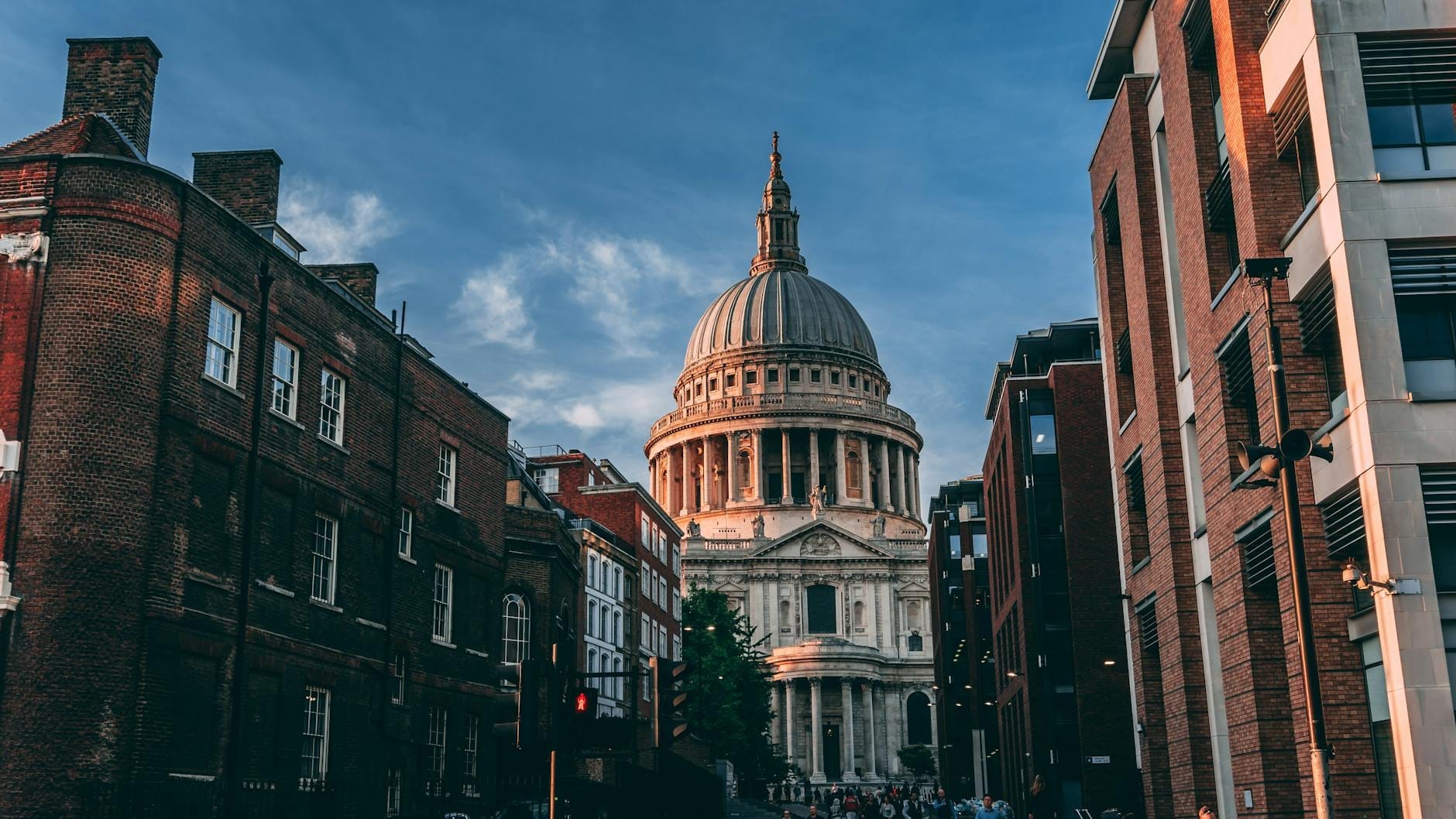
St Paul's Cathedral is the seat of the Bishop of London and the mother church of the Diocese of London, sitting at the highest point in the City on Ludgate Hill. The present building, designed by Sir Christopher Wren, was officially declared complete on 25 December 1711, replacing the medieval cathedral destroyed in the Great Fire of London in 1666. There has been a church dedicated to St Paul on this site since 604 CE, making the spiritual history here more than 1,400 years deep.
At 111 metres to the top of its cross, Wren's cathedral held the title of London's tallest building for over 250 years. Today it is dwarfed by towers of glass and steel in the surrounding Square Mile, but its dome still commands attention. From the south side of the Millennium Bridge or the embankment opposite Tate Modern, the dome rises above the roofline in a way that feels almost deliberate — as if the city arranged itself to keep it visible.
ℹ️ Good to know
Sunday sightseeing is not available. The cathedral opens for worship only on Sundays. Plan your visit for Monday, Tuesday, Thursday, Friday, or Saturday to access the dome, crypt, and cathedral floor.
The Experience Floor by Floor
The Cathedral Floor
Entering through the West Front, you pass beneath two towers that frame the main portico and step into a nave that is immediately, physically imposing. The ceiling vaults climb to around 30 metres overhead. The floor is largely clear stone, and footsteps echo with a low resonance that changes the moment organ music fills the space. Morning visits, especially on weekdays before 10am, are the quietest: the light through the south aisle windows is warm and low, and the cleaning staff move quietly through the aisles.
The cathedral contains significant memorial works, including the tomb of the Duke of Wellington and memorials to figures from Nelson to Florence Nightingale. The American Memorial Chapel behind the High Altar commemorates the 28,000 American servicemen and women based in Britain who died in World War II. The illuminated roll of honour is housed within it. This is not a detail most visitors linger over, but it is worth the two minutes it takes to read the chapel's dedication.
The floor-level experience pairs well with a broader walk through the City of London's historic core. The Temple Church, the Leadenhall Market, and The Monument are all within walking distance and together build a strong picture of this district's layered history.
The Dome: Whispering Gallery, Stone Gallery, and Golden Gallery
The dome climb is the centrepiece of any sightseeing visit and requires physical effort. The Whispering Gallery, reached by 257 steps, is open again after its long closure for conservation work — check the official website before visiting in case of temporary restrictions. The Stone Gallery at 376 steps and the Golden Gallery at 528 steps are typically open for sightseeing on weekdays and Saturdays, though access can vary; check the cathedral website for current arrangements.
The Stone Gallery sits on the exterior of the dome's base and gives you an open-air view of central London at moderate height. The Golden Gallery, at the very top of the dome, narrows the world to a cylindrical railing and a 360-degree panorama that on a clear day extends to Canary Wharf in the east, the Shard rising to the south, and Westminster to the west. The wind at that height is noticeable even in summer. The spiral staircase to the Golden Gallery is narrow and steep; anyone with claustrophobia or limited mobility should treat the Stone Gallery as the destination instead.
💡 Local tip
Aim to reach the Golden Gallery by 9am on a weekday morning. Tour groups and school parties arrive in force from mid-morning onwards. The cathedral opens at 08:30 Monday, Tuesday, Thursday, Friday, and Saturday, giving you a genuine window of relative quiet.
The Crypt
The crypt is the largest in Europe and runs beneath the entire footprint of the cathedral. It contains the tombs of Lord Nelson and the Duke of Wellington, whose enormous monument stands at ground level above. Wren himself is buried here. His epitaph, carved above the north door of the crypt, translates from Latin as: 'Reader, if you seek his monument, look around you.' It is a rare example of an epitaph that is simply, demonstrably true.
The crypt also houses the cathedral's permanent exhibition spaces, a gift shop, and a cafe. The lighting down here is lower and cooler than the main floor, and it is noticeably quieter even when the cathedral above is busy. If you have children with you, the crypt tends to hold their attention better than the nave — the tombs and the low stone vaulting read as dramatic rather than merely old.
Tickets & tours
Hand-picked options from our booking partner. Prices are indicative; availability and final rates are confirmed when you complete your booking.
London Top Sights Walking Tour with Visit to St Paul's Cathedral
From 110 €Instant confirmationFree cancellationSt Paul's Cathedral and London Top Sights Private Tour
From 148 €Instant confirmationFree cancellationSt Paul's Cathedral and Westminster Private Tour
From 148 €Instant confirmationFree cancellationHarry Potter Guided Tour with Thames Cruise and St Paul's Cathedral
From 106 €Instant confirmationFree cancellation
Historical and Architectural Context
Wren's design is English Baroque, shaped by his exposure to French and Italian influences during a trip to Paris in 1665 and his study of architectural treatises. The dome draws obvious comparison to St Peter's Basilica in Rome and the Panthéon in Paris, though Wren's solution is technically distinct: the visible outer dome, the brick cone hidden between inner and outer shells that bears the structural load, and the painted interior dome are three separate constructions. This engineering ingenuity is what allowed him to achieve the visual height of the exterior while maintaining a proportionate interior.
The cathedral played a significant ceremonial role in the 20th century. Winston Churchill's funeral was held here in 1965, drawing heads of state from around the world. The wedding of Prince Charles and Lady Diana Spencer took place here in 1981. During the Blitz in World War II, the cathedral survived the bombing of the surrounding City — partly through the extraordinary efforts of the St Paul's Watch, a volunteer fire-watching group who patrolled the roof every night for four years. The photograph of the dome rising above smoke and flames, taken on the night of 29 December 1940, became one of the defining images of wartime Britain.
For visitors interested in London's wider architectural story, the City of London packs an extraordinary range of building types within a small area, from medieval churches to Norman Foster's 30 St Mary Axe (the Gherkin). Our guide to the best views in London covers how St Paul's appears from the various vantage points across the city, including across the Thames from the South Bank.
Getting There and Practical Logistics
The nearest Underground station is St Paul's on the Central line, a two-minute walk from the cathedral's north side. The station is step-free from street to platform in one direction; check the TfL accessibility map if step-free access throughout the interchange is essential. Mansion House (District and Circle lines) and Blackfriars (District, Circle, and National Rail) are both about 10 minutes on foot and add flexibility for Oyster card routing.
Sightseeing opens at 08:30 Monday, Tuesday, Thursday, Friday, and Saturday, and at 10:00 on Wednesdays. Last entry is at 16:00, with the cathedral closing to visitors at 16:30. The cathedral is closed to sightseers on Sundays and may close at short notice for special services or events, which happen with some regularity given its role as an active place of worship. Always check the official website before travelling, particularly around public holidays and state occasions.
Timed entry tickets are available online with a discount compared to buying at the door. Family tickets and concessions for children, students, and seniors over 65 are offered. Booking online also lets you skip the ticket queue, which on busy summer days can take 20 minutes or more. The nearest car park is Baynard House on Queen Victoria Street, but driving to this part of the City is rarely practical given traffic, the Congestion Charge zone, and limited availability.
⚠️ What to skip
The cathedral is an active church. If a service or special event is underway, sightseeing access may be suspended or restricted without advance notice. Midweek mornings are the safest bet for uninterrupted visits.
Photography, Weather, and the Best Time to Visit
The exterior is most photogenic from the south bank of the Thames, particularly from the Millennium Bridge or the riverside walk east of Tate Modern. The dome photographs well in low-angle morning light and in the blue hour after sunset, when the floodlighting activates and the sky is deep blue rather than black. Avoid the middle of the day in summer, when the stone washes out and tourist density around the front steps makes clean composition difficult.
Inside the cathedral, photography is permitted in most areas but tripods and professional-looking camera setups may attract attention from staff. Flash photography is prohibited. The painted interior of the dome, depicting scenes from the life of St Paul, is challenging to photograph well with a standard phone lens given the distance — bring or borrow a camera with some optical zoom if the ceiling paintings are a priority.
Spring and early autumn are the most comfortable seasons for visiting. Summer brings school groups, international tour parties, and peak queues from June through August. The dome galleries are exposed to wind at all times of year; a layer you can remove is advisable even in summer. In winter, the lower visitor numbers and quieter atmosphere make the interior feel more resonant, though the shorter daylight window means the Golden Gallery is at its best earlier in the day.
If you are planning a multi-day itinerary that includes St Paul's alongside other major sites in the Square Mile, the 3-day London itinerary works the City into a broader programme that covers the tower and riverside.
Who Should Think Twice
The dome climb is the experience that most visitors remember, but it requires climbing 528 steps to the Golden Gallery on a staircase that becomes progressively narrower. There is no lift to the dome galleries. Visitors with limited mobility, vertigo, or heart or breathing conditions should read the cathedral's accessibility information carefully before purchasing dome-access tickets. The cathedral floor and crypt are accessible without stair climbing and offer considerable interest in their own right.
If cathedrals as a category leave you cold, the admission cost is a significant ask for what is essentially a very large church. The dome view, while impressive, competes with free or lower-cost alternatives: the Sky Garden, the Tate Modern's viewing level, and Primrose Hill all offer London panoramas without timed entry constraints. That said, the architectural and historical depth here is real, and the experience is harder to replicate elsewhere in the city.
Insider Tips
- Wednesday openings start at 10:00 rather than 08:30, meaning the early-bird advantage is only available Monday, Tuesday, Thursday, Friday and Saturday on the standard schedule. Plan a Tuesday or Thursday morning arrival if you want the quietest possible experience.
- The lunchtime recitals, often held on selected weekdays at 12:30, are free to attend and offer a genuine musical experience in the cathedral acoustics without requiring a sightseeing ticket. Check the cathedral's events calendar for the current schedule.
- The Stone Gallery, one level below the Golden Gallery, is significantly less crowded because most visitors continue upward. Spend a few minutes here first to orient yourself with the views before making the final ascent.
- Sir Christopher Wren's tomb in the crypt carries no grand monument — just a flat stone slab and the Latin epitaph above the door. It is easy to walk past. Look for the floor inscription near the centre of the crypt.
- For the classic dome-above-smoke view that defined wartime photography, the spot on the north side of the Millennium Bridge gives you the Thames foreground plus the dome rising above Cannon Street rooftops. Late afternoon in autumn, when the sun is low from the southwest, produces the most dramatic light on the west face.
Who Is St Paul's Cathedral For?
- Architecture and design enthusiasts who want to understand how Wren engineered a three-shell dome in post-medieval London
- History visitors with specific interest in British military history, the Blitz, and 20th-century state occasions
- Confident climbers looking for a high-level view of the City of London from a historic structure
- Travellers combining the cathedral with a walk through the Square Mile, including the Monument and riverside
- Anyone attending one of the regular free lunchtime recitals for an acoustic experience that the building was literally designed to produce
Nearby Attractions
Other things to see while in The City of London:
- Leadenhall Market
Leadenhall Market is a Grade II-listed Victorian covered market in the heart of the City of London, built in 1881 over a site used for commerce since Roman times. With its ornate wrought-iron and glass roof, cobbled walkways, and mix of wine bars, restaurants, and independent shops, it's one of the Square Mile's most atmospheric stops — and it won't cost you a penny to walk through.
- Millennium Bridge
The London Millennium Footbridge is a sleek steel pedestrian span linking the City of London to Bankside, connecting St Paul's Cathedral on the north bank to Tate Modern and Shakespeare's Globe on the south. Free to cross at any hour, it offers some of the most photographed views of the Thames and a front-row look at two of London's most contrasting skylines.
- Sky Garden
Perched 155 metres above the City of London inside the Walkie Talkie building, Sky Garden offers panoramic views across the Thames, St Paul's, and the surrounding skyline — at no cost to visitors. The catch: tickets must be booked in advance, and they go fast.
- St Bartholomew the Great
Founded in 1123 by a courtier of King Henry I, St Bartholomew the Great in Smithfield is London's oldest surviving parish church. It offers free entry, extraordinary Norman architecture, and an atmosphere of genuine antiquity that few places in the capital can match.