Temple Church: London's Knights Templar Circle Hidden in the Legal District
Temple Church is one of London's oldest and most architecturally distinctive buildings, a 12th-century round church built by the Knights Templar within the walled precinct of the Inner and Middle Temple. With Templar knight effigies, 900 years of layered history, and a remarkably quiet courtyard setting just off Fleet Street, it rewards visitors who know where to look.
Quick Facts
- Location
- Temple Church, off Fleet Street, London EC4Y 7BB (main visitor entrance commonly via Tudor Street)
- Getting There
- Temple (Circle/District line) or Chancery Lane (Central line); buses 4, 11, 15, 26, 76, 341 nearby
- Time Needed
- 45–90 minutes
- Cost
- £5 adults / £3 concessions / Free for children and members of the Inns of Court
- Best for
- History enthusiasts, architecture lovers, medieval London, quiet escapes from the City
- Official website
- www.templechurch.com
What Temple Church Actually Is
Temple Church is a Royal Peculiar, meaning it falls directly under the Crown rather than any diocese, a status shared with Westminster Abbey and the Chapel Royal. It occupies the grounds of the Temple precinct, home to the Inner and Middle Temple, two of London's four Inns of Court. Barristers have trained and worked in these lanes since at least the 15th century, and the church has served as their parish ever since the Knights Templar were suppressed between 1307 and 1314.
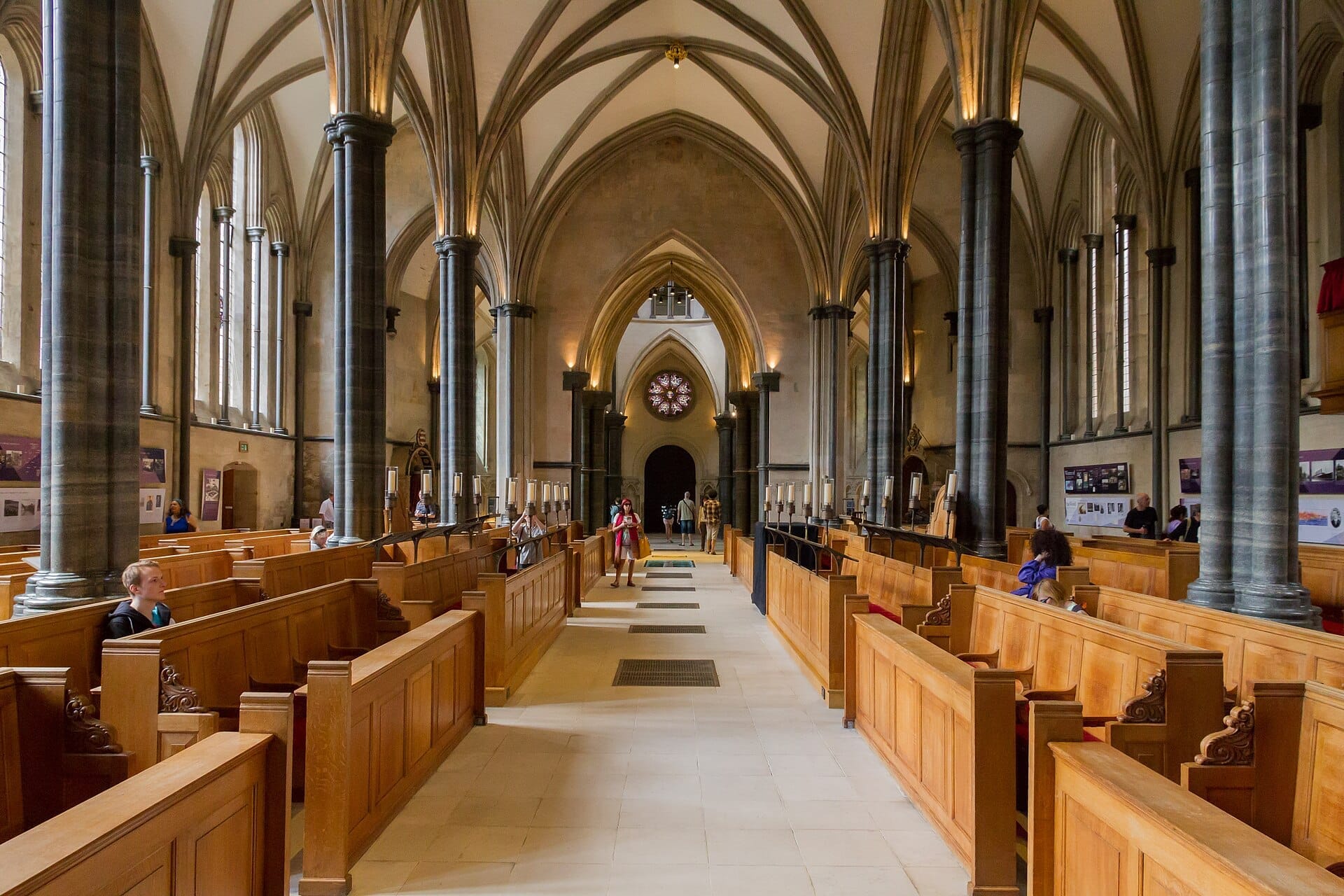
The church is structured in two distinct sections: the Round and the Chancel. The Round Church, consecrated in 1185 by the Patriarch of Jerusalem, was deliberately modelled on the Church of the Holy Sepulchre in Jerusalem, the most sacred site in the Crusader world. The Chancel, a more conventionally rectangular Gothic nave, was added and consecrated in 1240. Together they form one of the finest examples of Norman transitional architecture surviving in London.
ℹ️ Good to know
Opening hours for sightseeing vary and can change due to services, legal events, or private functions. Always check the official website at templechurch.com before visiting to confirm times for your specific date.
Getting There: Navigating the Temple Precinct
Finding Temple Church for the first time requires a little orientation. The precinct itself is gated and sits between Fleet Street to the north and the Thames Embankment to the south. A common access for visitors is via Tudor Street, and the entrance to the precinct feels deliberately understated. If you are arriving by Underground, Temple station on the Circle and District lines is the closer of the two main options, a short walk along the Embankment and up through the precinct. Chancery Lane on the Central line is slightly further but puts you on Fleet Street, from where the church lane is signposted.
Multiple bus routes serve the surrounding streets, including the 4, 11, 15, 26, 76, and 341, all of which stop near Fleet Street or the Strand. Cyclists can lock up outside the precinct gates. There is no on-site parking, and driving into this part of the City during working hours is impractical. Walking from Blackfriars station is also a reasonable option if you are combining this visit with the South Bank.
💡 Local tip
The Temple precinct gates are sometimes locked outside core hours and on weekends. Arrive during confirmed sightseeing hours and enter via Tudor Street rather than attempting other entrances, which may be access-only for Inn members.
Tickets & tours
Hand-picked options from our booking partner. Prices are indicative; availability and final rates are confirmed when you complete your booking.
Churchill War Rooms tickets and political London audio tour
From 53 €Instant confirmationFree cancellationPrivate espionage tour in London with Churchill War Rooms tickets
From 298 €Instant confirmationFree cancellationChurchill War Rooms and Westminster Guided Tour
From 87 €Instant confirmationFree cancellationLondon top sights tour with Westminster Abbey and Churchill War Rooms
From 115 €Instant confirmationFree cancellation
The Architecture: What You Are Looking At
The Round Church's exterior is relatively modest by tourist-attraction standards, which is partly why it surprises visitors once they step inside. The circular nave is supported by Purbeck marble columns, a bluish-grey polished stone quarried in Dorset that became a signature material in high-status English ecclesiastical buildings of the 12th and 13th centuries. The columns are slender and clustered, creating an effect somewhere between Romanesque solidity and early Gothic lightness.
On the floor of the Round, nine stone effigies of medieval knights lie in various states of preservation. These are among the oldest and most significant funerary monuments in London, representing members of the Templar order and their associates. Several are depicted with legs crossed and hands reaching toward sword hilts, a posture once thought to indicate participation in a Crusade, though historians now question this as a firm rule. Whatever their precise meaning, the effigies carry a weight that reproduction cannot replicate.
The Chancel, by contrast, is lighter and more spacious, with tall lancet windows that flood the eastern end with daylight. This section was heavily restored in the Victorian era and rebuilt following significant bomb damage during the Blitz in 1941, when the roof was destroyed and several of the original fittings were lost. What you see today is a careful post-war reconstruction completed in the 1950s, faithful in form but not entirely ancient in fabric. The restoration is competent and respectful, though it is worth knowing that not everything that looks medieval here actually is.
The History Behind the Stone
The Knights Templar were a military-religious order founded in the early 12th century to protect Christian pilgrims travelling to and from Jerusalem. At the height of their power, they were among the wealthiest and most politically connected institutions in Europe. Their London headquarters, the New Temple, was established here on land between the City and Westminster, deliberately placed to give them access to both power centres. The church was in use by 1163 and the Round was consecrated in 1185.
The Templars' downfall was swift and brutal. Between 1307 and 1314, under pressure from the French Crown and a financially stretched papacy, the order was suppressed, its leaders arrested, tortured, and in some cases executed. The Temple precinct passed through various hands before lawyers of the Inner and Middle Temple became firmly established here by the 15th century. Their occupation was formally confirmed by Letters Patent of King James I on 13 August 1608, which entrusted the maintenance of the church to the two Inns of Court. They continue to manage it today.
The senior cleric is titled the Master of the Temple, a title that consciously echoes the head of the Knights Templar order. This unbroken ceremonial thread connecting a 12th-century military brotherhood to a functioning 21st-century legal institution is part of what makes Temple Church unusual among London's many historic churches. For more on London's layered legal and royal history, the nearby St Paul's Cathedral and the City of London more broadly offer complementary threads of the same story.
Visiting in Practice: What Different Times of Day Feel Like
Temple Church sits inside a functioning legal precinct, which gives the surrounding area a character unlike most tourist attractions. On weekday mornings, the lanes and courtyards fill with barristers in black robes and wigs moving between buildings. The smell of old stone and freshly cut grass from the precinct gardens is particularly noticeable in spring and early summer. The church itself is quiet even when the precinct outside is busy.
Midday on a weekday tends to bring the highest concentration of visitors, partly because lunch-hour tourists and office workers from the City both arrive at once. If you want the Round to yourself, early opening time on a weekday is significantly quieter. Weekend sightseeing hours, where offered, can also be quieter in terms of foot traffic, though always verify in advance as weekend access is more variable.
On overcast days, the light inside the Round is cool and slightly blue-tinged, filtered through the lancets in a way that emphasises the age of the stone. On bright sunny days, the Chancel's eastern windows flood the nave with sharp light. Neither condition is inherently better, but if you are photographing the knight effigies, diffuse natural light works better than direct sunlight, which creates harsh shadows across the carved stone faces.
💡 Local tip
Photography of the knight effigies works best from a low angle with the camera near floor level. The raking light across the carved stone reveals detail that is invisible in standard standing-height shots.
Is It Worth Visiting? An Worth Knowing
For anyone with genuine interest in medieval London, the Crusades, or ecclesiastical architecture, Temple Church is one of the most rewarding 45 minutes you can spend in the City. The combination of the circular plan, the Purbeck marble columns, and the knight effigies is rare. Very few buildings in London let you stand inside something consecrated in 1185 and still functioning as intended. It sits alongsideSt Bartholomew the Great in Smithfield as one of the two best surviving examples of Norman-era church architecture accessible to the public in London.
However, visitors expecting a large, ornate, tourist-optimised experience will find it underwhelming. The interior is compact. There are no extensive exhibitions, no audio tours with dramatised commentary, and the setting, while atmospheric, is not visually spectacular by the standards of, say, a Gothic cathedral. The £5 admission is fair given the significance of what you are seeing, but visitors should calibrate expectations: this is a place for quiet looking, not entertainment.
Those with very limited time in London and a long checklist of sights may find that the effort of locating the precinct entrance and confirming opening hours is not worthwhile compared to larger free attractions like the British Museum. But if you are already walking along Fleet Street or combining it with a visit to the Sir John Soane's Museum nearby, it makes an excellent pairing.
Practical Notes for Your Visit
Admission is £5 for adults and £3 for concessions. Children enter free, as do members of the Inns of Court, their staff, and guests. The church is a Royal Peculiar with an active role in the legal community, meaning it hosts regular services, special events, and legal ceremonies. These can close it to sightseers at short notice. Checking the official website at templechurch.com immediately before your visit is essential, not optional.
The precinct's cobbled lanes are uneven, and the church interior involves some stone floor surfaces. Those with mobility considerations should contact the church directly to confirm current arrangements for step-free access before travelling. No dedicated parking is available nearby, and the area is not easily accessible by car during working hours.
The Temple precinct itself is worth a slow wander before or after the church. The gardens facing the Thames, the fountain courts, and the quiet lanes between the Inn buildings have a collegiate atmosphere with almost no tourist infrastructure. If you are exploring the broader City, the ruined church garden of St Dunstan in the East and Leadenhall Market are both within a 20-minute walk and make logical additions to a day focused on the historic City.
Insider Tips
- The precinct gardens between the church and the Thames Embankment are open to the public during daylight hours and are almost always uncrowded. They offer a rare patch of green calm in the middle of the City and are worth 10 minutes even if the church is closed when you arrive.
- The church hosts occasional organ recitals and choral events that are open to the public. These offer the chance to experience the acoustic qualities of the Round, which are exceptional. Check the events calendar on the official website before your visit.
- If you arrive through the Tudor Street entrance and the courtyard feels deserted, do not assume the church is closed. Walk through to the inner courtyard and look for the sightseeing entrance sign. The gates being open does not always mean every door is clearly labelled.
- The knight effigies were severely damaged during the Blitz and subsequently restored. Some restoration work is visible if you look closely at the stone. Knowing this in advance means you can appreciate what survived rather than being confused by the patchwork of old and new stone.
- Midweek mornings in term time bring the most authentic atmosphere, with the legal precinct in full operation around you. Arriving then, rather than on a tourist-heavy Saturday afternoon, transforms the surrounding context completely.
Who Is Temple Church For?
- History enthusiasts focused on medieval London and the Crusades
- Architecture visitors interested in Norman and early Gothic ecclesiastical buildings
- Travellers combining a walking route through the City and Fleet Street
- Visitors interested in the living legal history of London's Inns of Court
- Photographers looking for low-light interior subjects with genuine antiquity
Nearby Attractions
Other things to see while in The City of London:
- Leadenhall Market
Leadenhall Market is a Grade II-listed Victorian covered market in the heart of the City of London, built in 1881 over a site used for commerce since Roman times. With its ornate wrought-iron and glass roof, cobbled walkways, and mix of wine bars, restaurants, and independent shops, it's one of the Square Mile's most atmospheric stops — and it won't cost you a penny to walk through.
- Millennium Bridge
The London Millennium Footbridge is a sleek steel pedestrian span linking the City of London to Bankside, connecting St Paul's Cathedral on the north bank to Tate Modern and Shakespeare's Globe on the south. Free to cross at any hour, it offers some of the most photographed views of the Thames and a front-row look at two of London's most contrasting skylines.
- Sky Garden
Perched 155 metres above the City of London inside the Walkie Talkie building, Sky Garden offers panoramic views across the Thames, St Paul's, and the surrounding skyline — at no cost to visitors. The catch: tickets must be booked in advance, and they go fast.
- St Bartholomew the Great
Founded in 1123 by a courtier of King Henry I, St Bartholomew the Great in Smithfield is London's oldest surviving parish church. It offers free entry, extraordinary Norman architecture, and an atmosphere of genuine antiquity that few places in the capital can match.