The Monument to the Great Fire of London: What to Expect Before You Climb
The Monument to the Great Fire of London is a 61-metre Doric column completed in 1677, standing at the edge of the City's financial district. Climb its 311 spiral steps and you reach a rooftop cage with close-up views of the Shard, Tower Bridge, and the dense skyline of the Square Mile. It is one of the few City landmarks where the effort of getting there is literally built into the experience.
Quick Facts
- Location
- Fish Street Hill, London EC3R 8AH (City of London)
- Getting There
- Monument (Circle/District line) — 1 min walk; Cannon Street — 5 min walk
- Time Needed
- 45–60 minutes including the climb and descent
- Cost
- Paid admission; timed tickets recommended in advance (check official site for current pricing)
- Best for
- History enthusiasts, City walkers, anyone who wants a rooftop view without the queue or price of the Shard
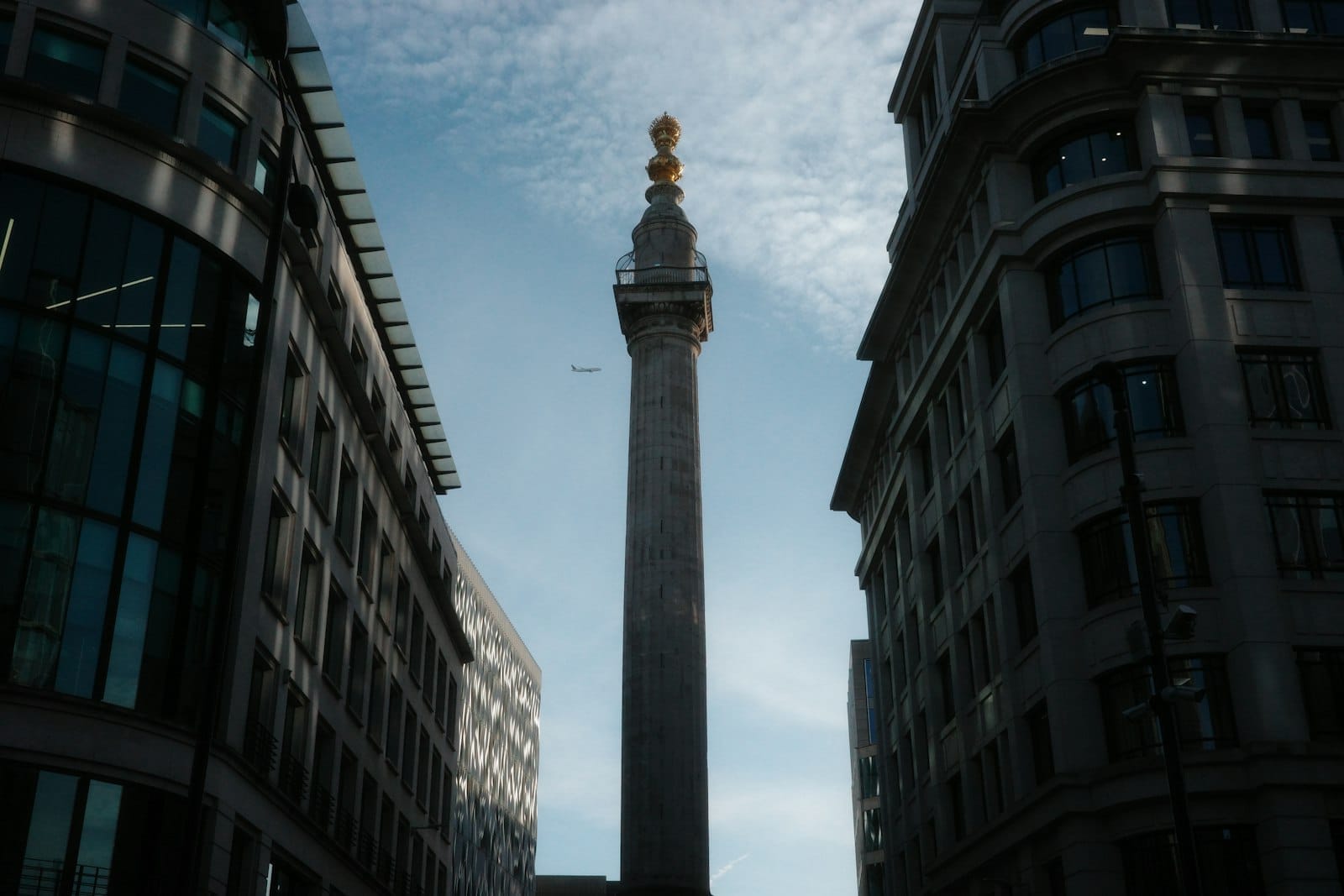
What The Monument Actually Is
The Monument to the Great Fire of London is a freestanding Doric column of Portland stone, completed in 1677 to designs by Sir Christopher Wren and Robert Hooke. It stands 61 metres tall — precisely the same distance as its horizontal measurement to the spot in Pudding Lane where the fire began on 2 September 1666. That detail was deliberate: if the column were toppled to the west, its tip would land at the exact origin of the blaze. It is a piece of urban geometry as much as a piece of architecture, and once you know it, you cannot look at the column without thinking about the catastrophic fire it replaced.
The Great Fire burned for four days and destroyed roughly 13,200 houses and 87 parish churches across the medieval City. The Monument, completed eleven years later, was not built purely as a memorial. Hooke used it as a scientific instrument — a giant zenith telescope — attempting to measure stellar parallax through a shaft cut down the column's core. The experiment ultimately failed due to vibrations from street traffic, but the dual identity of the structure as both civic monument and scientific apparatus says a great deal about the Restoration-era ambitions of the men who built it.
💡 Local tip
Book timed tickets in advance. Walk-up access can be limited, particularly on weekday lunchtimes when City workers use it as a quick lunchbreak destination. Check the official City of London website for current hours and pricing before your visit.
The Climb: 311 Steps and What You Find at the Top
The interior staircase is a continuous spiral of 311 steps cut into the column's stone core, lit by natural light filtered through occasional windows and supplemented by low artificial lighting. The steps are stone, narrow, and worn smooth in the centre by three and a half centuries of visitors. The handrail runs along the outer wall. As you ascend, the staircase narrows and the air cools slightly. There is no lift. Visitors who are prone to claustrophobia should note that the shaft is confined, particularly on the upper third of the climb where the walls feel close and you are aware of the person above and below you.
The platform at the top is enclosed by an iron cage, added in the 19th century after several suicides. The cage is tight to the stonework, which limits the framing for photographs but does not impede the view itself. What you get from the top is an unusually intimate look at the City roofscape — not the sweeping panorama of the Shard or the London Eye, but a mid-level view that puts you at roughly eye level with the upper floors of Georgian counting houses and directly below the glass towers of the modern financial district. On a clear morning, the golden dome of St Paul's is visible to the northwest. Tower Bridge is clearly identifiable to the east. The river is a narrow grey ribbon between the buildings.
The descent uses the same staircase in the opposite direction, which requires some care when passing ascending visitors. Most people manage the full climb in around ten to fifteen minutes at a comfortable pace. Visitors with knee problems report that the descent is more demanding than the ascent.
⚠️ What to skip
The Monument is not accessible to wheelchair users or those unable to manage 311 stairs. There is no step-free alternative. If mobility is a concern, the view from the base — looking straight up the column — is itself worth a few minutes.
Tickets & tours
Hand-picked options from our booking partner. Prices are indicative; availability and final rates are confirmed when you complete your booking.
The Monument of the Great Fire of London audio-guided tour
From 5 €Instant confirmationSoho Instagram a self-guided walking tour to top photo spots
From 6 €Instant confirmationFree cancellationTootbus London by Night: Bus tour
From 32 €Instant confirmationFree cancellationIFS Cloud Cable Car Ride and Uber Boat Hop-on Hop-off 1 Day Ticket
From 38 €Instant confirmationFree cancellation
How the Experience Changes by Time of Day
The area around Fish Street Hill is different at different hours. In the early morning, before 9am, the immediate streets are quiet and the column stands in relative isolation against the sky. The smell of the nearby Thames is faintly present on still days, mixed with the stone-dust scent that characterises old City streets in the morning. Delivery vans are still making rounds to the nearby offices, and the financial workers who pour through Monument station at 8.30am have not yet arrived in numbers.
By midday the area fills with office workers eating lunch on the steps and benches nearby. The queue for tickets — if you have not booked — tends to be longest between 12pm and 2pm. Late afternoon, particularly between 3pm and an hour before closing, tends to offer a calmer ascent and better light for photography looking west toward St Paul's. Overcast days reduce harsh shadows on the stonework, which actually benefits close-up photographs of the column's carved reliefs.
The base of the column is carved with a detailed relief panel on its north face depicting Charles II directing the rebuilding of London after the fire. It rewards a close look before you enter, particularly in angled morning light when the carved figures cast legible shadows. Most visitors walk past it entirely.
Historical and Architectural Context
The Monument sits within the Square Mile, the historic core that has been London's commercial heart since the Romans founded Londinium around AD 43. After 1666, Wren and Hooke rebuilt the City with a new generation of churches and civic buildings, and The Monument was one of the first structures completed in that effort. It stands just north of London Bridge, which in the 17th century was still the only fixed crossing of the Thames in London, making this part of Fish Street Hill one of the most commercially important thoroughfares in the country.
The column's design follows the classical Doric order, but its fluted shaft and the gilded bronze urn of flames at its top give it a specificity that separates it from generic civic columns. The urn, representing the fire, was the subject of considerable debate among the architects — an earlier design proposed a statue of Charles II, which Wren resisted. The current design is more honest: fire remembers fire. The building occupies a place in the City of London that is both literal and symbolic, marking the edge of where the fire stopped as much as where it started.
John Keats reportedly referred to the column in his poem 'Sleep and Poetry' as a point of poetic reference. More concretely, the column appears in Dickens' 'Martin Chuzzlewit', where it is mentioned in connection with the nearby Monument Street, suggesting how thoroughly it had embedded itself in London's geographic imagination by the early Victorian period.
Practical Walkthrough: Getting There and Around
The most direct approach is from Monument Underground station on the Circle and District lines. Exit the station toward Fish Street Hill and the column is visible immediately on your left as you emerge. The walk takes under a minute. Cannon Street station is a five-minute walk east, useful if you are coming from mainline services. There is no convenient parking nearby — this is a dense City street and driving is not practical.
The area around The Monument connects naturally with several other worthwhile stops in the City. St Paul's Cathedral is a 12-minute walk northwest. Leadenhall Market is about 8 minutes east, and Tower Bridge is a 15-minute walk along the river. The Monument integrates well into a half-day City walk without requiring a separate journey.
There are no cafes or facilities inside the Monument itself. The surrounding streets have several coffee shops and sandwich places aimed at office workers — prices reflect the City postcode. The area immediately around Fish Street Hill is largely pedestrianised at the base of the column, giving you room to photograph it without standing in traffic.
Is It Worth Your Time? An Worth Knowing
The Monument is not a dramatic experience in the way that the Shard's viewing platform or the London Eye is dramatic. The view from the top is good but not spectacular by modern London standards, and the confined iron cage reduces its photographic appeal compared to open-air viewpoints. What it offers instead is something rarer: a genuine encounter with a 17th-century structure that has not been modernised around the edges. The stairs are still the original stairs. The stone is worn by the same motion repeated across 350 years. There is no gift shop at the top and no audio-visual presentation at the bottom.
For travellers interested in the texture of London history rather than headline attractions, The Monument delivers considerable value. It is particularly rewarding when combined with a broader walk through the City's medieval street pattern, stopping at St Bartholomew the Great or the lanes around Cornhill. If you are primarily chasing panoramic views, the rooftop of Sky Garden (free, book in advance) offers a wider perspective from greater height.
Visitors who should consider skipping it: those with mobility limitations, anyone who dislikes enclosed spiral staircases, and travellers on a very tight schedule who have already seen the City from a high viewpoint. It is also less interesting in heavy rain, when the view from the top is obscured and the stone steps become slippery.
Insider Tips
- Look at the carved relief panel on the north face of the column before entering — it depicts Charles II overseeing the rebuilding of London and is easy to miss. Morning light, particularly from the east, brings out the detail in the figures far better than midday sun.
- The column's height in feet (202 ft) equals the distance east to the Pudding Lane bakery where the fire started. Standing at the base and visualising that horizontal distance gives the monument's geometry a sudden visceral quality.
- Late afternoon on weekdays, roughly 3pm to 4pm, tends to be the least crowded window. City workers have returned to their desks after lunch and the tourist peak has often passed.
- Wear rubber-soled shoes. The stone steps are smooth and worn in the centre, and can feel slippery under leather soles, particularly on the descent.
- Once you have your entry certificate (a tradition that continues at the Monument), keep it — it is one of the more unusual London souvenirs and costs nothing extra.
Who Is The Monument For?
- History and architecture enthusiasts who want direct contact with 17th-century London
- City walkers building a half-day route through the Square Mile
- Travellers who want a rooftop view without the crowds or cost of major observation decks
- Anyone with an interest in the Great Fire of London and its legacy on the city's layout
- Photographers looking for a mid-level City roofscape with strong architectural foreground
Nearby Attractions
Other things to see while in The City of London:
- Leadenhall Market
Leadenhall Market is a Grade II-listed Victorian covered market in the heart of the City of London, built in 1881 over a site used for commerce since Roman times. With its ornate wrought-iron and glass roof, cobbled walkways, and mix of wine bars, restaurants, and independent shops, it's one of the Square Mile's most atmospheric stops — and it won't cost you a penny to walk through.
- Millennium Bridge
The London Millennium Footbridge is a sleek steel pedestrian span linking the City of London to Bankside, connecting St Paul's Cathedral on the north bank to Tate Modern and Shakespeare's Globe on the south. Free to cross at any hour, it offers some of the most photographed views of the Thames and a front-row look at two of London's most contrasting skylines.
- Sky Garden
Perched 155 metres above the City of London inside the Walkie Talkie building, Sky Garden offers panoramic views across the Thames, St Paul's, and the surrounding skyline — at no cost to visitors. The catch: tickets must be booked in advance, and they go fast.
- St Bartholomew the Great
Founded in 1123 by a courtier of King Henry I, St Bartholomew the Great in Smithfield is London's oldest surviving parish church. It offers free entry, extraordinary Norman architecture, and an atmosphere of genuine antiquity that few places in the capital can match.