Old Spitalfields Market: What to Expect Before You Go
Old Spitalfields Market is one of east London's most enduring landmarks, a historic market hall on a site where trading dates back to the 17th century. Today it blends independent designers, street food traders, and a rotating programme of themed market days under a magnificent 19th-century iron-and-glass roof. Entry is free, the atmosphere is lively without being overwhelming, and the surrounding streets of Shoreditch and Spitalfields reward further exploration.
Quick Facts
- Location
- 16 Horner Square, London E1 6EW (Shoreditch / East End)
- Getting There
- Liverpool Street (5 min walk); Shoreditch High Street Overground (7 min)
- Time Needed
- 1–2 hours for the market; half a day if exploring the surrounding neighbourhood
- Cost
- Free entry; individual trader prices vary
- Best for
- Independent shopping, street food, weekend culture, architecture
- Official website
- oldspitalfieldsmarket.com
What Old Spitalfields Market Actually Is
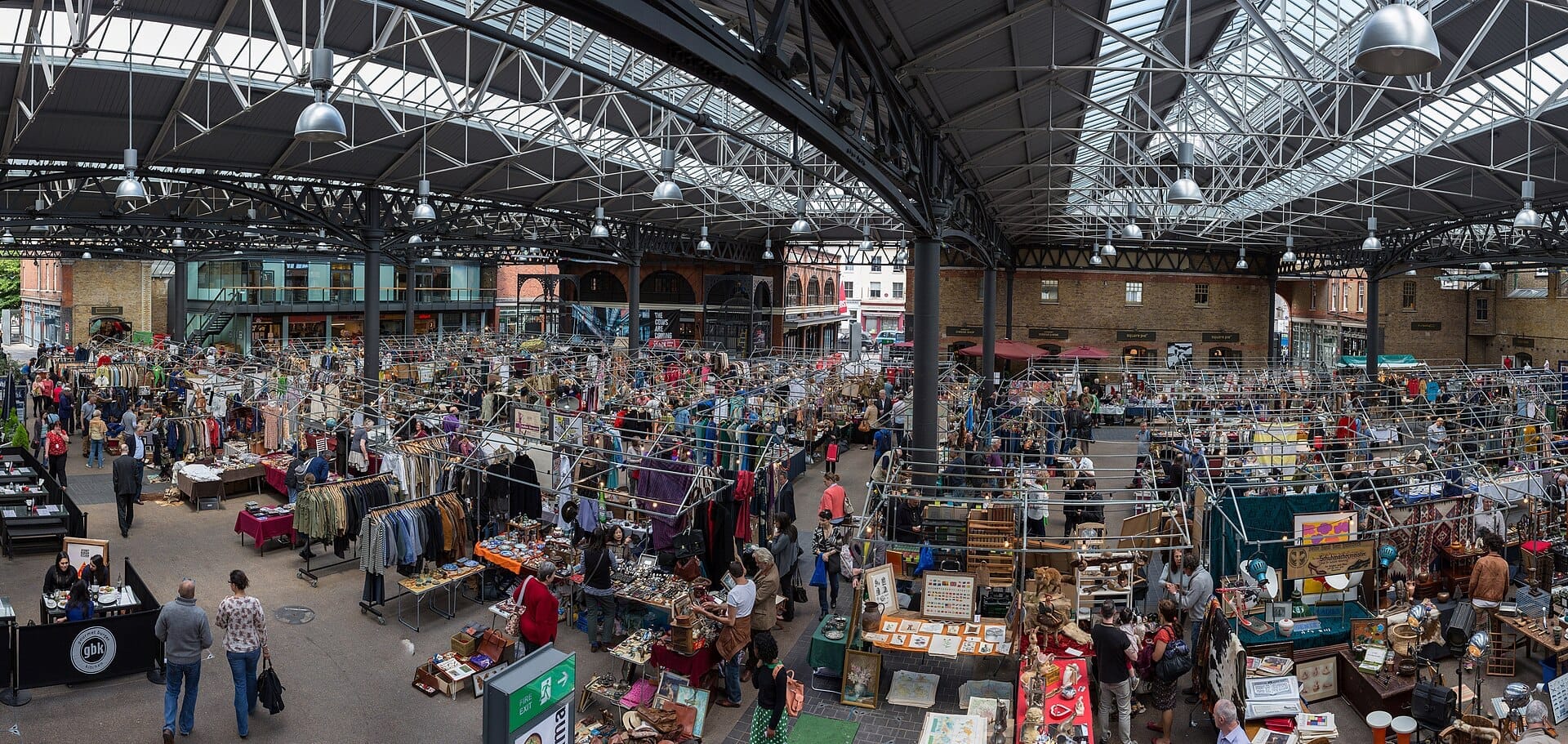
Old Spitalfields Market occupies a handsome Victorian market hall in the heart of east London, a few minutes on foot from Liverpool Street station. Trading on this site dates back to the 17th century, including a 1638 licence from King Charles I to sell produce on Spital Fields. The current Horner Buildings, begun in the late 19th century, served as a wholesale fruit and vegetable market for over a century before the traders relocated to a new site in Leyton in 1991. Since then, the building has been sensitively redeveloped, and today it hosts independent fashion designers, vintage sellers, artisan food stalls, jewellery makers, and a permanent food court called The Kitchens.
The market runs every day of the week, which makes it more accessible than most London markets, but the character shifts noticeably depending on the day. Sundays draw the largest crowds and the widest variety of traders. Thursdays have a distinctly antique and vintage focus, with dealers setting up from 8am. Weekday visits offer a quieter, more browse-friendly experience, though the permanent food court and surrounding restaurants are open throughout.
💡 Local tip
If browsing is your priority rather than people-watching, a Tuesday or Wednesday morning visit offers the same atmosphere with noticeably fewer crowds and easier access to stalls.
The Architecture: What the Building Tells You
The Victorian market hall is the feature most visitors underestimate. The original 1875 structure by Robert Horner uses a series of ornate iron columns and a high glazed roof to create a space that feels cathedral-like in its proportions. Light falls across the trading floor in shifting patterns throughout the day, making morning visits feel particularly atmospheric when the sun is low. Look up and you will notice the ironwork detailing that distinguishes this kind of late-Victorian civic infrastructure from a generic covered shopping centre.
A later extension by Foster + Partners added a contemporary glass canopy to the eastern end of the site, providing additional covered space without trying to replicate the Victorian aesthetic. The contrast works better than you might expect, and the seating areas in this section are a good place to eat if you buy from The Kitchens.
The market sits on Horner Square, surrounded by Brushfield Street to the south and Elder Street to the north. Brushfield Street itself is worth a slow walk: it retains some of the Georgian terraced buildings that characterise this part of Spitalfields, and the contrast between the 18th-century brickwork, the Victorian market hall, and the glass towers of Liverpool Street visible above the rooflines gives the area a layered quality that photography struggles to capture.
Tickets & tours
Hand-picked options from our booking partner. Prices are indicative; availability and final rates are confirmed when you complete your booking.
Soho Instagram a self-guided walking tour to top photo spots
From 6 €Instant confirmationFree cancellationTootbus London by Night: Bus tour
From 32 €Instant confirmationFree cancellationIFS Cloud Cable Car Ride and Uber Boat Hop-on Hop-off 1 Day Ticket
From 38 €Instant confirmationFree cancellationThe Making of Harry Potter Guided Tour of London Warner Bros. Studio
From 201 €Instant confirmationFree cancellation
How the Market Changes Through the Day
On weekday mornings, the market hall is calm enough to examine individual stalls without jostling. Traders are often more willing to talk about their work, whether that is a silversmith explaining the stones in a ring or a printer describing the process behind a screenprinted poster. The smell of coffee from multiple vendors hits you almost immediately as you enter from the Liverpool Street side, and The Kitchens begin service from 11am.
By midday on weekends, the volume changes entirely. The acoustics of the iron-and-glass roof amplify conversation into a general hum, the food queues lengthen, and the central walkways fill with visitors navigating stroller traffic and photography stops in equal measure. Weekend afternoons are enjoyable if you do not mind crowds, but if your goal is considered shopping rather than atmosphere-soaking, arrive before 11am.
The market closes earlier on Sundays (17:00 compared to 18:00 on weekdays and Saturday), and traders begin packing down around 30 minutes before closing. Arriving in the final hour on any day means reduced stock and less engagement from sellers.
⚠️ What to skip
The market is covered but the sides are open to the street, so it can feel cold in winter. Bring an extra layer if visiting between November and March.
What You Can Buy (and Eat)
The trader mix leans heavily toward independent and small-batch makers. On a typical visit you might find hand-dyed scarves, ceramic tableware, vintage leather jackets, limited-edition prints, handmade candles, and jewellery that ranges from fashion-forward to antique. The quality is uneven, as it is at any market, but the proportion of original work is higher here than at many of London's more tourist-oriented markets.
The Kitchens food court offers a permanent selection of vendors with seating, and the cuisine spans several continents. On market days, additional food stalls operate in the main hall. The overall food offer here is solid rather than exceptional, but it is convenient and covers most dietary requirements. For serious eating, the streets immediately around the market reward exploration: Brushfield Street, Commercial Street, and the wider Spitalfields area have a strong independent restaurant scene. The Brick Lane street food corridor is a short walk east and worth combining with a market visit.
Thursday is the specific day to come if vintage is your focus, when an antiques and vintage market operates from 8am with dealers setting out glassware, ceramics, books, clothing, and miscellaneous antiques. The early morning light, the smell of old paper and polished brass, and the relative quiet of a weekday morning make this arguably the most characterful version of the market. Serious vintage buyers arrive at opening.
Getting There and Getting Around
Liverpool Street station is the most convenient access point, served by the London Underground (Central, Circle, Hammersmith & City, and Metropolitan lines), National Rail services, and the Elizabeth line. From the station, exit onto Bishopsgate and walk north; Horner Square is about five minutes on foot. Shoreditch High Street on the Overground is a seven-minute walk and suits visitors arriving from the north. For broader context on navigating London by public transport, see the guide to getting around London.
Several bus routes stop on Brushfield Street (route 67) and on Primrose Street nearby (routes 8, 26, 35, 78, 135, 149, 205, 242, 388), making the market accessible from most parts of central and east London without needing the Tube. Cycling is a viable option: the streets around Spitalfields have cycle infrastructure, and several docking stations for Santander Cycles are within a few minutes of the market.
The market floor is generally level and navigable, though the weekend crowds can make pushchair or wheelchair navigation through the central aisles slow during peak hours. The food court area at the eastern extension tends to be slightly less congested and has more accessible seating.
The Surrounding Neighbourhood
Old Spitalfields Market sits at the meeting point of several distinct east London worlds. To the west is the City of London, visible in the form of glass towers that rise above the Georgian rooflines of Spitalfields. To the east, Brick Lane runs through a neighbourhood shaped by successive waves of Huguenot, Jewish, and Bangladeshi settlement, each layer visible in the buildings, the food, and the street names. The area rewards slow walking.
Directly adjacent to the market, Christ Church Spitalfields (designed by Nicholas Hawksmoor and completed in 1729) rises with an authority that stops most visitors mid-step. It is one of the finest Baroque churches in England and contrasts sharply with the surrounding commercial activity. A few streets north, Shoreditch offers independent galleries, street art, and a concentration of cafes and bars that makes the area worth extending your visit into the afternoon.
If you are building a longer east London day, Columbia Road Flower Market runs on Sunday mornings nearby, though it closes by mid-afternoon. Combining both markets on a Sunday is a common approach, though note that the crowds on both sites peak simultaneously around midday.
Worth Knowing: Strengths and Limitations
Old Spitalfields Market has genuine strengths: a remarkable building, free entry, daily opening, and a trader mix that is meaningfully different from the chain retail that surrounds it. For first-time visitors to London wanting a quick sense of the independent east London creative scene, it delivers efficiently and without requiring advance planning.
The limitations are real too. On busy weekends, the market can feel like a thoroughfare rather than a browsing destination, particularly for visitors arriving between noon and 3pm. The food offer, while competent, does not justify a dedicated journey if eating well is the primary goal. And compared to the rawer atmosphere of some other London markets, Spitalfields has a polished, curated quality that some visitors find less characterful. That is not a criticism so much as a calibration: know what you are coming for.
Travellers who find markets overwhelming, who are visiting specifically for one-of-a-kind antique finds (Thursday excepted), or who struggle with uneven paving and cobblestone surroundings may find the experience less satisfying. The market is also not well suited to large group visits on weekends, when coordinating movement through crowded aisles becomes frustrating.
ℹ️ Good to know
Opening hours: Mon–Wed, Fri–Sat 10:00–18:00; Thu 08:00–18:00; Sun 10:00–17:00. The Kitchens food court opens at 11:00 daily (closing at 18:00 Mon–Sat, 17:00 Sun). Entry is free.
Insider Tips
- Thursday is the antique and vintage specialist day, with dealers arriving from 8am. If that is your focus, go early on a Thursday rather than joining the weekend crowds.
- The Foster + Partners eastern extension has better natural light for photography than the older Victorian section. If you are shooting the architecture, afternoon light through the western entrance of the Victorian hall is the most dramatic angle.
- Brushfield Street, running along the market's southern edge, has some of the best-preserved Georgian shopfronts in east London. Most visitors walk straight past them heading for the market entrance.
- Christ Church Spitalfields is free to enter and runs regular lunchtime concerts. Check the schedule before visiting: combining a concert with a market visit makes for an unexpectedly memorable afternoon.
- The market's trader roster rotates, particularly for weekend pop-ups. Check the official site or social media the week of your visit if you are coming specifically to see a particular designer or maker.
Who Is Old Spitalfields Market For?
- Independent shoppers looking for jewellery, fashion, and design work outside the mainstream retail circuit
- Architecture enthusiasts interested in Victorian iron-and-glass market halls and their 21st-century adaptations
- East London day-trippers combining the market with Brick Lane, Shoreditch street art, and surrounding Georgian streets
- Thursday morning antique hunters who want a quieter, more specialist vintage experience
- Families with children who need covered, free, and easily exitable spaces on unpredictable weather days
Nearby Attractions
Other things to see while in Shoreditch & the East End:
- Brick Lane
Brick Lane cuts through the heart of East London, carrying five centuries of immigrant history in its curry houses, beigel shops, and covered markets. Free to explore, endlessly varied, and best experienced on a Sunday morning with the market in full swing.
- Queen Elizabeth Olympic Park
Built for the 2012 Summer Olympic and Paralympic Games, Queen Elizabeth Olympic Park transformed a former industrial wasteland in Stratford into about 247 acres of parkland, wetlands, and world-class sporting venues. Entry to the open spaces is free, and the park now functions as a genuine neighbourhood green space as much as a tourist destination.
- Victoria Park
Opened in 1845 for the working-class communities of the East End, Victoria Park is one of London's earliest purpose-built public parks and still its most democratic. Covering 86 hectares in Tower Hamlets, it draws over 9 million visitors a year with its lakes, gardens, sports facilities, summer festivals, and a particular kind of unhurried neighbourhood energy that larger, more central parks rarely manage.
- Whitechapel Gallery
The Whitechapel Gallery has been at the forefront of contemporary art since 1901, bringing major international exhibitions to the heart of East London. With free entry to most displays, late-night Thursdays, and a building worth studying in its own right, it rewards curious visitors far more than its low profile might suggest.