Brick Lane: East London's Most Layered Street
Brick Lane cuts through the heart of East London, carrying five centuries of immigrant history in its curry houses, beigel shops, and covered markets. Free to explore, endlessly varied, and best experienced on a Sunday morning with the market in full swing.
Quick Facts
- Location
- Between Whitechapel High Street/Osborn Street and Bethnal Green Road, London Borough of Tower Hamlets
- Getting There
- Aldgate East (District/Hammersmith & City lines) for the south end; Shoreditch High Street Overground for the north end
- Time Needed
- 1–3 hours for a walk; half a day if you browse the Sunday market properly
- Cost
- Free to enter as a public street; Sunday market is free to browse; costs vary for food, shops and events
- Best for
- Street food lovers, vintage hunters, street art fans, culture seekers, weekend explorers
What Brick Lane Actually Is
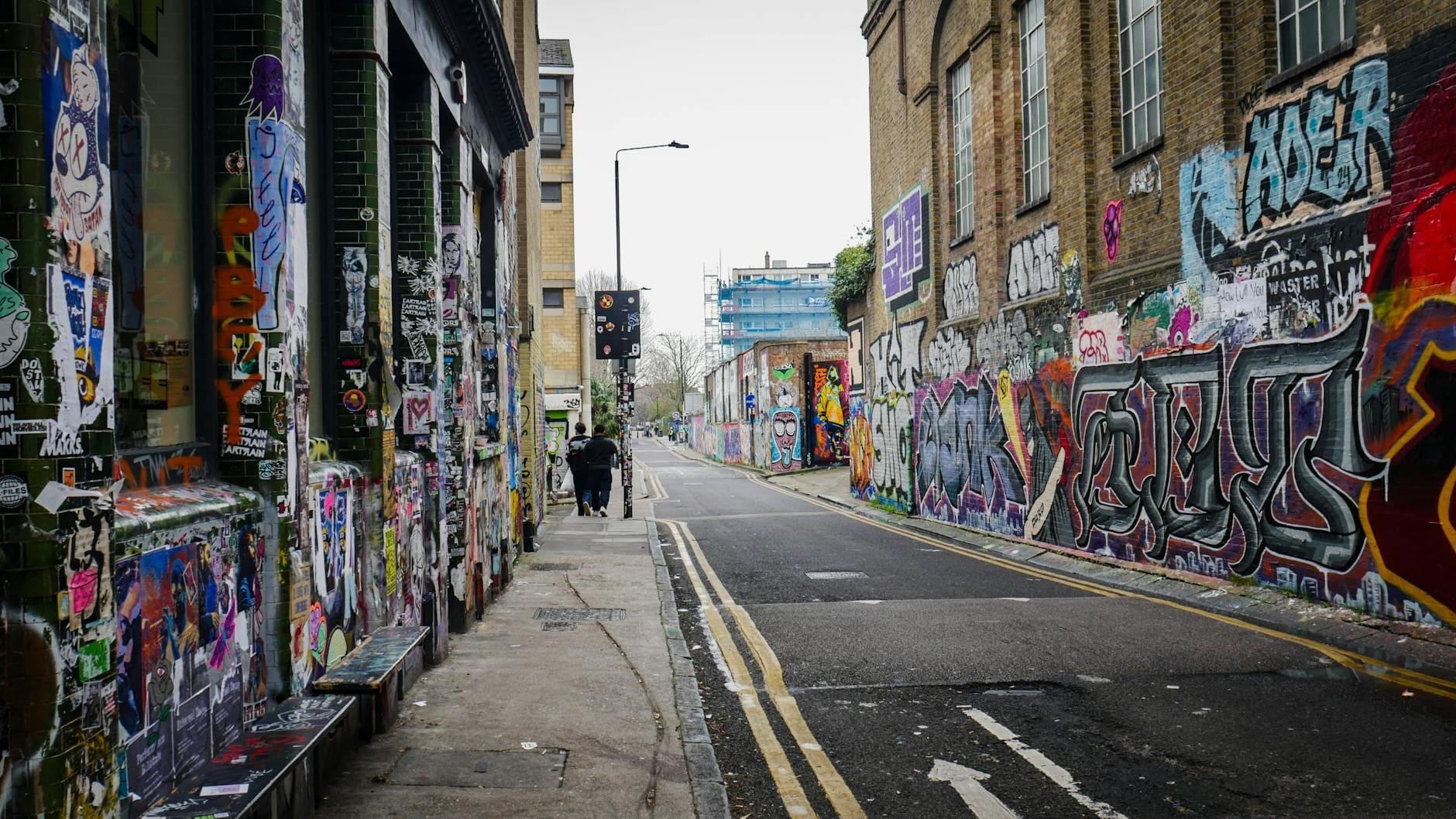
Brick Lane is a roughly north-to-south street about a kilometre long, running from Whitechapel High Street/Osborn Street at its southern tip to Bethnal Green Road in the north. On a map it looks modest. On the ground it is one of the most densely layered streets in London, where a Huguenot church became a mosque after serving as a synagogue, where century-old beigel bakeries operate around the clock next to specialty coffee shops, and where the walls are covered in murals that get painted over and repainted every few months.
It sits inside the London Borough of Tower Hamlets, which places it firmly in East London, adjacent to the Shoreditch creative corridor to the north and the older Whitechapel neighbourhood to the south. The street itself costs nothing to walk. What you spend depends entirely on what you stop to buy.
💡 Local tip
Sunday is the main event. The street market runs roughly 10:00–18:00 on Sundays, and the surrounding lanes fill with additional traders. Weekdays are quieter but still worthwhile for the food and architecture.
A Street Built from Other People's Cities
The name Brick Lane appears in records from around 1550, when the area was open land used for clay extraction to make bricks and tiles. After the Great Fire of London in 1666 destroyed much of the medieval city, demand for building materials surged and the lane's identity became fixed to the industry that gave it its name.
The first significant wave of refugees to settle here were French Huguenots, Protestant craftsmen who fled religious persecution in France after the revocation of the Edict of Nantes in 1685. They established a Huguenot chapel on the corner of Fournier Street, in the building now known as the Jamme Masjid mosque. As the Huguenots prospered and moved outward, Jewish communities from Eastern Europe took over the same streets from the late 19th century. The building became a synagogue. By the 1970s and 1980s, a large Bangladeshi and Sylheti community had settled in the area, transforming the lower half of the street into what is now informally called Banglatown. The building became a mosque. It remains one today.
That single building at the corner of Fournier Street and Brick Lane is the most compressed piece of London social history you will find anywhere in the city. It is not heavily signposted and easy to walk past, which makes pausing to look at it all the more satisfying. The formal recognition of Banglatown is visible in the bilingual English and Bengali street signs throughout the southern half of the lane.
For a broader understanding of how immigration shaped this part of East London, the Whitechapel Gallery nearby and the Old Spitalfields Market a few streets to the west both offer strong context, and either can be combined with a Brick Lane visit in a single half-day.
Tickets & tours
Hand-picked options from our booking partner. Prices are indicative; availability and final rates are confirmed when you complete your booking.
Bubble Planet Immersive Experience with VR Technology
From 31 €Instant confirmationSoho Instagram a self-guided walking tour to top photo spots
From 6 €Instant confirmationFree cancellationTootbus London by Night: Bus tour
From 32 €Instant confirmationFree cancellationIFS Cloud Cable Car Ride and Uber Boat Hop-on Hop-off 1 Day Ticket
From 38 €Instant confirmationFree cancellation
The Sunday Market: What to Expect
On Sunday mornings, the street and the courtyards around the Old Truman Brewery fill with a mix of vintage clothing rails, independent food stalls, handmade goods, and second-hand furniture sellers. Arrive before 11:00 if you want to browse at a pace that feels enjoyable rather than combative. By midday, crowds thicken considerably, particularly around the food court inside Backyard Market and the outer lanes.
The market is not a single organised event with a ticket booth. It is an accumulation of traders who set up along the street itself, inside the Truman Brewery complex, and in the surrounding alleyways. The quality varies significantly. You will find good vintage pieces mixed in with mass-produced items dressed up as independent work. Spending time looking before committing to anything pays off.
The smells shift as you walk north. Around the southern end, cardamom and coriander dominate, spilling from the Bangladeshi curry houses and spice shops. In the brewery courtyard, the air carries frying onions, fresh bread, and occasionally the yeasty sweetness of craft beer from nearby taps. On cold mornings, the steam from food stalls rises visibly and the lane takes on a sensory density that is difficult to find anywhere else in London.
ℹ️ Good to know
The Old Truman Brewery on Brick Lane was once one of the largest breweries in the world. The Victorian brick complex now houses independent shops, galleries, event spaces, and the Sunday Upmarket. Entry to browse is free.
Street Art: A Gallery That Never Closes
Brick Lane and the streets that branch off it, particularly Hanbury Street, Sclater Street, and the alleys around the Truman Brewery, form one of London's most active street art corridors. Pieces appear and disappear on a cycle of weeks or months, which means no visit is identical to the last. Some of the most significant works in recent street art history have appeared on these walls.
The concentration is highest in the northern section and the side streets rather than the main strip itself. Turning left or right off Brick Lane onto streets like Grimsby Street or Chance Street reveals murals on a scale that would not look out of place in a commercial gallery. Morning light from the east makes the stretch along the Truman Brewery's rear wall particularly worth photographing in the first two hours after sunrise.
This street art scene is part of what defines the broader Shoreditch and East End creative character. The Shoreditch and East End neighbourhood guide covers the wider area in more detail, including how to connect the street art walk to nearby galleries and independent venues.
Food: The Real Reason Most People Come
The curry houses along the southern half of Brick Lane are famous enough to have become a cliché, which has made some of them lazy. A few establishments employ touts who step into your path outside, offering fixed-price menus and deals that feel aggressive. The restaurants that do this are rarely the ones worth eating at. Walk past them and look for places with a queue or a full dining room rather than an empty one being loudly promoted.
At the northern end, Beigel Bake at 159 Brick Lane operates 24 hours a day, seven days a week, and has done so for decades. The salt beef beigel, with yellow mustard and a small scoop of pickles, costs only a few pounds and is one of the more authentic things you can eat in this city. There is usually a short queue. It moves quickly. Get there at 2am on a Saturday and the queue is longer but the experience is stranger and arguably better.
The Sunday market's food section in the Truman Brewery courtyard rotates traders frequently. Ethiopian, Japanese, South American, and Turkish options all appear regularly alongside the more predictable street food standards. Prices are fair for London, typically in the range you would expect for market food.
⚠️ What to skip
Avoid restaurants with aggressive doorstep touting along the curry house strip. A full dining room at 7:30pm is a much better signal of quality than a deal shouted at you from the pavement.
Practical Walkthrough: Getting There and Getting Around
The two most useful Underground stops are Aldgate East on the District and Hammersmith and City lines, which drops you at the southern end of Brick Lane near the curry house stretch, and Shoreditch High Street on the London Overground, which brings you in from the north end near the market and street art. Liverpool Street station on the Central, Circle, Hammersmith & City, and Metropolitan lines, plus National Rail and Elizabeth line services, is about a 10 to 12 minute walk from the lane and useful if you are already on the Elizabeth line or National Rail.
Bus routes 8, 242, and 388 serve the surrounding area. The lane itself is flat and fully walkable. Cobbled sections exist in some of the side streets around the Truman Brewery, so trainers or flat shoes are more practical than heels if you intend to explore the alleyways.
Accessibility at street level is broadly manageable, as Brick Lane is a standard London street with paved footpaths and controlled crossings. Individual market stalls, shops, and the older parts of the Truman Brewery vary significantly in step-free access. If step-free entry to specific venues matters, it is worth checking with each directly before visiting.
Brick Lane works well as part of a broader East End day. Pair it with a morning at Columbia Road Flower Market on Sundays, or build it into a walking route through Spitalfields, which takes you past Old Spitalfields Market and towards the City. The London walking tours guide outlines several self-guided routes that include this stretch.
When to Visit and What Weather Does to the Experience
Brick Lane functions in all weather but changes character significantly depending on conditions. On a warm Sunday in late spring or early summer, the brewery courtyard fills to capacity, music spills from open doors, and the street itself becomes crowded by early afternoon. That energy is real but the trade-off is queue lengths and reduced browsing space.
In autumn and winter, the market continues but outdoor traders thin out and the indoor sections of the Truman Brewery become the focus. Rain drives people inside and concentrates activity in fewer spaces. The curry houses and beigel shops are unaffected by weather and arguably more appealing when it is cold. The street art is better photographed on overcast days when harsh shadows are absent.
Weekday mornings are the quietest time on Brick Lane. The restaurants and cafes are open, the beigel shops never close, and the street has a working-neighbourhood feel that is different from the weekend performance. If you are visiting mid-week, you see a version of Brick Lane that most tourists miss.
For broader context on timing a London visit, the best time to visit London guide covers seasonal crowds, weather patterns, and event calendars across the city.
Who Might Not Enjoy It
Brick Lane on a Sunday afternoon is crowded, loud in patches, and requires a tolerance for the unpredictable. Travellers looking for a curated or peaceful cultural experience will find it frustrating. The market quality is inconsistent, and the most hyped restaurants on the strip are not necessarily the best. If you are expecting a polished attraction with clear signage, structured routes, and guaranteed quality, this is not the right place.
Families with very young children in pushchairs will find navigation difficult on market Sundays when the pavement is at capacity. Weekday visits are considerably easier for anyone who needs more space.
Insider Tips
- Turn off the main lane onto Hanbury Street, Grimsby Street, or the alleys behind the Truman Brewery for the densest concentration of street art. The main strip itself has relatively little compared to the surrounding network of side streets.
- Beigel Bake at 159 Brick Lane is open 24 hours. The salt beef beigel is the order. It costs roughly the same as, or a bit more than, most London vending machine snacks and tastes significantly better.
- The building at the corner of Brick Lane and Fournier Street has served sequentially as a Huguenot chapel, a Methodist chapel, a Jewish synagogue, and now a mosque. It is unlabelled and easy to miss. It is arguably the single most historically loaded building on the street.
- If you want to photograph the murals without people walking through your frame, arrive on the street before 9:00am on a Sunday. By 10:30am the lanes fill quickly.
- The best curry house indicator is a full dining room at peak hours, not a deal shouted from the door. Walk the strip first, look through the windows, and then choose.
Who Is Brick Lane For?
- Street food and curry enthusiasts who want depth and variety over comfort
- Vintage and second-hand shoppers with patience for inconsistent market quality
- Street art and urban photography enthusiasts who want an evolving outdoor gallery
- Cultural history travellers interested in immigrant communities and layered London identity
- Weekend explorers who want to combine market browsing with a broader East End walking day
Nearby Attractions
Other things to see while in Shoreditch & the East End:
- Old Spitalfields Market
Old Spitalfields Market is one of east London's most enduring landmarks, a historic market hall on a site where trading dates back to the 17th century. Today it blends independent designers, street food traders, and a rotating programme of themed market days under a magnificent 19th-century iron-and-glass roof. Entry is free, the atmosphere is lively without being overwhelming, and the surrounding streets of Shoreditch and Spitalfields reward further exploration.
- Queen Elizabeth Olympic Park
Built for the 2012 Summer Olympic and Paralympic Games, Queen Elizabeth Olympic Park transformed a former industrial wasteland in Stratford into about 247 acres of parkland, wetlands, and world-class sporting venues. Entry to the open spaces is free, and the park now functions as a genuine neighbourhood green space as much as a tourist destination.
- Victoria Park
Opened in 1845 for the working-class communities of the East End, Victoria Park is one of London's earliest purpose-built public parks and still its most democratic. Covering 86 hectares in Tower Hamlets, it draws over 9 million visitors a year with its lakes, gardens, sports facilities, summer festivals, and a particular kind of unhurried neighbourhood energy that larger, more central parks rarely manage.
- Whitechapel Gallery
The Whitechapel Gallery has been at the forefront of contemporary art since 1901, bringing major international exhibitions to the heart of East London. With free entry to most displays, late-night Thursdays, and a building worth studying in its own right, it rewards curious visitors far more than its low profile might suggest.