Victoria and Albert Museum: What to See, When to Go, and How to Make the Most of It
The Victoria and Albert Museum in South Kensington houses over 4.5 million objects spanning 5,000 years of art, design, and craft. Entry to the permanent collection is free, and a single visit barely scratches the surface. Here is what you actually need to know before you go.
Quick Facts
- Location
- South Kensington, Kensington & Chelsea, London
- Getting There
- South Kensington (Circle, District, Piccadilly lines) — 3-minute walk
- Time Needed
- 2–4 hours minimum; could absorb a full day
- Cost
- Free (permanent collection); ticketed temporary exhibitions vary
- Best for
- Design enthusiasts, fashion history lovers, architecture admirers, families with older children
- Official website
- www.vam.ac.uk
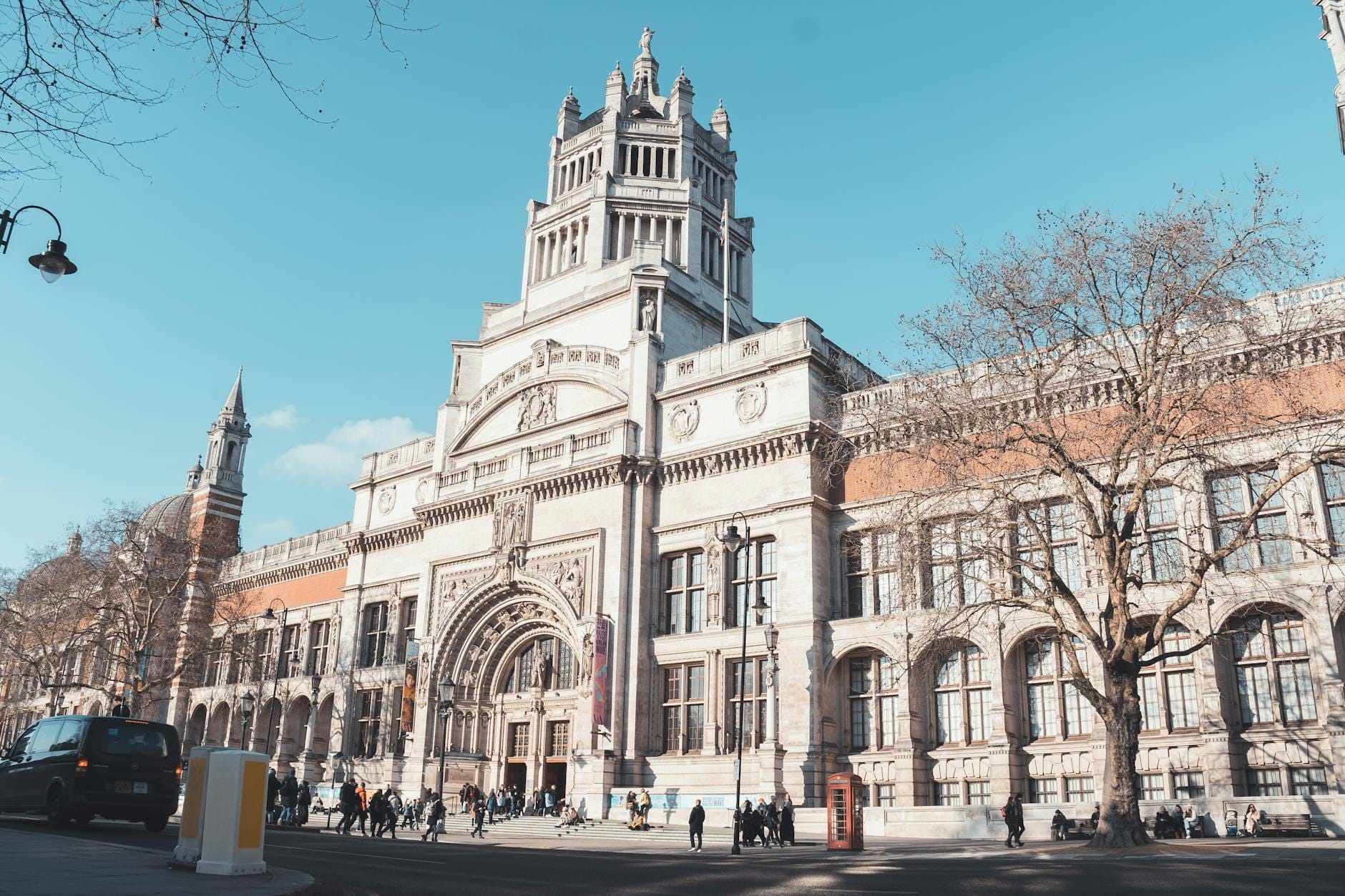
What the Victoria and Albert Museum Actually Is
The Victoria and Albert Museum, universally known as the V&A, is one of the world's largest museums of decorative arts and design. Founded in 1852 as the Museum of Manufactures and later renamed in honour of Queen Victoria and Prince Albert, it began developing its current South Kensington site in 1857, with the striking terracotta facade visitors see today completed in 1909. The collection runs to over 4.5 million objects across its sites — ceramics, textiles, jewellery, furniture, sculpture, fashion, photography, architecture, metalwork, and digital design all coexist under the same roof.
The breadth is both the museum's great strength and its single biggest challenge for visitors. There is no single narrative thread pulling you from room to room the way a natural history museum might guide you from dinosaurs to mammals. The V&A is more like a city than a building: you need to decide which neighbourhood you want to explore, because you will not see everything.
💡 Local tip
Download the free V&A floor plan before you arrive and pick two or three galleries to prioritise. Trying to see everything without a plan leads to decision fatigue before lunch.
The Building Itself: Why It's Worth Slowing Down
Most visitors walk through the main entrance on Cromwell Road and head straight for the galleries, never pausing to absorb the architecture. That is a mistake. The entrance hall features a mosaic floor that dates to the 1870s, and the John Madejski Garden at the centre of the building — a large courtyard with a shallow reflecting pool — is one of central London's quieter outdoor spaces, almost unknown to anyone outside the neighbourhood.
The Raphael Court, the Medieval and Renaissance galleries, and the ironwork staircase off the main rotunda are each worth five minutes of standing still and looking upward. The building was designed partly as a teaching aid: the decorative elements on the walls and ceilings are themselves objects of applied art, not just containers for objects. In the early morning light, when visitor numbers are low, the quality of silence in the larger galleries is something the photographs on social media never capture.
The V&A sits in the middle of one of London's densest museum clusters. The Natural History Museum is immediately adjacent to the west, and the Science Museum is a two-minute walk beyond that. If you have a full day in the area, plan at least a brief look at all three exteriors, even if you only go deep inside one.
Tickets & tours
Hand-picked options from our booking partner. Prices are indicative; availability and final rates are confirmed when you complete your booking.
Jack The Ripper guided walking tour in the Victorian London
From 16 €Instant confirmationFree cancellationHamilton, the musical experience at Victoria Palace Theatre
From 152 €Instant confirmationWarner Bros. Studio Tour London – The Making of Harry Potter from London Victoria
From 114 €Instant confirmationFree cancellationSoho Instagram a self-guided walking tour to top photo spots
From 6 €Instant confirmationFree cancellation
How the Experience Changes by Time of Day
Arriving when the museum opens at 10:00 on a weekday is the clearest route to a calm experience. The Fashion gallery, the Jewellery gallery, and the Cast Courts are all navigable without crowds at this hour. By 11:30, school groups begin to arrive in the lower galleries and the cafe queue extends through the main hall.
Weekend afternoons between roughly 13:00 and 15:30 are the busiest period. The main entrance hall can feel congested, and popular rooms like the Cast Courts — where enormous plaster reproductions of Trajan's Column and Michelangelo's David fill a Victorian vaulted space — attract a steady flow of visitors who linger. If you are visiting at the weekend, arrive at opening or after 15:30 when families with younger children begin to leave.
Friday evenings the museum stays open until 22:00, and from roughly 18:00 the atmosphere shifts entirely. The café and the courtyard bar serve alcohol, the school groups are gone, and the permanent galleries become unusually contemplative spaces. The Fashion gallery at 20:30 on a Friday, with its dramatically lit display cases and sparse visitors, is one of the more unusual experiences the London museum circuit offers.
ℹ️ Good to know
The V&A is open daily, 10:00–17:45 (last entry 17:15), with Friday late opening until 22:00. Hours for specific galleries and temporary exhibitions may differ. Always check the official website before visiting, especially around public holidays.
The Galleries Worth Prioritising
The Fashion gallery on level 0 is one of the strongest single rooms in London. It runs chronologically from roughly 1600 to the present day and balances grand historical dress with 20th-century couture. The lighting is low to protect the textiles, which gives the room a slightly theatrical quality. Allow at least 45 minutes.
The Cast Courts, also on level 0, divide visitors neatly into those who find them extraordinary and those who find them slightly unsettling. Two Victorian iron-framed halls contain full-scale plaster casts of major European sculptures and architectural features — including a reproduction of the 30-metre Trajan's Column, cut in two to fit the ceiling height. The premise is that in the 19th century, most people could never travel to see the originals. The casts were the next best thing. Today they occupy a strange position: simultaneously less authentic than the originals and considerably more accessible.
The Jewellery gallery, located on level 3, holds one of the world's most significant collections of European jewellery from 3000 BCE to the present. It is quieter than the lower galleries and tends to attract visitors with specific interests rather than casual browsers. The Medieval and Renaissance rooms on level 2 and 3 contain furniture, tapestries, sculpture, and metalwork of the kind that fills major European castles — exhibited here with more space and better lighting than most of those castles provide.
For context on how the V&A fits within London's broader cultural landscape, the best museums in London guide covers the full picture across the city, including the British Museum, the National Gallery, and several smaller institutions worth knowing about.
Photography, Access, and What to Bring
Personal photography without flash is permitted throughout most of the permanent collection, and the museum's photogenic quality — particularly in the Cast Courts and the Fashion gallery — makes it a draw for visitors who photograph interiors seriously. Tripods require prior permission. Some temporary exhibitions restrict photography; check signage at each entrance.
The museum is largely accessible for wheelchair users, with lifts connecting the main levels. Some older parts of the building involve steps where lifts are not immediately obvious; the V&A's visit pages provide current accessibility maps and details. Families with pushchairs should enter via the Exhibition Road entrance, which has a more spacious lobby and easier access to the lifts. The museum provides baby-changing facilities and is generally well-equipped for visitors with children, though the content skews better for children aged eight and above than for toddlers.
💡 Local tip
The V&A's café in the main building is a Victorian dining room worth seeing in its own right — the Gamble Room, the Poynter Room, and the Morris Room are decorated with original tilework and painted panels from the 1860s and 70s. It is among the earliest purpose-built museum restaurants in the world, and lunch here is a legitimate reason to visit, not just a convenience.
Temporary Exhibitions and What They Cost
The permanent collection is free. Temporary exhibitions carry a separate charge, typically in the range of £15–£25 per adult, though prices vary and are set per exhibition. The V&A runs four to six major temporary shows per year, covering topics from specific designers and architects to broader cultural movements. Past exhibitions on subjects like David Bowie, Alexander McQueen, and Dior drew very large numbers; booking in advance for any high-profile show is strongly advisable.
If you are visiting London on a constrained budget, you can have a full and worthwhile visit to the V&A without paying anything beyond transport. The permanent galleries alone represent a multi-hour experience. The temporary exhibitions are additions rather than the core offering, and many visitors skip them entirely.
For visitors trying to manage costs across multiple major attractions, the London Pass occasionally includes exhibition access at certain venues, though the V&A permanent collection does not require it. The free things to do in London guide lists the V&A alongside the other major free national museums.
Getting There and the Surrounding Area
South Kensington Underground station on the Circle, District, and Piccadilly lines is the standard approach. The station exit on Pelham Street brings you to a pedestrian tunnel that leads directly toward the museum complex — a covered walkway lined with food vendors and, at the weekend, occasional musicians. The walk from the station to the main Cromwell Road entrance takes about three minutes.
Several bus routes serve Exhibition Road and Cromwell Road, including the 14, 74, and 414. If you are arriving from central London, the 14 from Piccadilly is a direct connection. For visitors staying in west London or travelling from Paddington or Notting Hill, the Tube to South Kensington is faster than most alternatives.
The neighbourhood of Kensington and Chelsea contains several other significant attractions within walking distance, including Kensington Palace and Hyde Park, both reachable on foot in under 15 minutes from the museum.
The Exhibition Road area is largely uncongested by London standards, and the streets between the museum complex and Hyde Park make for a pleasant walk in good weather. In rain, the covered tunnel from South Kensington station and the museum's interior spaces make this a particularly practical wet-day destination.
Insider Tips
- The John Madejski Garden — the courtyard at the centre of the building — has deck chairs in summer and is almost entirely unknown to visitors who don't seek it out. It is one of the calmest places to sit in this part of London.
- The museum's Friday late opening (until 22:00) is not heavily advertised and draws far smaller crowds than daytime visits. The bar in the courtyard opens from 18:00, and the permanent galleries become tranquil by 20:00.
- If you want to visit the Cast Courts without a crowd, go on a weekday morning within the first hour of opening. By 11:00, tour groups begin to fill the space and the acoustic properties of the vaulted ceiling mean noise levels rise quickly.
- The V&A shop near the main entrance sells design objects, prints, and books that are well-curated rather than the generic souvenir merchandise common at major attractions. It is worth browsing even if you are not a buyer.
- Temporary exhibition tickets sell out for the most popular shows weeks in advance. If there is a specific exhibition you want to see, book your timed entry slot through the official website as soon as dates are released, not when you arrive in London.
Who Is Victoria and Albert Museum For?
- Design and fashion history enthusiasts who want to see objects, not just read about them
- Architecture lovers drawn to Victorian institutional building at its most ambitious
- Travellers with a rainy afternoon who need a substantial indoor destination in west London
- Adults looking for a different Friday evening in London without paying for a ticketed event
- Families with children aged eight and above who have an interest in art, craft, or history
Nearby Attractions
Other things to see while in Kensington & Chelsea:
- Chelsea Physic Garden
Founded in 1673 by the Worshipful Society of Apothecaries, Chelsea Physic Garden is a four-acre walled enclosure in the heart of Chelsea containing over 4,500 medicinal, edible, and historically significant plants. It is the second-oldest botanic garden in Britain and one of the quietest places you will find in central London.
- The Design Museum
Housed in the dramatically restored former Commonwealth Institute building on Kensington High Street, the Design Museum is one of Europe's most respected institutions dedicated to design, architecture, fashion, and product innovation. Entry to the permanent collection is free, while rotating exhibitions draw on names from global creative culture.
- Harrods
Founded in 1849 and occupying over a million square feet in Knightsbridge, Harrods is as much a London spectacle as it is a shop. Whether you're browsing the Food Halls or shopping the designer floors, here's exactly what to expect.
- Hyde Park
Hyde Park is one of London's eight Royal Parks, covering 142 hectares in the heart of the city. Free to enter, open until midnight, and rich in history stretching back to a Tudor hunting ground, it rewards visitors who pace themselves and explore beyond the obvious.