Shekou sits at the southern tip of the Nantou Peninsula in Nanshan District, facing Hong Kong across Shenzhen Bay. Once the site of China's earliest foreign-investment experiments, it has evolved into Shenzhen's most internationally oriented neighborhood, mixing waterfront leisure, ferry connections to Hong Kong and Macau, and a food scene that runs from Sichuan noodle shops to European wine bars.
Shekou is where Shenzhen faces the sea. Positioned at the southern edge of Nanshan District, this compact waterfront subdistrict carries more international energy than almost anywhere else in the city, shaped by decades of foreign investment, a large expat community, and ferry links to Hong Kong that make it a natural arrival and departure point for the wider Pearl River Delta.
Orientation
Shekou is a subdistrict within Nanshan District, occupying the southernmost point of the Nantou Peninsula. To the north and northwest, it borders the Zhaoshang and Yuehai subdistricts. The rough boundaries run along Fuwan Road and Wanghai Road to the north, Gongye 1st Road and Gongye 3rd Road to the east, and Nanhai Avenue and Taizi Road marking the inner edges before the land meets the water. South and west of those streets, the district opens onto Shenzhen Bay, with Dongjiaotou forming the southwestern tip where Shenzhen Bay Port sits.
Within the broader city, Shekou is part of the Nanshan corridor that stretches from the tech campuses near Tencent headquarters in the north all the way down to the ferry terminals in the south. It sits well to the west of Luohu and Futian, which are the more traditional commercial cores of Shenzhen. That distance from the older urban center is part of what gives Shekou its distinct pace: it does not feel like a business district, even though it contains serious infrastructure.
Nanshan District as a whole is one of the most dynamic parts of the city. Reading more about Nanshan's wider character and key attractions helps put Shekou in context, particularly for travelers deciding between staying near the tech corridor versus the waterfront.
ℹ️ Good to know
Shekou is served by Metro Line 2. The Sea World station is the central hub for most visitors, with the Shekou Ferry Terminal a short walk to the southwest. Shenzhen Bay Port, a separate road border crossing to Hong Kong, is located at Dongjiaotou further along the waterfront.
Character and Atmosphere
Shekou has a quality that is genuinely unusual in Shenzhen: it slows down. The streets around Sea World Plaza are wide and relatively tree-lined, the pace of foot traffic is easier than in the commercial intensity of Huaqiangbei or the CBD towers of Futian, and the presence of international schools, foreign consulate staff, and long-term expat residents gives the area a lived-in quality that is different from most of the city's newer districts.
Mornings in Shekou are quiet by Shenzhen standards. The residential lanes behind the main commercial strip see older residents doing tai chi in small parks, and local breakfast spots serve congee and fried dough alongside the coffee shops that cater to the international crowd. By mid-morning the ferry terminal area picks up as travelers arrive from Hong Kong and Macau, rolling luggage through the plaza and fanning out into taxis or metro connections.
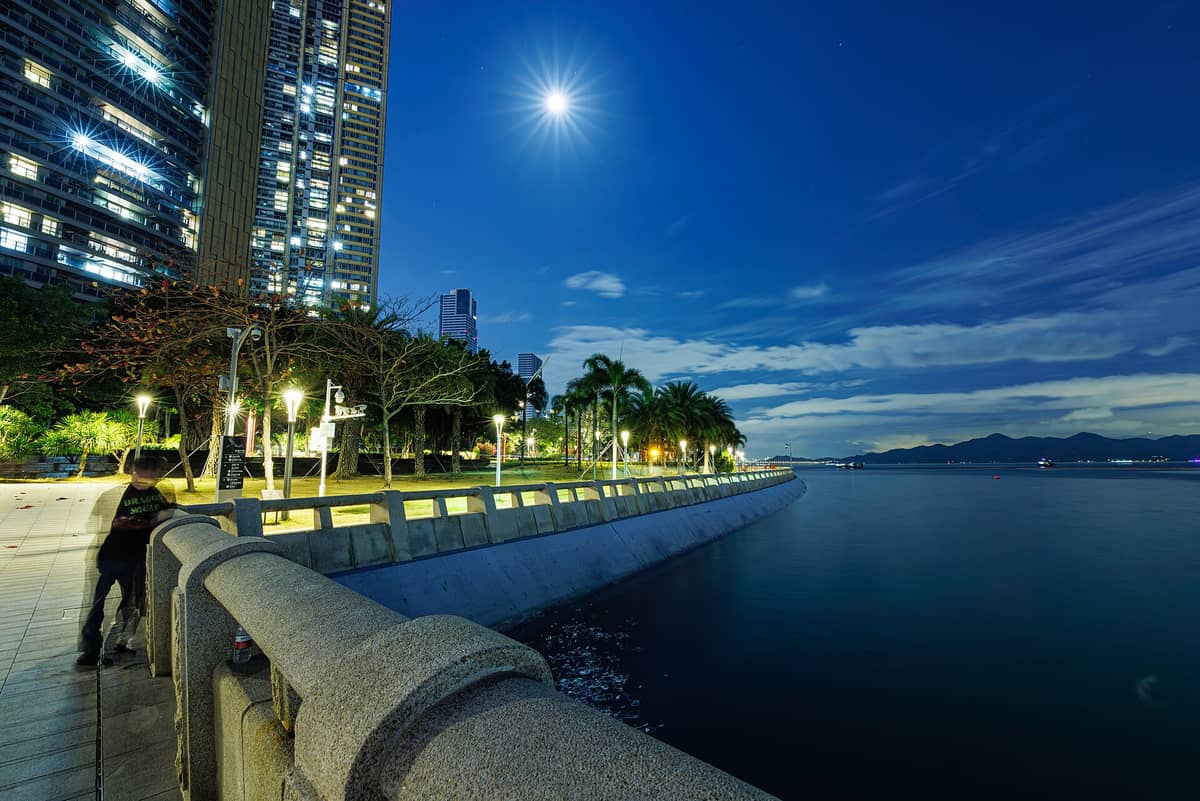
Afternoons are best spent along the waterfront. The light over Shenzhen Bay in the hours before sunset has a particular quality, with the water reflecting the industrial haze in ways that are photogenic rather than grim. Sea World Plaza fills with families and couples in the early evening, and the restaurants and bars lining the square begin to animate after 6pm. Weekend nights draw a noticeably mixed crowd: Chinese families, expat groups, tourists arriving from or heading to Hong Kong. The energy is relaxed rather than loud.
Weekday afternoons in the residential pockets away from the waterfront feel almost suburban. The streets between Gongye 1st Road and the water are narrow enough that a single delivery truck can block traffic entirely, and small convenience stores and barbershops occupy ground floors of apartment blocks that were built during Shekou's first decades of development. This older urban fabric contrasts sharply with the gleaming towers visible along Nanhai Avenue.
What to See and Do
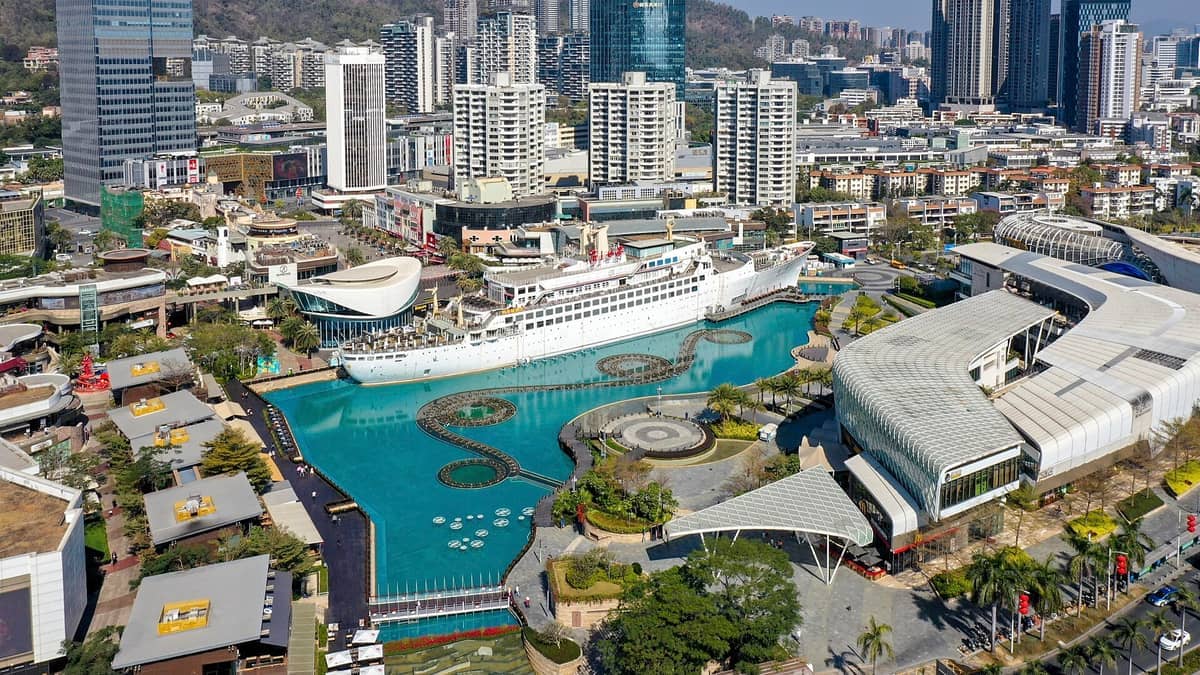
The centerpiece of Shekou's leisure offer is Sea World Plaza, a waterfront development built around a permanently moored cruise ship, the Ming Hua, which now houses restaurants and event spaces. The plaza itself is one of the more photogenic public spaces in western Shenzhen, particularly in the early evening when the lights from the ship reflect across the water. It functions as both a local gathering point and a landmark recognizable enough to orient visitors arriving for the first time.
The Shekou Ferry Terminal, a short walk from Sea World station, is not just a transit point but a genuine neighborhood landmark. The terminal building has been upgraded in recent years and handles ferry services to Hong Kong International Airport, the Hong Kong China Ferry Terminal in Tsim Sha Tsui, and Macau. For travelers doing a Pearl River Delta loop, the ability to arrive by train from the north and depart by ferry to Hong Kong in the same afternoon is a genuine convenience. Even if you are not catching a ferry, walking through the terminal area and down to the waterfront promenade gives a clear sense of Shekou's identity as a port district.
Shenzhen Bay Port at Dongjiaotou is a road and pedestrian border crossing to Hong Kong, distinct from the ferry terminal. It handles vehicle and foot traffic, is accessible by metro, and is worth knowing about as an alternative Hong Kong crossing, especially late in the day when the Luohu rail crossing is congested.
Shekou sits within easy reach of several larger Nanshan attractions. Nantou Ancient City, a walled settlement with over 1,700 years of recorded history, is a short taxi or bus ride north. To the southwest, Shenzhen Bay Park stretches along the waterfront toward Futian and offers one of the city's best cycling and walking paths with unobstructed bay views.
Sea World Plaza and the Ming Hua cruise ship: waterfront dining and photography
Shekou Ferry Terminal: connections to Hong Kong and Macau
Shenzhen Bay Port: road crossing to Hong Kong at Dongjiaotou
Waterfront promenade walks along Shenzhen Bay
Day trips north to Nantou Ancient City or west along the bay to Shenzhen Bay Park
💡 Local tip
If you are planning a day trip to Hong Kong from Shenzhen, the Shekou Ferry Terminal is often more convenient than the rail crossings at Luohu or Futian, especially if your Hong Kong destination is the airport or Kowloon. Ferries run regularly but book ahead during public holidays and Golden Week.
Eating and Drinking
The food scene in Shekou is the most internationally diverse in Shenzhen. The area around Sea World Plaza and the streets running north toward Taizi Road have a concentration of restaurants that spans cuisines from across Europe, Southeast Asia, the Middle East, and Japan, alongside a full range of Chinese regional cooking. This is largely a product of the long-established expat community: the restaurants that survive here do so because international residents eat in them regularly, not just because tourists pass through.
For Chinese food, the options range from Cantonese seafood restaurants along the waterfront to smaller Sichuan and Hunan spots tucked into the side streets behind the main plaza. Dim sum is available at multiple spots within walking distance of the metro, and the quality is generally high by city standards. Street food is less concentrated here than in areas like Dongmen in Luohu, but small noodle shops and breakfast stalls operate in the residential lanes during morning hours.
The drinking scene around Sea World skews toward wine bars and craft beer venues, catering to the expat crowd that has shaped the neighborhood for decades. Several bars with outdoor terracing operate into the late evening on weekends, and the atmosphere is noticeably more relaxed than the karaoke and nightclub culture found in other parts of the city. If you are looking for a quieter evening drink with a view of the water, this is one of the better options in Shenzhen.
For travelers wanting to understand Shenzhen's full food geography, the Shenzhen food guide covers the city's best eating neighborhoods in depth, including how Shekou compares to the older food streets of Luohu and the seafood clusters of Yantian.
ℹ️ Good to know
Price expectations in Shekou run slightly higher than the Shenzhen average, particularly for restaurants around Sea World Plaza. A meal at a mid-range international restaurant will typically cost 80-150 CNY per person. Local Chinese spots in the residential streets are significantly cheaper. All prices should be verified locally as they change frequently.
Getting There and Around
Shekou is served by Shenzhen Metro Line 2, which runs east-west across the city and connects the area to Futian, Luohu, and the rest of the metro network. Sea World station is the primary stop for the plaza, the ferry terminal, and most of the restaurants and hotels in the area. The ferry terminal itself is approximately 800 meters southwest of the station, a walk that takes around ten minutes on flat ground. Shenzhen Bay Port at Dongjiaotou is further west and is best reached by taxi or bus from Sea World station.
From Futian CBD, Line 2 connects directly to Sea World in around 30 minutes. From Luohu, a transfer is typically required. For travelers arriving from Shenzhen Bao'an International Airport, a combination of metro lines connects to Sea World, though journey times are significant and a taxi or Didi may be more practical depending on luggage and time of day. The complete guide to getting around Shenzhen covers all transit options in detail, including how to navigate the metro with English-language apps.
Within Shekou, most points of interest are walkable from Sea World station. The neighborhood is compact and flat, and the waterfront promenade is accessible on foot from the plaza. Taxis and Didi are readily available for reaching Nantou Ancient City or Shenzhen Bay Park to the east. Cycling is a practical option along the bay path if you are heading toward Futian.
Travelers arriving from Hong Kong by ferry will find themselves at the Shekou Ferry Terminal, from which Sea World station is a short walk. For those crossing at Shenzhen Bay Port by foot, a bus or taxi to Sea World takes under 15 minutes. The guide on crossing from Hong Kong to Shenzhen covers all the border options including the ferry route in detail.
⚠️ What to skip
Shenzhen Bay Port is a full border crossing with immigration and customs controls. Carry your passport and ensure your visa documentation is in order before approaching. Crossing times can be slow during rush hours on weekday mornings and evenings, and significantly slower on public holidays. The ferry terminal is generally faster for tourist arrivals.
Where to Stay
Shekou offers a reasonable range of accommodation, concentrated mainly around the Sea World area. International hotel brands operate in the district, and the proximity to the ferry terminal makes it a practical base for travelers who plan to move between Shenzhen and Hong Kong or Macau. It is not the cheapest part of Shenzhen to stay, but the waterfront setting and the relative calm of the neighborhood justify the premium for many visitors.
The neighborhood suits travelers who want a less hectic base than Luohu or Futian, who plan to use the ferry connections regularly, or who are visiting the Nanshan tech corridor and prefer a waterfront address over a business district hotel. It is a good fit for couples, solo travelers with an interest in the international food scene, and anyone arriving from or departing to Hong Kong. Families will find the Sea World area manageable, though the neighborhood overall lacks the specific child-focused attractions found in other parts of the city.
For a broader view of the city's accommodation options across different neighborhoods, the where to stay in Shenzhen guide compares Shekou with Futian, Luohu, Nanshan, and other districts by traveler type and budget.
Shekou in Context: Strengths and Drawbacks
Shekou works well as a neighborhood for a specific type of Shenzhen visit. Its strengths are real: the ferry connections are useful, the international food scene is the best in the city, the waterfront setting is attractive, and the pace is easier than the commercial intensity of central Shenzhen. For travelers doing a Hong Kong to Shenzhen day trip or short stay, arriving by ferry into Shekou and exploring outward from there is a logical approach.
The drawbacks are equally real. Shekou is not where you go to understand the core of Shenzhen's story. The electronics markets of Huaqiangbei, the older border-town energy of Luohu, and the sheer scale of the Futian CBD are all more representative of what made this city what it is. Shekou's international character, which is its main selling point for foreign visitors, also means it can feel somewhat removed from the city around it. The older residential areas behind the waterfront have some character, but they are not particularly scenic.
Travelers trying to cover Shenzhen efficiently in a short trip might consider using Shekou as an entry or exit point via the ferry rather than a primary base. The two-day Shenzhen itinerary works Shekou into a broader city circuit alongside Futian, Nanshan, and the OCT district, which gives a more complete picture of the city than staying in any single neighborhood alone.
TL;DR
Shekou is one of Shenzhen's most internationally oriented neighborhoods, shaped by its history as an early special economic zone and a large long-term expat population.
The Shekou Ferry Terminal provides ferry connections to Hong Kong and Macau, making it a convenient neighborhood for cross-border travelers.
Sea World Plaza is the social and commercial heart of the area, with the best concentration of international restaurants and bars in Shenzhen.
Metro Line 2 connects Shekou to the rest of the city, with Sea World station as the central hub, though journey times to eastern districts like Luohu are longer than from Futian.
Best suited to travelers who want a relaxed waterfront base, value international dining and drinking options, or are using the ferry connections as part of a wider Pearl River Delta trip. Less ideal for those wanting to experience the more typical pace and texture of Chinese urban life in Shenzhen.
Two days in Shenzhen is enough to move through its most distinct neighbourhoods, from the electronics labyrinth of Huaqiangbei to the coastal parks of Nanshan and the art spaces of OCT Loft. This itinerary is built around the metro, keeps mornings efficient, and leaves room for the food and nightlife that most guides gloss over.
Shenzhen's climate is subtropical and unforgiving in summer. This guide breaks down every season clearly, from the ideal October–December window to the typhoon risks of July–September, so you can plan your trip around real conditions rather than brochure weather.
Shenzhen sits at the centre of one of the most connected corners of Asia. Within a few hours, you can reach Hong Kong, Guangzhou, Zhuhai, Macau, and the coastal villages of Dapeng. This guide covers the best day trips from Shenzhen with realistic travel times, transport logistics, and clear assessments of what each destination actually offers.
Shenzhen delivers far more than its reputation as a tech-and-shopping city. From coastal greenways and hilltop parks to art districts and Ming Dynasty fortresses, a remarkable amount of the city costs nothing to explore. This guide covers the best free attractions across every district.
Shenzhen has one of the most extensive metro systems in China, plus buses, taxis, and ride-hailing to fill the gaps. This guide breaks down every transport option, from airport arrival to cross-city metro trips, so you can move around confidently from day one.
Getting from Hong Kong to Shenzhen is straightforward once you know which crossing suits your itinerary. This guide covers every route — high-speed rail, MTR foot crossings, and 24-hour options — with realistic queue times, operating hours, and practical advice for first-timers.
Shenzhen is one of China's most misunderstood cities. It's not just a tech showcase or a shopping stopover from Hong Kong. This guide cuts through the clichés to help you decide if Shenzhen belongs on your itinerary, and what to prioritize if it does.
Shenzhen built more supertall skyscrapers in 40 years than most cities manage in a century. This guide covers the key landmarks, the best districts for architectural exploration, observation decks, design culture, and practical tips for getting around the skyline.
Chinese New Year in Shenzhen is neither a ghost town nor a nonstop party — it's something more interesting than either. This guide covers the real rhythm of the city during Spring Festival: which events are worth your time, how crowds shift, what actually closes, and how to make the most of one of China's most distinctive holiday periods.
Shenzhen has built one of China's most serious contemporary art ecosystems in under four decades. This guide covers the key museums, gallery districts, and creative spaces — from OCAT Shenzhen to Dafen Oil Painting Village — with practical details on getting there, what to expect, and when to visit.
Huaqiangbei is the world's largest electronics market district, but navigating it without a plan is a recipe for overpaying or leaving empty-handed. This guide covers which buildings to visit, realistic price expectations, negotiation strategy, payment methods, and practical advice on what is cheap versus what only looks like a deal.
Shenzhen's food scene reflects its identity as a migrant city: no single ancient cuisine, but an extraordinary range of Cantonese, Hakka, Teochew, Hunan, Sichuan, and international cooking all under one roof. This guide covers the dishes worth seeking out, the neighborhoods to find them in, and the practical details that make eating here genuinely easy.
Shenzhen is far more than tech malls and theme parks. This guide takes you to the ancient fortresses, artist communities, coastal trails, and architectural wonders that most visitors walk straight past.
Shenzhen surprises most visitors with the quality and variety of its hiking. Within the city limits you'll find a 944-meter mountain summit, a 15-kilometer coastal greenway, dramatic clifftop sea trails, and forested urban parks. This guide covers the best of all of them.
Shenzhen at night is more varied than most visitors expect. This guide breaks down the city's top nightlife districts by vibe and budget, covering rooftop bars, live music venues, megaclubs, and late-night food streets — with metro directions, realistic price ranges, and clear notes on what's worth your time.
Shenzhen is one of the most affordable major cities in Asia for travelers who know where to look. This guide breaks down realistic daily costs, the cheapest transport options, free and low-cost attractions, and the neighborhoods that give you the best value without sacrificing convenience.
Shenzhen takes its reputation as a City of Parks seriously. This guide covers the best parks in Shenzhen across every type, from hilltop viewpoints and wetland boardwalks to beach trails and sprawling botanical gardens.
Shenzhen is China's most concentrated hub of consumer tech, hardware manufacturing, and innovation showrooms. This guide covers the best stops, realistic routes, logistics, and practical advice for planning your own tech tour across Nanshan, Futian, and Huaqiangbei.
Shenzhen is far more than a tech hub. It has world-class theme parks, wildlife reserves, natural history museums, and coastal beaches that make it a genuinely rewarding destination for families. This guide covers the best of it, organized by what works for different ages and energy levels.
Shenzhen is one of Asia's great shopping cities, but it rewards those who know where to go. This guide breaks down the best markets, malls, and districts by category, with clear advice on prices, bargaining, and what's worth buying.
Shenzhen rewards visitors who look beyond the shopping malls. This guide covers the city's best experiences across parks, coastlines, heritage districts, and skyline viewpoints — organized by what kind of traveler you are, with practical details on getting there, what to expect, and what to skip.
Shenzhen has 10 districts and no single obvious center, which makes choosing where to stay genuinely confusing. This guide breaks down the best neighborhoods by trip type, with clear price ranges, metro access notes, and practical trade-offs for each area.