Nantou Ancient City: Shenzhen's Oldest Corner, Reimagined
Nantou Ancient City (南头古城) is Shenzhen's oldest surviving urban settlement, with roots stretching back to the Eastern Jin Dynasty in 331 A.D. Today this 70,000-square-meter walled district in Nanshan blends Ming-era gates and ancestral halls with independent cafes, galleries, and street food — offering a rare counterpoint to Shenzhen's reputation as a city with no past.
Quick Facts
- Location
- 2 Nantou Jiaochang, Shennan Boulevard, Nanshan District, Shenzhen
- Getting There
- Metro Line 1 (Taoyuan Station, Exit B) — approx. 5-min walk
- Time Needed
- 1.5 to 3 hours depending on pace; allow more time if dining or gallery-hopping
- Cost
- Free entry to the public area; some heritage halls or exhibitions may charge separately
- Best for
- History curious visitors, architecture enthusiasts, food explorers, photographers
- Official website
- www.sz.gov.cn/en_szgov/travel/cultural/content/post_1352096.html
What Nantou Ancient City Actually Is
Nantou Ancient City is not a theme park or a polished tourist reconstruction. It is a living, densely occupied urban quarter — a place where people eat breakfast at folding tables under worn awnings, children cut through narrow alleys to school, and a Ming Dynasty gate tower stands a short walk from a specialty coffee roaster. That collision of eras is what makes it genuinely interesting.
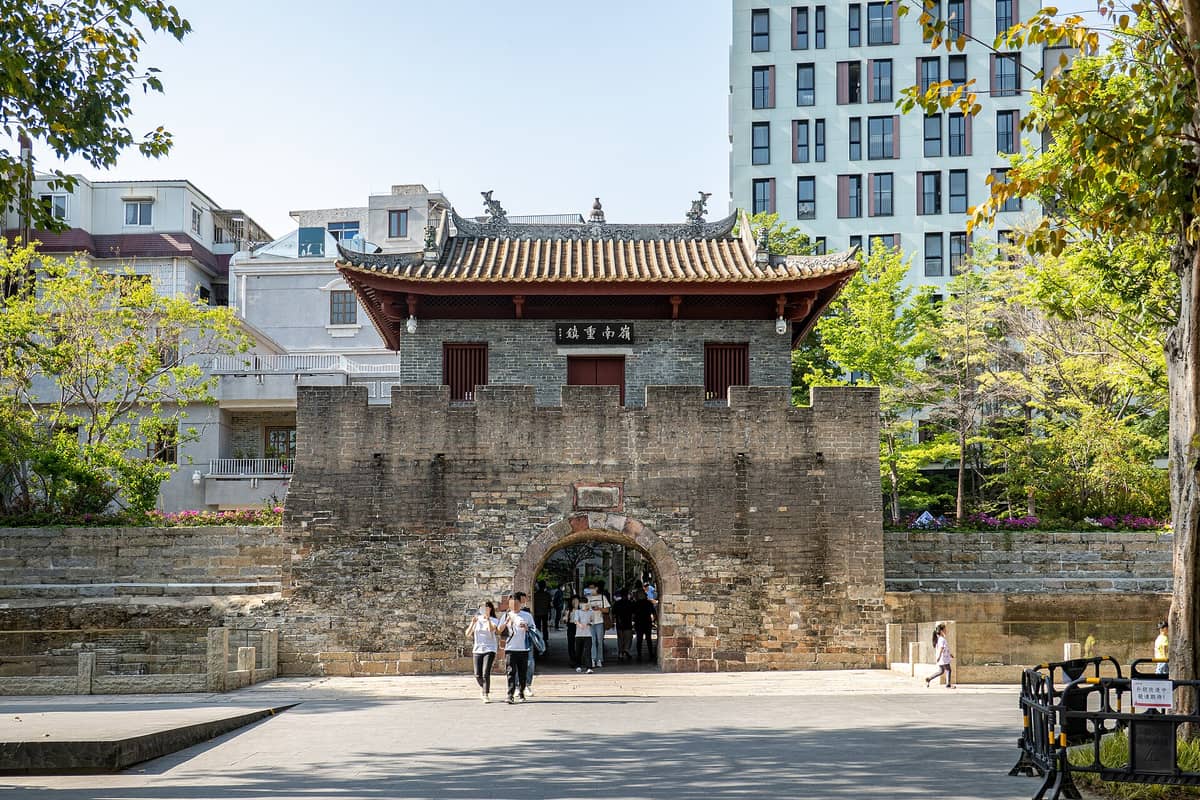
Officially known in Chinese as 南头古城 and sometimes rendered in English as Xin'an Ancient Town or Xin'an Old Town, the site covers approximately 70,000 square meters of Nanshan District. Its history stretches back to 331 A.D., when a regional administrative seat was established here during the Eastern Jin Dynasty — making this patch of Shenzhen nearly 1,700 years old. A separate layer of the site dates to the Ming Dynasty: the current walled compound and its iconic South Gate were built in 1394, and remnants of that fortification are still legible today.
For Shenzhen, a city often described as having appeared from nowhere in the 1980s, this kind of depth is unusual. The broader context is explored inShenzhen's architecture guide, which traces how different eras of the city's built environment coexist.
ℹ️ Good to know
Opening hours are inconsistently reported across sources. The outdoor public areas appear accessible at all times, but specific heritage structures and exhibition halls are typically open from around 10:00 to 20:30, with some sections closed on Mondays. Confirm current hours before planning a heritage-focused visit.
The Landscape of the Site: What You Will Actually See
The South Gate (南门) is the visual anchor of the site. Walk through it and you are immediately in a narrow main artery lined with shophouses — low, two- or three-story buildings with worn facades, some freshly repainted, some left deliberately unrestored to preserve the texture of age. The ground-floor units now house restaurants, boutiques, and craft studios, but the proportions of the buildings and the rhythm of the lane itself feel nothing like a modern Shenzhen street.
Moving deeper into the compound, the density increases. Side lanes branch off unpredictably. Some lead to ancestral halls with incense smoke drifting through open courtyards. Others open onto small plazas where older residents sit near food carts while younger visitors photograph the layered walls behind them. The Xinmin Public Hall and other heritage structures punctuate the residential fabric without dominating it.
The site is not pristine. Paint peels. Electrical cables cross overhead in dense tangles. Street food smells — scallion oil, grilled skewers, fermented tofu — layer in with the must of old concrete. This is part of the texture of the place. If you are expecting a sanitized heritage precinct, Nantou will surprise you. If you appreciate authentic urban layering, it will reward close attention.
Morning, Afternoon, and Evening: How the Visit Shifts
The experience changes meaningfully by time of day. Early mornings, before 9:00, belong to residents. Street vendors set up outside the gates, the main lane is quiet, and natural light angles low across the gate tower's worn stonework. This is the best time for photography of the architectural fabric without crowds obscuring the details.
By late morning, the cafes and shops open, and a younger, more design-conscious crowd begins to arrive. The mix of visitors peaks on weekend afternoons, when the main lane becomes badly congested. The food stalls do strong business, queues form at popular restaurants, and the atmosphere shifts from reflective to sociable. Weekend afternoons are fine for atmosphere but poor for unhurried exploration of the heritage structures.
After sunset the site takes on another character entirely. String lights appear on several stretches of the main lane. Bars and evening food stalls replace the daytime snack vendors. The gate tower is lit from below, and its silhouette against the Nanshan skyline is one of the better visual juxtapositions in the city. If you are visiting primarily for atmosphere and photographs, a weekday evening is a strong choice.
💡 Local tip
For the best balance of good light and manageable crowds, arrive on a weekday morning around 9:30. You will catch the heritage structures in low golden light and have the main lane largely to yourself before the lunch crowd arrives.
Historical and Cultural Context
Understanding Nantou requires a short detour through regional history. The site's origins in the Eastern Jin Dynasty (317–420 A.D.) make it contemporaneous with the administrative development of what is now the Pearl River Delta region. For roughly 1,500 years, the area around present-day Nanshan was a functioning county seat — Xin'an County — governing a territory that included what is now both Shenzhen and Hong Kong. When the British leased the New Territories in 1898, the administrative functions shifted, and Nantou's centrality gradually faded.
The Ming-era walls, built in 1394 during the Hongwu reign, were designed as part of a coastal defense network against piracy. The South Gate that visitors pass through today is a remnant of that fortification system. By the time Shenzhen's rapid development began in the 1980s, Nantou was already a dense, low-income urban village — a pattern common across the city where pre-existing villages became absorbed into the expanding urban fabric without being demolished.
This overlap of historical periods within one city block is what gives Nantou its character. It is, in microcosm, the story of Shenzhen's relationship with its own past. TheShenzhen Museumin Futian provides useful background on this broader history before or after a visit.
Getting There and Moving Through the Area
The most direct transit route is Metro Line 1 to Taoyuan Station, then Exit B, followed by approximately a five-minute walk north. Metro Line 12 also provides access, with a dedicated Nantou Ancient City Station, making it even more straightforward if you are traveling from elsewhere in the metro network. Zhongshan Park Station on Line 1 is another option depending on your specific approach.
If you are combining Nantou with other Nanshan attractions, the district is well-connected.Sea World Plazain Shekou is accessible within 20 to 30 minutes by metro, andOCT Loft— another creative district in the area — is a natural pairing for those interested in contemporary culture alongside history.
Within the site itself, navigation is straightforward at the main artery level but can become disorienting in the side lanes. There are directional signs for the key heritage structures, mostly in Chinese with some English. The site is not large enough to get seriously lost in, but a loose sense of direction is helpful. Wear comfortable flat shoes — the paving is uneven in parts, and some thresholds have raised stone steps.
⚠️ What to skip
No verified wheelchair accessibility information is available for the interior of the site. The main lane is paved and relatively flat, but side alleys and heritage building entries often have steps and narrow doorways. Visitors with mobility requirements should assess access carefully on arrival.
Food, Shopping, and What Stays With You
The food scene inside Nantou is one of its strongest features. Cantonese snacks sit alongside Hunan-style grills, craft beer bars, and specialty coffee. The resident population and the younger creative crowd that the site now attracts have produced a diverse, informal dining culture rather than a curated food court. Prices are moderate — noticeably lower than comparable creative districts in Futian or the bay area.
The independent retail inside Nantou is varied: vintage clothing, locally designed ceramics, photography prints, and small-batch food products all have a presence. It is not a shopping destination in the conventional sense, but browsers will find things of interest. For a different kind of Shenzhen retail experience,the Huaqiangbei electronics marketin Futian offers a complete contrast in scale and character.
The lasting impression Nantou leaves is one of productive contradiction. A city this young should not have this kind of historical weight. A neighborhood this old should not feel this alive. That tension is not resolved — and that is what makes it worth an afternoon.
Who Will Not Enjoy This
Visitors looking for a fully restored, clearly signed, bilingual heritage experience are likely to find Nantou incomplete. The English signage is sparse, some heritage buildings are in poor repair, and the street-level chaos can feel overwhelming rather than atmospheric to those expecting a quieter museum-style experience. Similarly, anyone visiting on a weekend afternoon during peak hours may find the main lane too congested to appreciate the architecture properly.
Families with very young children may find the site manageable but not particularly tailored to kids. For a more structured family outing,the Shenzhen with kids guideoffers better-suited alternatives.
Insider Tips
- The stretch of lane immediately north of the South Gate is the most photographed area — and the most crowded. If you continue past the main cluster of shops and turn into the smaller residential lanes, you will find quieter architectural details, local life, and almost no other visitors.
- Several of the ground-floor heritage structures are used as temporary exhibition spaces by local artists and institutions. These change frequently and are rarely publicized in English. Walking in without prior research often yields unexpected exhibitions at no cost.
- The gate tower exterior looks best in early morning or at night. Midday overhead light flattens the stonework and removes the shadow detail that makes it visually compelling. Photography in the late-afternoon golden hour from the south side of the gate is particularly effective.
- Payments at most food stalls and smaller shops inside the site require WeChat Pay or Alipay. Cash is accepted at some vendors, but do not assume it. Set up a digital payment method before visiting.
- If you are visiting in October through December — the driest and most comfortable months in Shenzhen — Nantou becomes even more pleasant. Summer visits are possible but the heat and humidity inside the narrow lanes can be intense; bring water and plan to step into air-conditioned cafes frequently.
Who Is Nantou Ancient City For?
- Architecture and history enthusiasts who appreciate unpolished authenticity over reconstructed heritage
- Photographers looking for layered urban texture, particularly in early morning or evening light
- Food explorers seeking a mix of Cantonese street food and independent cafes without tourist-district pricing
- Travelers interested in how Shenzhen negotiates the tension between rapid modernization and its older urban fabric
- Visitors combining a half-day Nanshan cultural itinerary with nearby creative or waterfront districts
Nearby Attractions
Other things to see while in Nanshan:
- Shenzhen Bay Mangrove Nature Reserve
The Futian Mangrove Nature Reserve sits on the northeast shore of Shenzhen Bay, offering free access to boardwalks, bird observation platforms, and one of China's most unusual ecological spaces: a protected national nature reserve embedded inside a major city. It is quiet, photogenic, and worth a morning.
- Shenzhen Bay Park
Stretching along the southwestern shoreline of Nanshan District, Shenzhen Bay Park is a free, 13-kilometre coastal park where mangrove wetlands meet bay views toward Hong Kong. It is one of the few places in the city where the pace drops, the air moves, and the skyline stops competing for attention.
- Shenzhen Safari Park
Shenzhen Safari Park (深圳野生动物园) is one of the largest wildlife parks in southern China, spreading across roughly 1.2 million square meters in the Xili area of Nanshan District. Open since 1993, it draws families and animal lovers looking for a full-day outing away from the city's tech corridors.
- Tanglang Mountain Park
Tanglang Mountain Country Park (塘朗山郊野公园) is a free, 10-square-kilometer nature reserve in Nanshan District. Shaded trails, sweeping views over Shenzhen's tech corridor, and easy metro access make it the most practical urban hike on the west side of the city.