Tanglang Mountain Country Park: Nanshan's Green Escape Above the City
Tanglang Mountain Country Park (塘朗山郊野公园) is a free, 10-square-kilometer nature reserve in Nanshan District. Shaded trails, sweeping views over Shenzhen's tech corridor, and easy metro access make it the most practical urban hike on the west side of the city.
Quick Facts
- Location
- 51 Longzhu Road 6, Longzhu Boulevard, Nanshan District, Shenzhen
- Getting There
- Shuttle from Caitian housing complex with stops at several Line 2 stations
- Time Needed
- 2–4 hours depending on trail choice
- Cost
- Free admission
- Best for
- Hikers, morning exercisers, photographers, families with older children
What Tanglang Mountain Country Park Actually Is
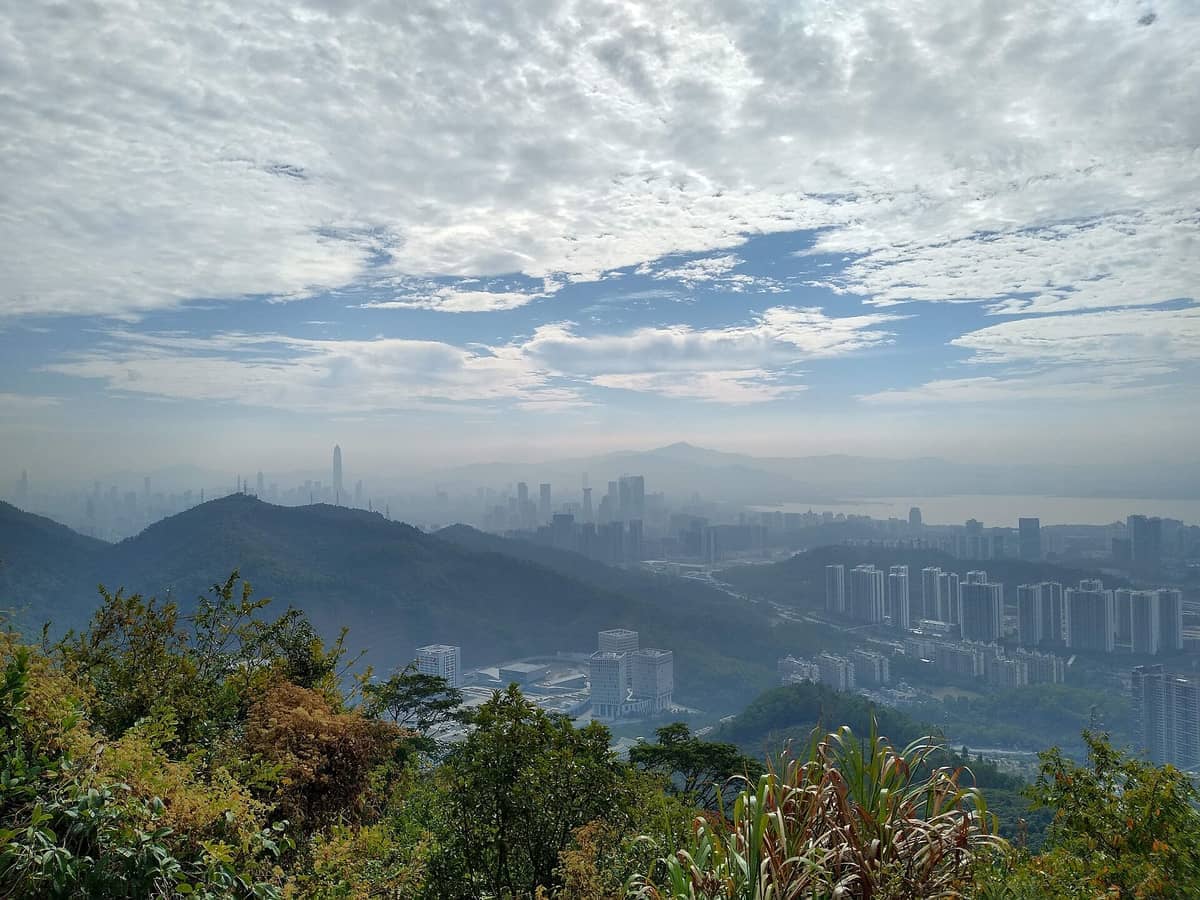
Tanglang Mountain Country Park sits at the northern edge of Nanshan District, one ridge above the glass towers and R&D campuses that define Shenzhen's tech corridor. The park covers roughly 10 square kilometers of subtropical forest, and its trail network connects to elevated viewpoints that take in Shenzhen Bay, the Qianhai financial zone, and on clear days, the outline of Hong Kong's New Territories to the south. Entry is completely free.
Built and formally opened in 2002, the park is classified as a country park (郊野公园), a land-use category that sits between a groomed urban park and a protected nature reserve. The trails are maintained and signed, but the terrain is real enough to require proper footwear. This is not a manicured promenade. The canopy is dense subtropical woodland, and in summer the undergrowth hums with insects and the damp air carries the smell of mossy rock and wet soil after rain.
For context on how Tanglang fits into Nanshan's broader outdoor landscape, see theShenzhen hiking guide, which covers route difficulty and seasonal conditions across the city's main peaks.
Getting There: Metro, Shuttle, and On Foot
The clearest route is Metro Line 7 to Taoyuancun Station, Exit D. From there, the walk to the park entrance along Longzhu 6th Road takes roughly 15–20 minutes on flat ground. The road itself is shaded for part of the route, which matters in summer when midday temperatures can push past 33°C.
A shuttle service also serves the park's base, departing from the Caitian housing complex and making stops at several Line 2 metro stations. This is worth knowing if you are coming from Futian or Luohu, as it removes the walk from the shuttle stop entirely. Check current shuttle schedules locally, as departure times and stops can change.
💡 Local tip
Wear trail shoes or at minimum flat, closed-toe shoes with grip. Paved paths near the entrance give way to packed earth and uneven stone steps higher up. Flip-flops will slow you down and can be genuinely dangerous on wet descents.
If you are new to navigating Shenzhen's metro system, thegetting around Shenzhen guideexplains line transfers, ticketing, and the best apps for real-time navigation.
What the Experience Feels Like, Hour by Hour
Early morning, between 7:30 and 9:00, is when the park belongs to locals. Retired residents do slow stretching exercises near the lower entrance. Groups of friends climb together at a steady pace, chatting quietly. Birdsong is loud enough to hear clearly over footsteps, and the light comes through the canopy in low angled shafts. The air is cooler and the humidity is at its most tolerable.
By mid-morning on weekends, the entrance area fills with families and recreational hikers. The main trails can feel crowded at certain bottlenecks, particularly near photo-stop platforms with city views. If you want the viewpoints to yourself, arrive before 8:00 or come on a weekday. Weekday mornings are noticeably quieter — you can walk for stretches of 20 minutes without passing another person.
Afternoon visits are feasible but require more planning in summer. Between May and September, afternoon temperatures combined with humidity make the climb physically demanding. The trails are mostly shaded, which helps significantly, but exposed ridge sections offer no shelter. Bring at least one liter of water per person. In the cooler months between October and December, afternoon light on the city below is excellent for photography.
The park stays open until 22:00, and some locals do evening walks on the lower, well-lit sections near the entrance. Venturing deep into the trails after dark is not recommended without a headlamp and local trail knowledge.
The Trails and What You See at the Top
Tanglang Mountain Country Park has multiple trail routes at different difficulty levels. The main ascent follows stone steps that climb steadily through increasingly dense forest. The vegetation transitions as you gain elevation: lower sections are mixed subtropical woodland, while higher sections are dominated by species typical of the Pearl River Delta's hill forests, including various pine and eucalyptus stands alongside native cover.
Summit viewpoints look south toward Shenzhen Bay and the Qianhai area, where construction of new financial infrastructure has been ongoing for over a decade. On the clearest days, typically in autumn and early winter, you can identify the hills of Hong Kong's New Territories across the water. The contrast between the dense green below your feet and the dense gray of the city extending in every direction is what makes the climb worth it.
Photography is best in the first two hours after sunrise or the two hours before sunset. The midday haze common in Shenzhen, especially in warmer months, softens the skyline into a gray blur. Bring a lens cloth — the humidity near the top can cloud optics quickly after a rest stop.
⚠️ What to skip
Typhoon season runs from June to September. After a major storm, trails can be damaged by fallen trees and landslides. Check local Nanshan District parks announcements before visiting following any significant weather event. The park may partially close during an active typhoon warning.
Cultural and Urban Context
Tanglang Mountain sits at the edge of one of China's most intensively developed urban districts. Nanshan is home to the headquarters of technology companies, financial firms, and research institutions. The mountain itself has been a geographic boundary and a named landmark in this part of Guangdong for much longer than the city around it has existed.
Shenzhen was a small market town before the establishment of the Special Economic Zone in 1980; the speed of development since then is part of what makes green spaces like Tanglang valued by the city's 18 million residents. The parks network across the city is substantial, and if Tanglang sparks an interest in Shenzhen's outdoor culture, the broaderShenzhen parks guidecovers everything from the formal lakeside parks of Futian to the wilder coastal reserves.
Nanshan itself is worth understanding as a district beyond the mountain. It includes the commercial and leisure waterfront atSea World Plaza, the creative redevelopment zone atOCT-LOFT, and the historic walled settlement atNantou Ancient City. The mountain hike pairs naturally with a full Nanshan day.
Practical Details Before You Go
Opening hours are 7:30 to 22:00 daily. Admission is free. There are no ticket gates at the entrance. The park's official address is 51 Longzhu Road 6, Longzhu Boulevard, Nanshan District.
Facilities near the lower entrance include basic rest areas. Bring snacks and enough water for longer routes. In the cooler October to December window, 500ml per person is usually sufficient for a two-hour hike. In summer, double that.
Accessibility at the lower sections is improved by the shuttle service to the mountain base. The upper trails involve sustained stair climbing and are not wheelchair accessible. Families with young children can enjoy the entrance area and lower paths comfortably; the full summit ascent is better suited to children aged eight and above who are comfortable with long stair sections.
ℹ️ Good to know
The best overall months to visit Shenzhen for hiking are October through December. Temperatures are milder, rainfall drops significantly from the summer monsoon peak, and visibility from ridge viewpoints is at its clearest.
If you are planning a broader Shenzhen itinerary that includes outdoor time, thebest time to visit Shenzhenguide breaks down the seasonal trade-offs in detail.
Who Should Think Twice
Tanglang Mountain Country Park is not the right choice for visitors with very limited time who want a single iconic experience. The views are rewarding but not dramatically different from what Wutong Mountain in the east offers at greater scale, or what elevated city districts provide without the climb. If your schedule is tight and you are choosing between the park and a cultural attraction, the park makes most sense for those who specifically want outdoor exercise or a break from the city's commercial energy.
Visitors who struggle in heat and humidity should be realistic about summer visits. Even with mostly shaded trails, the combination of physical effort and Shenzhen's summer conditions is taxing. The October to December window removes this concern almost entirely.
Insider Tips
- Weekday mornings before 9:00 give you the trails almost entirely to yourself. Weekend mornings, particularly on public holidays, can be crowded at the main viewpoints.
- The shuttle from Line 2 stations is not widely advertised in English-language guides. Asking locally at the Caitian area or checking the Nanshan District government's parks notices will confirm current departure times and stops.
- Autumn haze clears most reliably in the early morning. If your main goal is a clear photograph looking toward Shenzhen Bay and Hong Kong, set your alarm and reach the summit before 8:30.
- Pack a light rain jacket year-round. Afternoon convective storms develop quickly in Shenzhen between April and September, and ridgeline exposure during a downpour is unpleasant and slippery.
- The lower entrance area is a good spot to observe local exercise culture at its most authentic. Older residents practice tai chi, younger groups jog the paved lower loop, and the social atmosphere on weekend mornings is warm and unhurried.
Who Is Tanglang Mountain Park For?
- Hikers and trail runners looking for an accessible workout close to Nanshan's urban core
- Photographers wanting elevated city views outside the standard rooftop-bar circuit
- Travelers spending multiple days in Shenzhen who want a half-day break from shopping and museum visits
- Families with active older children who are comfortable with sustained stair climbing
- Early risers who want to see Shenzhen from above before the midday haze settles in
Nearby Attractions
Other things to see while in Nanshan:
- Shenzhen Bay Mangrove Nature Reserve
The Futian Mangrove Nature Reserve sits on the northeast shore of Shenzhen Bay, offering free access to boardwalks, bird observation platforms, and one of China's most unusual ecological spaces: a protected national nature reserve embedded inside a major city. It is quiet, photogenic, and worth a morning.
- Nantou Ancient City
Nantou Ancient City (南头古城) is Shenzhen's oldest surviving urban settlement, with roots stretching back to the Eastern Jin Dynasty in 331 A.D. Today this 70,000-square-meter walled district in Nanshan blends Ming-era gates and ancestral halls with independent cafes, galleries, and street food — offering a rare counterpoint to Shenzhen's reputation as a city with no past.
- Shenzhen Bay Park
Stretching along the southwestern shoreline of Nanshan District, Shenzhen Bay Park is a free, 13-kilometre coastal park where mangrove wetlands meet bay views toward Hong Kong. It is one of the few places in the city where the pace drops, the air moves, and the skyline stops competing for attention.
- Shenzhen Safari Park
Shenzhen Safari Park (深圳野生动物园) is one of the largest wildlife parks in southern China, spreading across roughly 1.2 million square meters in the Xili area of Nanshan District. Open since 1993, it draws families and animal lovers looking for a full-day outing away from the city's tech corridors.