Ghent vs Bruges: Which Belgian City Should You Visit?
Both cities are medieval, canal-laced, and packed with Flemish history — but they feel completely different on the ground. This guide breaks down the real differences between Ghent and Bruges so you can choose wisely, or plan both.
Plan and book this trip
Tools from our partner Travelpayouts help you compare flights and hotels. If you book through them, we may earn a commission at no extra cost to you.
Flights
Hotels map
TL;DR
- Bruges is smaller, more polished, and far more tourist-heavy — especially in summer. Ghent is a living city of 270,000 people where locals still outnumber visitors.
- The Ghent to Bruges train takes just 22–28 minutes from Gent-Sint-Pieters, making both cities easy to combine on a longer trip — see our 2-day Ghent itinerary for how to structure it.
- Ghent wins on nightlife, student energy, contemporary culture, and year-round appeal. Bruges wins on concentrated medieval scenery and canal romance.
- If you only have one day and want maximum historic impact per square metre, Bruges is efficient. If you want to feel like you've actually been somewhere, Ghent rewards you more.
- Visiting in July? Ghent hosts the Gentse Feesten, one of Europe's largest free street festivals — a decisive advantage over Bruges in midsummer.
The Core Difference: Tourist Town vs Living City
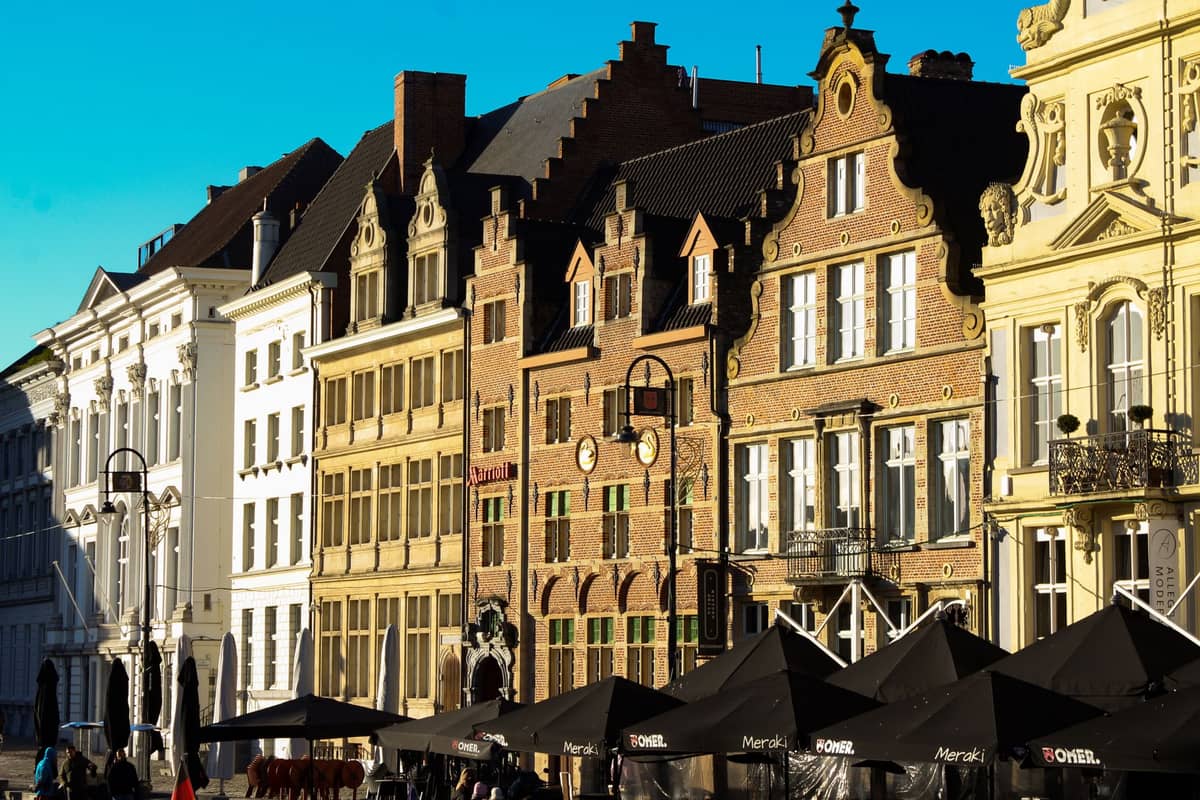
The Ghent vs Bruges debate is often framed as a question of aesthetics, but the more useful distinction is functional. Bruges is a World Heritage-listed medieval city with a permanent population of around 20,000 in its historic core — a place that has, to a significant degree, oriented itself around the visitor experience. Ghent is Belgium's second-largest municipality, home to 270,000 people, two major universities, and an economy that isn't dependent on tourism. That difference shapes everything from the restaurants you'll eat in to the atmosphere on a Tuesday evening in October.
Bruges is genuinely beautiful. The canals, the Belfry, the Markt square, the cluster of late-Gothic architecture — it all holds up. But beauty at that density and that level of international fame comes with a cost: the city centre in peak season can feel like a theme park running at capacity. Horse-drawn carriages queue on cobblestones. Waffles and chocolate shops repeat every 50 metres. Many of the restaurants near the main square are priced for tourists who won't return. Ghent has its own tourist infrastructure, but it remains embedded in a functional Flemish city, and that makes the experience qualitatively different.
ℹ️ Good to know
Neither city is 'better' in an absolute sense. Bruges is excellent for what it is. The question is whether you want a concentrated, photogenic medieval showcase or a historic city that also has a real urban life running alongside it.
Historic Sights: What Each City Actually Offers
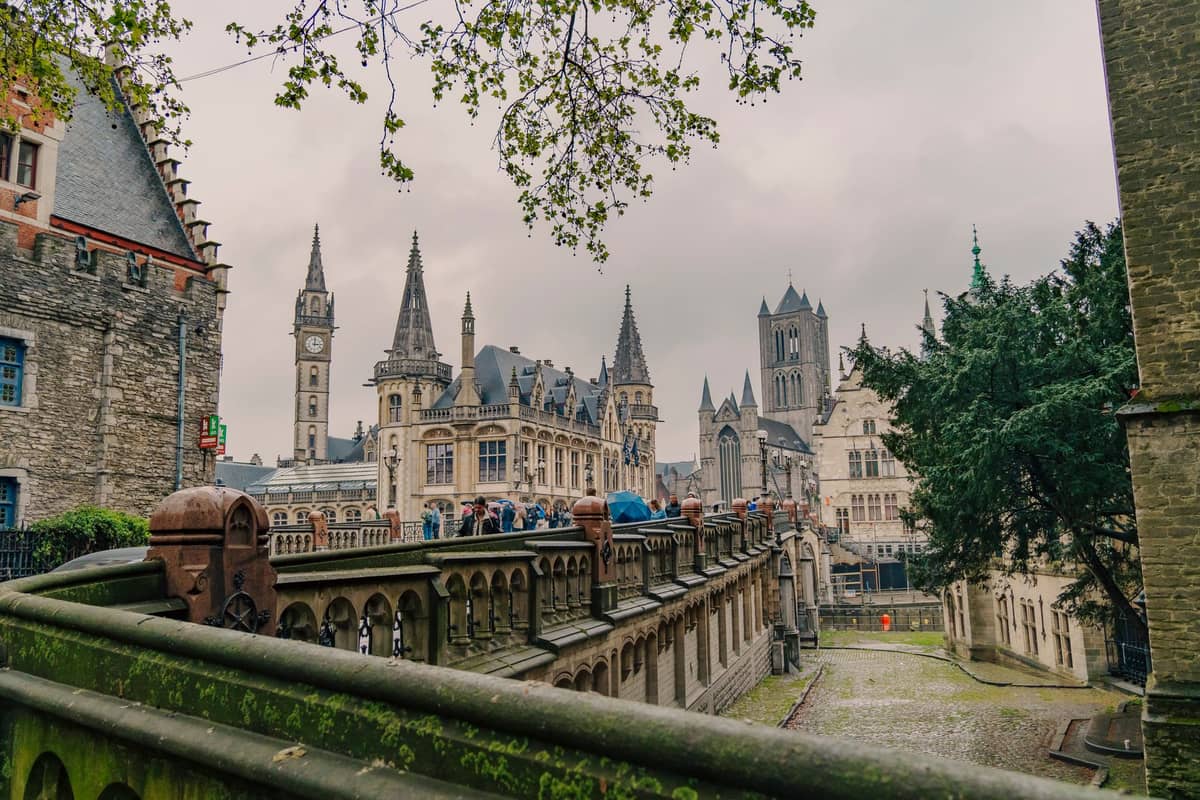
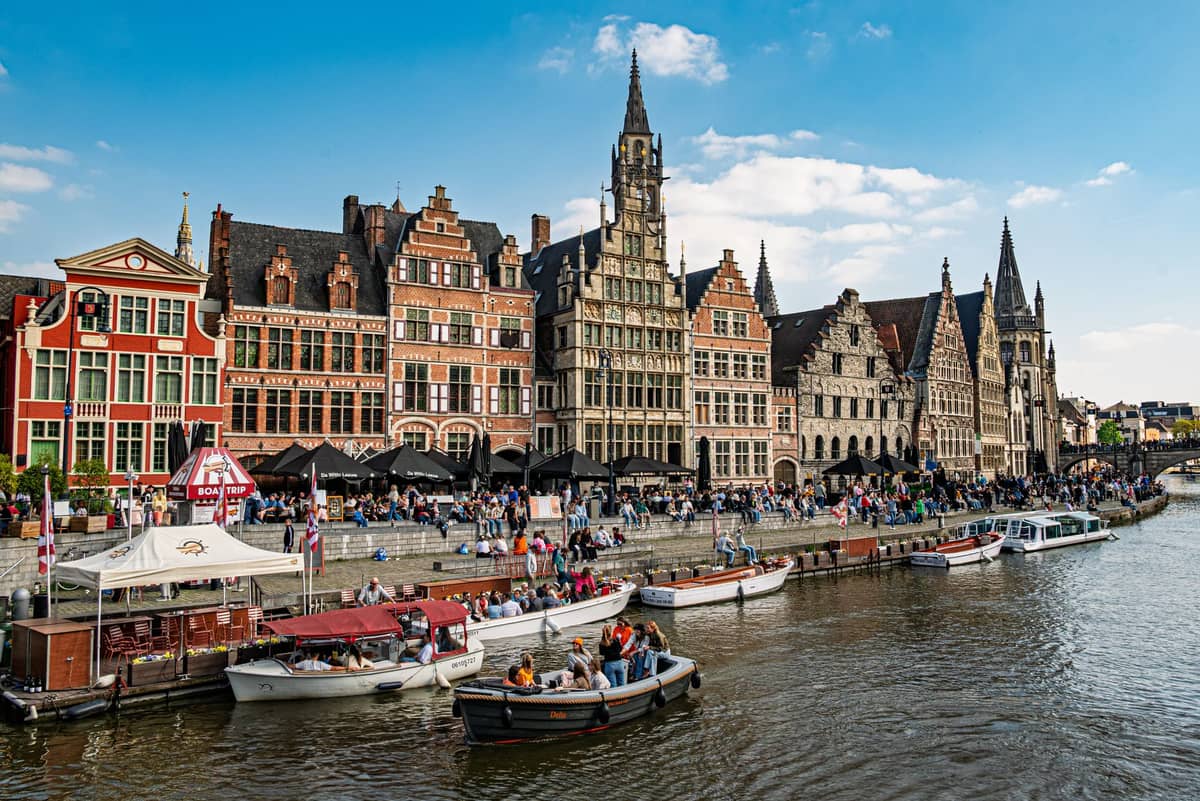
Ghent's historic centre is anchored by three medieval towers that form one of the most impressive skylines in northern Europe: the St Bavo's Cathedral, home to the Van Eyck altarpiece 'The Adoration of the Mystic Lamb'; the Ghent Belfry, a UNESCO World Heritage site in its own right; and St Nicholas' Church, one of the finest examples of Scheldt Gothic architecture in Belgium. Add the Gravensteen, a 12th-century castle that survived intact into the modern era, and the medieval guild houses along the Graslei and Korenlei, and the density of major sights is comparable to Bruges — just less universally photographed.
Bruges counters with the Markt, the Belfry of Bruges, the Basilica of the Holy Blood, the Groeninge Museum (with its own outstanding collection of Flemish Primitives), and the Begijnhof. Its canal network is more compact and more immediately picturesque than Ghent's. For travellers whose primary goal is to walk through a preserved medieval cityscape and photograph it, Bruges has an edge in sheer visual coherence. Everything is within a very short walking radius and the scale is intimate.
Ghent's museum offering goes deeper and is less visited. The Museum of Fine Arts (MSK) and the SMAK contemporary art museum sit side by side in the Citadelpark museum quarter — a combination that Bruges cannot match. If art and culture beyond medieval architecture matter to you, Ghent is the stronger destination.
Crowds, Seasons, and When to Go
Bruges receives **around 8.3 million visitors per year** in a city whose historic centre is roughly 1 km across. Summer weekends in July and August are genuinely overwhelming — queues for the Belfry stretch long, the main canals are lined with boat queues, and finding a reasonably priced meal near the Markt requires effort. January and February are the quietest months, but temperatures are typically in the low single digits Celsius and rain is frequent. The sweet spots are late April through early June and September through early October: mild weather, manageable crowds, full opening hours.
Ghent handles its visitor numbers more gracefully because it has the urban infrastructure to absorb them. The city also has a decisive seasonal advantage in July: the Gentse Feesten runs for ten days in mid-July, transforming the historic centre into a free, open-air festival with hundreds of stages and events. It draws around a million visitors but the city is built to cope with it. If your trip coincides with this period, Ghent is the obvious choice. Bruges in the same fortnight is busy, expensive, and offers nothing comparable.
In winter, Ghent comes into its own in a different way. The Ghent Christmas Market runs across multiple squares in December and is considerably less commercialised than Bruges's equivalent. The city's bars, restaurants, and covered arcades mean cold-weather visits are genuinely comfortable, and the floodlit medieval skyline in December is among the best urban winter views in Belgium.
⚠️ What to skip
Avoid Bruges on summer weekend afternoons if you have any flexibility. Coach groups from Brussels, Amsterdam, and Paris all converge on the same streets between 11am and 4pm. If you must visit in summer, arrive on a weekday morning before 10am and plan to leave or retreat to quieter neighbourhoods by midday.
Getting Between Ghent and Bruges (And Getting There)
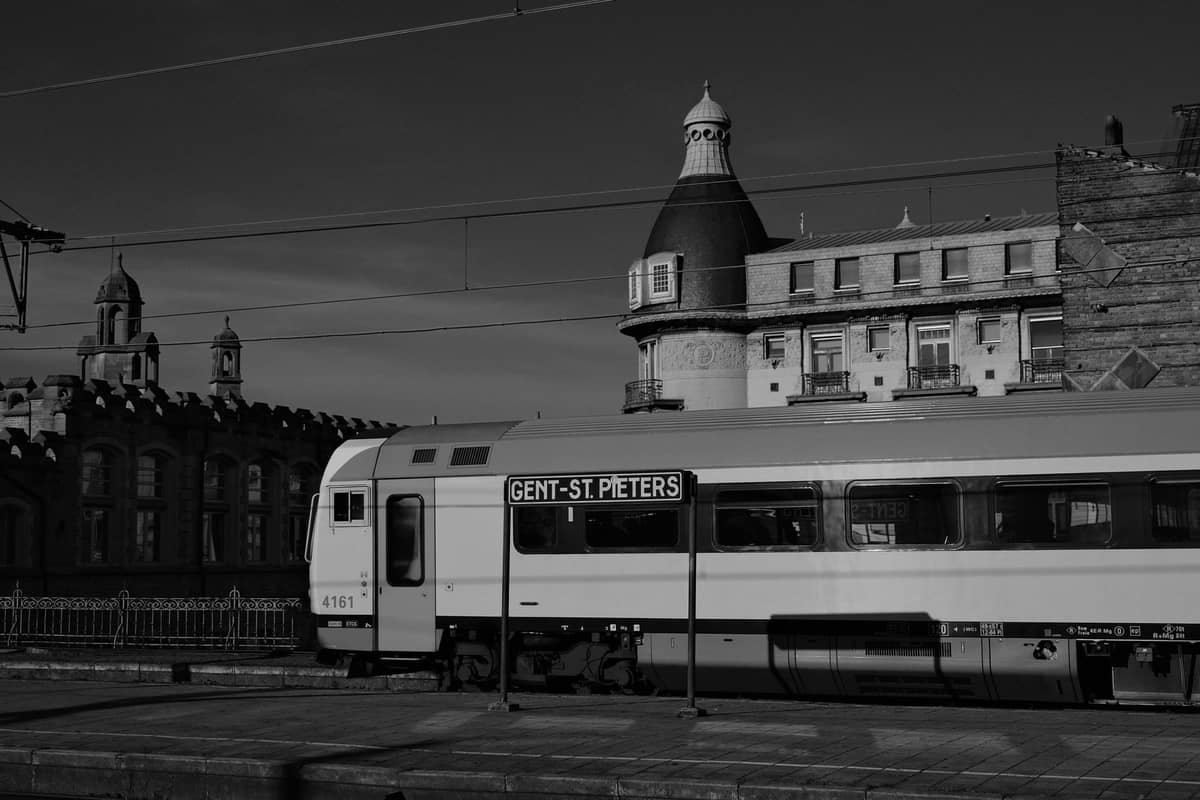
A common misconception is that choosing between the two cities is a binary decision. In practice, the Ghent to Bruges train makes combining them straightforward. Direct services run from Gent-Sint-Pieters throughout the day, with the journey taking approximately 22–28 minutes. Services begin early (around 05:45–06:00) and run until late evening, so a day trip from Ghent to Bruges, or vice versa, is entirely practical without needing to book anything in advance. The Belgian rail operator SNCB (also known as NMBS) runs the service; timetables and fares are available at belgiantrain.be.
Neither city has its own commercial airport. Both are typically accessed via Brussels Airport (BRU), with direct or one-change rail connections to Gent-Sint-Pieters taking around 50–70 minutes depending on the route. From Brussels Airport, there is a direct train to Gent-Sint-Pieters roughly once per hour, or you can connect via Brussels Noord or Brussels Midi for more frequent departures. Brussels South Charleroi Airport (CRL) is used by some low-cost carriers but adds significant transfer complexity and is not recommended unless the fare saving is substantial. For Bruges, the train from Brussels Midi takes around 60 minutes.
💡 Local tip
If you're flying into Brussels Airport and want to visit both cities, base yourself in Ghent. It sits roughly between Brussels and Bruges on the main rail corridor, making day trips in either direction quick and cheap. The Ghent to Bruges train fare is modest — check belgiantrain.be for current pricing.
Within Ghent, public transport is run by De Lijn, with trams and buses covering the city well. A single ride costs **around €3** and is valid for one hour, with contactless payment accepted. Tram line 1 connects Gent-Sint-Pieters station to Korenmarkt (the heart of the historic centre) in approximately 5–10 minutes. For more detail on moving around the city, see our guide to getting around Ghent.
Food, Drink, and Nightlife
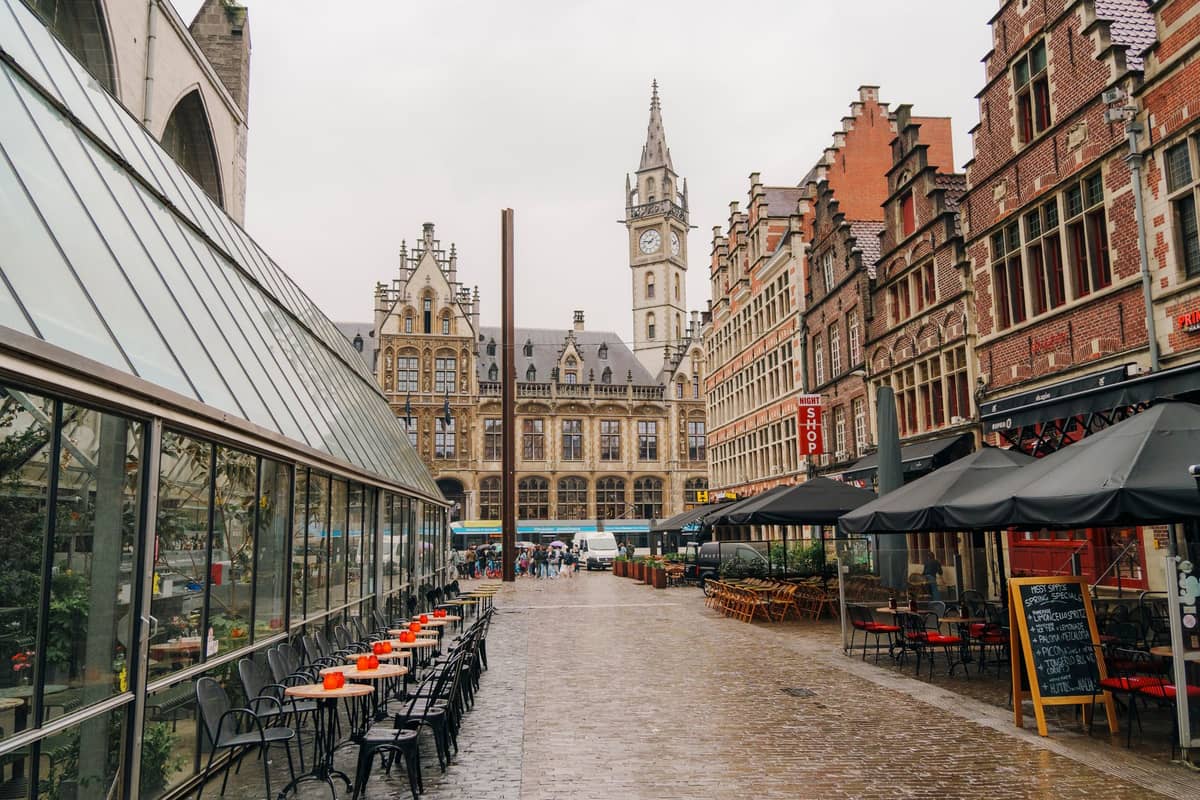
Ghent has a genuinely strong food scene, driven partly by its large student population and partly by a local culture that takes eating and drinking seriously. The city has a notable reputation for vegetarian and vegan dining — Ghent was an early adopter of 'Veggie Thursday', a city-wide initiative encouraging meat-free meals one day a week, and the range of plant-based restaurants is exceptional for a city of its size. That said, traditional Flemish cooking is equally well represented: waterzooi (the city's signature stew, made with chicken or fish), stoverij (Flemish beef and ale stew), and a serious selection of Belgian abbey beers.
The neighbourhood to know for eating and drinking is Patershol, a warren of narrow medieval streets between the Gravensteen and the Vrijdagmarkt that has been Ghent's restaurant quarter for decades. It's slightly off the main tourist drag, prices are more honest than those around the Graslei, and the quality is consistently high. For a broader food overview, our Ghent food guide covers the full range from market stalls to fine dining.
Bruges has good restaurants but the concentration of tourist-oriented establishments around the Markt and Burg squares means you need to work harder to find value. The further you walk from the main canal circuit, the better the food-to-price ratio tends to become. Bruges's nightlife is limited — the city winds down early and has few late venues. Ghent, by contrast, has a genuine bar and club scene centred on the Overpoortstraat student quarter and the historic centre, with options running from craft beer bars to live music venues to clubs open past 2am.
The Verdict: Which City Is Right for You?
There is no universally correct answer, but there are clear patterns. First-time visitors to Belgium who have one day and want to photograph a perfectly preserved medieval Flemish city will find Bruges more concentrated and immediately rewarding. The visual payoff per hour is high. Travellers with more time, or those returning to Belgium, tend to find Ghent more satisfying on balance — the sights are less globally famous but equally impressive, the city feels authentic, and there is more beneath the surface.
- Choose Bruges if: You have one day, photography is a priority, you want a compact walkable medieval core, or you're visiting off-season and want concentrated sights within a small area.
- Choose Ghent if: You have two or more days, you want a city with real local life, you're visiting in July (Gentse Feesten), you care about contemporary art and nightlife, or you want better value for money on food and accommodation.
- Visit both if: You're in Belgium for three or more days. Base yourself in Ghent and take the 25-minute train to Bruges for a half-day or full day. The rail connection is so convenient that choosing one and skipping the other is unnecessary on most trips.
For budget-conscious travellers, Ghent is the stronger base. Accommodation tends to be better value than in Bruges's tourist-oriented centre, and Ghent has more free or low-cost sights. See our guide to Ghent on a budget for practical cost-saving strategies. For accommodation options in both price ranges, our guide to where to stay in Ghent covers the best neighbourhoods by trip type.
✨ Pro tip
If you're arriving from Brussels and want to visit both cities efficiently, consider doing Bruges as a morning day trip first (trains from Brussels Midi take around 60 minutes) then continuing to Ghent to spend the afternoon and evening — or stay overnight. Ghent's illuminated medieval centre at night is one of Belgium's most underrated experiences.
FAQ
Is Ghent or Bruges better for a day trip from Brussels?
Both work as day trips. Bruges takes around 60 minutes by direct train from Brussels Midi and is the more commonly recommended option for first-time visitors due to its compact, walkable medieval centre. Ghent is **around 40 minutes** from Brussels Midi and is better suited to travellers who want more depth — a larger city, more museums, and a stronger food scene. If you can only do one, Bruges edges it for pure sightseeing efficiency; Ghent is better if you want something beyond the postcard version of Belgium.
How long does the train from Ghent to Bruges take?
The direct train from Gent-Sint-Pieters to Bruges (Brugge) takes approximately 22–28 minutes, with frequent departures throughout the day. It's one of the shortest international-calibre city-to-city rail connections in Europe. Check current timetables and fares at belgiantrain.be before travel, as schedules and prices are subject to change.
Is Ghent less touristy than Bruges?
Yes, significantly. Bruges receives around 8 million visitors per year in a historic core that covers roughly 1 km across. Ghent draws far fewer tourists per square metre and has a permanent population of 270,000 — so even in the busy summer months, the ratio of locals to visitors is very different. You will share Ghent's streets with students, residents, and commuters, not just other tourists.
Can you visit Ghent and Bruges in the same day?
Technically yes, but it would be rushed and you'd see neither city properly. The train between them takes under 30 minutes, so visiting both on the same day is possible if you start early, but you'd have limited time in each. A better approach is to spend at least one full day in Ghent and take a half-day excursion to Bruges, or vice versa. If you're visiting from Brussels, a one-city-per-day itinerary works well over two days.
Which city is cheaper, Ghent or Bruges?
Ghent is generally cheaper, particularly for food, drink, and accommodation. Bruges's tourist economy has pushed prices up in the historic centre, especially for restaurants and hotels near the main sights. In Ghent, you'll find better-value meals in neighbourhoods like Patershol and the student quarter, and mid-range hotels typically offer more for your money than equivalents in Bruges.