Ghent Belfry (Belfort van Gent): Climbing the City's Medieval Watchtower
Standing 91 metres above Sint-Baafsplein, the Belfort van Gent is the tallest belfry in Belgium and a UNESCO-listed symbol of Flemish civic power. This guide covers everything you need to know before you climb: tickets, crowds, views, and what the tower reveals about Ghent's medieval ambitions.
Quick Facts
- Location
- Sint-Baafsplein, 9000 Gent (Historic Centre)
- Getting There
- Tram line T2 to Korenmarkt (from Gent Zuid or Koophandelsplein), then a 3–5 minute walk
- Time Needed
- 45–90 minutes
- Cost
- €13 standard; €5 Ghent residents and students 19–25; €2.20 ages 13–18; under 12 free
- Best for
- History lovers, photographers, and first-time visitors to Ghent
- Official website
- visit.gent.be/en/see-do/ghent-belfry
What the Belfry Actually Is
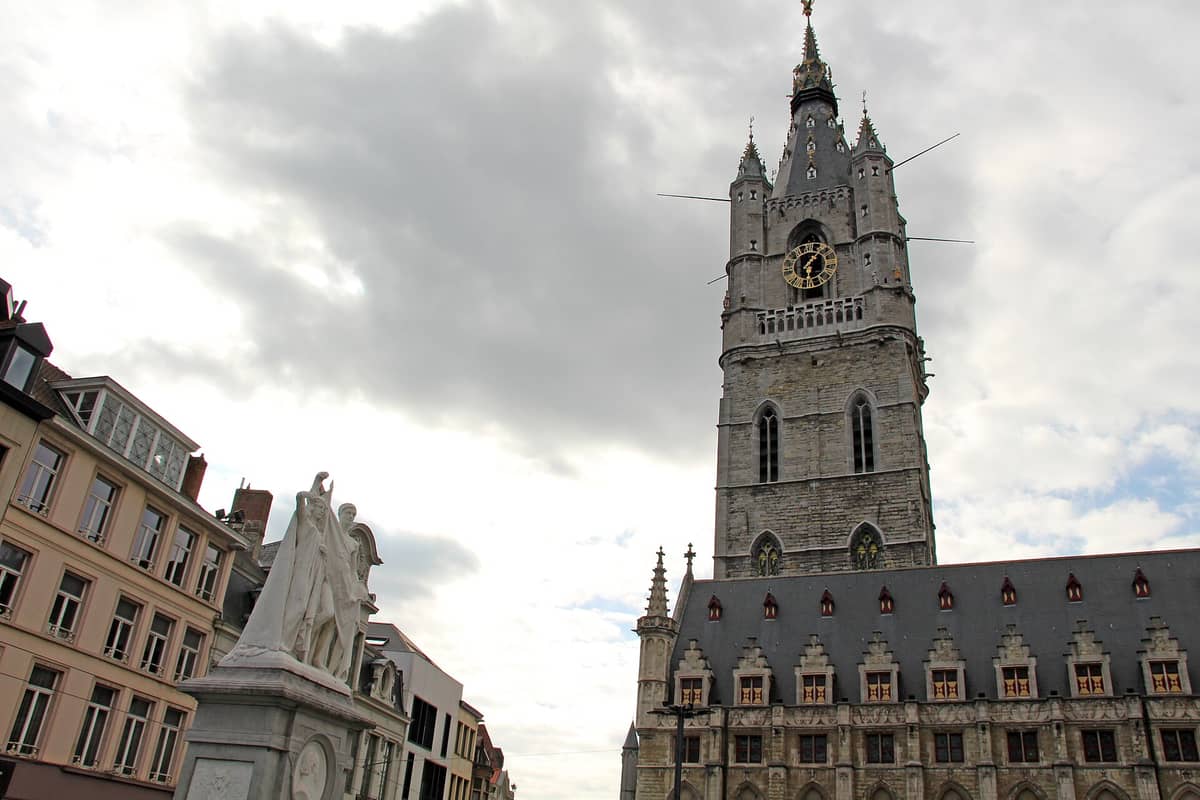
The Ghent Belfry, known locally as the Belfort van Gent, is a freestanding medieval tower rising 91 metres above Sint-Baafsplein in the heart of the historic city. It was built not as a church or a fortress, but as a statement of civic independence: a place to store the city's privileges and charters, to hang the bells that governed the rhythms of trade, and to keep watch over a city that, at its medieval peak, was one of the largest in northern Europe.
Recognised by UNESCO as part of the Belfries of Belgium and France World Heritage Site, the Belfort van Gent stands alongside the nearby St Bavo's Cathedral and St Nicholas' Church to form one of the densest concentrations of medieval architecture anywhere in Belgium. From the top, all three of these towers are visible simultaneously, which is reason enough to make the climb.
Construction began in 1313 and continued across several phases. The distinctive neo-Gothic stone spire that crowns the tower today dates from the 19th century, replacing an earlier wooden structure. At the very summit perches a gilded copper dragon, a medieval symbol of the city's authority and vigilance. The dragon is not the original, which now sits inside the tower's exhibition space, but it is a faithful replica and a striking detail that catches the light on clear afternoons.
The Climb: What to Expect at Each Level
⚠️ What to skip
Accessibility note: The Belfry has a lift, but it only begins at the first floor. The entrance level and the final sections to the top require navigating steep spiral stairs. The tower is not accessible to visitors with significant mobility limitations.
The route up is structured around a series of interior rooms and landings, each with something to show before you reach the panoramic level. The ground floor sets the context with exhibits about the tower's history and its role as the guardian of the city's legal documents. The Charter Room, located partway up, once held the sealed privileges granted by medieval counts and is where the great alarm bell, the Roeland, was controlled.
The carillon mechanism room is one of the more unexpected stops. The belfry houses 54 bells, and a large mechanical drum studded with pins programs their automated sequences. The smell here is metallic and oily, the air noticeably cooler and darker than the floors below. This is not a theatrical reconstruction for tourists but a working instrument: concerts are still performed on the carillon, and the automated bells still ring across the square on the hour.
The final climb to the open platform requires effort. The stairs are narrow, the stone worn smooth in the centre of each step from centuries of use, and the incline is steep enough that visitors moving in opposite directions need to press flat against the wall to pass. Allow extra time if you have any hesitation with heights or confined spaces. The discomfort is brief and the payoff considerable.
Tickets & tours
Hand-picked options from our booking partner. Prices are indicative; availability and final rates are confirmed when you complete your booking.
Historic Ghent city exploration game
From 10 €Instant confirmationFree cancellationBelgian waffle making workshop and beer tasting in Ghent
From 45 €Instant confirmationFree cancellationTaste of Ghent private chocolate walking tour
From 256 €Instant confirmationFree cancellationSips and stories, a private beer tour in Ghent
From 373 €Instant confirmationFree cancellation
The View from the Top
On a clear day, the viewing platform at the top of the Belfort van Gent delivers one of the most instructive skylines in Belgium. The three towers of Ghent, as the local trio of the Belfry, St Bavo's Cathedral, and St Nicholas' Church are known, appear to cluster almost within arm's reach below you. Looking north toward Gravensteen, you can trace the waterways that made medieval Ghent its fortune.
The platform is open-air and exposed. In summer, the view stretches over terracotta rooftops and the green line of the Graslei and Korenlei quaysides. In winter, when a low mist settles over the city, the tower tops of St Nicholas emerge from the grey like something from a Flemish painting, and the light has a quality that photographers come specifically to chase. Bring a windproof layer regardless of the season; the platform catches a significant breeze even on days that feel warm at street level.
The viewing area is not large, and during peak summer weekends it can feel crowded with a dozen or more people on it simultaneously. This is one of the clearest arguments for arriving when the doors open at 10:00, when both crowds and light conditions tend to be at their best.
Time of Day and Seasonal Considerations
Morning visits, ideally within the first hour of opening, offer the quietest experience and the most consistent light for photography. Sint-Baafsplein below is already active by mid-morning with tour groups and visitors to the cathedral, and the tower queue builds steadily from around 11:00 onward in high season.
💡 Local tip
Photography tip: For the classic Ghent three-towers shot from the Belfry platform, position yourself on the northwest side of the viewing level and shoot in the late morning when the sun is behind you and illuminating St Nicholas' Church directly.
The Belfry is closed on 24, 25, and 31 December and on 1 January. Winter visits outside those dates can be rewarding: the Ghent Christmas Market fills Sint-Baafsplein directly below, and the view of the market stalls and ice rink from the top is genuinely striking. However, Belgian winter weather is unpredictable and the open platform is exposed, so check the forecast before committing.
Late afternoon in summer produces warmer light over the roofscape but also the highest visitor numbers of the day. If you visit then, expect to wait 20 to 30 minutes at the entrance during July and August.
Tickets, Hours, and Getting There
The Belfry is open daily 10:00 to 18:00, with last tickets sold around 17:00. Standard individual admission is €13. Students aged 19 to 25 and Ghent residents pay €5, visitors aged 13 to 18 pay €2.20, and children under 12 enter free. Companions of persons with disabilities are admitted without charge. Groups of at least 15 people qualify for the group price of €9. These prices were verified from official sources updated in 2026 and may change; always confirm current rates on the official Visit Gent website before your trip.
Getting there is straightforward. From Gent-Sint-Pieters railway station, take tram line T1 toward the city centre and change at Gent Zuid or Koophandelsplein for tram line T2 to Korenmarkt, or walk 5–10 minutes from Koophandelsplein. From Korenmarkt, Sint-Baafsplein is a short walk east along Belfortstraat. The square is also the location of St Bavo's Cathedral, which houses the Ghent Altarpiece, so pairing both in a single morning is efficient and logical. For a broader picture of how to structure your day, the Ghent walking tour guide maps a natural route between the historic centre's main points.
Historical Context: Why a Freestanding Tower?
In medieval Flanders, belfries were deliberate architectural politics. Where church towers belonged to religious institutions and castle towers to feudal lords, belfries belonged to the citizens. They housed the aldermen's charter room, the city treasury, and the great alarm bell whose ring could summon every guild member to the market square within minutes. Ghent's belfry, begun in 1313 and extended over the following centuries, was among the most ambitious in the region, scaled to match a city whose cloth trade made it one of the wealthiest in northern Europe.
The dragon at the summit has particular significance: versions of it have crowned the tower since the medieval period, symbolising the city's claim to protect its own privileges. The original medieval dragon is preserved inside the tower as part of the permanent exhibition. It is battered, repainted over centuries, and much smaller in person than its legend suggests, which makes it one of the more humanising exhibits in the building.
For visitors interested in the broader sweep of Flemish civic and religious architecture in the same district, the Ghent Town Hall on Botermarkt, just minutes away, offers another chapter in the same story of a city that spent centuries negotiating between commercial ambition and political authority.
Who Should Skip This
If you have significant mobility limitations, the Belfry will present genuine difficulties. The lift begins only at the first floor, and the upper sections require climbing steep, narrow spiral stairs with low overhead clearance in places. There is no workaround for this, and the official visitor information confirms the tower is not accessible to less mobile visitors.
If panoramic views are your primary motivation but heights are not, it is worth knowing that the view from the Belfry, while excellent, is not dramatically more expansive than what you see from the free viewpoint at St Michael's Bridge below. What the Belfry offers that the bridge cannot is altitude, the interior exhibitions, and the specific pleasure of being inside a working medieval tower rather than looking at one.
Insider Tips
- Book tickets in advance through the official Visit Gent website during July and August. Walk-up queues can run 20 to 30 minutes on weekends, and pre-booking secures a time slot and typically reduces waiting at the entrance.
- The original medieval dragon from the tower summit is displayed inside the exhibition space. It is easy to walk past without noticing it is the real thing rather than a reproduction. Look for the interpretive panel identifying it near the upper floors.
- The carillon plays automated sequences on the hour throughout the day, but live carillon concerts take place seasonally. Check the current schedule on the Historische Huizen Gent website before your visit as concert days vary by season.
- Pair the Belfry with St Bavo's Cathedral immediately next door on Sint-Baafsplein. The Ghent Altarpiece, housed in the cathedral's Vijd (former baptismal) chapel, requires a separate timed ticket but can be booked for the same morning without leaving the square.
- If you want the tower largely to yourself, visit on a weekday in late September or October. The summer crowds have thinned, the autumn light is flattering, and the views across the rooftops carry a different quality than in peak season.
Who Is Ghent Belfry (Belfort van Gent) For?
- First-time visitors to Ghent wanting to orientate themselves with a bird's-eye view of the historic centre
- Architecture and history enthusiasts interested in medieval Flemish civic culture
- Photographers seeking the classic three-towers panorama from above
- Visitors combining the Belfry with the Ghent Altarpiece at St Bavo's Cathedral on the same square
- Travellers visiting during the Christmas market period, when the view over Sint-Baafsplein takes on a distinctive character
Nearby Attractions
Other things to see while in Ghent Historic Centre:
- City Pavilion (Stadshal)
Completed in 2012 by Ghent architects Robbrecht & Daem and Marie-José Van Hee, the Stadshal is a free, open public structure spanning roughly 40 metres at Emile Braunplein, surrounded by the Belfry, Town Hall, and St Nicholas' Church. Whether you pass through at noon or after dark, this latticed wooden canopy changes character with the light and the crowd beneath it.
- Design Museum Gent
Design Museum Gent, founded in 1903 and located in Ghent's historic centre, holds a collection of approximately 22,500 objects tracing applied arts and design from the 18th century to the present day. The museum is currently closed for a major expansion and renovation, but its permanent collection and architectural setting make it one of Ghent's most distinctive cultural institutions., holds a collection of approximately 22,500 objects tracing applied arts and design from the 18th century to the present day. The museum is currently closed for a major expansion and renovation, but its permanent collection and architectural setting make it one of Ghent's most distinctive cultural institutions.
- Castle of Gerald the Devil (Geeraard de Duivelsteen)
Built in the 13th century in Scheldt Gothic style, Geeraard de Duivelsteen is one of the most architecturally striking medieval structures in Ghent. From knight's residence to madhouse to event venue, its layered history is as dramatic as its stone facade. The building is not open for regular walk-in visits, but its exterior and occasional scheduled openings make it essential context for understanding Ghent's medieval character.
- Ghent Altarpiece (Adoration of the Mystic Lamb)
Completed in 1432 by Hubert and Jan van Eyck, the Ghent Altarpiece is a 12-panel polyptych (with paintings on both sides of most wings) housed in St Bavo's Cathedral in Ghent's historic centre. It is one of the most technically advanced and historically significant paintings ever made, and seeing it in person requires a ticket, a timed slot, and some preparation.