St Nicholas' Church (Sint-Niklaaskerk): Ghent's Medieval Merchant Church
Rising from the heart of Ghent's historic centre, Sint-Niklaaskerk is one of Belgium's finest examples of Scheldt Gothic architecture. Built by and for the city's medieval merchant class, it stands free to enter between the Belfry and Korenmarkt, and rewards visitors who look past its famous neighbours.
Quick Facts
- Location
- Cataloniëstraat, 9000 Ghent, Belgium — steps from Korenmarkt in the historic centre
- Getting There
- Tram 1 or 4, Bus 3/17/18 to Gent Korenmarkt (2-minute walk)
- Time Needed
- 30–60 minutes for an independent visit; longer if attending a concert or guided tour
- Cost
- Free admission. No booking required.
- Best for
- Medieval architecture, religious art, organ music, photography, quiet reflection
- Official website
- http://www.sintniklaaskerk.be
What Is Sint-Niklaaskerk and Why Does It Matter?
Sint-Niklaaskerk — St Nicholas' Church — is the oldest and architecturally richest of Ghent's three famous medieval towers, which together form the most photographed skyline in Belgium. While the Ghent Belfry gets the postcards and St Bavo's Cathedral gets the crowds queuing to see the Ghent Altarpiece, St Nicholas' Church tends to be the one people walk past rather than into. That's a mistake.
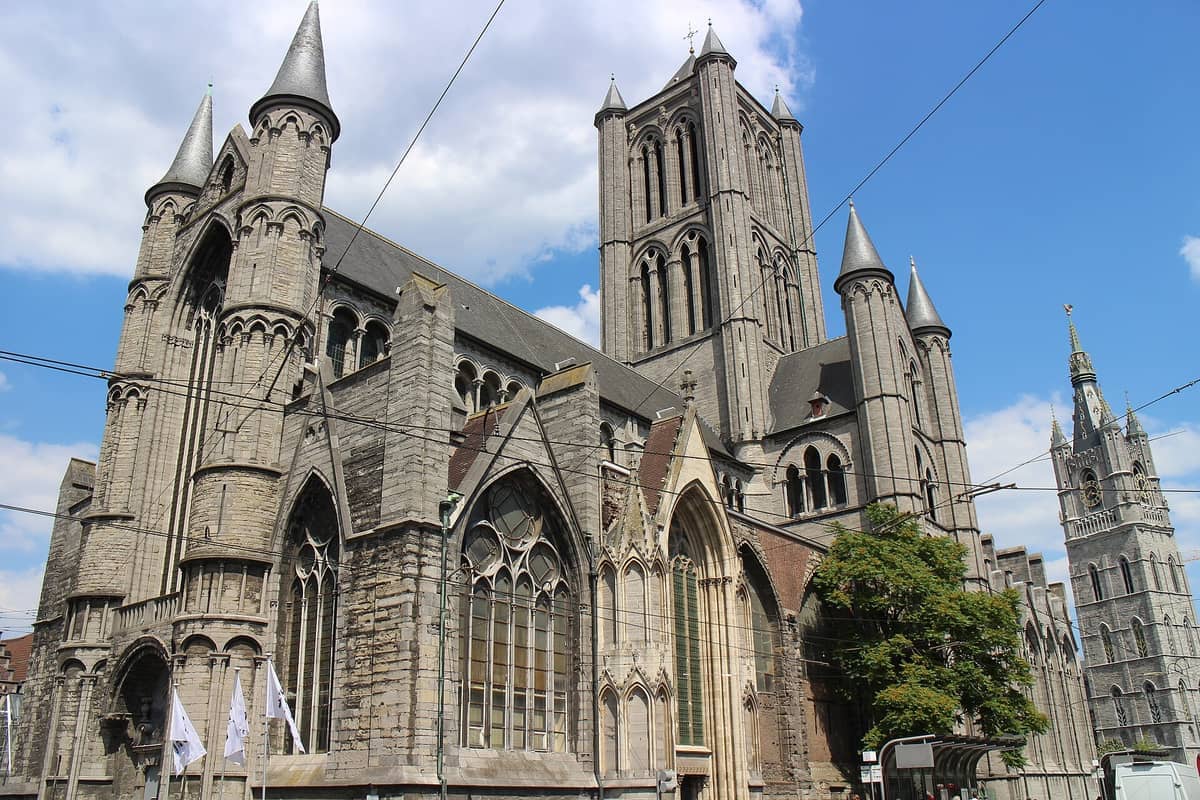
The church was built largely in the 13th and 14th centuries in the Scheldt Gothic style — a regional variant of Gothic architecture that developed specifically in the towns along the Scheldt river valley. Where French High Gothic reaches for skeletal lightness, Scheldt Gothic is sturdier, more horizontal in feel, with massive compound piers and a characteristic grey-white Tournai limestone that gives the interior a calm, almost monochromatic quality. The stone absorbs light differently at different hours, which matters more than it sounds.
The church was the parish church of Ghent's merchant guilds, dedicated to Saint Nicholas of Myra, patron saint of traders and sailors. Its position between the old grain market (Korenmarkt) and the cloth halls of the Graslei waterfront was no accident. Commerce and devotion were inseparable in medieval Ghent, and the building reflects both impulses: ambitious in scale, precise in craftsmanship, built to impress business partners as much as God.
💡 Local tip
Entry is completely free and no tickets are required. The church is open daily approximately 10:00–17:00 (on Mondays usually 14:00–17:00), though hours can vary slightly with seasons or special events. Check sintniklaaskerk.be or the Visit Gent website before arriving.
The Architecture: What to Actually Look At
From the outside, the west facade facing Korenmarkt is the obvious first impression: three towers clustered together, the central crossing tower dominant, the flanking turrets giving the composition a silhouette unlike any other Belgian church. The stonework has the slightly rough, textured quality of aged limestone rather than the smooth restoration look of some Gothic revivals. Look at the base of the towers where the stone is darkest — that patination represents seven centuries of urban air.
Inside, the nave is wide and the triforium gallery runs the full length at mid-height, a feature common in Scheldt Gothic that reinforces the horizontal reading of the space. The compound piers are thick enough that you can place both hands flat on opposing faces simultaneously. The overall effect is not soaring aspiration but contained power — a church that feels like it was built to last rather than to astonish.
The church underwent significant restoration and interior rearrangement over the centuries, including during the French Revolutionary period when much religious art was removed or destroyed. What survives, however, is substantial. The Cavaillé-Coll organ, installed in the 19th century, is one of the finest instruments of its type in Belgium. Aristide Cavaillé-Coll, the French organ builder responsible for instruments in Notre-Dame de Paris and Saint-Sulpice, made relatively few Belgian commissions, which gives Sint-Niklaaskerk's instrument particular significance among organists and music historians.
Tickets & tours
Hand-picked options from our booking partner. Prices are indicative; availability and final rates are confirmed when you complete your booking.
Historic Ghent city exploration game
From 10 €Instant confirmationFree cancellationSelf guided tour with interactive city game of Ghent
From 29 €Instant confirmationFree cancellationBelgian waffle making workshop and beer tasting in Ghent
From 45 €Instant confirmationFree cancellationTaste of Ghent private chocolate walking tour
From 256 €Instant confirmationFree cancellation
Light, Time of Day, and When to Visit
The church opens at 10:00, and the first hour is often the quietest. Ghent's walking tour groups tend to gather at Korenmarkt from mid-morning onwards, and the church absorbs them quickly. If you arrive close to opening, you may have the nave almost to yourself, with the low morning light cutting obliquely through the upper clerestory windows and landing in long rectangles on the limestone floor.
By noon, the space fills with ambient noise: school groups from late spring through summer, the occasional tour guide narrating in Dutch, French, or English, and the shuffle of visitors following the interior circuit. The Tournai stone responds differently as the light changes through the afternoon — it softens perceptibly around 14:00–15:00 when south-facing windows catch direct sun, shifting the interior from cool grey to something closer to warm cream.
The closing time of approximately 17:00 means there is no evening access, so the atmospheric late-afternoon golden hour inside is available only to visitors who time their arrival carefully, roughly 30–40 minutes before close. The exterior, however, is spectacular at dusk when the surrounding square empties of market traffic and the towers are illuminated.
ℹ️ Good to know
If you're visiting Ghent between October and April, expect lower light levels inside the church throughout the day. Bring patience for photography — a tripod or a phone with good low-light capability makes a significant difference.
The Interior Details Worth Slowing Down For
The stained-glass windows in the choir include work by Herman Blondeel, a Ghent-based glass artist whose work appears in several city churches. The palette is deeper and more jewel-like than the earlier clear or grisaille glazing visible elsewhere in the nave, creating a visual contrast between the medieval and the modern within a single building. Stand at the entrance to the choir and look back towards the west: the organ case frames the upper nave in a way that makes the space feel like a stage.
The funerary monuments and floor slabs deserve more attention than they typically get. Some of the carved stone memorial tablets date to the 14th and 15th centuries and commemorate the merchant families whose donations funded the building's expansion. The Latin inscriptions are largely illegible without specialist knowledge, but the heraldic details — merchant marks, guild symbols, family crests — are readable as visual documents of commercial Ghent.
There is a quietness to the side chapels, particularly on weekday mornings, that is qualitatively different from the main nave. The chapels smell of cold stone and occasionally of fresh candle wax. If you are looking for a few minutes of stillness in the middle of a busy day in the city centre, the side chapels are useful for exactly that.
Getting There and Navigating the Area
St Nicholas' Church sits on Cataloniëstraat, directly adjacent to Korenmarkt — the wide square that serves as Ghent's central transit and social hub. Tram lines 1 and 4, along with several bus routes (3, 17, 18, 38, 39), stop at Gent Korenmarkt. From the tram stop, the church's towers are already visible; the walk is under two minutes. For those arriving by train, take any tram from Gent-Sint-Pieters station towards the centre and alight at Korenmarkt. Tickets for De Lijn trams currently cost around €3 for a single journey valid for one hour — confirm current fares at the De Lijn website or our guide to getting around Ghent.
The wheelchair-accessible entrance is on the Poeljemarkt side of the church. The main entrance on Cataloniëstraat is accessible with assistance but involves an uneven threshold. The surrounding streets are largely pedestrianised but paved with historic cobblestones, which can be tiring for mobility aid users over longer distances.
St Nicholas' Church sits at the pivot point of Ghent's most historically dense walking circuit. The Graslei and Korenlei guild-house waterfront is a three-minute walk east. The Belfry is immediately behind the church to the south. This triangular concentration of landmarks means that visiting St Nicholas is naturally part of any serious exploration of the Ghent historic centre rather than a detour.
Photography Notes
The exterior shot that most photographers want — all three towers in a single frame — is best taken from the middle of Korenmarkt, slightly offset to the north to clear the flower stalls and market infrastructure that occupy the square on weekdays. Early mornings (before 09:30) give clean light and near-empty foregrounds. The three-tower composition also works well in the late afternoon when low western sun catches the limestone of the Belfry and creates tonal contrast against the darker stonework of Sint-Niklaaskerk.
For interior photography, tripods are not prohibited but are awkward in the narrow side aisles during peak hours. A wide-angle lens captures the full nave effectively from the west door. The Ghent photography guide covers the three-tower skyline in more detail, including the best vantage points from the St Michael's Bridge area.
Context: Sint-Niklaaskerk in Ghent's Religious Landscape
Ghent has an unusually dense concentration of medieval churches for a city of its size, a legacy of its 14th-century status as one of Europe's largest and wealthiest cities. Sint-Niklaaskerk was the merchant church; St Bavo's was the episcopal seat; the Beguinage chapels and smaller parish churches served specific communities. Understanding this specialization helps explain why each building feels distinct in atmosphere and scale. If you want to compare Gothic ecclesiastical architecture across a single afternoon, the best churches in Ghent are all within walking distance of each other in the historic core.
The church is an active parish, not purely a heritage site, which means Sunday morning visits may coincide with services. This is worth knowing for two reasons: services typically restrict free movement inside the nave, and the acoustic quality of the Cavaillé-Coll organ during a service is — by all accounts — considerably more impressive than silence.
⚠️ What to skip
Sint-Niklaaskerk has undergone restoration work in recent years and some sections may be partially screened by scaffolding. Check current conditions via sintniklaaskerk.be before a dedicated architectural visit.
Insider Tips
- The three-tower skyline view from the northern end of Korenmarkt is the one in every guidebook, but the reverse angle — looking south from St Michael's Bridge with Sint-Niklaaskerk, the Belfry, and St Bavo's receding in a line — is arguably more dramatic and far less photographed.
- Organ recitals are held periodically in the church, often free or at low cost. The historic Cavaillé-Coll organ is currently unplayable and awaiting restoration; recitals, when they happen, use other instruments. Check the church's official website or the UiTinVlaanderen events calendar for upcoming concerts.
- The Poeljemarkt entrance on the north side of the church is both the accessible entrance and the quieter one — useful if you want to enter without navigating through tour groups gathering at the main Cataloniëstraat door.
- The floor of the nave contains medieval grave slabs that most visitors walk over without noticing. Slow down and look down: the carved merchant marks on 14th and 15th century memorial stones are among the most tactile historical documents in the city.
- If you are visiting on a grey Flemish day, the interior of Sint-Niklaaskerk actually improves — overcast northern light enters the upper clerestory without harsh shadow and makes the Tournai stone glow in a way that bright sun tends to flatten.
Who Is St Nicholas' Church (Sint-Niklaaskerk) For?
- Architecture and design travellers interested in the regional Scheldt Gothic style
- Church music enthusiasts who want to hear a historically significant Cavaillé-Coll organ
- Photographers working the three-tower skyline or looking for quiet interior shots
- Travellers on a budget — the church is free and genuinely rewarding without spending a cent
- Anyone needing ten minutes of calm silence in the middle of a full day in the city centre
Nearby Attractions
Other things to see while in Ghent Historic Centre:
- City Pavilion (Stadshal)
Completed in 2012 by Ghent architects Robbrecht & Daem and Marie-José Van Hee, the Stadshal is a free, open public structure spanning roughly 40 metres at Emile Braunplein, surrounded by the Belfry, Town Hall, and St Nicholas' Church. Whether you pass through at noon or after dark, this latticed wooden canopy changes character with the light and the crowd beneath it.
- Design Museum Gent
Design Museum Gent, founded in 1903 and located in Ghent's historic centre, holds a collection of approximately 22,500 objects tracing applied arts and design from the 18th century to the present day. The museum is currently closed for a major expansion and renovation, but its permanent collection and architectural setting make it one of Ghent's most distinctive cultural institutions., holds a collection of approximately 22,500 objects tracing applied arts and design from the 18th century to the present day. The museum is currently closed for a major expansion and renovation, but its permanent collection and architectural setting make it one of Ghent's most distinctive cultural institutions.
- Castle of Gerald the Devil (Geeraard de Duivelsteen)
Built in the 13th century in Scheldt Gothic style, Geeraard de Duivelsteen is one of the most architecturally striking medieval structures in Ghent. From knight's residence to madhouse to event venue, its layered history is as dramatic as its stone facade. The building is not open for regular walk-in visits, but its exterior and occasional scheduled openings make it essential context for understanding Ghent's medieval character.
- Ghent Altarpiece (Adoration of the Mystic Lamb)
Completed in 1432 by Hubert and Jan van Eyck, the Ghent Altarpiece is a 12-panel polyptych (with paintings on both sides of most wings) housed in St Bavo's Cathedral in Ghent's historic centre. It is one of the most technically advanced and historically significant paintings ever made, and seeing it in person requires a ticket, a timed slot, and some preparation.