Geeraard de Duivelsteen: Inside Ghent's Castle of Gerald the Devil
Built in the 13th century in Scheldt Gothic style, Geeraard de Duivelsteen is one of the most architecturally striking medieval structures in Ghent. From knight's residence to madhouse to event venue, its layered history is as dramatic as its stone facade. The building is not open for regular walk-in visits, but its exterior and occasional scheduled openings make it essential context for understanding Ghent's medieval character.
Quick Facts
- Location
- Geraard de Duivelstraat 1, 9000 Gent, Belgium (Ghent Historic Centre)
- Getting There
- Walk from Korenmarkt or Sint-Baafsplein (about 10 min). Several De Lijn tram and bus lines stop nearby.
- Time Needed
- Exterior viewing only; special openings or events may allow interior access
- Cost
- Free to view from outside. Interior access via events only — check duivelsteen.gent for current pricing
- Best for
- Medieval architecture, history enthusiasts, photographers, heritage day visitors
- Official website
- www.duivelsteen.gent
What You're Looking At: A Fortress in the Middle of a City
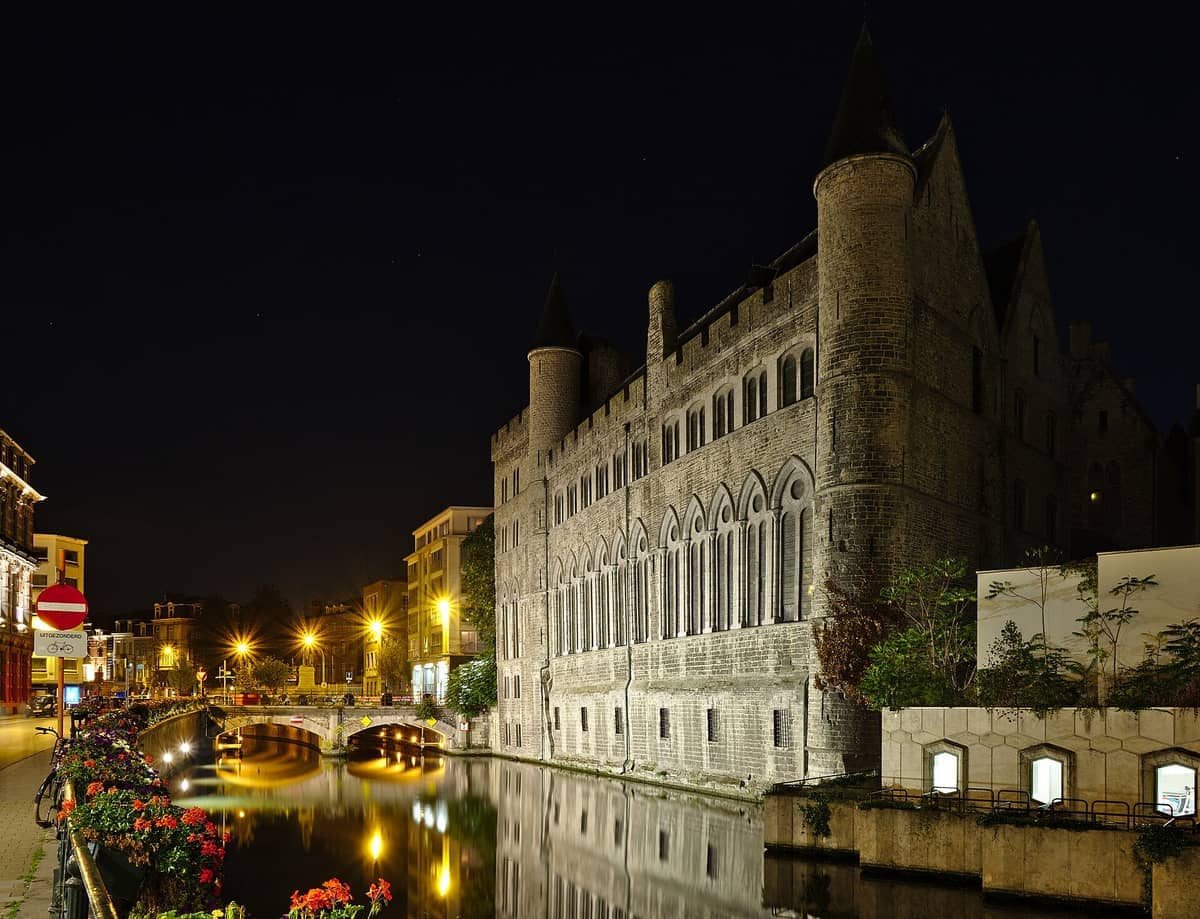
Geeraard de Duivelsteen — the Castle of Gerald the Devil — rises from a quiet street just southeast of Sint-Baafsplein with the blunt authority of something that was never meant to impress, only to endure. Built around 1245, it is one of the oldest and most intact secular stone buildings in Ghent, and one of the few medieval private fortresses in Belgium that still stands to anything approaching its original height and massing. The walls are thick bluestone and sandstone, the windows are narrow Romanesque-transitional openings, and the roofline is castellated in a way that leaves no doubt about the building's original defensive intent.
What makes it immediately interesting, visually, is how out of scale it feels in its current context. The surrounding streets are narrow and residential, lined with the kind of brick facades typical of later Ghent centuries. Then the Duivelsteen appears: a fortress volume with virtually no decorative concession to its neighbors. Stand across from the main facade and the proportions are sobering — the walls look like they were built to outlast everything around them, and largely, they have.
ℹ️ Good to know
The building is not open for regular public walk-in visits. The exterior can be viewed freely at any time. Interior access is only possible during special events or scheduled openings. Check duivelsteen.gent before visiting to confirm any current programming.
The History Behind the Name
The building takes its name from Geeraard Vilain, a 13th-century nobleman whose family owned the property. The nickname 'de Duivel' (the Devil) was earned through his reputation. What is more certain is that by the time of construction, this was one of the largest private stone residences in Ghent, a statement of feudal power in a city that was already economically dominant in northwestern Europe through its wool trade.
The building's post-medieval history is a compressed catalog of institutional repurposing. It served as a knight's residence, an armoury, a monastery, and later housed archives. Each phase left traces in the fabric of the building: alterations, blocked doorways, added floors in some sections, stripped interiors in others. The fact that the exterior reads as coherent medieval architecture despite all of this is a credit to the original construction's solidity.
For visitors interested in how this building fits into the broader arc of Ghent's medieval development, the STAM Ghent City Museum offers detailed chronological context for the city's architectural and social history, including the period when the Duivelsteen was at its peak political significance.
Tickets & tours
Hand-picked options from our booking partner. Prices are indicative; availability and final rates are confirmed when you complete your booking.
Historic Ghent city exploration game
From 10 €Instant confirmationFree cancellationBelgian waffle making workshop and beer tasting in Ghent
From 45 €Instant confirmationFree cancellationTaste of Ghent private chocolate walking tour
From 256 €Instant confirmationFree cancellationSips and stories, a private beer tour in Ghent
From 373 €Instant confirmationFree cancellation
Scheldt Gothic: The Architectural Style Explained
Scheldt Gothic is a regional variant of Gothic architecture that developed along the Scheldt river valley in the 13th century, characterized by the use of local blue limestone (known as bluestone or Doornikse steen), relatively restrained ornamental detail compared to French Gothic, and a structural emphasis on mass and solidity over vertical lightness. It sits chronologically and stylistically between the heavier Romanesque tradition and the more elaborate High Gothic of the later medieval period.
At the Duivelsteen, you can see both phases of this transition clearly. The lower portions of the walls and the window surrounds retain Romanesque proportions — round-headed or slightly pointed, deeply recessed — while the upper sections and some of the interior vaulting lean toward Gothic verticality. The building is not cathedral-scale, but as a piece of secular Gothic construction, it is architecturally significant in a way that most general guidebooks understate.
If Scheldt Gothic interests you, Ghent rewards the comparison. The nearby St Nicholas Church is the finest ecclesiastical example of the same regional style, and seeing both buildings on the same walk makes the stylistic similarities and functional differences immediately legible.
The Experience of Visiting: Exterior and What to Notice
Even without interior access, the Duivelsteen merits a deliberate stop rather than a passing glance. Walk the full perimeter of the building before spending time on any single facade. The structure has multiple distinct elevations, and the relationship between the main tower mass and the lower wings becomes clearer as you move around it. The corners show the original bonding of the bluestone courses with particular clarity — large, precisely cut blocks laid in a pattern that speaks to significant skilled labor and resources for the period.
The street-level surroundings are quiet, which works in the building's favor. Early morning visits, before 9am, offer the cleanest light on the main facade and the fewest interruptions from foot traffic. The stone color shifts noticeably depending on weather and time of day: in flat overcast light, the bluestone reads as a cool grey; in low-angle morning or late-afternoon sun, the iron content in the stone produces warm amber and rust tones that make the facade considerably more dramatic. Photographers should note that the street opposite the main entrance is narrow, so wide-angle lenses or a longer working distance from the adjacent open area will be needed for full-facade shots.
💡 Local tip
For the best exterior photograph of the main facade, position yourself at the southeastern corner of the adjacent open space in the late afternoon when the sun catches the stone at an angle. The resulting texture and color in the bluestone is considerably more interesting than midday shots.
Interior Access: Events, Heritage Days, and How to Plan Ahead
The most reliable opportunity for interior access is during Open Monumentendag, an annual heritage event held each September, when historically significant buildings that are otherwise closed open their doors to the public free of charge. The Duivelsteen regularly participates in this event, and queues can form early in the morning. If this is your primary reason for visiting, arriving at opening time is strongly advised.
The building is also used as a venue for private and cultural events, and the official Duivelsteen website (duivelsteen.gent) occasionally lists scheduled public programming. The interior may include original Gothic cellars and medieval structural elements despite centuries of adaptation. Accessibility details should be confirmed with organizers before attending any event.
⚠️ What to skip
Do not plan your visit solely around interior access without first checking the official site. The building is regularly closed to the public with no walk-in option. Showing up unannounced will leave you with exterior views only, which, while worth seeing, may disappoint if you had expected entry.
Context in the Historic Centre: Where It Fits in Your Itinerary
The Duivelsteen sits within easy walking distance of Ghent's core medieval circuit. From Sint-Baafsplein, where St Bavo's Cathedral and its celebrated Ghent Altarpiece are located, it is roughly a 5-minute walk southeast. This means the building integrates naturally into any walking route through the historic centre without requiring a dedicated detour.
If you are following a structured walking route through Ghent's medieval core, the Duivelsteen makes logical sense as a stop between Sint-Baafsplein and the quieter streets south of the Groentenmarkt. The Ghent Town Hall is another short walk from there, and together these three buildings form a reasonably comprehensive overview of how Ghent's medieval civic and private architecture expressed power differently depending on context and patron.
For a broader photographic and walking strategy through the historic centre, the Ghent photography guide covers the Duivelsteen alongside other landmark buildings and offers timing recommendations for different light conditions.
Who Should Visit — and Who Might Want to Prioritize Elsewhere
Visitors with a strong interest in medieval architecture, Flemish history, or Gothic construction will find the Duivelsteen genuinely rewarding even at the exterior level. The building is not replicated elsewhere in Ghent in terms of its secular Gothic character and scale, and the visual impact of seeing it in a residential context — rather than a purpose-built heritage precinct — is actually part of what makes it worth the short detour.
However, travelers on a tight schedule who need their stops to provide immediate, interior-based experiences should be realistic: without a heritage event or scheduled opening, this is an exterior-only visit. Families with young children will find the narrow surrounding streets and absence of interactive content less engaging than other sites in Ghent. If your time is limited to a single day and you need to prioritize, the Duivelsteen is secondary to Gravensteen, St Bavo's Cathedral, and the Graslei waterfront. If you have two days or more, it earns its place comfortably.
Insider Tips
- Flemish Heritage Days (Open Monumentendag) in September is the single most reliable opportunity to access the interior for free. Set a reminder in advance and arrive at opening time — queues form quickly at popular sites like this one.
- The building's bluestone changes color dramatically depending on weather. Overcast days flatten it to grey; low sun in the morning or late afternoon brings out amber and rust tones in the iron-rich stone. Plan photography accordingly.
- The street directly opposite the main facade is too narrow for a full-width shot of the building. Move to the small open area to the side for a composition that captures the full height and massing without distortion.
- Check the official duivelsteen.gent website for occasional public programming and cultural events that include interior access — these are not always widely promoted and can offer a more intimate visit than heritage day crowds.
- If you are visiting in conjunction with St Bavo's Cathedral, the walk between the two takes about 5 minutes and passes through some of the quieter, less-visited streets of the historic centre — worth doing slowly.
Who Is Castle of Gerald the Devil (Geeraard de Duivelsteen) For?
- Medieval architecture and Scheldt Gothic enthusiasts
- Ghent history researchers and heritage travelers
- Photographers seeking unusual angles on 13th-century civic structures
- Visitors attending Flemish Heritage Days who want interior access
- Walkers building a comprehensive medieval Ghent itinerary over two or more days
Nearby Attractions
Other things to see while in Ghent Historic Centre:
- City Pavilion (Stadshal)
Completed in 2012 by Ghent architects Robbrecht & Daem and Marie-José Van Hee, the Stadshal is a free, open public structure spanning roughly 40 metres at Emile Braunplein, surrounded by the Belfry, Town Hall, and St Nicholas' Church. Whether you pass through at noon or after dark, this latticed wooden canopy changes character with the light and the crowd beneath it.
- Design Museum Gent
Design Museum Gent, founded in 1903 and located in Ghent's historic centre, holds a collection of approximately 22,500 objects tracing applied arts and design from the 18th century to the present day. The museum is currently closed for a major expansion and renovation, but its permanent collection and architectural setting make it one of Ghent's most distinctive cultural institutions., holds a collection of approximately 22,500 objects tracing applied arts and design from the 18th century to the present day. The museum is currently closed for a major expansion and renovation, but its permanent collection and architectural setting make it one of Ghent's most distinctive cultural institutions.
- Ghent Altarpiece (Adoration of the Mystic Lamb)
Completed in 1432 by Hubert and Jan van Eyck, the Ghent Altarpiece is a 12-panel polyptych (with paintings on both sides of most wings) housed in St Bavo's Cathedral in Ghent's historic centre. It is one of the most technically advanced and historically significant paintings ever made, and seeing it in person requires a ticket, a timed slot, and some preparation.
- Ghent Belfry (Belfort van Gent)
Standing 91 metres above Sint-Baafsplein, the Belfort van Gent is the tallest belfry in Belgium and a UNESCO-listed symbol of Flemish civic power. This guide covers everything you need to know before you climb: tickets, crowds, views, and what the tower reveals about Ghent's medieval ambitions.