The Ghent Altarpiece (Adoration of the Mystic Lamb): What to Expect at One of Painting's Greatest Works
Completed in 1432 by Hubert and Jan van Eyck, the Ghent Altarpiece is a 12-panel polyptych (with paintings on both sides of most wings) housed in St Bavo's Cathedral in Ghent's historic centre. It is one of the most technically advanced and historically significant paintings ever made, and seeing it in person requires a ticket, a timed slot, and some preparation.
Quick Facts
- Location
- Sint-Baafsplein, 9000 Gent — St Bavo's Cathedral, Ghent Historic Centre
- Getting There
- Tram from Gent-Sint-Pieters station to the city centre (10–15 min), or a 30-min walk. Sint-Baafsplein is in the pedestrianised historic core.
- Time Needed
- 60–90 minutes for the altarpiece and visitor centre; add 30 min if you explore the cathedral nave
- Cost
- Altarpiece-only ticket €12.50; ticket with AR tour €16. CityCard Gent holders save €10. Children under 6 free. Cathedral entry itself is free.
- Best for
- Art history enthusiasts, first-time visitors to Ghent, detail-oriented travellers, and anyone with an interest in medieval Flemish culture
- Official website
- www.sintbaafskathedraal.be/en/history/the-ghent-altarpiece
What Exactly Is the Ghent Altarpiece?
The Ghent Altarpiece, known in Dutch as Het Lam Gods (The Adoration of the Mystic Lamb), is a polyptych of 24 painted panels completed in 1432 by Hubert and Jan van Eyck for St Bavo's Cathedral. In its open configuration, the work stretches roughly 3.5 metres high and 4.6 metres wide. It is not an oversized decorative piece; it is a technical and theological argument in paint, created at a moment when oil painting as a medium was still being defined. The van Eycks were, in large part, defining it.
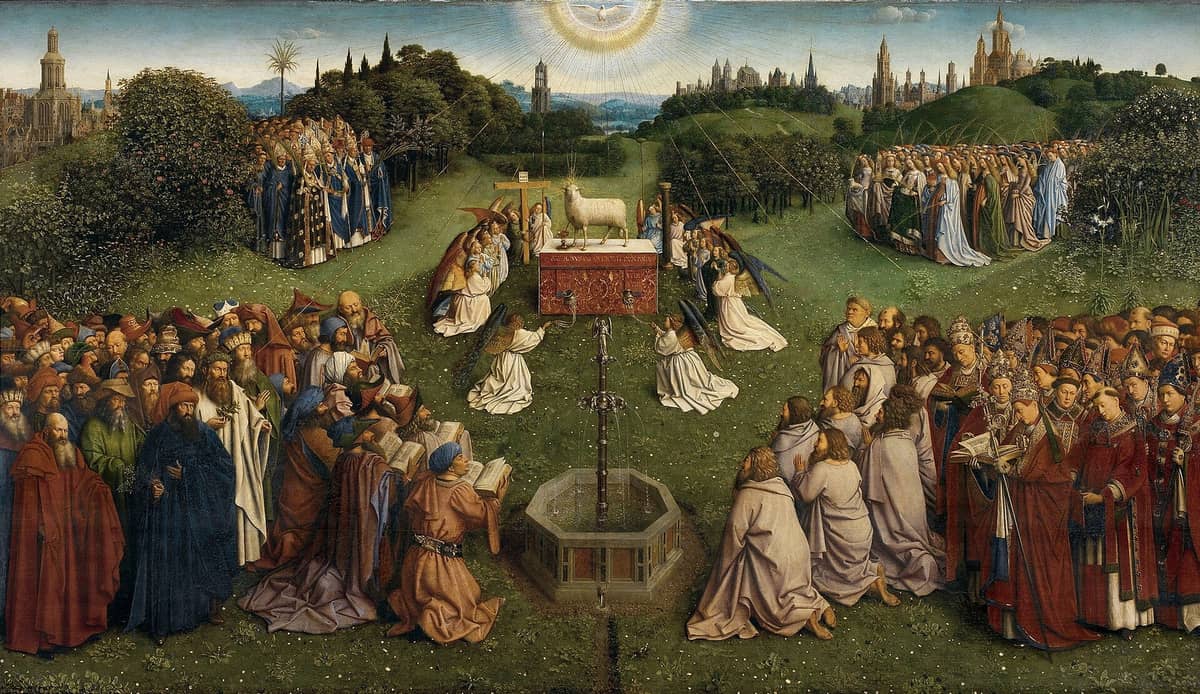
The central lower panel depicts the Lamb of God on an altar, bleeding into a chalice, surrounded by pilgrims, knights, hermits, and angels converging from all directions across a luminous Flemish landscape. The upper tier features God the Father in full regal vestments, flanked by the Virgin and John the Baptist, with panels of singing and music-making angels on either side. The outer panels, visible when the altarpiece is closed, are rendered in near-monochrome grisaille, depicting the Annunciation and the donors who commissioned the work: Jodocus Vijd and his wife Elisabeth Borluut.
ℹ️ Good to know
The altarpiece has been stolen, dismembered, sold, smuggled, and nearly destroyed more times than almost any other artwork in history. One of its 12 original panels — the Just Judges — was stolen in 1934 and has never been recovered. The panel on display today is a 1945 copy.
The Visitor Centre: How the Viewing Actually Works
Entry to St Bavo's Cathedral is free. The Ghent Altarpiece, however, is housed in a dedicated Mystic Lamb Visitor's Centre within the cathedral complex, which requires a separate paid ticket. The visitor centre is open Monday to Saturday from 10:00 to 17:00, and on Sundays from 13:00 to 17:00. Last admission for the full 60-minute AR tour is at 16:00; the shorter visit option allows entry slightly later. These hours are subject to change, so check the official cathedral website before you visit.
The altarpiece-only ticket costs €12.50 and gives access to the altarpiece and visitor centre displays. The €16 ticket includes an augmented reality tour, which uses a tablet device to reveal under-painted layers, restoration details, and compositional choices invisible to the naked eye. For anyone with a genuine interest in the work's history and technique, the AR tour is worth the extra cost. CityCard Gent holders receive a €10 discount, bringing the AR ticket to €6. Children under 6 enter free.
💡 Local tip
Book tickets online in advance, particularly in summer and during school holidays. Walk-in availability is not guaranteed, and the visitor centre operates on timed entry. The cathedral website sells tickets directly: sintbaafskathedraal.be.
The viewing room is controlled for light and visitor numbers. You will stand close to the altarpiece, separated by a low barrier, in the visitors' centre. As of 2026, seven upper-register panels are high-quality photographs while the originals are restored at MSK, with that phase scheduled through spring 2027. The difference from seeing a reproduction, even a high-quality one, is significant: the depth of colour in Jan van Eyck's jewels, textiles, and flesh tones is not something that photographs faithfully reproduce.
Tickets & tours
Hand-picked options from our booking partner. Prices are indicative; availability and final rates are confirmed when you complete your booking.
Historic Ghent city exploration game
From 10 €Instant confirmationFree cancellationBelgian waffle making workshop and beer tasting in Ghent
From 45 €Instant confirmationFree cancellationTaste of Ghent private chocolate walking tour
From 256 €Instant confirmationFree cancellationSips and stories, a private beer tour in Ghent
From 373 €Instant confirmationFree cancellation
What to Look at Once You're in the Room
Most visitors instinctively move toward the central Lamb panel and stay there. That is understandable — it is the focal point — but the altarpiece rewards a more systematic approach. Start with the closed outer panels: the grisaille Annunciation scenes and the portrait panels of the donors are exercises in trompe l'oeil illusionism, painted to look like stone sculpture. Jan van Eyck is demonstrating that paint can deceive the eye into reading three-dimensional form before you have even seen the interior.
On the open interior, move first to the upper register. The God the Father panel in the centre is one of the most lavishly painted objects in northern European art: the tiara, the robe, the staff, the carpet beneath his feet. Count the stones. Each one is a distinct mineral. The singing angels panel to the left is where you will find one of the altarpiece's most discussed puzzles: the figures at the back of the choir appear to have a different spatial relationship to the frame than the figures in front, a compositional decision that art historians still argue about.
The Lamb panel itself is dense. The figure count runs into the hundreds across the four landscape panels of the lower register. The distant Ghent-like cityscape in the background is painted with the same precision as the foreground flowers. Bring good eyes, or use the AR tablet to zoom into details your eyes cannot resolve from standing distance.
The Cathedral Beyond the Altarpiece
St Bavo's Cathedral is itself worth time outside the ticketed visitor centre. The cathedral has been on this site since the 10th century, though the current Gothic structure was built primarily between the 14th and 16th centuries. The interior is large and relatively cool, even in summer, with a nave that rewards upward attention. A Rubens painting, The Conversion of St Bavo, hangs in the first chapel on the right as you enter, and it is easy to miss if you are focused on reaching the altarpiece.
The cathedral sits on Sint-Baafsplein, one of Ghent's central squares, directly adjacent to the Ghent Belfry and within easy walking distance of St Nicholas Church. The three towers of Ghent — the Belfry, St Nicholas, and St Bavo's — form one of Belgium's most recognisable skylines, best viewed from St Michael's Bridge to the west.
Cathedral opening hours are broader than the visitor centre: Monday to Saturday 08:30 to 17:30, and Sunday 13:00 to 17:30. Arriving when the cathedral opens gives you the nave largely to yourself before the group tours begin. Morning light enters through the clerestory windows at an angle that changes the character of the stone interior considerably.
Time of Day, Crowds, and Practical Timing
The visitor centre sees its highest footfall between 11:00 and 14:00, when day-trippers from Brussels and the main tour groups arrive. If you have a pre-booked ticket for a 10:00 or 10:30 slot, you will have a noticeably less crowded experience in the viewing room. Late-afternoon slots, between 15:00 and 16:00, are also quieter, though you should be aware that the last AR tour entry is around 16:00.
Ghent sees significant visitor numbers in July during the Gentse Feesten festival — the city's ten-day street festival — when accommodation is full and queues form at most major sights. If you are planning around this period, the Gentse Feesten guide covers timing and logistics. Outside of summer, spring and early autumn offer comfortable temperatures and shorter waits at the cathedral.
⚠️ What to skip
The altarpiece viewing room has restricted photography conditions. Flash photography is not permitted. The AR tour uses a provided tablet and is conducted at your own pace, not in a guided group — confirm current conditions with the cathedral when booking.
Getting There and Accessibility
Sint-Baafsplein sits in the pedestrianised heart of Ghent's historic centre. From Gent-Sint-Pieters railway station (the main rail terminus, served by direct trains from Brussels Airport via Brussels-Noord or Brussels-Midi), take a De Lijn tram into the city centre, approximately 10 to 15 minutes. A single De Lijn ride costs €3, valid for one hour, and contactless payment is accepted on board. From Korenmarkt stop, the cathedral square is a two-minute walk east.
Ghent's historic centre is largely car-free, which makes orientation easier on foot. For a broader sense of how to move around the city, the getting around Ghent guide covers tram routes, cycling, and the logic of the pedestrian zone in detail.
The visitor centre is set up for modern visitor flows with controlled entrances. For visitors with mobility requirements, the cathedral has dedicated accessible entrances and the visitor centre incorporates lift access. Contacting the cathedral in advance is advised for detailed accessibility assistance.
Is It Worth the Ticket Price? An Honest Assessment
For anyone with an interest in art history, medieval theology, or the technical development of European painting, yes, without reservation. The Ghent Altarpiece is not a famous painting that turns out to be smaller and less impressive in person. It is large, complex, and visually overwhelming in a way that no reproduction prepares you for. The €16 AR ticket is fair for the depth of content on offer.
If you are visiting Ghent primarily for its architecture, waterways, and food, you can reasonably prioritise the free cathedral visit and skip the ticket, but you will be standing 10 metres from one of the most important paintings ever made. For context on how the altarpiece fits into Ghent's broader art and museum landscape, see the Flemish Masters in Ghent guide and the best museums in Ghent.
Visitors who find religious iconography inaccessible or who are primarily interested in contemporary culture may find the experience more academic than moving. The altarpiece rewards prior knowledge; the more you know about its subject matter and troubled history before you arrive, the more you will get out of the 60 minutes inside.
Insider Tips
- The AR tour tablet lets you zoom into micro-details — particularly the plants and minerals in the central Lamb panel — that your eyes simply cannot resolve from standing distance. Even visitors who are sceptical of technology-assisted viewing tend to find it genuinely useful here.
- The cathedral nave is free and uncrowded in the first hour after opening (08:30 on weekdays). Arriving then to see the Rubens and walk the nave before your ticketed altarpiece slot is a good use of time and costs nothing.
- The missing Just Judges panel is replaced by a 1945 copy painted by Jef Van der Veken. It is in the same position as the original and easy to miss as a substitution. Look closely at the lower left panel when the altarpiece is open: that is the copy.
- CityCard Gent covers a wide range of museums and transport in addition to the altarpiece discount. If you are spending more than one full day in Ghent, the card typically pays for itself. Check current pricing and coverage before you buy.
- Sint-Baafsplein gets crowded from mid-morning. If you are combining the altarpiece visit with the Belfry or a walk along the Graslei, plan the outdoor portions of your itinerary for the earlier or later part of the day when the square is less congested.
Who Is Ghent Altarpiece (Adoration of the Mystic Lamb) For?
- Art history enthusiasts and anyone with a serious interest in the development of European painting
- First-time visitors to Ghent who want to anchor their trip in its most significant cultural landmark
- Travellers on a Brussels day trip who want a single world-class artwork as their destination
- Detail-oriented visitors who will spend time with a complex, layered composition rather than moving quickly
- Families with older children who have studied medieval history or art and can engage with the iconographic content
Nearby Attractions
Other things to see while in Ghent Historic Centre:
- City Pavilion (Stadshal)
Completed in 2012 by Ghent architects Robbrecht & Daem and Marie-José Van Hee, the Stadshal is a free, open public structure spanning roughly 40 metres at Emile Braunplein, surrounded by the Belfry, Town Hall, and St Nicholas' Church. Whether you pass through at noon or after dark, this latticed wooden canopy changes character with the light and the crowd beneath it.
- Design Museum Gent
Design Museum Gent, founded in 1903 and located in Ghent's historic centre, holds a collection of approximately 22,500 objects tracing applied arts and design from the 18th century to the present day. The museum is currently closed for a major expansion and renovation, but its permanent collection and architectural setting make it one of Ghent's most distinctive cultural institutions., holds a collection of approximately 22,500 objects tracing applied arts and design from the 18th century to the present day. The museum is currently closed for a major expansion and renovation, but its permanent collection and architectural setting make it one of Ghent's most distinctive cultural institutions.
- Castle of Gerald the Devil (Geeraard de Duivelsteen)
Built in the 13th century in Scheldt Gothic style, Geeraard de Duivelsteen is one of the most architecturally striking medieval structures in Ghent. From knight's residence to madhouse to event venue, its layered history is as dramatic as its stone facade. The building is not open for regular walk-in visits, but its exterior and occasional scheduled openings make it essential context for understanding Ghent's medieval character.
- Ghent Belfry (Belfort van Gent)
Standing 91 metres above Sint-Baafsplein, the Belfort van Gent is the tallest belfry in Belgium and a UNESCO-listed symbol of Flemish civic power. This guide covers everything you need to know before you climb: tickets, crowds, views, and what the tower reveals about Ghent's medieval ambitions.