St Michael's Bridge (Sint-Michielsbrug): Ghent's Greatest View
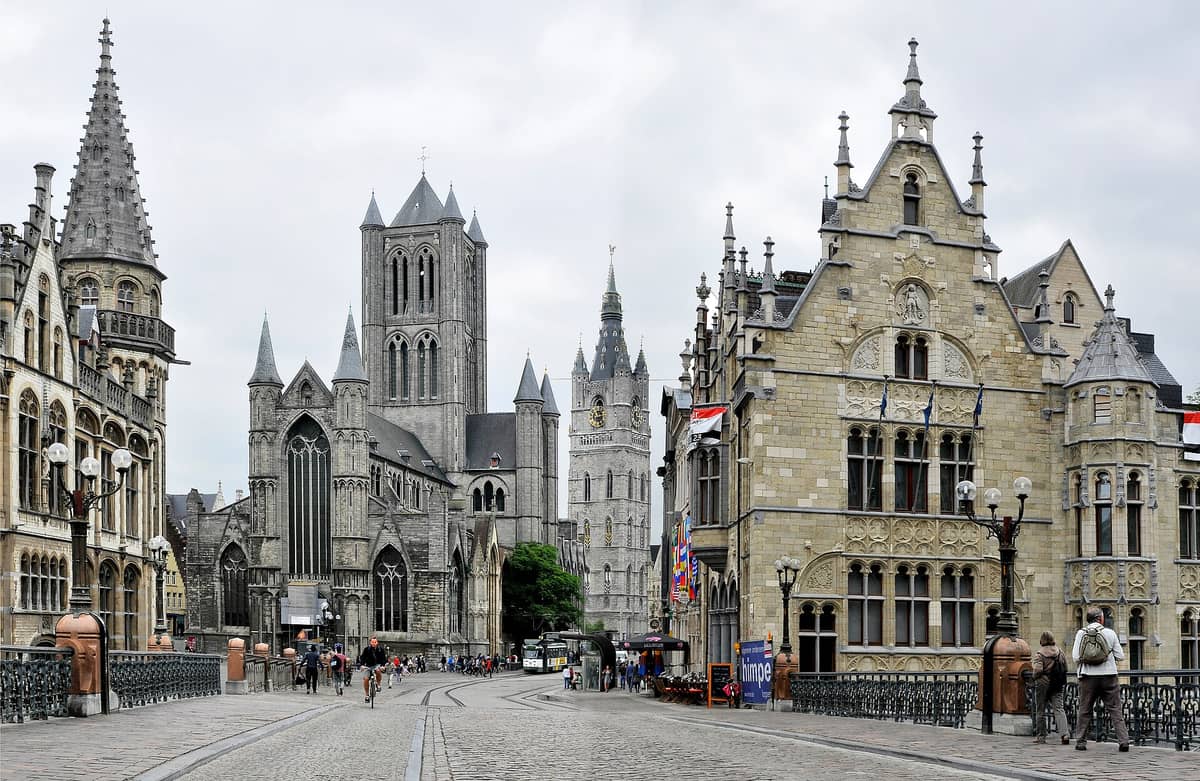
Standing on Sint-Michielsbrug, you see Ghent's three medieval towers aligned in a single glance — St Nicholas Church, the Belfry, and St Bavo's Cathedral. It is the most rewarding viewpoint in the city, completely free, and reachable on foot within minutes of Korenmarkt.
Quick Facts
- Location
- Sint-Michielsbrug / Sint-Michielshelling, 9000 Gent, Belgium
- Getting There
- See current De Lijn service updates for tram line 1 to Korenmarkt
- Time Needed
- 15–30 minutes at the bridge; allow more for the surrounding area
- Cost
- Free — open public bridge, no tickets
- Best for
- Panoramic photography, evening walks, first-time visitors to Ghent
- Official website
- visit.gent.be/en/see-do/st-michaels-bridge-romantic-ghent
What You Actually See From the Bridge
Sint-Michielsbrug earns its reputation the moment you step onto its central arch and turn to face northeast. Spread out before you is the full lineup of Ghent's medieval skyline: the tower of St Nicholas Church closest to you, the Belfry rising behind it, and the soaring nave of St Bavo's Cathedral anchoring the far end of the composition. On clear days, all three sit in near-perfect alignment above the rooflines of the Graslei and Korenlei quaysides, which frame the foreground with their guild houses and warehouse facades. Few European cities can offer a comparably concentrated view of medieval architecture from a single, freely accessible public point.
Below the bridge, the Leie River splits into two channels. Looking downstream, you can see the historic quays stretching toward the old city harbour. Looking upstream, the water opens toward the Vrijdagmarkt district. Cyclists and pedestrians cross constantly, and the foot traffic alone tells you how central this bridge is to daily Ghent life, not just to tourism.
💡 Local tip
For the classic three-towers photograph, position yourself at the middle of the bridge and shoot toward the northeast. A wide-angle lens captures all three towers in a single frame; a 35mm equivalent on a smartphone works well too. The view is unobstructed from both sides of the bridge railing.
How the Experience Changes by Time of Day
Early morning, roughly 7 to 9am, is when Sint-Michielsbrug is at its quietest. Commuter cyclists outnumber tourists, the light comes in low from the east, and the stone facades of the guild houses on Graslei glow amber without a tourist boat in sight. If photography is your priority, this window is by far the most rewarding.
By mid-morning the tour groups arrive. From around 10am onward, the bridge becomes a standard stop on walking tours, and the railings fill with people pointing cameras at the same northeast view. The boats on the Leie begin their hourly circuits, their narration carrying up from the water. It is still a good experience, but expect company.
The evening shift is something different altogether. As daylight fades, the towers are lit from below and their reflections begin to appear in the water. The crowd thins, cafes along the quays get louder, and the whole scene takes on a slower character. In summer, dusk falls after 9pm, giving you a long golden hour to work with. Winter evenings are shorter but the lighting on the stonework is arguably more dramatic against a dark sky.
⚠️ What to skip
During Gentse Feesten (Ghent's ten-day summer festival, held annually in July), the entire historic centre including Sint-Michielsbrug fills with crowds from mid-afternoon well into the night. The bridge becomes near-impassable during peak evening hours. Plan visits before noon if you want any breathing room.
Tickets & tours
Hand-picked options from our booking partner. Prices are indicative; availability and final rates are confirmed when you complete your booking.
Historic Ghent city exploration game
From 10 €Instant confirmationFree cancellationBelgian waffle making workshop and beer tasting in Ghent
From 45 €Instant confirmationFree cancellationTaste of Ghent private chocolate walking tour
From 256 €Instant confirmationFree cancellationSips and stories, a private beer tour in Ghent
From 373 €Instant confirmationFree cancellation
History: From 1322 to the 1913 World's Fair
A bridge at this crossing is documented as early as 1322, when a city record refers to it as "up Sente Mechiels bricge." For centuries the crossing served as a working component of the medieval city's canal network, modest in structure and primarily functional.
The bridge you walk on today was built between approximately 1905 and 1909, designed by the Ghent architect Louis Cloquet. It replaced an earlier wooden turning bridge and was conceived as a monumental stone arch structure commensurate with the ambitions of early 20th-century Ghent. The finishing of the approach slopes and surrounding streetscape was completed around 1912, timed deliberately for the 1913 World's Fair that Ghent hosted. The fair drew international visitors to the city, and the renewed bridge and its panoramic view were intended as a showcase of civic confidence.
Cloquet worked within the historicist architectural tradition dominant in Belgium at the time, drawing on Flemish Gothic and Romanesque references that would harmonize with the medieval towers the bridge was designed to frame. The result is a structure that does not compete with its surroundings but anchors them. It is worth comparing the bridge's proportions with those of nearby landmarks: the tower of St Nicholas Church directly across the water predates the bridge by roughly six centuries, yet the two coexist without visual discord.
Getting There and Practical Logistics
Sint-Michielsbrug sits in the heart of Ghent's historic centre and is easily reached without a car. From Gent-Sint-Pieters railway station, check the current De Lijn service for tram line 1 to Korenmarkt. The bridge is a 2 to 3 minute walk along Sint-Niklaasstraat toward the Leie. The bridge is entirely free and open 24 hours a day, every day of the year. From Korenmarkt, the bridge is a 2 to 3 minute walk along Sint-Niklaasstraat toward the Leie. The bridge is entirely free and open 24 hours a day, every day of the year.
If you are arriving from Brussels by train, the journey to Gent-Sint-Pieters takes around 30 minutes from Brussels Midi. From Brussels Airport, trains run approximately once per hour directly to Gent-Sint-Pieters, or you can connect via Brussels Noord. Ghent has no airport of its own. Transport fares and timetables are managed by De Lijn (trams and buses) and NMBS/SNCB (national rail); verify current prices before traveling as these change periodically.
The bridge falls within Ghent's low-emission zone, so driving a private car directly to the bridge is not straightforward. Walking or cycling are the practical options once you are in the city centre. The historic core is compact enough that most major sights are reachable on foot from Sint-Michielsbrug within 10 minutes.
ℹ️ Good to know
Accessibility: Sint-Michielsbrug is a paved public bridge used daily by pedestrians and cyclists. The surface is flat and maintained, though the approach slopes on either side have a gentle gradient. One visitor account describes it as wheelchair accessible, but this is experiential rather than certified accessibility data. Those with mobility concerns should assess the approach slopes from Sint-Michielshelling before committing to the full crossing.
The Bridge as a Starting Point for the Historic Centre
Most visitors treat Sint-Michielsbrug as a viewpoint and move on, but it also works well as a geographic anchor for a walking route through the Ghent historic centre. From the bridge, you can walk north along the Leie toward the Graslei and Korenlei quays, Ghent's most photographed waterfront, in under five minutes. The medieval guild houses there are best seen from water level or from the opposite bank, which is why the elevated perspective from Sint-Michielsbrug provides a useful complement to the quayside walk.
Heading in the other direction, a short walk southeast from the bridge brings you to St Michael's Church, which gives the bridge its name. The church's facade faces the bridge directly and is part of the same visual sequence that Cloquet's design was meant to frame. Further along the same axis stands the Ghent Belfry, the only UNESCO World Heritage Site among the three towers visible from the bridge, and worth a separate visit for its interior and the view from its summit.
For travelers following a structured route, the bridge appears on most versions of the Ghent walking tour itinerary and is typically visited in the first hour alongside the quays and St Nicholas Church. It pairs naturally with a stop at St Bavo's Cathedral to see the Ghent Altarpiece, which is roughly 10 minutes on foot from the bridge.
Photography Conditions and Weather Realities
Ghent has a temperate maritime climate with no reliable dry season. Rain is possible in any month, and overcast skies are common from November through March. This matters for photography: the three-towers view reads well under cloud cover because the diffused light reduces harsh shadows on the stone, but flat grey skies compress the depth of the image. A partly cloudy day with directional light is ideal, which means weather luck plays a genuine role.
The best natural light for the main northeast-facing view arrives in the morning when the sun is behind you and illuminating the towers from the front. Late afternoon puts the towers in shadow and into backlight, which can produce interesting silhouette images but loses the architectural detail. Summer evenings after 8pm see the artificial lighting come on while residual daylight still fills the sky, creating a mixed-light window that many photographers find compelling.
If the weather turns, the bridge itself offers no shelter. The nearest indoor option is the Groot Vleeshuis (the medieval covered meat hall) a few minutes' walk toward Graslei, or the many cafes along the quayside. For a broader guide to photographing the city, see the Ghent photography guide, which covers the best vantage points across the historic centre with timing notes.
Is Sint-Michielsbrug Worth Your Time?
The short answer is yes, and the reason is that it costs nothing and takes almost no time. The bridge is on the route between Korenmarkt and the main sights of the medieval centre, which means most visitors pass over it anyway. The view from the middle of the arch is legitimately one of the best in Belgium, not because of the bridge itself but because of what it reveals about the city's medieval skyline in a single, unobstructed look.
Where Sint-Michielsbrug can disappoint is if visitors expect it to be a destination in its own right. There is nothing to do on the bridge beyond walk across it and look at the view. No café, no exhibition, no interpretation panels. If you are traveling with restless children or expecting a narrative experience, you will exhaust what the bridge has to offer in five minutes. For those who can spend a quarter of an hour simply looking at a medieval skyline reflected in a Belgian river, it delivers something more lasting.
Insider Tips
- The view from Sint-Michielsbrug is photographed from the bridge itself, but the bridge also looks good from the water. Ghent's canal boat tours depart from Graslei and pass under Sint-Michielsbrug; the low-angle perspective looking up at the stone arches and the three towers above is a completely different composition from what you see standing on the bridge.
- On foggy mornings in autumn and winter, the towers partially disappear into mist and the Leie takes on a glassy stillness. This is arguably a more atmospheric scene than the full clear-sky panorama, and far fewer photographers are present to compete for the railing.
- The south side of the bridge (looking upstream toward Sint-Michielskerk) is almost always less crowded than the north side. If the north railing is packed with tour groups, cross to the south-facing view while you wait — it frames the church and the university quarter and is overlooked by most visitors.
- Ghent's three-tower view is also partially visible from the top of the Gravensteen castle, from the Vrijdagmarkt square, and from the upper floors of the Belfry. If crowds on the bridge are heavy, these alternatives give you a different frame for the same iconic skyline.
- At night the bridge surface becomes slick in wet weather. The stone is smooth and the gradient of the approach slopes is enough to cause slipping if you are moving quickly. Wear sensible footwear, especially in autumn and winter.
Who Is St Michael's Bridge (Sint-Michielsbrug) For?
- First-time visitors to Ghent wanting a fast orientation to the city's medieval skyline
- Photographers seeking Ghent's signature three-towers panorama
- Couples on an evening walk along the lit quays and waterways
- Travelers building a self-guided walking route through the historic centre
- Anyone visiting on a tight schedule who needs a high-reward, zero-cost stop
Nearby Attractions
Other things to see while in Ghent Historic Centre:
- City Pavilion (Stadshal)
Completed in 2012 by Ghent architects Robbrecht & Daem and Marie-José Van Hee, the Stadshal is a free, open public structure spanning roughly 40 metres at Emile Braunplein, surrounded by the Belfry, Town Hall, and St Nicholas' Church. Whether you pass through at noon or after dark, this latticed wooden canopy changes character with the light and the crowd beneath it.
- Design Museum Gent
Design Museum Gent, founded in 1903 and located in Ghent's historic centre, holds a collection of approximately 22,500 objects tracing applied arts and design from the 18th century to the present day. The museum is currently closed for a major expansion and renovation, but its permanent collection and architectural setting make it one of Ghent's most distinctive cultural institutions., holds a collection of approximately 22,500 objects tracing applied arts and design from the 18th century to the present day. The museum is currently closed for a major expansion and renovation, but its permanent collection and architectural setting make it one of Ghent's most distinctive cultural institutions.
- Castle of Gerald the Devil (Geeraard de Duivelsteen)
Built in the 13th century in Scheldt Gothic style, Geeraard de Duivelsteen is one of the most architecturally striking medieval structures in Ghent. From knight's residence to madhouse to event venue, its layered history is as dramatic as its stone facade. The building is not open for regular walk-in visits, but its exterior and occasional scheduled openings make it essential context for understanding Ghent's medieval character.
- Ghent Altarpiece (Adoration of the Mystic Lamb)
Completed in 1432 by Hubert and Jan van Eyck, the Ghent Altarpiece is a 12-panel polyptych (with paintings on both sides of most wings) housed in St Bavo's Cathedral in Ghent's historic centre. It is one of the most technically advanced and historically significant paintings ever made, and seeing it in person requires a ticket, a timed slot, and some preparation.