Graslei & Korenlei: Ghent's Medieval Waterfront, Explained
Graslei and Korenlei are the twin quays that frame the Leie river in Ghent's historic centre, lined with guild houses dating back to the 12th century. Access is free and around the clock, making them one of the most accessible and architecturally rich stretches of public space in Belgium.
Quick Facts
- Location
- Graslei, 9000 Ghent, Belgium (Historic Centre)
- Getting There
- Korenmarkt tram stop (De Lijn tram line T2 and other bus routes) — approx. 5-minute walk
- Time Needed
- 30–90 minutes for the quays; longer if you stop for a drink
- Cost
- Free — 24/7 public access, no ticket required
- Best for
- Architecture lovers, photographers, first-time visitors to Ghent
- Official website
- visit.gent.be/en/see-do/history-graslei-and-korenlei
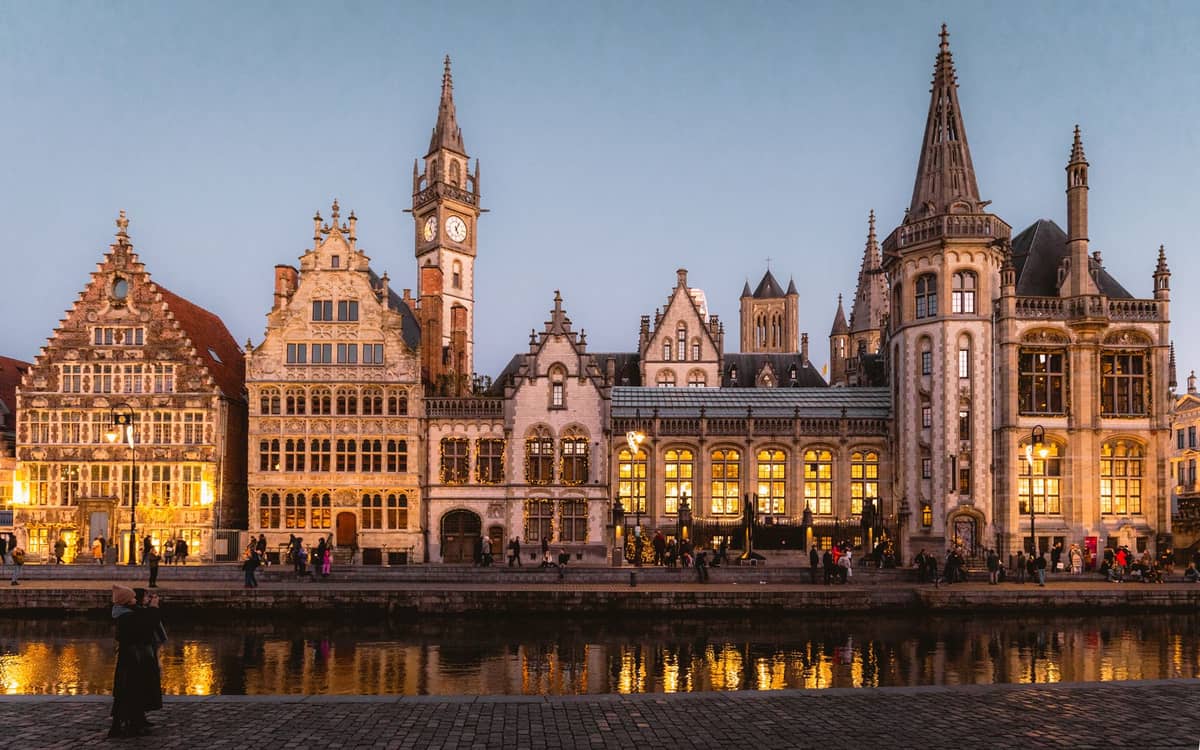
What Are the Graslei and Korenlei?
Graslei and Korenlei are two parallel quays running along opposite banks of the Leie river in the heart of Ghent's medieval city centre. Together, they form one of the best-preserved medieval waterfront ensembles in northern Europe. The Graslei sits on the right (east) bank; the Korenlei faces it from the left (west). Between them, the river opens into a wide stretch that reflects the stepped gables and sandstone facades of guild houses, warehouses, and Romanesque stoops built between the 12th and 17th centuries.
The quays were not built as a scenic attraction. They were the economic heart of medieval Ghent, a city that in the 13th and 14th centuries ranked among the largest in northern Europe after Paris. Grain, salt, and textiles arrived here by barge; guild buildings regulated trade; and the grain weighing house managed the flow of commodities that made Ghent wealthy. Understanding that commercial history makes the facades more than decorative. Each building tells you something about who had power, money, and trading rights in medieval Flanders. For deeper context on how Ghent's medieval layers stack up, the STAM Ghent City Museum provides an excellent chronological overview before or after your visit to the quays.
💡 Local tip
The single best viewpoint over both quays is from Sint-Michielsbrug (St. Michael's Bridge). Stand at the centre of the bridge and you'll see the Graslei guild houses, the towers of St. Nicholas and the Belfry behind them, and the Korenlei arcade to your left — all in one frame.
The Architecture: What You're Actually Looking At
The Graslei is the more architecturally varied of the two quays. Walking its length from south to north, you pass through several centuries of Flemish building styles without moving more than 200 metres. The Romanesque Spijker (grain storehouse), dating from around 1200, is one of the oldest surviving civic buildings in Ghent, with thick stone walls and small round-arched windows that feel more fortified than decorative. Immediately north of it, the Korenstapelhuis (Corn Stacking House) continues the Romanesque grain-warehouse typology, its warm grey-yellow stone catching afternoon light differently depending on the season.
The Gildehuis der Vrije Schippers (Free Boatmen's Guild House) and the Tolhuisje (Customs House) complete the central section of the Graslei, each reflecting the distinct identity of the guild that commissioned them. The Free Boatmen, who held rights to trade within Ghent itself, built more elaborately than the Tied Boatmen, whose guild controlled traffic beyond the city walls. The contrast in facade ambition is visible even to an untrained eye: one building broadcasts status, the other does not.
The Korenlei across the river is quieter architecturally. Its guild houses and private residences are largely Baroque and neo-Gothic, built or heavily modified in the 17th and 18th centuries. The row is handsome but less layered than the Graslei. Most visitors spend their time on the Graslei side, which is correct — the Korenlei is worth a walk primarily for the view back across the water to the Graslei facades.
Tickets & tours
Hand-picked options from our booking partner. Prices are indicative; availability and final rates are confirmed when you complete your booking.
Historic Ghent city exploration game
From 10 €Instant confirmationFree cancellationBelgian waffle making workshop and beer tasting in Ghent
From 45 €Instant confirmationFree cancellationTaste of Ghent private chocolate walking tour
From 256 €Instant confirmationFree cancellationSips and stories, a private beer tour in Ghent
From 373 €Instant confirmationFree cancellation
How the Quays Change Throughout the Day
Early morning, roughly before 9:00, the Graslei belongs to dog walkers, cyclists crossing the Leie, and occasional joggers. The cafe terraces are empty and the facades are at their clearest: no awnings, no crowd noise, no beer umbrellas blocking sightlines. In spring and summer, the low morning sun hits the Graslei's east-facing stonework directly, making the warm sandstone glow in a way that afternoon side-lighting cannot replicate. This is the window photographers consistently prefer.
By mid-morning the cafe terraces fill and the quayside takes on its most recognisable character: people sitting along the stone embankment with their legs dangling over the water, tour groups stopping in front of the Spijker, and boat tours launching from the landing stages between the two quays. The sound changes too — the echo off the water amplifies conversation and the low thrum of boat engines. It is convivial rather than overwhelming, at least outside of peak summer weekends.
Evenings transform the atmosphere entirely. As the light fades, the guild houses are illuminated from below, turning the Graslei into something more theatrical. The stone buildings, which read as worn and functional in daylight, become dramatic silhouettes. The cafe and restaurant terraces along both quays are fully occupied on warm evenings, and the waterway itself mirrors the lights above it. If you are in Ghent for only one evening, this is where to spend the first hour after dark.
⚠️ What to skip
On summer weekends, particularly during major festivals, the Graslei becomes genuinely congested by early afternoon. If crowds are a problem for you, come before 10:00 or after 20:00.
Boat Tours and the Water Perspective
One element guidebooks tend to underemphasise is how different the Graslei looks from the water. The boat tour landing stages are located between the two quays, roughly at the point where the Leie opens up before Sint-Michielsbrug. From water level, the scale of the Spijker and Korenstapelhuis becomes apparent in a way that standing on the quayside does not convey. The boat tours also extend further into Ghent's canal network, passing the Gravensteen castle moat and the older residential waterways of the Patershol quarter. If you have 45 minutes and it is not raining, a canal tour is worth considering. See our guide to Ghent's waterways and canal tours for operator information and what each route covers.
Getting There and Navigating the Area
The Graslei and Korenlei are in Ghent's historic centre, approximately 500 metres northeast of the main market square, Korenmarkt. From Gent-Sint-Pieters railway station (the main arrival point for trains from Brussels and Brussels Airport), take a De Lijn tram toward the city centre and alight at Korenmarkt. From there, walk north along Graslei or cross the Leie at Sint-Michielsbrug — both approaches work. The walk from Korenmarkt tram stop to the quays takes around five minutes.
The area lies within Ghent's low-emission zone, so arriving by private car requires advance registration and is not practical for most visitors. Walking and cycling are the natural modes for exploring this part of the city. The quayside itself is entirely on foot; there are no steps or significant barriers on the main promenade, though some of the cobbled sections adjacent to the embankment can be uneven. Wheelchair users should note that the older cobblestones near the water's edge may be difficult to navigate, while the main pedestrian zone slightly inland is more even.
The Graslei sits at the centre of Ghent's medieval core, within a short walk of several other major attractions. St. Michael's Bridge is immediately to the south and provides the panoramic view over both quays. St. Nicholas' Church is visible from the quays and a two-minute walk away. For a full itinerary that takes in the quays and the surrounding landmarks, the one-day Ghent itinerary sequences them efficiently.
Photography Practical Notes
The postcard shot — the full Graslei lineup reflected in calm water — requires a combination of timing and conditions. Still water (no boat traffic or wind chop) is most common in the early morning. The reflection disappears almost entirely when boats are running, which from spring onwards means most of the day. A polarising filter helps cut glare on overcast days when the water is silvery rather than reflective.
For a wider compositional frame that includes both quays and Ghent's famous towers, position yourself on Sint-Michielsbrug rather than on the quayside itself. The bridge elevation adds depth and allows the Belfry and St. Nicholas' spire to sit above the roofline. At golden hour in summer, the towers turn amber while the facades below remain in shadow — a contrast that photographs well even with a phone camera.
In winter, the Graslei is significantly less crowded but the light is lower and flatter. Grey skies are common. That said, misty winter mornings along the Leie produce an atmosphere that summer cannot replicate, and the lack of cafe umbrellas and crowds makes the architecture far easier to read in photographs.
Context: Is This Worth Your Time?
Honestly assessed: yes, for almost any visitor to Ghent, but with an important caveat. The Graslei and Korenlei are exterior architecture and public open space. There is nothing to enter, no collection to study, and no guided interpretation built into the site itself. Visitors who prefer structured indoor experiences, or who primarily want to understand medieval history in depth, will extract more from a morning at the STAM Ghent City Museum or standing in front of the Ghent Altarpiece at St. Bavo's Cathedral. The quays work best as part of a broader walk through the historic centre rather than as a standalone destination requiring dedicated travel time.
For first-time visitors to Ghent, the Graslei is close to essential — not because it is the most impressive single thing in the city, but because it anchors the spatial logic of the medieval core and gives you a reference point for understanding how the city was organised around water and trade. Once you have stood on Sint-Michielsbrug and seen the towers of the Belfry, St. Nicholas, and St. Bavo framing the guild house roofline, Ghent's layout makes sense in a way that maps alone do not convey.
Insider Tips
- The Spijker (grain storehouse), the oldest building on the Graslei, is easy to walk past without registering its age. Look for the thick Romanesque walls and the small round-arched windows near the waterline — this building was already old when most of the other guild houses were being planned.
- For the cleanest water reflection, visit on a weekday morning before 9:00 in spring. Boat traffic starts around mid-morning and destroys the mirror surface for the rest of the day.
- The Korenlei side of the river has less foot traffic and better shade in the afternoon, making it a quieter spot to sit and look back across at the Graslei. The view from the Korenlei toward the guild houses is the one most professional photographers actually use.
- If you are visiting in July, be aware that the Gentse Feesten festival transforms this entire area into an open-air event space. The quays are extraordinary during the festival but extremely crowded — plan accordingly.
- The embankment wall along the Graslei has shallow ledges where locals sit with feet over the water. This is a perfectly normal thing to do and one of the better ways to actually spend time on the quays rather than just passing through.
Who Is Graslei & Korenlei For?
- First-time visitors to Ghent who want an orientation point for the medieval city
- Architecture enthusiasts interested in Flemish Romanesque, Gothic, and Baroque guild buildings in one compact stretch
- Photographers, especially those visiting in early morning or at dusk
- Couples or small groups looking for an unhurried evening walk followed by dinner along the waterfront
- Budget travellers — the quays themselves are free, and the view from Sint-Michielsbrug costs nothing
Nearby Attractions
Other things to see while in Ghent Historic Centre:
- City Pavilion (Stadshal)
Completed in 2012 by Ghent architects Robbrecht & Daem and Marie-José Van Hee, the Stadshal is a free, open public structure spanning roughly 40 metres at Emile Braunplein, surrounded by the Belfry, Town Hall, and St Nicholas' Church. Whether you pass through at noon or after dark, this latticed wooden canopy changes character with the light and the crowd beneath it.
- Design Museum Gent
Design Museum Gent, founded in 1903 and located in Ghent's historic centre, holds a collection of approximately 22,500 objects tracing applied arts and design from the 18th century to the present day. The museum is currently closed for a major expansion and renovation, but its permanent collection and architectural setting make it one of Ghent's most distinctive cultural institutions., holds a collection of approximately 22,500 objects tracing applied arts and design from the 18th century to the present day. The museum is currently closed for a major expansion and renovation, but its permanent collection and architectural setting make it one of Ghent's most distinctive cultural institutions.
- Castle of Gerald the Devil (Geeraard de Duivelsteen)
Built in the 13th century in Scheldt Gothic style, Geeraard de Duivelsteen is one of the most architecturally striking medieval structures in Ghent. From knight's residence to madhouse to event venue, its layered history is as dramatic as its stone facade. The building is not open for regular walk-in visits, but its exterior and occasional scheduled openings make it essential context for understanding Ghent's medieval character.
- Ghent Altarpiece (Adoration of the Mystic Lamb)
Completed in 1432 by Hubert and Jan van Eyck, the Ghent Altarpiece is a 12-panel polyptych (with paintings on both sides of most wings) housed in St Bavo's Cathedral in Ghent's historic centre. It is one of the most technically advanced and historically significant paintings ever made, and seeing it in person requires a ticket, a timed slot, and some preparation.