City Pavilion (Stadshal): Ghent's Bold Architectural Canopy
Completed in 2012 by Ghent architects Robbrecht & Daem and Marie-José Van Hee, the Stadshal is a free, open public structure spanning roughly 40 metres at Emile Braunplein, surrounded by the Belfry, Town Hall, and St Nicholas' Church. Whether you pass through at noon or after dark, this latticed wooden canopy changes character with the light and the crowd beneath it.
Quick Facts
- Location
- Emile Braunplein / Poeljemarkt, 9000 Gent, Historic Centre
- Getting There
- Walk from Korenmarkt (5 min) or take a De Lijn tram toward the city centre and walk from the historic core
- Time Needed
- 15–30 minutes to explore; longer if an event is on
- Cost
- Free. Temporary events (e.g. winter ice rink) charge separate fees
- Best for
- Architecture lovers, photographers, and anyone exploring the historic centre on foot
- Official website
- visit.gent.be/en/see-do/city-pavilion
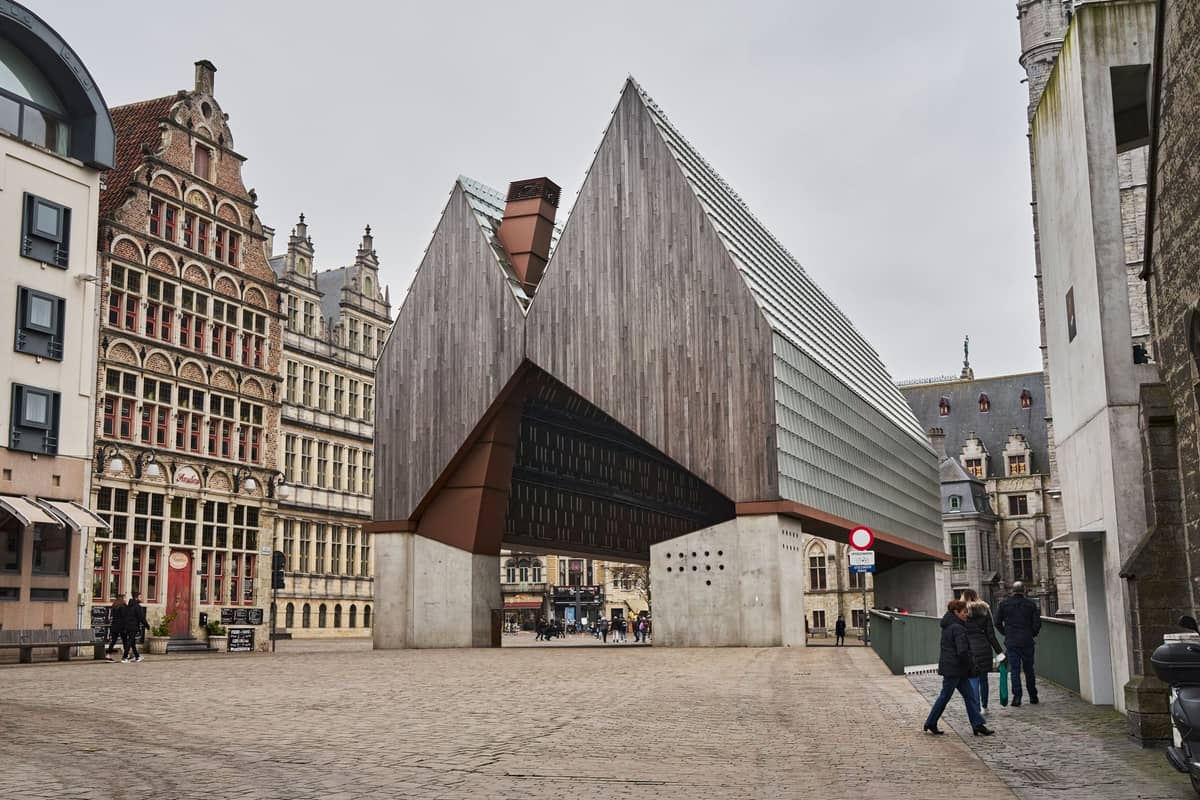
What the Stadshal Actually Is
The City Pavilion, known in Dutch as the Stadshal, is not a museum, not a shopping arcade, and not quite a square. It is a permanent open canopy, completed in 2012, that covers a public space at Emile Braunplein in the heart of Ghent's historic centre. There are no walls, no entrance gates, and no ticket desks. You simply walk in from any direction, and the city shifts around you.
The structure was designed by the Ghent-based architectural practice Robbrecht & Daem together with architect Marie-José Van Hee, who won the commission as part of a broader urban regeneration effort for this corner of the historic centre. The result spans approximately 40 metres and is punctuated by small windows set into a layered wooden roof. Those windows filter light in constantly shifting patterns depending on the time of day and the season, which is the detail most visitors notice first, and remember longest.
ℹ️ Good to know
The Stadshal is open 24 hours a day, every day of the year. There is no fee to enter the pavilion itself. Some seasonal events held beneath it, such as the winter ice rink, have their own separate charges.
Architecture in Context: A Modern Canopy Among Medieval Stones
Standing under the pavilion, look in any direction and you will see why the design generated debate before it gained admiration. To the northwest, the grey stone tower of St Nicholas' Church rises over the roofline. To the east, the Belfry of Ghent and the adjacent cloth halls anchor the skyline. To the north, the ornate facade of Ghent's Town Hall faces the square. The Stadshal does not imitate any of these. It does not try to blend in. The architects chose a latticed wood-and-steel construction that reads as unambiguously contemporary, yet its warm timber tones and human-scaled detail hold a visual conversation with the medieval surroundings rather than shouting over them.
The wooden canopy structure sits on concrete pillars and the underside of the roof reveals a dense, geometric framework that rewards a slow look upward. Ghent's architecture scene encompasses centuries of stone, and the Stadshal represents a deliberate argument that new buildings can be inserted with confidence into historic fabric. For a deeper look at the buildings surrounding the pavilion, the Ghent Belfry and Ghent Town Hall are both within a two-minute walk.
Tickets & tours
Hand-picked options from our booking partner. Prices are indicative; availability and final rates are confirmed when you complete your booking.
Historic Ghent city exploration game
From 10 €Instant confirmationFree cancellationBelgian waffle making workshop and beer tasting in Ghent
From 45 €Instant confirmationFree cancellationTaste of Ghent private chocolate walking tour
From 256 €Instant confirmationFree cancellationSips and stories, a private beer tour in Ghent
From 373 €Instant confirmationFree cancellation
How the Space Changes Through the Day
Morning is the quietest time here. Between roughly 8 and 10 am, the square beneath the canopy is mostly empty except for delivery cyclists threading past and a few early commuters crossing diagonally. The roof windows cast small bright lozenges of light across the paving stones, and the air inside feels slightly warmer than the open square outside, sheltered from the wind. The wooden structure smells faintly of damp timber on cool mornings.
By late morning, tour groups begin arriving from the nearby Belfry and Town Hall. The ambient noise rises: languages mix, shoes scrape the stone, someone is always photographing the roof from directly below. At midday in summer the pavilion attracts people eating lunch on the benches, and street performers sometimes occupy the open central space. The acoustics amplify everything, which is part of its charm and also its occasional irritation.
Early evening is the best time for photography. The golden-hour light enters at a low angle through the side openings, hits the underside of the wooden lattice, and throws the whole structure into warm relief. After dark, artificial lighting illuminates the canopy from below, and the square becomes a meeting point for locals rather than tourists. On weekends it stays lively until late.
💡 Local tip
For the best photographs of the roof windows, visit on a bright morning between 9 and 11 am when the light enters at an angle and creates a mosaic of shadow and reflection on the paving below. Bring a wide-angle lens if you have one — the underside of the canopy is vast.
Getting There and Getting Around
Emile Braunplein is in the pedestrianised core of Ghent's historic centre, roughly five minutes on foot from Korenmarkt, which is a major tram stop in the centre. De Lijn trams running along the central axis stop at Korenmarkt, and from there you simply follow the crowds or the signs toward the Belfry. The Stadshal appears as you descend toward the lower square.
Ghent has no airport of its own. Most visitors arrive via Brussels Airport (IATA: BRU) and travel to Ghent's main station, Gent-Sint-Pieters, by train. From Gent-Sint-Pieters, tram line 1 currently does not run directly to Korenmarkt because of works; check De Lijn's current service updates before travelling. For full transport logistics from Brussels, see the guide on getting from Brussels to Ghent. For navigating the city once you arrive, the getting around Ghent guide covers tram routes, tickets, and walking distances in detail.
Drivers should note that the Stadshal sits within Ghent's low-emission zone, and vehicle access to the immediate area is heavily restricted. Parking on the fringes of the historic centre and continuing on foot or by tram is strongly recommended.
Accessibility
The Stadshal itself is flat and open, making it physically straightforward for wheelchair users and visitors with limited mobility. The surrounding area of Emile Braunplein has some cobblestone sections, which can be rough to navigate. Benches are available nearby.
Events and Seasonal Uses
The permanent structure of the Stadshal is only one layer of what happens here. The city uses the covered space for temporary events across the calendar year. In winter, a pop-up ice skating rink typically appears beneath the canopy, drawing both locals and visitors and creating a completely different atmosphere from the usual open square. Admission to the rink is charged separately; fees and dates vary by year and should be confirmed closer to the time.
During the Gentse Feesten, Ghent's massive ten-day summer festival held each July, the area around the Stadshal becomes one of the festival's central gathering points. The noise, the crowd density, and the energy are unlike any other time of year. If you are planning a visit during this period, the Gentse Feesten guide will help you make sense of what to expect.
Markets, film screenings, and outdoor performances have all been staged under the pavilion. The city treats it as a flexible piece of infrastructure as much as a landmark, which means the experience on any given day can differ considerably from a quiet Tuesday in October to a packed Saturday in summer.
Honest Assessment: Is It Worth Your Time?
The Stadshal does not compete with the Ghent Altarpiece or the Gravensteen for headline status, nor should it. Taken on its own, a 15-minute visit to a covered public square might not justify a detour from elsewhere in Belgium. But that framing misses the point. The pavilion sits at the exact geographic and visual centre of Ghent's most concentrated cluster of medieval monuments. You will almost certainly pass through it anyway.
The value is in the pause it creates. The canopy gives you a reason to stop, look upward, look outward at the surrounding towers, and recalibrate your sense of the city's scale. For travellers following a walking tour of Ghent, the Stadshal functions as a natural midpoint and a reference landmark that everything else orientates around.
Those seeking a traditional sightseeing experience with historical interiors, guided context, or tangible exhibits will find the Stadshal underwhelming on its own. It rewards people who engage with architecture as public space rather than as spectacle. Visitors with very limited time in Ghent who need to prioritise should note that several of the surrounding buildings, including the Belfry and St Nicholas' Church, are more fully developed as stand-alone experiences.
Insider Tips
- Look upward from directly below the centre of the canopy: the windows are not uniformly distributed, and the pattern only becomes legible when you are underneath them rather than approaching from the side.
- The pavilion's acoustic properties mean it amplifies any performance dramatically. If you hear music from across the square, it is almost certainly being played inside or just beneath the edge of the canopy.
- On rainy days, the Stadshal is one of the few genuinely sheltered outdoor spaces in the historic centre where you can stop without entering a paid venue. It stays dry inside even in moderate rain.
- The winter ice rink, when it appears, is operated seasonally and not every year on the same schedule. Check Visit Gent's event calendar before assuming it will be present during a winter visit.
- For a composed photograph that includes both the Stadshal canopy and the Belfry tower behind it, position yourself near the Botermarkt side of the square and shoot toward the southeast in the late afternoon.
Who Is City Pavilion (Stadshal) For?
- Architecture and design enthusiasts who want to see how a 21st-century structure handles insertion into a medieval city centre
- Photographers looking for geometric patterns, light play, and a backdrop that combines contemporary and Gothic elements
- Travellers on a budget — it costs nothing to enter and is central enough to anchor a full day on foot
- Visitors attending seasonal events such as the Gentse Feesten or the winter festival, where the pavilion becomes a primary gathering venue
- Anyone exploring the historic centre who wants a natural rest stop and orientation point midway through a walking route
Nearby Attractions
Other things to see while in Ghent Historic Centre:
- Design Museum Gent
Design Museum Gent, founded in 1903 and located in Ghent's historic centre, holds a collection of approximately 22,500 objects tracing applied arts and design from the 18th century to the present day. The museum is currently closed for a major expansion and renovation, but its permanent collection and architectural setting make it one of Ghent's most distinctive cultural institutions., holds a collection of approximately 22,500 objects tracing applied arts and design from the 18th century to the present day. The museum is currently closed for a major expansion and renovation, but its permanent collection and architectural setting make it one of Ghent's most distinctive cultural institutions.
- Castle of Gerald the Devil (Geeraard de Duivelsteen)
Built in the 13th century in Scheldt Gothic style, Geeraard de Duivelsteen is one of the most architecturally striking medieval structures in Ghent. From knight's residence to madhouse to event venue, its layered history is as dramatic as its stone facade. The building is not open for regular walk-in visits, but its exterior and occasional scheduled openings make it essential context for understanding Ghent's medieval character.
- Ghent Altarpiece (Adoration of the Mystic Lamb)
Completed in 1432 by Hubert and Jan van Eyck, the Ghent Altarpiece is a 12-panel polyptych (with paintings on both sides of most wings) housed in St Bavo's Cathedral in Ghent's historic centre. It is one of the most technically advanced and historically significant paintings ever made, and seeing it in person requires a ticket, a timed slot, and some preparation.
- Ghent Belfry (Belfort van Gent)
Standing 91 metres above Sint-Baafsplein, the Belfort van Gent is the tallest belfry in Belgium and a UNESCO-listed symbol of Flemish civic power. This guide covers everything you need to know before you climb: tickets, crowds, views, and what the tower reveals about Ghent's medieval ambitions.