Self-Guided Walking Tour of Ghent: The Complete Expert Guide
Ghent rewards walkers more than almost any city in Belgium. This guide covers the best self-guided walking routes through the historic centre, practical logistics, CityCard value, seasonal tips, and the landmarks you genuinely should not skip.
Plan and book this trip
Tools from our partner Travelpayouts help you compare flights and hotels. If you book through them, we may earn a commission at no extra cost to you.
Flights
Hotels map
TL;DR
- Ghent's entire historic core is walkable in a day, but two days lets you go deeper without rushing.
- The official Visit Gent website offers multiple free digital walking routes, including the 5 km Light Plan Walk for evenings. See our one-day Ghent itinerary for a timed framework.
- The CityCard Ghent (€49 for 48 hours, €55 for 72 hours) covers entry to STAM, Gravensteen, and most major museums, plus some public transport.
- STAM city museum closes every Wednesday and on key winter dates; plan around it.
- Tram line 1 connects Gent-Sint-Pieters station to Korenmarkt (the ideal walking tour start point) in around 5-10 minutes. See the full guide to getting around Ghent for transport details.
Why Ghent Works So Well on Foot
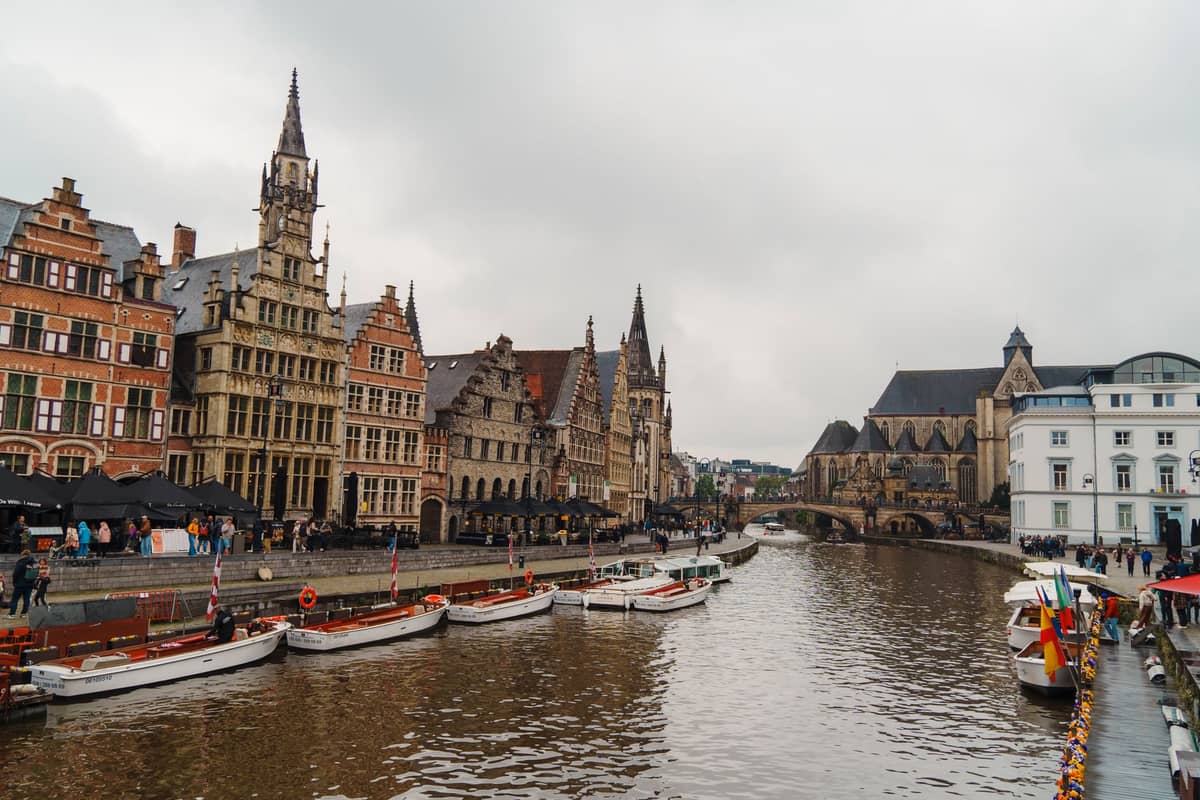
Ghent is Belgium's second-largest municipality by population (over 270,000 residents as of 2024) and the capital of East Flanders, but its medieval core is compact enough that most major sights sit within a 1.5 km radius of Korenmarkt. The city grew around the confluence of the Scheldt and Leie rivers, and that waterfront geography gives walkers a natural spine: follow the quays and you thread past cathedrals, guild houses, a medieval castle, and a belfry without needing a map. Streets are generally flat, signage in the centre is good in both Dutch and English, and the car-free zones introduced over the past decade have made the historic centre genuinely pleasant on foot.
Unlike Bruges, which can feel stage-managed for tourism, Ghent is a living university city with around 80,000 students. That means the streets have texture: local cafes beside Gothic churches, street art in medieval alleyways, covered markets that still function. For walkers, this is an asset. The historic centre and the nearby Patershol quarter are where self-guided walking delivers the most per kilometre walked.
ℹ️ Good to know
Ghent has no airport of its own. Most visitors arrive via Brussels Airport (BRU), then take a train to Gent-Sint-Pieters station. Direct trains run roughly once per hour and take about 55–80 minutes; via Brussels-Noord, frequency rises to around three per hour. From Gent-Sint-Pieters, tram line 1 drops you at Korenmarkt in under 10 minutes. Verify current timetables and fares with NMBS/SNCB before travelling.
The Core Walking Route: Korenmarkt to Vrijdagmarkt
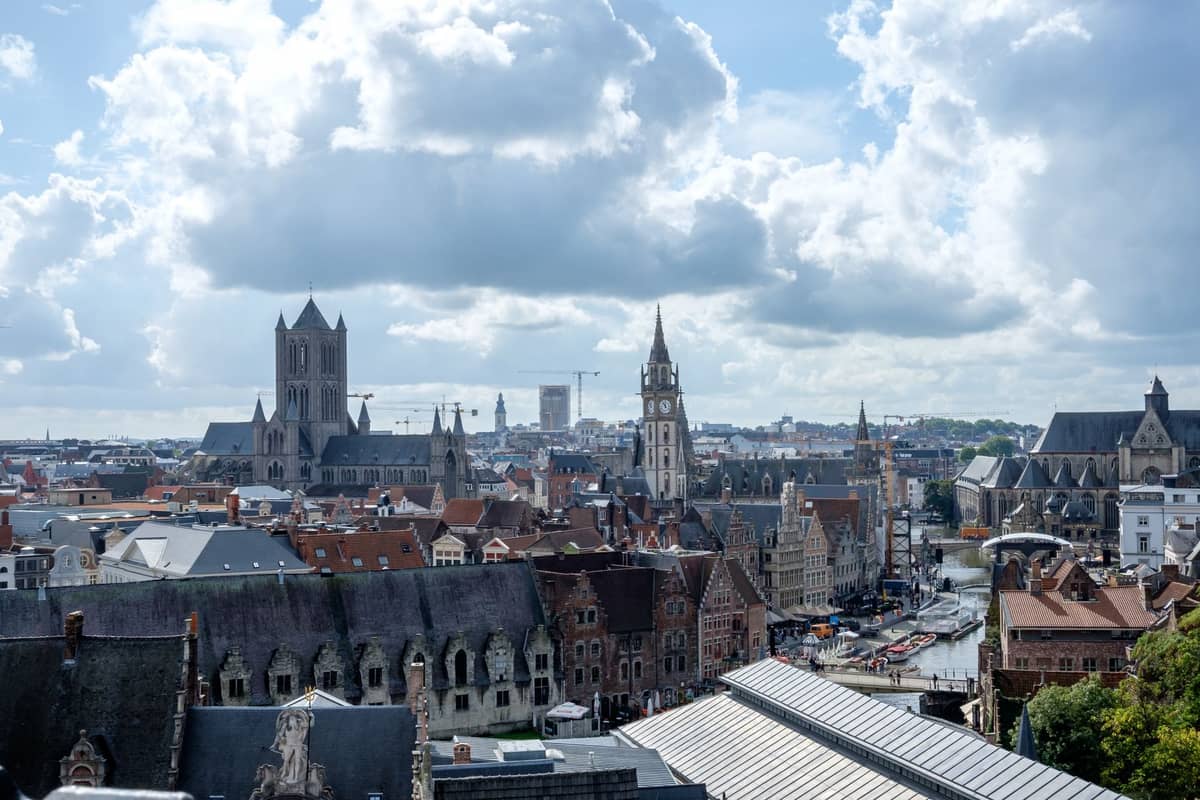
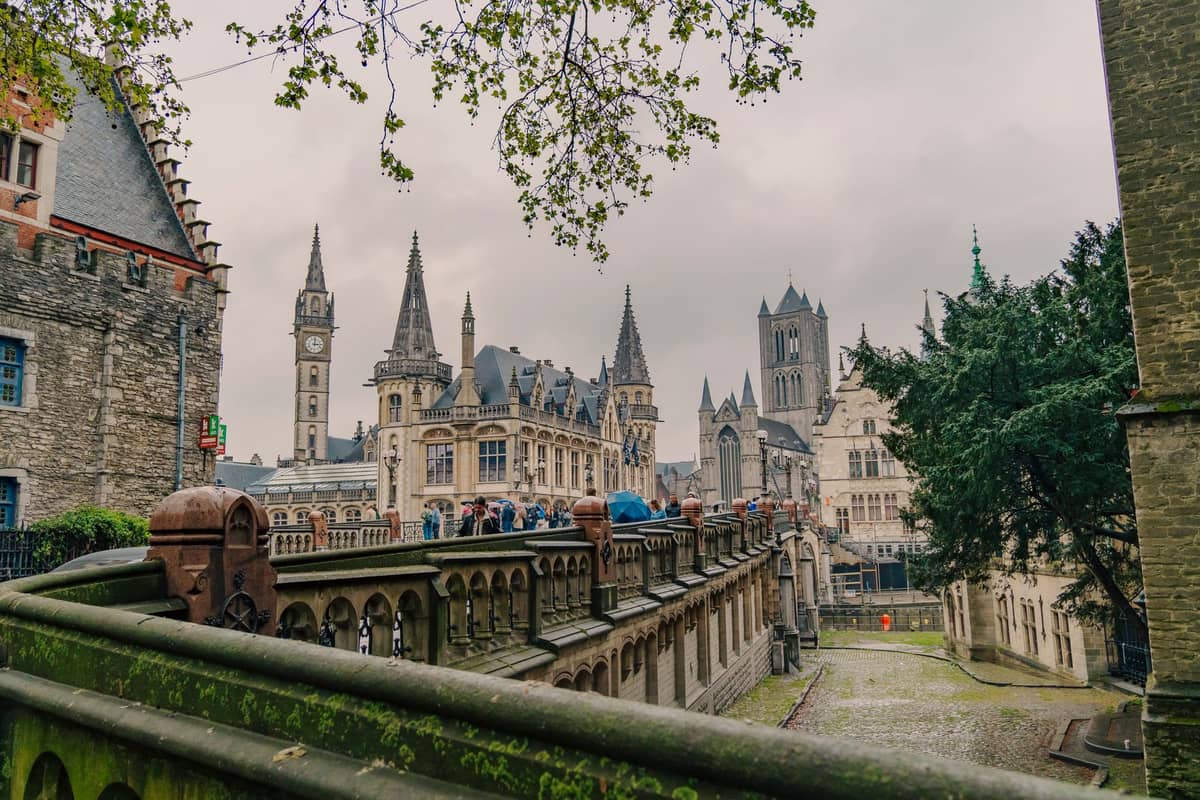
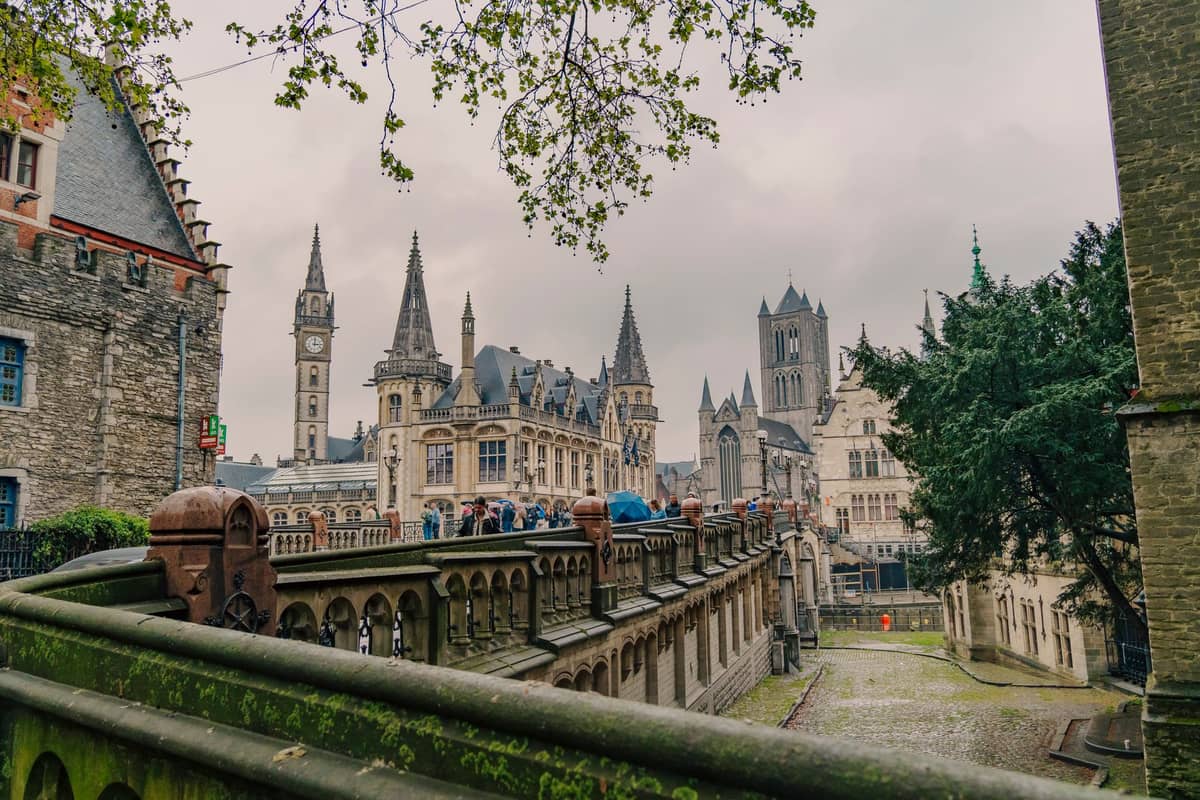
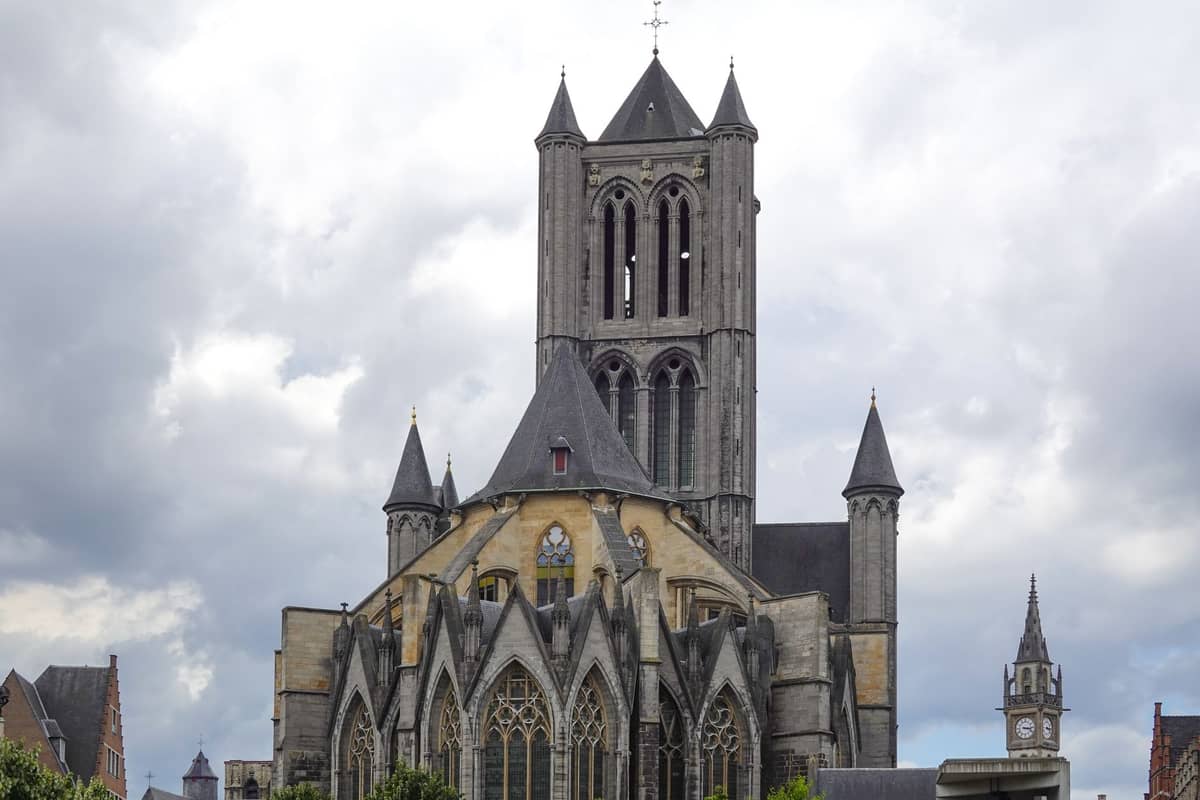
The logical start for any self-guided walking tour of Ghent is St. Michael's Bridge, which sits right beside Korenmarkt and offers the city's most photographed panorama: the three towers of St. Nicholas' Church, the Belfry, and St. Bavo's Cathedral lined up in a single frame. Spend a few minutes here before moving north along the quays.
From the bridge, walk north along Graslei and Korenlei, the twin medieval waterfront quays. The guild houses here date from the 12th to 17th centuries and their reflections in the water are best in the morning before tour boats arrive. Continue to Sint-Veerleplein square, where the Visit Gent inquiry desk is located at Sint-Veerleplein 5 and you can pick up printed maps. The Gravensteen (Castle of the Counts) dominates the square and is open daily 10:00-18:00, with last entry at 16:40, closing only on 24, 25, 31 December and 1 January. Entry includes a free audioguide, which is worth using: the castle's history as both a fortress and a prison is genuinely grim.
From Gravensteen, the Patershol neighbourhood is immediately to the east. This former working-class district of narrow cobbled streets is now Ghent's best area for traditional Flemish restaurants. It is easy to lose an hour here without intending to. Exit north-east toward Vrijdagmarkt, the large square that served as Ghent's political heartland for centuries, where public executions and guild meetings both took place. The statue of Jacob van Artevelde at the centre is a useful landmark. Total walking distance for this core loop is around 2.5-3 km, typically taking 2-3 hours with stops.
Official Routes and Digital Maps from Visit Gent
The city's official tourism platform offers several free self-guided walking routes, all plotted on digital maps that work on a smartphone. These were developed in cooperation with local guide associations and cover different themes: architecture, parks, the waterfront docks, the station quarter, and contemporary art. You do not need to book anything or download a special app. The maps are free to access on the Visit Gent website and can be followed in full or adapted to your interests and time.
- Ghent City Walk: Quirky Charm Uses an essential map of the historic centre highlighting key sights, structured around what the city considers its non-negotiable experiences. Good for first-time visitors with half a day.
- Lens on Ghent A main loop with optional additional walking loops that you can view in full online before setting out. The modular structure lets you lengthen or shorten depending on energy levels and daylight.
- Light Plan Walk Approximately 5 km through the illuminated city, designed to take at most two hours. Best done between October and March when darkness falls early. A digital map is available on the Stad Gent website. Additional illuminated sites outside the basic loop can be added for a longer evening circuit.
- Thematic Routes (Parks, Docks, Stations) Several themed routes on the Visit Gent platform go beyond the immediate historic core, covering Citadelpark, the former dock district, and the university quarter.
✨ Pro tip
The Light Plan Walk is most rewarding in autumn and winter precisely because other visitor numbers are lower, daylight ends by 4:30-5:00 pm, and the illuminated stonework looks its best against a dark sky. Start around 6 pm for a good balance of atmosphere and safety. Pick up the printed brochure at the Visit Gent desk, Sint-Veerleplein 5.
Key Attractions to Build Your Route Around
Any serious walking itinerary should include St. Bavo's Cathedral and the Ghent Altarpiece (the Adoration of the Mystic Lamb by the Van Eyck brothers). This is one of the most important paintings in the Western tradition, not just a regional attraction, and it now occupies a dedicated chamber with exceptional lighting and interpretation. Allow 45-60 minutes minimum.
For city history and context, STAM Ghent City Museum at Godshuizenlaan 2 is the best single stop. Standard hours are Monday, Tuesday, Thursday, Friday 09:00-17:00 and weekends plus public and school holidays 10:00-18:00. STAM closes every Wednesday without exception, including on public holidays. It is also closed on 24, 25, and 31 December and 1 January. Adult tickets are listed at a base price of €14; CityCard Ghent holders enter free. If you are visiting multiple paid sites, the CityCard almost certainly saves money.
- St. Bavo's Cathedral and the Ghent Altarpiece: allow 45-60 minutes
- Gravensteen Castle: allow 60-90 minutes; audioguide included in ticket price
- STAM Ghent City Museum: allow 60-90 minutes; closed Wednesdays
- Graslei and Korenlei quays: 20-30 minutes for a walking pass, longer if you stop at a terrace
- Vrijdagmarkt square: 15 minutes as a stop, longer if the market is running
- Patershol neighbourhood: best explored slowly; no timed entry, just wander
⚠️ What to skip
Do not try to visit STAM, the Ghent Altarpiece, Gravensteen, and the Belfry all in the same morning. Each deserves proper time and most visitors underestimate how much they will want to linger. A two-day visit makes much more sense for the core attractions. The CityCard is designed exactly for this kind of multi-day, multi-venue itinerary.
CityCard Ghent: Is It Worth It?
The CityCard Ghent comes in two versions: 48 hours for €49 and 72 hours for €55. It covers free entry to STAM, Gravensteen, and almost all major museums and monuments in the city, plus some public transport. For a walker visiting four or more paid attractions over two days, the maths typically work in your favour. The Gravensteen alone costs €15 for an adult; STAM is €14; the Belfry and Altarpiece chamber add further costs. Three or four paid entries and the card has paid for itself.
The 72-hour card at €55 is only €6 more than the 48-hour version at €49, making it the better buy for almost anyone spending two full days in the city. If you are doing a single day trip from Brussels, the 48-hour card may still be worthwhile depending on how many paid attractions you plan to enter. CityCards can be purchased at the Visit Gent inquiry desk at Sint-Veerleplein 5 and at some hotels. Verify current prices and included venues before purchase, as the card's contents are subject to change.
Practical Tips: Timing, Seasons, and Getting Started
Ghent has a temperate maritime climate: mild, overcast, and wet in winter, mild and occasionally warm in summer, with rainfall distributed fairly evenly across the year. There is no genuinely dry season. For walking, the most comfortable months are May through September, when temperatures typically reach the low-to-mid 20s °C and daylight extends well into the evening. July brings the Gentse Feesten festival, ten days of street performances and concerts that fill the historic centre. The atmosphere is extraordinary but the streets are crowded; self-guided walking during the festival requires patience.
Weekday mornings before 10:00 am are consistently the least crowded time to walk the Graslei, Korenmarkt, and the area around St. Bavo's. Tour groups and boat trips tend to arrive from mid-morning onwards, and the waterfront terraces fill up by noon on good weather days. If photography is a priority, early morning also gives better light on the north-facing guild houses on Graslei. Evenings are good for the Patershol and Vrijdagmarkt, when restaurants open and locals outnumber tourists.
For transport within the city, De Lijn operates trams and buses throughout Ghent. A single ride costs €3 and is valid for one hour, allowing transfers between tram and bus within that window. Contactless payment by bank card, phone, or smartwatch is accepted on board. Tram line 1 is usually the most useful for walkers, running between Gent-Sint-Pieters station and the historic centre, but due to ongoing works it does not currently run directly between Gent-Sint-Pieters and Korenmarkt; a replacement bus and other tram routes link the station area with the centre. For more on navigating the city, see the full guide to getting around Ghent. Fares and line numbers change periodically; always verify the current De Lijn network map before your visit.
FAQ
How long does a self-guided walking tour of Ghent take?
The compact historic core can be covered in 3-4 hours of walking, but that does not include time inside attractions. Realistically, doing the main sights properly takes at least a full day. Two days is the better choice if you want to visit STAM, Gravensteen, St. Bavo's Cathedral, and explore Patershol without feeling rushed.
Do I need to book a guided walking tour, or can I do it alone?
You can absolutely do it alone. The Visit Gent website provides free digital maps and themed routes that are designed for independent use. No booking is required. The Visit Gent inquiry desk at Sint-Veerleplein 5 can also supply printed maps if you prefer not to rely on a phone screen.
Is the Ghent CityCard worth buying for a walking tour?
For most visitors planning to enter three or more paid attractions, yes. The 48-hour card is €49 and the 72-hour card is €55. Gravensteen and STAM alone together approach that price at standard adult rates. The card also covers some public transport. Verify the current list of included venues before purchasing.
What is the best starting point for a self-guided walk in Ghent?
Korenmarkt or St. Michael's Bridge. From St. Michael's Bridge you get the classic three-towers panorama immediately and can then move north along the waterfront quays toward Gravensteen, or south toward St. Bavo's Cathedral. Normally tram line 1 drops you at Korenmarkt from Gent-Sint-Pieters station in around 5-10 minutes, but during the current works you must use a replacement bus or alternative tram route instead.
Is Ghent walkable from Brussels as a day trip?
Yes. A direct train from Brussels-Midi to Gent-Sint-Pieters takes around 30 minutes. With an early start you can complete the core walking route and visit one or two paid attractions before returning in the evening. If you want to see the Ghent Altarpiece and Gravensteen in the same day, arrive before 10:00 am. For more detail, see our Brussels to Ghent day trip guide.