Gravensteen (Castle of the Counts): Ghent's Medieval Fortress Explained
Gravensteen, the Castle of the Counts, rises from Sint-Veerleplein square in central Ghent like a stone argument against the passage of time. Part fortress, part torture museum, part rooftop viewpoint, it rewards visitors who know what they're walking into.
Quick Facts
- Location
- Sint-Veerleplein 11, 9000 Gent — Ghent Historic Centre
- Getting There
- 10-minute walk from Korenmarkt tram stop (De Lijn lines 1, 2, 3, 4). No direct tram stop at the castle.
- Time Needed
- 1.5 to 2.5 hours, including audio guide and rooftop
- Cost
- €15 adults (audio guide included); free for under-12s; free for Ghent residents on the first Sunday of the month
- Best for
- History enthusiasts, medieval architecture, rooftop views over the canal district
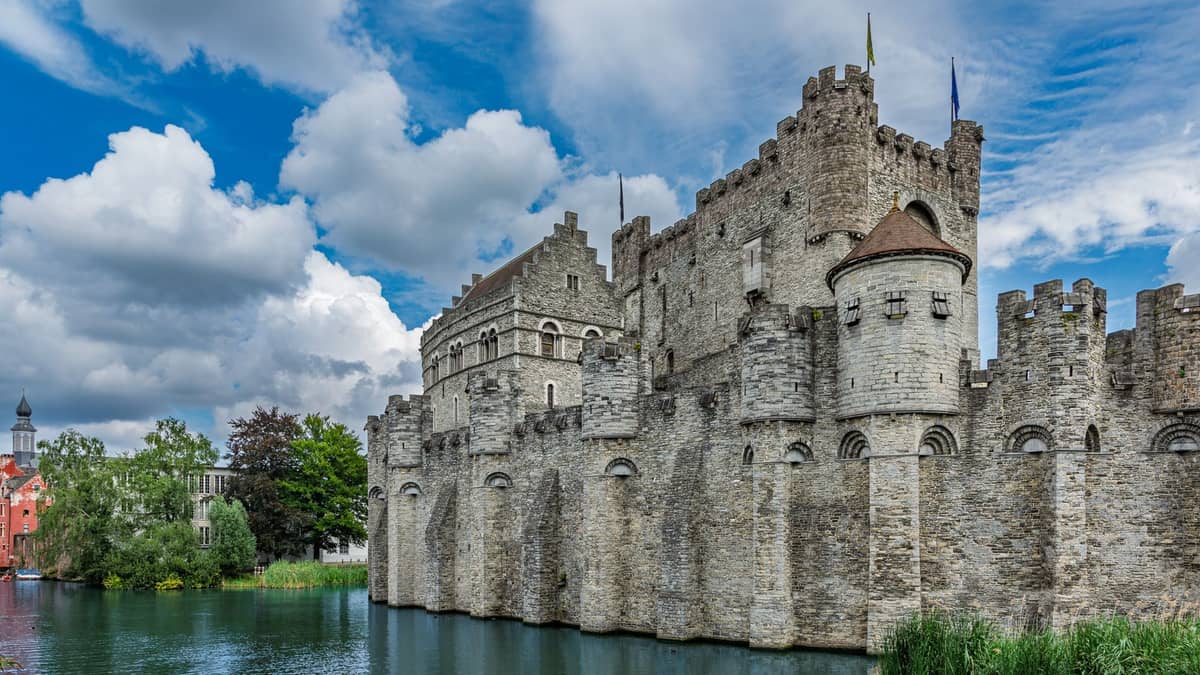
What Gravensteen Actually Is
Gravensteen, the Castle of the Counts, is one of the best-preserved examples of a medieval water castle in Western Europe and arguably the most dramatic single structure in Ghent. It sits on Sint-Veerleplein square in the heart of the historic city centre, surrounded on three sides by the Lieve canal, its stone walls rising directly from the water. From the outside, it looks exactly like the idea of a castle: a moat, a gatehouse, crenellated towers, and walls thick enough to absorb cannon fire.
The original fortress on this site was built by Philip of Alsace, Count of Flanders, in 1180, modelled on castles he had encountered during the Crusades. The design is unambiguously military: a rectangular inner courtyard surrounded by a curtain wall with 24 towers, a donjon (keep) at the north end, and a great hall on the south side. What makes Gravensteen unusual is that this structure has survived in largely coherent form, rather than as a ruin. After centuries of use as a mint, a court of justice, and notoriously a cotton mill during the industrial era, the castle was restored and opened to the public in the early twentieth century.
ℹ️ Good to know
Opening hours: daily 10:00–18:00. Last admission is at 16:40. Closed 24, 25, 31 December and 1 January. The castle is not wheelchair accessible due to more than 480 steps across four narrow spiral staircases.
The Experience: What You Actually See Inside
Entry is through the original gatehouse, a dark, low-ceilinged passage that forces you to slow down and pay attention. The €15 ticket includes an audio guide, and this is one attraction where using it pays off. The commentary is wry and detailed, covering feudal politics, medieval punishment, and the castle's less glorious industrial chapter when it was divided into floors and filled with looms. The production quality is notably better than most Belgian museum audio guides.
The interior circuit takes you through the basement rooms first, where a substantial collection of medieval instruments of torture and execution is displayed. The tone here is documentary rather than sensationalist: these are genuine historical artefacts from the castle's time as a seat of justice, not theatrical props. The collection includes items used in public executions at Sint-Veerleplein, the square just outside the castle gates. It is graphic enough to give some younger children pause, so parents should be prepared.
From the basement you work upward through the keep and great hall, passing rooms that show the evolution of the fortress from a twelfth-century military command centre into a later administrative and residential building. Stone fireplaces, carved capitals, and narrow window openings all reward close attention. The floors are uneven, the ceilings low in places, and the spiral staircases genuinely steep. Wear shoes with grip.
Tickets & tours
Hand-picked options from our booking partner. Prices are indicative; availability and final rates are confirmed when you complete your booking.
Historic Ghent city exploration game
From 10 €Instant confirmationFree cancellationBelgian waffle making workshop and beer tasting in Ghent
From 45 €Instant confirmationFree cancellationTaste of Ghent private chocolate walking tour
From 256 €Instant confirmationFree cancellationSips and stories, a private beer tour in Ghent
From 373 €Instant confirmationFree cancellation
The Rooftop: The Real Payoff
The walkway along the top of the curtain wall is the highlight of the visit for many people, and justifiably so. From up here, the geometry of Ghent's medieval canal network becomes legible in a way it never quite does at street level. You can see the point where the Leie and Lieve canals converge, the spires of Sint-Niklaaskerk and Sint-Baafskathedraal rising above the rooftops, and the long waterfront of the Graslei and Korenlei stretching south.
The view north and west from the battlements reaches into the older Patershol neighbourhood, a dense tangle of narrow streets and low gabled houses that remains one of the most intact medieval residential quarters in Ghent. It looks, from Gravensteen's walls, almost unchanged from maps drawn centuries ago. If you want to follow up the castle visit with a walk through that neighbourhood, the Patershol quarter is immediately adjacent and takes about an hour to explore at a relaxed pace.
Photography from the rooftop is reliable from mid-morning onward when the low eastern light no longer creates strong shadows across the canal. In the late afternoon, the light falls across the castle's stone facing at a low angle, picking out the texture of the masonry in a way that works particularly well in photographs. The rooftop walkway is narrow in places, with iron guardrails, and is exposed to wind. A light jacket is advisable even in summer.
When to Visit: Time of Day and Seasonal Notes
Gravensteen is open daily and draws significant crowds from mid-morning, particularly in summer and during school holidays. Arriving when doors open at 10:00 gives you roughly 45 minutes before tour groups arrive in volume. By 11:30 on a summer weekend, the gatehouse queue can stretch back onto Sint-Veerleplein. If you arrive later in the day, note that last admission is 16:40, which gives approximately 80 minutes inside before closing at 18:00. This is workable if you move efficiently.
Ghent's best visiting season for outdoor sightseeing is roughly May through September, when the weather is milder and daylight hours are long. Gravensteen is fully enclosed for much of the circuit, making it a reasonable wet-weather option in spring and autumn. In winter, the stone interiors are cold regardless of outdoor temperature, and the rooftop walkway can be slippery after rain or frost. Ghent's best season for outdoor sightseeing is roughly May through September, when the weather is milder and daylight hours are long. Gravensteen is fully enclosed for much of the circuit, making it a reasonable wet-weather option in spring and autumn. In winter, the stone interiors are cold regardless of outdoor temperature, and the rooftop walkway can be slippery after rain or frost. The castle closes on 24, 25, and 31 December and 1 January.
💡 Local tip
Ghent residents get free entry on the first Sunday of the month. For everyone else, arriving at opening time on a weekday avoids the worst of the crowds. Check current conditions before visiting as terms may change.
Getting There and the Surrounding Square
The castle sits on Sint-Veerleplein, a square that was historically Ghent's public execution ground, which gives the location a context the audio guide addresses directly. The nearest De Lijn tram stop is Korenmarkt, roughly a ten-minute walk south along the Lieve canal. From Gent-Sint-Pieters railway station, take the shuttle bus or another tram to the centre and walk from there. The walk from the station to the castle takes around 25 minutes on foot along the canalside, which is itself worth doing.
Sint-Veerleplein is also the access point for the Groot Vleeshuis, the fifteenth-century covered meat market immediately east of the castle square. The two buildings together make a coherent half-day of medieval Ghent without any significant walking between them. The square itself functions as a useful orientation point: from here you can see the castle to the north, the canal wharves of the Graslei and Korenlei to the south, and the spire of Sint-Niklaaskerk visible in the middle distance.
Historical Context: Why This Castle Survived
Most medieval urban fortresses in the Low Countries were either demolished for building material or absorbed into later structures beyond recognition. Gravensteen's survival in coherent form is partly accidental. After the Counts of Flanders moved their residence away from the castle in the fourteenth century, the building cycled through uses: a court of law, a mint, a prison, and eventually a cotton mill during the eighteenth and nineteenth centuries. The industrial conversion subdivided the interior but left the shell largely intact. When the city of Ghent acquired the property in 1887 and undertook restoration, there was enough of the original structure remaining to justify reconstruction rather than replacement.
The restoration, led by city architect Joseph De Waele, was ambitious and not without controversy among architectural historians., was ambitious and not without controversy among architectural historians. Some elements were reconstructed rather than conserved, meaning the castle as it stands today is partly a late-nineteenth-century interpretation of its medieval form. This is worth knowing before you visit: Gravensteen is not a perfectly preserved medieval artefact but a carefully assembled picture of what such a fortress looked like, informed by the scholarship of its time.
Accessibility and Practical Limits
Gravensteen is one of the most physically demanding of Ghent's major attractions. The full circuit involves more than 480 steps, spread across four narrow spiral staircases where two people cannot comfortably pass each other. The route is not circular in places, meaning you sometimes retrace your steps. The castle is explicitly not wheelchair accessible, and the tight stairwells and uneven floors make it difficult for anyone with limited mobility, vertigo, or knee problems. Assistance dogs are welcome throughout.
Visitors who cannot manage the stairs can still view the castle courtyard and ground level, and the exterior from Sint-Veerleplein is impressive enough to photograph well. For a more accessible overview of Ghent's medieval history with exhibition-style presentation, the STAM city museum in the Bijloke quarter offers a complementary experience without the physical demands.
Who Should Think Twice
Gravensteen is a genuine medieval fortress with all the physical inconveniences that implies. Travellers with mobility limitations, a fear of heights, or claustrophobia in tight stairwells will find the experience uncomfortable. The torture and execution displays in the basement, while treated soberly, may not suit all families with young children. Anyone expecting a fairy-tale palace interior will also be disappointed: the rooms are stone, sparse, and cold. That is precisely the point, but it helps to know this in advance.
Insider Tips
- The audio guide is included in the ticket price and is worth using from the first room. Unlike many museum guides, it is genuinely entertaining and covers historical detail the signage alone does not.
- The rooftop walkway is the most photographed part of the visit, but it becomes crowded by mid-morning. If you move through the interior quickly, you can reach the battlements before the first tour groups arrive.
- Sint-Veerleplein, the square in front of the castle, has a small fish market on weekend mornings. Arriving early on a Saturday or Sunday means catching both the market and the quieter castle opening.
- Ghent residents enter free on the first Sunday of the month, which means Sunday openings can still be busier than weekday mornings despite the early hour. A weekday opening visit is the most reliable way to avoid queues., which means Sunday mornings can paradoxically be busier than weekday mornings despite the early hour. A weekday opening visit is the most reliable way to avoid queues.
- The castle walls are original medieval stonework in many sections. Look for carved mason's marks on individual stones, especially in the stairwells and lower corridors. These personal signatures of medieval builders are easy to miss but visible on close inspection.
Who Is Gravensteen (Castle of the Counts) For?
- Travellers with a specific interest in medieval military architecture and fortress design
- History enthusiasts who want context for Ghent's role as a medieval commercial and political power
- Photographers looking for elevated canal views and large-format architectural subjects
- Families with children aged roughly 10 and above who can manage the stairs and have some interest in history
- Visitors in Ghent for two days or more who have time to pair the castle with a walk through the adjacent Patershol neighbourhood
Nearby Attractions
Other things to see while in Ghent Historic Centre:
- City Pavilion (Stadshal)
Completed in 2012 by Ghent architects Robbrecht & Daem and Marie-José Van Hee, the Stadshal is a free, open public structure spanning roughly 40 metres at Emile Braunplein, surrounded by the Belfry, Town Hall, and St Nicholas' Church. Whether you pass through at noon or after dark, this latticed wooden canopy changes character with the light and the crowd beneath it.
- Design Museum Gent
Design Museum Gent, founded in 1903 and located in Ghent's historic centre, holds a collection of approximately 22,500 objects tracing applied arts and design from the 18th century to the present day. The museum is currently closed for a major expansion and renovation, but its permanent collection and architectural setting make it one of Ghent's most distinctive cultural institutions., holds a collection of approximately 22,500 objects tracing applied arts and design from the 18th century to the present day. The museum is currently closed for a major expansion and renovation, but its permanent collection and architectural setting make it one of Ghent's most distinctive cultural institutions.
- Castle of Gerald the Devil (Geeraard de Duivelsteen)
Built in the 13th century in Scheldt Gothic style, Geeraard de Duivelsteen is one of the most architecturally striking medieval structures in Ghent. From knight's residence to madhouse to event venue, its layered history is as dramatic as its stone facade. The building is not open for regular walk-in visits, but its exterior and occasional scheduled openings make it essential context for understanding Ghent's medieval character.
- Ghent Altarpiece (Adoration of the Mystic Lamb)
Completed in 1432 by Hubert and Jan van Eyck, the Ghent Altarpiece is a 12-panel polyptych (with paintings on both sides of most wings) housed in St Bavo's Cathedral in Ghent's historic centre. It is one of the most technically advanced and historically significant paintings ever made, and seeing it in person requires a ticket, a timed slot, and some preparation.