Groot Vleeshuis (Great Butcher's Hall): Ghent's Medieval Meat Market
Built between 1407 and 1419, the Groot Vleeshuis is one of the finest surviving examples of a medieval covered meat market in northern Europe. Located on the Groentenmarkt in the heart of Ghent's historic centre, this long, low hall with its distinctive timber roof has served the city for over six centuries. It is currently closed for renovation works, but remains a landmark worth understanding before you visit.
Quick Facts
- Location
- Groentenmarkt 7, 9000 Ghent, Belgium (Historic Centre)
- Getting There
- Tram to Korenmarkt (lines T1 and T2), then a short walk north along the Groentenmarkt
- Time Needed
- 15–30 minutes for the exterior; longer if interior access resumes post-renovation
- Cost
- Free to visit exterior; no admission charged. Check Visit Gent for renovation updates.
- Best for
- Architecture lovers, medieval history, food culture enthusiasts, photographers
- Official website
- visit.gent.be/en/eat-drink/great-butchers-hall
What Is the Groot Vleeshuis?
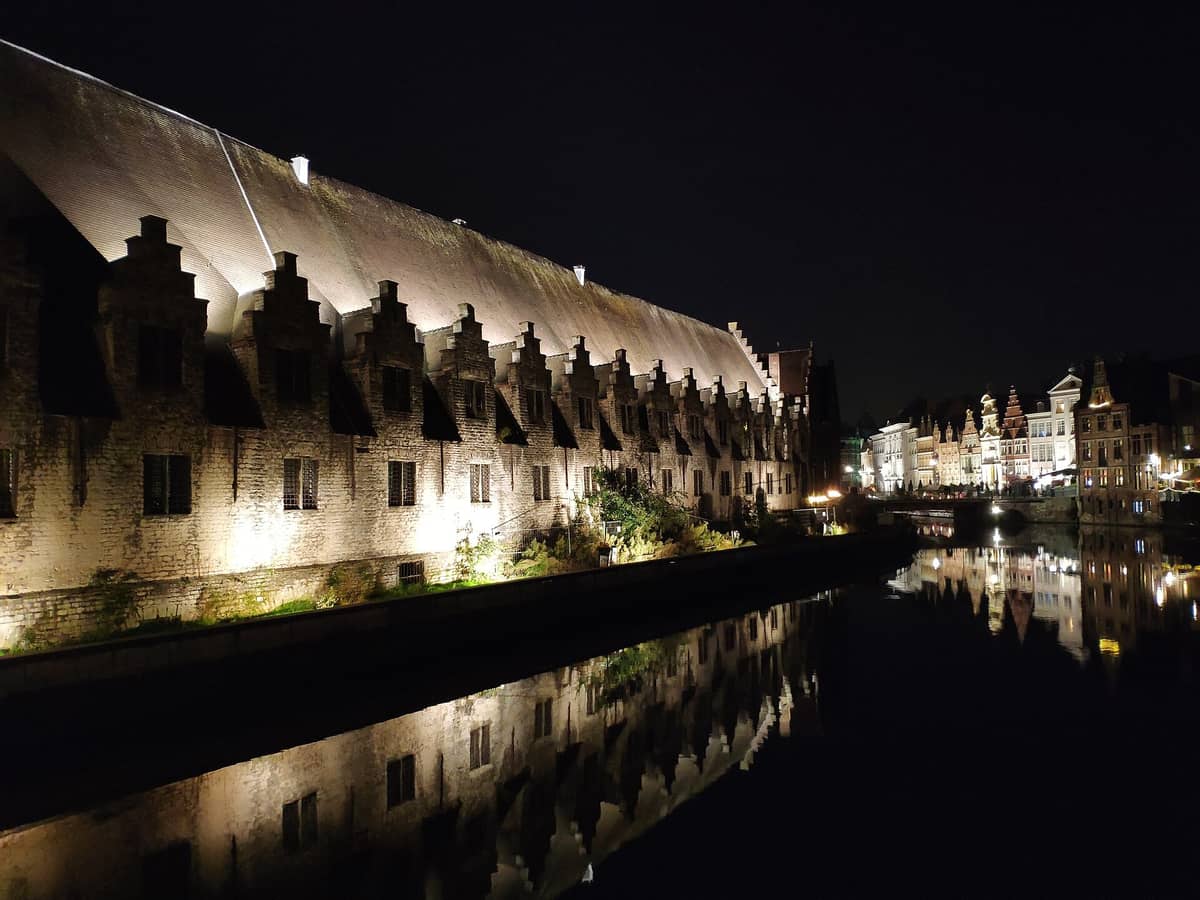
The Groot Vleeshuis, or Great Butcher's Hall in English, is a medieval covered market hall on the Groentenmarkt in central Ghent. Construction began in 1407 and was completed in 1419, making it one of the oldest and best-preserved civic food market buildings in the Low Countries. For centuries, it functioned as the city's principal regulated meat market, where butchers operated under guild rules that governed everything from the weight of cuts to the hours of trade.
The building is long and narrow, with a roof structure that runs the length of the hall and is interrupted, unusually, by a small chapel projecting from the roofline. That chapel, dedicated to Saint Anthony, is one of the more unexpected details of the exterior and signals how deeply religious life was woven into commercial architecture in medieval Flanders. Butchers' guilds were among the wealthiest and most powerful in Ghent, and buildings like this were statements of civic and economic power as much as practical infrastructure.
⚠️ What to skip
The Groot Vleeshuis is currently closed for urgent renovation works. The interior is not accessible to visitors. Confirm the reopening status via Visit Gent's official website before planning a visit around the interior.
The Architecture Up Close
Even from the outside, the Groot Vleeshuis rewards careful observation. The building sits low along the Groentenmarkt, its long brick facade punctuated by a series of arched openings. The roof is steep and runs without interruption for most of its length, giving the hall a barn-like silhouette that stands in contrast to the taller Gothic towers clustered nearby. From certain angles, you can see the small chapel volume sitting on top of the roofline at one end, its miniature Gothic detailing slightly incongruous against the utilitarian body of the hall below.
The stonework and brickwork reflect the pragmatic building traditions of 15th-century Flanders, where civic buildings were built to last rather than to dazzle. There is no elaborate stone carving on the main facade, but the proportions of the arched openings and the quality of the original masonry are notable for a building of this age that has survived largely intact. The Groentenmarkt side of the building faces a square that connects to the wider canal-side street network, meaning you can frame the hall against the surrounding roofline from several angles.
The hall sits within easy walking distance of several of Ghent's most visited medieval structures. The St. Nicholas Church is a few minutes south, and the broader historic core around the Graslei and Korenlei is close enough that the Groot Vleeshuis naturally fits into any walking circuit of the medieval city centre.
Tickets & tours
Hand-picked options from our booking partner. Prices are indicative; availability and final rates are confirmed when you complete your booking.
Historic Ghent city exploration game
From 10 €Instant confirmationFree cancellationBelgian waffle making workshop and beer tasting in Ghent
From 45 €Instant confirmationFree cancellationTaste of Ghent private chocolate walking tour
From 256 €Instant confirmationFree cancellationSips and stories, a private beer tour in Ghent
From 373 €Instant confirmationFree cancellation
A History Rooted in Guild Power
Medieval Ghent was one of the largest and most economically active cities in northern Europe, with a population and commercial reach that put it alongside London and Paris. The butchers' guild, which controlled the slaughter and retail sale of meat, was among the most regulated of the city's trade bodies. The construction of the Groot Vleeshuis between 1407 and 1419 was a deliberate civic project: by concentrating meat sales in a single, supervised hall, the city authorities could enforce hygiene standards, collect taxes, and prevent unlicensed trading.
This kind of centralised market hall was common in prosperous medieval Flemish cities, but many did not survive intact. Ghent's version is exceptional for its scale and its state of preservation. The fact that it remained in food-related use for most of its history, eventually becoming a shop promoting East Flemish regional products before its current closure for renovation, meant that successive generations had a practical reason to maintain rather than demolish it.
If you want to understand the civic and commercial forces that shaped medieval Ghent, the Groot Vleeshuis makes most sense when seen alongside the city's other great institutional buildings. The Ghent Belfry and the Ghent Town Hall together tell the story of a city whose guilds, merchants, and municipal government competed and cooperated to build one of the most architecturally dense historic centres in Belgium.
What the Visit Actually Looks Like Right Now
Because the building is currently closed for renovation, the experience is essentially an exterior one. The Groentenmarkt is a lively square during market days and busy with foot traffic from visitors moving between the canal waterfront and the St. Nicholas Church area. The Groot Vleeshuis exterior is visible and accessible from the square at all times, and the building can be photographed freely from street level.
In morning light, the eastern-facing facade catches the sun reasonably well, and the square itself is quieter before 10am, which makes for cleaner photographs without crowds in the frame. By midday the area fills with visitors and local workers, particularly if a market is running on the Groentenmarkt. Late afternoon brings softer light and, in summer, longer shadows that emphasise the roofline and the chapel projection.
💡 Local tip
For photography, position yourself toward the far end of the Groentenmarkt to capture the full length of the hall's roofline in a single frame. The chapel detail on the roofline is best seen from a slight distance rather than up close.
When the hall was open, the interior housed a shop selling East Flemish regional products, including cheeses, cured meats, and local beers, which gave the space a contemporary relevance that connected it back to its original purpose as a food market. That shop has been relocated during the renovation. The Visit Gent website is the most reliable source for updates on the reopening timeline.
How to Get There and What to Expect Nearby
The Groot Vleeshuis is at Groentenmarkt 7 in the historic centre. The nearest tram stop is Korenmarkt, served by De Lijn tram lines T1 and T2. From Korenmarkt, the walk to the Groentenmarkt takes about three to five minutes on foot, heading north past St. Nicholas Church. If you are arriving by train, Gent-Sint-Pieters is the main station; tram line T1 connects it to Korenmarkt in roughly ten to fifteen minutes.
The Groentenmarkt sits at a natural crossroads in the historic centre. From here you can walk west toward the Gravensteen castle, or south toward the Korenmarkt and the main canal waterfront. The compact scale of Ghent's medieval core means that most major landmarks are within a ten-to-fifteen minute walk of the Groot Vleeshuis, making it easy to combine with a broader circuit of the city.
ℹ️ Good to know
De Lijn tram and bus fares are subject to change. A single ride was priced at €3 at the time of writing, valid for one hour with free transfers. Verify current fares with De Lijn or at the Lijnwinkel ticket office at Gent-Sint-Pieters station before travel.
Honest Assessment: Is It Worth Your Time?
With the interior closed, the Groot Vleeshuis is not a destination in its own right for most visitors. However, it is extremely easy to include as part of a walking route through the historic centre, and the exterior is genuinely worth a few minutes of attention. For anyone with an interest in medieval urban history, civic architecture, or the guild culture that shaped Flemish cities, the building's scale and survival are impressive.
Visitors expecting an interactive museum experience or a functioning food market will be disappointed in the current closure period. If the renovation is complete by the time you visit and the regional-products shop has returned, the combination of a surviving medieval interior with locally produced food and drink makes for an engaging stop. It is one of the few places in Ghent where the architecture and its original purpose align so directly.
Travellers with very limited time in Ghent who are prioritising the absolute headline attractions may reasonably skip the Groot Vleeshuis while it remains closed. Those spending two days or more, or who are interested in the texture of medieval commercial life rather than just the art and religious monuments, will find it a satisfying addition to any route through the centre.
Insider Tips
- Check the Visit Gent website the day before your visit for any change in the renovation status. The hall's reopening would significantly change what the visit offers, particularly if the regional-products shop returns.
- The Groentenmarkt hosts a Saturday morning market. Visiting on a market day adds street life and local colour to the square, which makes the exterior context of the Groot Vleeshuis easier to read as a historic food-trade space.
- Look up at the roofline from the far end of the square to spot the small Gothic chapel dedicated to Saint Anthony sitting on top of the hall. Most visitors walk past without noticing it because it is only visible from a certain distance.
- The building is at its least crowded in the first hour after the area opens up in the morning. If you want the exterior to yourself for photographs, arriving before 9:30am on a weekday is reliably effective.
- Combine the Groot Vleeshuis with the nearby Vrijdagmarkt, about a ten-minute walk northeast, which gives a broader picture of how medieval Ghent organised its public commercial and political life in distinct squares with specific civic roles.
Who Is Great Butcher's Hall (Groot Vleeshuis) For?
- Medieval history enthusiasts who want to see Flemish guild architecture beyond the cathedral and belfry circuit
- Food and culinary culture travellers interested in the historic infrastructure of European food markets
- Photographers looking for a less photographed medieval building within Ghent's densely historic centre
- Visitors on a two-day itinerary who want to move beyond the main headline sites
- Architecture students and researchers interested in surviving examples of 15th-century civic construction in the Low Countries
Nearby Attractions
Other things to see while in Ghent Historic Centre:
- City Pavilion (Stadshal)
Completed in 2012 by Ghent architects Robbrecht & Daem and Marie-José Van Hee, the Stadshal is a free, open public structure spanning roughly 40 metres at Emile Braunplein, surrounded by the Belfry, Town Hall, and St Nicholas' Church. Whether you pass through at noon or after dark, this latticed wooden canopy changes character with the light and the crowd beneath it.
- Design Museum Gent
Design Museum Gent, founded in 1903 and located in Ghent's historic centre, holds a collection of approximately 22,500 objects tracing applied arts and design from the 18th century to the present day. The museum is currently closed for a major expansion and renovation, but its permanent collection and architectural setting make it one of Ghent's most distinctive cultural institutions., holds a collection of approximately 22,500 objects tracing applied arts and design from the 18th century to the present day. The museum is currently closed for a major expansion and renovation, but its permanent collection and architectural setting make it one of Ghent's most distinctive cultural institutions.
- Castle of Gerald the Devil (Geeraard de Duivelsteen)
Built in the 13th century in Scheldt Gothic style, Geeraard de Duivelsteen is one of the most architecturally striking medieval structures in Ghent. From knight's residence to madhouse to event venue, its layered history is as dramatic as its stone facade. The building is not open for regular walk-in visits, but its exterior and occasional scheduled openings make it essential context for understanding Ghent's medieval character.
- Ghent Altarpiece (Adoration of the Mystic Lamb)
Completed in 1432 by Hubert and Jan van Eyck, the Ghent Altarpiece is a 12-panel polyptych (with paintings on both sides of most wings) housed in St Bavo's Cathedral in Ghent's historic centre. It is one of the most technically advanced and historically significant paintings ever made, and seeing it in person requires a ticket, a timed slot, and some preparation.