Ghent Town Hall (Stadhuis Gent): A Building That Couldn't Make Up Its Mind — And Is Better For It
The Stadhuis Gent is one of Belgium's most architecturally complex civic buildings, combining Gothic stonework and Renaissance façades built across several centuries. Free to enter at street level on weekdays, it rewards those who look closely — and even more so on a guided tour.
Quick Facts
- Location
- Botermarkt 1, 9000 Gent — Ghent historic centre, steps from the Belfry
- Getting There
- Walk from Korenmarkt tram stop (De Lijn line T2; other lines may be diverted during works) — approx. 5 minutes on foot
- Time Needed
- 20–30 min for exterior and entrance hall; 2 hours for a full guided tour
- Cost
- Entrance hall: free. Guided group tours from approx. €115 per group (verify current rates)
- Best for
- Architecture lovers, history enthusiasts, travellers doing the Ghent walking circuit
- Official website
- historischehuizen.stad.gent/en/city-hall/visit
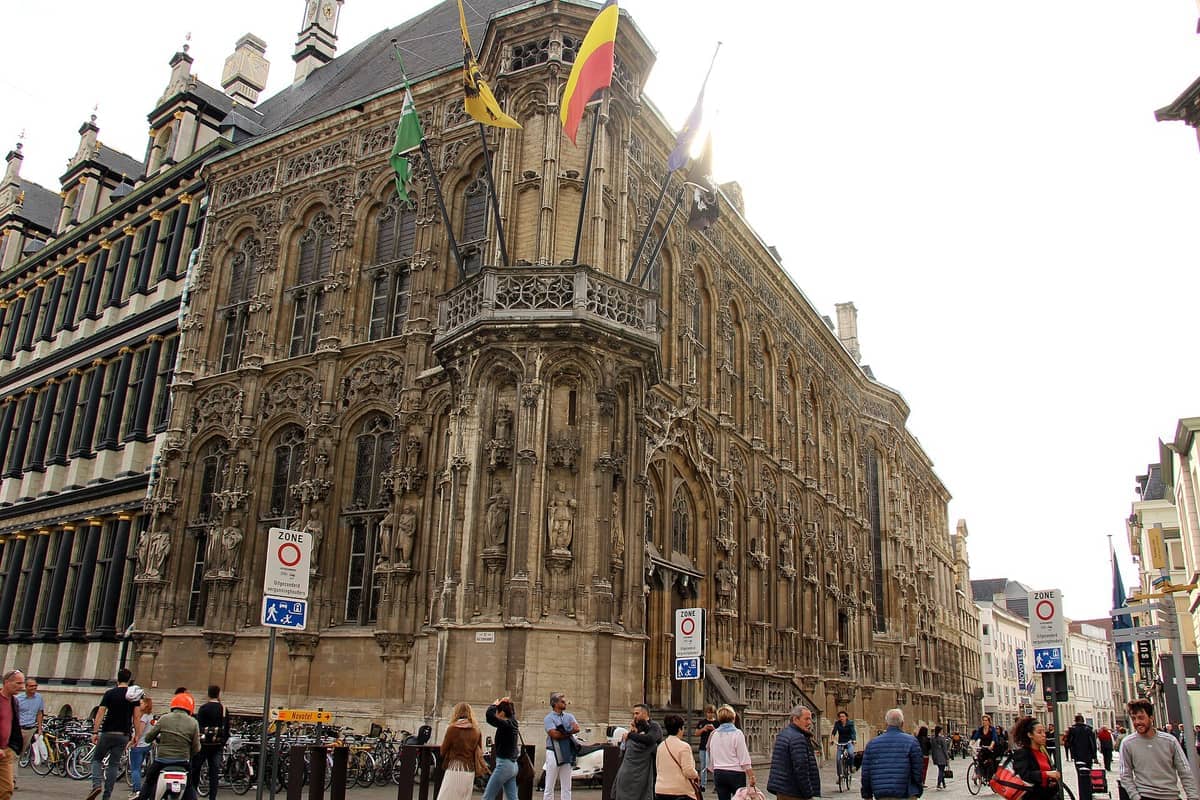
What the Stadhuis Gent Actually Is
The Ghent Town Hall — officially the Stadhuis Gent — sits at Botermarkt 1 in the heart of the historic city, occupying one of the most prominent civic addresses in Flanders. What stands here today is a four-sided complex bordered by Botermarkt, Hoogpoort, Stadhuissteeg and Poeljemarkt, with Gothic stonework on the Hoogpoort side and a Renaissance façade along the Botermarkt, each reflecting the architectural fashions of its era and the financial realities of the city at the time.
The official Visit Gent city guide describes the town hall as "schizophrenic" for its contrasting façades — and that is precisely the right word. The Late Gothic wing on Hoogpoort dates from the early sixteenth century (largely 1519–1539), but funds and politics halted further work. When building resumed under different patrons and different tastes later in the sixteenth century, the Renaissance had arrived, and the new sections followed suit. The result is an unfinished dialogue between two architectural languages, frozen in stone across a single civic block.
💡 Local tip
The entrance hall is free to visit Monday to Friday, 08:00–17:00. You do not need to book in advance for the reception area — simply walk in through the main entrance and introduce yourself to the front desk.
Reading the Façades: Gothic vs. Renaissance
Stand at the corner where Hoogpoort meets Botermarkt and you can see both architectural phases within a single sweep of the eye. The Gothic section, facing Hoogpoort, is the older of the two. Its stonework is finely carved with tracery, niches for statuary, and vertical lines that draw the eye upward — the grammar of Flemish Gothic civic architecture at its most ambitious. The stone is weathered and uneven in colour, giving it a layered, almost geological quality in afternoon light.
Turn the corner to the Botermarkt side and the tone shifts entirely. The Renaissance wing is more horizontal, its rhythms determined by classical pilasters, round-arched windows, and decorative registers rather than the vertical energy of Gothic. The contrast is abrupt enough to be jarring on a first visit, and deliberate enough on closer inspection to read as a kind of institutional autobiography: here is what we planned, and here is what we could afford and imagine when we finally continued.
For anyone following the Ghent walking tour circuit, the town hall is a natural pause point. It stands within metres of the Belfry and St. Nicholas' Church, forming the civic-religious cluster that defined medieval Ghent. The three buildings together tell the story of a city that was, at its medieval peak, one of the largest and wealthiest in northwestern Europe.
Tickets & tours
Hand-picked options from our booking partner. Prices are indicative; availability and final rates are confirmed when you complete your booking.
Escape Tour self-guided, interactive city challenge in Ghent
From 30 €Instant confirmationEscape Tour self-guided, interactive city challenge in Ghent
From 30 €Instant confirmationHistoric Ghent city exploration game
From 10 €Instant confirmationFree cancellationBelgian waffle making workshop and beer tasting in Ghent
From 45 €Instant confirmationFree cancellation
What You See Inside the Entrance Hall
The free entrance hall is functional rather than spectacular — this is an active administrative building, not a converted museum. The reception area gives you a sense of the building's scale and some visual contact with the historic fabric: stonework, vaulted elements, and period details that survive in the public corridors. Do not expect grand room after grand room without a guide; most of the ceremonial interior, including the former council chambers and the Wedding Hall, is only accessible on guided tours.
Guided tours, organised through operators such as the Gentse Gidsen (Ghent Guides association), take small groups through areas not visible on a self-guided visit. These rooms include historical council chambers with painted ceilings, decorative floor tiles, and period furniture that has remained in situ for centuries. Group tours are priced by the group rather than per person — the Gentse Gidsen lists rates from €115 for a two-hour tour — making them more economical for families or organised groups than for solo travellers.
ℹ️ Good to know
During the Gentse Feesten (Ghent's ten-day summer festival, held in July), the city sometimes opens parts of the town hall for free afternoon visits. Schedules vary by year — check the official Gentse Feesten programme for current details.
How the Experience Changes by Time of Day
The exterior is best appreciated in the morning, when the light hits the Gothic stonework on the Hoogpoort side at an angle that picks out the carved detail. By mid-morning on weekdays, the Botermarkt square begins filling with foot traffic from commuters and tourists, and the building reads differently in context: it becomes the backdrop to daily city life rather than an isolated monument. In early autumn and late spring, the stone takes on a warm honey tone in the late afternoon that makes it particularly photogenic from the western end of Botermarkt.
In the evening, once the entrance hall has closed and foot traffic in the area shifts to the restaurant and bar crowd, the façades are lit — but subtly, by ambient street lighting rather than dramatic floodlighting. For photography at dusk, the St. Michael's Bridge viewpoint a few hundred metres away offers a broader frame that includes the Belfry and St. Nicholas' Church alongside the town hall roofline.
Getting Here and Practical Logistics
The town hall is in the car-free historic centre, inside Ghent's low-emission zone (LEZ). If you are arriving by car, park outside the LEZ boundary and check zone regulations before entering — a fine for non-compliant vehicles is automatic and not reversible at the car park. In practice, most visitors arrive on foot or by tram.
From Gent-Sint-Pieters station (the main rail terminus, served by trains from Brussels in approximately 30 minutes), take a De Lijn tram to Korenmarkt — the journey takes around 5–10 minutes. A single De Lijn ride costs €3 and allows unlimited transfers within one hour. From Korenmarkt, the town hall is a 3–4 minute walk south along Volderstraat or via the Belfry square. For more detail on navigating the city's tram and bus network, the getting around Ghent guide covers ticketing, route planning, and the best stops for the historic centre.
Accessibility inside the historic building is limited in places. The Gothic and Renaissance wings involve level changes, narrow stairways, and corridors designed for medieval rather than modern standards. The ground-floor reception is the most accessible area. If accessibility is a priority, contact the Historische Huizen Gent office in advance to confirm what can be accommodated on any planned tour.
Placing the Town Hall in Ghent's Broader Historic Centre
The Stadhuis Gent sits within a remarkably concentrated cluster of medieval and early modern monuments. The Ghent Belfry, a UNESCO World Heritage Site and symbol of the city's civic independence, is adjacent to the south. St. Nicholas' Church stands just to the northwest. Together, these three structures — guild hall, belfry, church — represent the classic triangle of power in a Flemish medieval city: commercial, civic, and ecclesiastical authority each with its own monument.
If you are spending a full day in Ghent, the town hall pairs naturally with the Belfry (allow 45 minutes, including the climb) and with St. Bavo's Cathedral, home to the Ghent Altarpiece, which is a short walk east. The whole circuit from Korenmarkt through the Belfry, town hall, and cathedral and back takes roughly two to three hours at a comfortable pace, not counting queue time at the Altarpiece.
⚠️ What to skip
The town hall is an active government building. On busy weekday mornings, the entrance area can feel more like a municipal waiting room than a tourist attraction. If you want a quieter look at the entrance hall, mid-morning (around 10:00–11:00) tends to be calmer than first thing or lunchtime.
Photography Notes
The best single-frame exterior shot of the town hall is from the middle of Botermarkt, facing northeast, which captures the Renaissance wing against the sky. For the Gothic façade on Hoogpoort, a wider lens helps because the street is relatively narrow and the building rises steeply. The corner where the two styles meet is arguably the most interesting photographic subject here — the visual seam between Gothic and Renaissance is unlike anything else in the city. For broader compositions that include the Belfry in the same frame, the Ghent photography guide has specific vantage points mapped out for the historic centre.
Interior photography in the entrance hall is generally permitted for personal use; flash and tripods may not be. On guided tours, ask your guide before photographing individual rooms, particularly if the building is in ceremonial use.
Insider Tips
- Walk the full perimeter of the building before entering — the contrast between the Gothic Hoogpoort face and the Renaissance Botermarkt face is the single most interesting architectural observation you can make here, and it requires no ticket or tour.
- If your group is four or more people, a Gentse Gidsen guided tour works out economically competitive with paying per-person tour prices elsewhere, and it covers rooms that are genuinely impressive and not otherwise accessible.
- The Botermarkt square in front of the Renaissance façade is one of Ghent's central meeting points. On Saturday mornings, it edges toward crowded — if you want a clean exterior photo without pedestrians, aim for a weekday before 09:00.
- Check the Gentse Feesten programme (published each spring) for the year's free open-afternoon schedule — getting into the upper floor rooms at no charge during the festival is one of the better low-cost cultural opportunities in the city.
- The town hall is inside the pedestrianised zone, but bicycle traffic moves through some adjacent streets. Watch for cyclists when crossing Hoogpoort, particularly near the corner of the building.
Who Is Ghent Town Hall (Stadhuis Gent) For?
- Architecture enthusiasts who want to see a real-world example of Gothic-to-Renaissance stylistic transition within a single building
- History-focused travellers doing a full Ghent historic centre circuit alongside the Belfry and St. Bavo's Cathedral
- Group visitors who can split the cost of a Gentse Gidsen guided tour and access the ceremonial interiors
- Photography travellers interested in Flemish civic architecture and contrasting stone textures
- Budget travellers: the exterior and entrance hall cost nothing and are among the most architecturally significant free sights in the city
Nearby Attractions
Other things to see while in Ghent Historic Centre:
- City Pavilion (Stadshal)
Completed in 2012 by Ghent architects Robbrecht & Daem and Marie-José Van Hee, the Stadshal is a free, open public structure spanning roughly 40 metres at Emile Braunplein, surrounded by the Belfry, Town Hall, and St Nicholas' Church. Whether you pass through at noon or after dark, this latticed wooden canopy changes character with the light and the crowd beneath it.
- Design Museum Gent
Design Museum Gent, founded in 1903 and located in Ghent's historic centre, holds a collection of approximately 22,500 objects tracing applied arts and design from the 18th century to the present day. The museum is currently closed for a major expansion and renovation, but its permanent collection and architectural setting make it one of Ghent's most distinctive cultural institutions., holds a collection of approximately 22,500 objects tracing applied arts and design from the 18th century to the present day. The museum is currently closed for a major expansion and renovation, but its permanent collection and architectural setting make it one of Ghent's most distinctive cultural institutions.
- Castle of Gerald the Devil (Geeraard de Duivelsteen)
Built in the 13th century in Scheldt Gothic style, Geeraard de Duivelsteen is one of the most architecturally striking medieval structures in Ghent. From knight's residence to madhouse to event venue, its layered history is as dramatic as its stone facade. The building is not open for regular walk-in visits, but its exterior and occasional scheduled openings make it essential context for understanding Ghent's medieval character.
- Ghent Altarpiece (Adoration of the Mystic Lamb)
Completed in 1432 by Hubert and Jan van Eyck, the Ghent Altarpiece is a 12-panel polyptych (with paintings on both sides of most wings) housed in St Bavo's Cathedral in Ghent's historic centre. It is one of the most technically advanced and historically significant paintings ever made, and seeing it in person requires a ticket, a timed slot, and some preparation.