St Bavo's Cathedral (Sint-Baafskathedraal): Ghent's Gothic Masterpiece and the Ghent Altarpiece
St Bavo's Cathedral anchors the historic heart of Ghent with centuries of Gothic architecture and one of the most significant paintings in Western art. The cathedral itself is free to enter, while the Ghent Altarpiece by Hubert and Jan van Eyck occupies a dedicated visitor centre with an augmented reality experience.
Quick Facts
- Location
- Sint-Baafsplein, 9000 Ghent (Ghent Historic Centre)
- Getting There
- Tram to Korenmarkt, then a 5-minute walk east. From Gent-Sint-Pieters station, take tram line 1 to Korenmarkt.
- Time Needed
- 45 min for the cathedral; add 45–60 min for the Altarpiece visitor centre
- Cost
- Cathedral: free. Ghent Altarpiece AR centre: €16 adults, €12.50 altarpiece-only, €8 under 12 for the AR tour; CityCard holders €10 reduction
- Best for
- Art history lovers, architecture enthusiasts, cultural travellers, first-time visitors to Ghent
- Official website
- www.sintbaafskathedraal.be/en
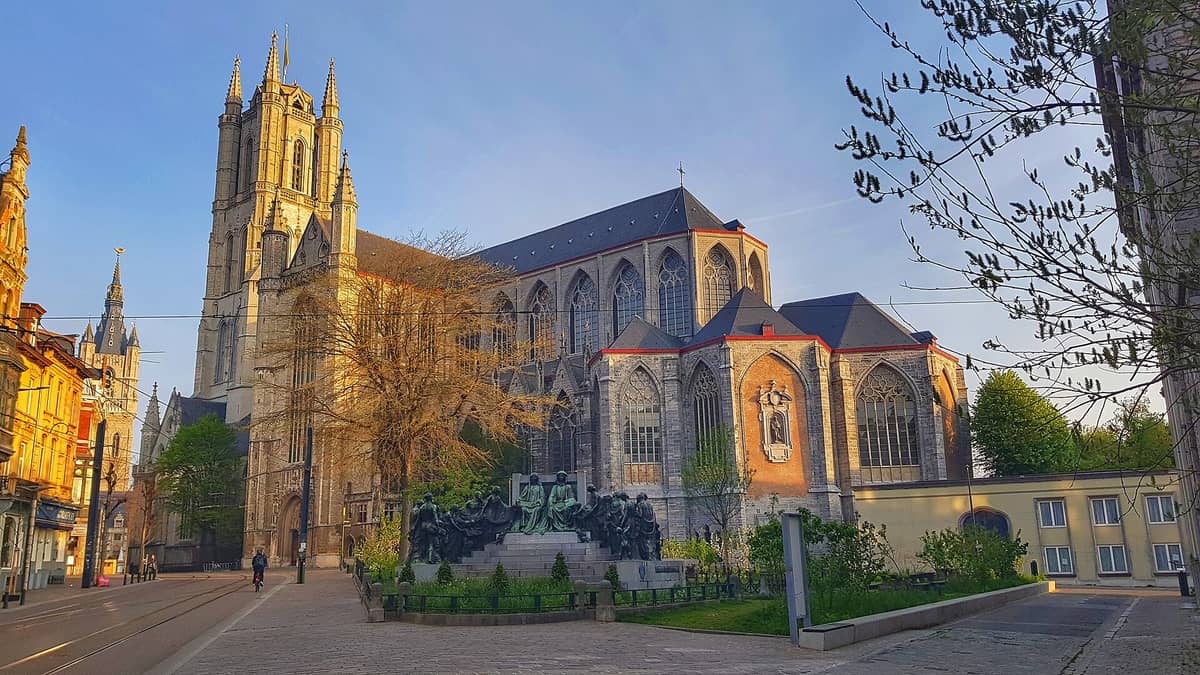
Why St Bavo's Cathedral Belongs at the Top of Your Ghent Itinerary
Sint-Baafskathedraal is the kind of place that earns its reputation. Presiding over Sint-Baafsplein in the heart of Ghent's historic centre, this Gothic cathedral has been the city's spiritual and artistic focal point for centuries. Its tall stone tower is visible from multiple angles as you navigate the old town, and stepping inside reveals a space that rewards careful attention rather than a quick scan.
Two things make St Bavo's genuinely exceptional among Belgium's many churches. The first is the cathedral itself, a layered Gothic structure with a nave that rises to an almost unsettling height and side chapels stacked with Baroque altarpieces, Rubens paintings, and carved tombs. The second is the Ghent Altarpiece, completed in 1432 by Hubert and Jan van Eyck, which is widely considered one of the most important paintings in European history. It now has its own dedicated visitor centre within the cathedral complex, with an augmented reality layer that reveals details the naked eye cannot catch.
💡 Local tip
The cathedral nave is free to enter. You only pay for the Ghent Altarpiece visitor centre. If you are short on time or budget, the nave alone justifies a 30-minute stop.
The Building Itself: Gothic Architecture in Layers
St Bavo's did not arrive fully formed. The cathedral sits on the foundations of a Romanesque chapel dedicated to St John the Baptist, which itself replaced an earlier structure. Construction of the Gothic building began in the fourteenth century and continued in phases through the sixteenth, which is why the choir and nave feel subtly different in character. The choir, built first, is older and more austere; the nave, completed later, opens wider and lets in more light.
The tower reaches approximately 89 metres and acts as a navigation aid throughout the historic centre. Inside, the sheer verticality of the nave is the first thing that registers: pointed arches climbing toward a stone vault, columns gathered in clusters, and side aisles that fold into a series of chapels. The stone underfoot is cool and worn in a way that registers through the soles of your shoes. On quiet weekday mornings, the only sounds are footsteps and the occasional cough of another visitor, which makes the scale feel even more pronounced.
The cathedral houses a remarkable collection of art beyond the Altarpiece. Rubens painted The Conversion of St Bavo for one of the side chapels, a large canvas showing the saint surrendering his worldly goods. Several carved tombs from Ghent's medieval merchant elite line the ambulatory, and the Baroque furnishings of the choir stalls demonstrate how the cathedral accumulated decorative layers across five centuries without losing its Gothic skeleton.
Tickets & tours
Hand-picked options from our booking partner. Prices are indicative; availability and final rates are confirmed when you complete your booking.
Historic Ghent city exploration game
From 10 €Instant confirmationFree cancellationBelgian waffle making workshop and beer tasting in Ghent
From 45 €Instant confirmationFree cancellationTaste of Ghent private chocolate walking tour
From 256 €Instant confirmationFree cancellationSips and stories, a private beer tour in Ghent
From 373 €Instant confirmationFree cancellation
The Ghent Altarpiece: What You Are Actually Looking At
The Adoration of the Mystic Lamb is a polyptych painting on oak panels, completed in 1432 by Hubert and Jan van Eyck. The altarpiece consists of twenty painted panels arranged in two registers, with twelve visible when the work is opened. If you have visited the Museum of Fine Arts (MSK Gent) or read anything about Flemish Primitive painting, you have encountered references to it. Seeing it in person is a different experience from photographs, partly because of its scale and partly because the colours, even after centuries, are extraordinarily vivid.
The work consists of twelve panels that can be opened or closed. The outer panels, visible when the altarpiece is closed, show the Annunciation in grisaille, painted to resemble stone sculpture. When opened, the interior reveals a complex theological landscape: angels singing, donors kneeling, Adam and Eve in the upper registers, and in the central lower panel, a vast gathering of figures converging on an altar where a lamb stands on a raised plinth, blood flowing into a chalice.
The visitor centre now houses the altarpiece in a climate-controlled, purpose-built room with controlled lighting. An augmented reality device, included in the ticket price, allows visitors to zoom into passages that are invisible to the naked eye, including inscriptions, underdrawing revealed by X-ray analysis, and the faces in distant crowds that van Eyck painted with the same precision as the foreground figures. For visitors with any interest in art history, this layer transforms the experience from passive observation into something more active.
ℹ️ Good to know
Visitor centre opening hours: Monday to Saturday 10:00–17:00, Sunday 13:00–17:00. Tickets: adults €16 with AR tour or €12.50 altarpiece-only; under-12 AR tour €8; CityCard Ghent holders €10 reduction. Prices verified June 2026; check the official site before your visit.
When to Visit and How the Experience Changes
The cathedral opens to the general public Monday to Saturday from 08:30 and Sunday from 13:00 (closing at 17:30 daily). The hours before the visitor centre opens at 10:00 are useful: the nave is often empty, the light from the clerestory windows shifts slowly across the stone floor, and you can take the choir and the Rubens chapel at your own pace without other visitors clustering nearby.
Midday in summer brings the largest crowds, particularly tour groups that arrive from Brussels or Bruges after their morning journeys. The visitor centre queue can build noticeably between 11:00 and 14:00. Arriving just after 10:00 when the visitor centre opens, or returning in the final hour before closing, tends to be the quietest. Weekdays in the shoulder season, roughly April to early June and September to October, offer a noticeably calmer experience.
The square outside, Sint-Baafsplein, is worth a moment of attention before you enter. The cathedral's Gothic facade reads differently depending on weather: flat grey skies flatten the stonework, while low-angle morning or late afternoon sun picks out the carved detail in sharp relief. For photography guidance specific to Ghent, the Ghent photography guide covers the best angles and times of day around the historic centre.
Getting There and Practical Logistics
Sint-Baafsplein is a five-minute walk east from Korenmarkt, the main tram stop in the city centre. Tram line 1 connects Gent-Sint-Pieters railway station to Korenmarkt in roughly 10 to 15 minutes. From Brussels Airport, trains connect via Brussels Midi or directly to Gent-Sint-Pieters; the journey takes approximately 30 minutes from Brussels Midi. Public transport in Ghent is operated by De Lijn, and a single ride costs €3 with contactless payment accepted. For a fuller overview of getting around, the guide to getting around Ghent covers tram routes, ticketing, and walking options in detail.
The cathedral and the Ghent Altarpiece visitor centre are both fully wheelchair accessible, with lifts and adapted circulation routes throughout the building. If you are visiting with children under six, they enter the Altarpiece centre free, though the AR device requires some manual dexterity and supervision. Older children and teenagers who engage with the AR layer tend to find the visit significantly more interesting than those left to observe the panels without context.
⚠️ What to skip
The cathedral is a working place of worship. Services take place regularly, and access to certain areas may be restricted during liturgical hours. Check the official website if your visit coincides with a Sunday morning or a public holiday.
St Bavo's in Context: The Surrounding Historic Centre
St Bavo's Cathedral sits in close proximity to several of Ghent's other major attractions, which makes it a natural anchor for a half-day walking route. The Ghent Belfry is immediately adjacent on Sint-Baafsplein, and the Ghent Town Hall is a short walk north. Combining the three sites with a walk to the Graslei waterfront makes for a full morning or afternoon.
For visitors interested in Flemish painting more broadly, Flemish Masters in Ghent provides context on how the van Eyck altarpiece fits into the wider tradition of painting in Flanders, and which other institutions in the city hold significant works from the same period.
One honest note: visitors who arrive primarily for the architecture and find Gothic cathedrals interchangeable may feel the entrance cost to the visitor centre is steep for a single painting, however significant. The AR experience does add substantial value, but if medieval religious art is not your interest, the free nave is the more honest recommendation. The altarpiece ticket is best reserved for those who will engage with it for at least 30 to 45 minutes.
Insider Tips
- Visit the nave before 10:00 when the visitor centre opens. The cathedral is at its quietest, the light is better for photography, and the Rubens chapel and choir are completely accessible without crowds.
- Book Altarpiece tickets online in advance during summer. Walk-up queues can run 20 to 30 minutes at peak times, and online booking typically allows a timed entry slot.
- The CityCard Ghent gives a €10 discount on the Altarpiece entry. If you plan to visit two or more paid attractions in Ghent, the card pays for itself quickly. Calculate the saving before you buy.
- Stand at the back of the nave and look toward the choir rather than the other way around. The proportions of the building read more dramatically from this angle, and the relationship between nave height and choir depth becomes clear.
- Sint-Baafsplein is one of the better squares in Ghent for a quiet coffee before or after the cathedral. Several cafes face the square and have outdoor seating that looks directly at the Gothic facade, which is particularly atmospheric in early morning light.
Who Is St Bavo's Cathedral (Sint-Baafskathedraal) For?
- Art history enthusiasts wanting to see one of the most significant paintings in European history in its original setting
- First-time visitors to Ghent building a classic historic-centre itinerary
- Architecture travellers interested in Gothic construction and the layering of medieval and Baroque interiors
- Families with older children who will engage with the augmented reality experience in the visitor centre
- Travellers on a budget, since the cathedral nave is free and offers substantial artistic and architectural interest at no cost
Nearby Attractions
Other things to see while in Ghent Historic Centre:
- City Pavilion (Stadshal)
Completed in 2012 by Ghent architects Robbrecht & Daem and Marie-José Van Hee, the Stadshal is a free, open public structure spanning roughly 40 metres at Emile Braunplein, surrounded by the Belfry, Town Hall, and St Nicholas' Church. Whether you pass through at noon or after dark, this latticed wooden canopy changes character with the light and the crowd beneath it.
- Design Museum Gent
Design Museum Gent, founded in 1903 and located in Ghent's historic centre, holds a collection of approximately 22,500 objects tracing applied arts and design from the 18th century to the present day. The museum is currently closed for a major expansion and renovation, but its permanent collection and architectural setting make it one of Ghent's most distinctive cultural institutions., holds a collection of approximately 22,500 objects tracing applied arts and design from the 18th century to the present day. The museum is currently closed for a major expansion and renovation, but its permanent collection and architectural setting make it one of Ghent's most distinctive cultural institutions.
- Castle of Gerald the Devil (Geeraard de Duivelsteen)
Built in the 13th century in Scheldt Gothic style, Geeraard de Duivelsteen is one of the most architecturally striking medieval structures in Ghent. From knight's residence to madhouse to event venue, its layered history is as dramatic as its stone facade. The building is not open for regular walk-in visits, but its exterior and occasional scheduled openings make it essential context for understanding Ghent's medieval character.
- Ghent Altarpiece (Adoration of the Mystic Lamb)
Completed in 1432 by Hubert and Jan van Eyck, the Ghent Altarpiece is a 12-panel polyptych (with paintings on both sides of most wings) housed in St Bavo's Cathedral in Ghent's historic centre. It is one of the most technically advanced and historically significant paintings ever made, and seeing it in person requires a ticket, a timed slot, and some preparation.