St Michael's Church (Sint-Michielskerk): Gothic Landmark at the Heart of Ghent
St Michael's Church stands at the edge of Sint-Michielsplein, its unfinished tower rising above the Leie canal as one of Ghent's most photographed silhouettes. Construction began in the mid-15th century and stretched over two centuries, leaving a Gothic church that rewards close attention inside and offers one of the city's finest vantage points from the bridge outside. Entry is free when the church is open during its limited afternoon hours.
Quick Facts
- Location
- Sint-Michielsplein 4, 9000 Gent — Ghent Historic Centre
- Getting There
- Walk from Korenmarkt (~5 min) or tram to Korenmarkt stop, then on foot. Fully within Ghent's low-emission zone — arriving by car requires checking access rules in advance.
- Time Needed
- 30–60 minutes inside; add time to linger on Sint-Michielsbrugge
- Cost
- Free admission during opening hours
- Best for
- Architecture lovers, photographers, history enthusiasts, first-time visitors to Ghent
- Official website
- visit.gent.be/en/see-do/st-michaels-church
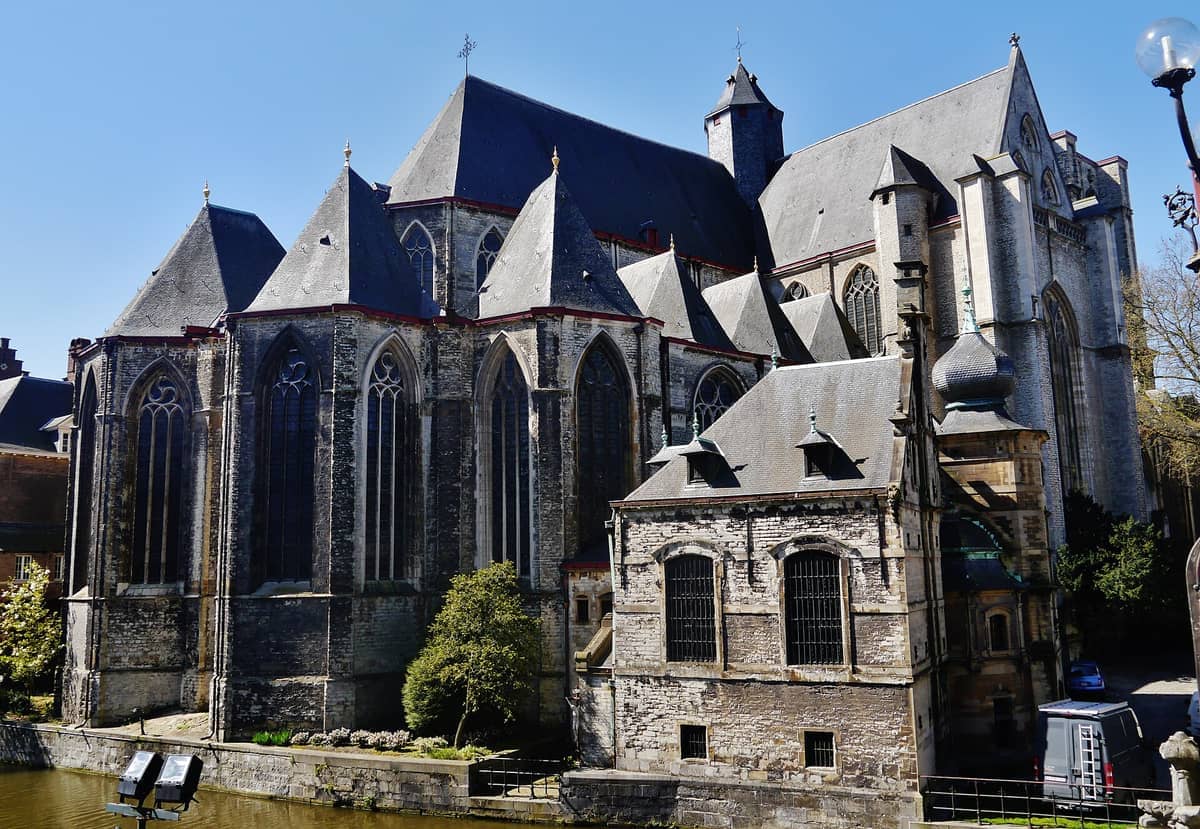
What Is St Michael's Church, and Why Does It Matter?
Sint-Michielskerk, known in English as St Michael's Church, is a Gothic parish church that has stood at the bend of the Leie river since the mid-fifteenth century. Construction began in the mid-fifteenth century and continued for more than two hundred years, a building campaign so long that changing tastes and finances left their mark on every stone. The result is a church that is neither perfectly uniform nor purely one style — and that incompleteness is part of what makes it interesting.
The most visible sign of that interrupted history is the tower. It was never finished. What stands today is a stump, wide and solid at the base but cutting off far below the height originally planned. From a distance, especially from Sint-Michielsbrugge (Saint Michael's Bridge) immediately in front of the church, this truncated silhouette sits within one of the most reproduced views in all of Ghent: five medieval spires rising together above the canal, each one from a different building, each one a different era.
That panorama from the bridge includes St Nicholas's Church, the Ghent Belfry, and St Bavo's Cathedral in the background — collectively forming what locals and photographers call Ghent's 'three towers', though Sint-Michielskerk and the bridge itself complete the composition. If you visit only one spot in Ghent for a photograph, the view from Sint-Michielsbrugge is it.
ℹ️ Good to know
Opening hours are limited: generally Tuesday to Sunday, 14:00–17:00, with a seasonal schedule running approximately late March to late October and closure from early November to late March. Hours vary and the church is sometimes closed for liturgical events. Always check locally before visiting — the tourism office at Visit Gent (visit.gent.be) carries the most current information.
The Architecture: More Than 200 Years in Stone
The exterior reads as Brabantine Gothic, the dominant ecclesiastical style across the Southern Low Countries from the late medieval period onward. Look at the nave from the bridge side and you will notice the flying buttresses splaying out from the walls in regular arcs, carrying the lateral thrust of the vaulted ceiling to the outer piers. The stonework is a pale cream-grey limestone that shifts in tone depending on the light: almost white at midday in summer, warm amber in the late afternoon when the sun catches the western face.
Step closer and the unfinished tower becomes more legible. The lower stages show the decorative niches and tracery typical of the period when construction was at its height; above a certain point, the detailing simply stops, the masonry becoming utilitarian. It is a visible freeze-frame of where ambition ran out of money or political will. Several Ghent churches share this story — the city's medieval wealth could fund extraordinary beginnings but rarely guaranteed the ending.
The interior is a three-aisled hall church. The nave is tall and relatively spare, which gives it a grander sense of vertical space than its footprint might suggest from outside. Light enters through the clerestory windows along the upper walls and, on clear afternoons, casts long diagonal bars across the stone floor. The side chapels contain funerary monuments and decorative ironwork that repay a slow circuit of the perimeter, particularly if you have already visited the more heavily trafficked altarpieces elsewhere in the city.
Tickets & tours
Hand-picked options from our booking partner. Prices are indicative; availability and final rates are confirmed when you complete your booking.
Historic Ghent city exploration game
From 10 €Instant confirmationFree cancellationSelf guided tour with interactive city game of Ghent
From 29 €Instant confirmationFree cancellationBelgian waffle making workshop and beer tasting in Ghent
From 45 €Instant confirmationFree cancellationTaste of Ghent private chocolate walking tour
From 256 €Instant confirmationFree cancellation
The Art Inside: What to Look For
Sint-Michielskerk holds a notable collection of works, the most discussed being the large canvases by Flemish Baroque painters in the transept and choir chapels. The most referenced piece is a Crucifixion painting attributed to Anthony van Dyck, displayed prominently within the church. Van Dyck spent formative years in Ghent and Antwerp, and works connected to his circle appear in several Ghent churches — Sint-Michielskerk is among the most accessible sites for seeing this strand of Flemish Baroque painting without paying museum admission.
For context on the broader tradition of Flemish Masters painting across Ghent's churches and institutions, the guide to Flemish Masters in Ghent covers the major works and where to find them across the city, including how Sint-Michielskerk fits into the wider picture.
Beyond the paintings, the church contains carved confessionals, a Baroque high altar, and several epitaph tablets set into the floor and walls. None of this is arranged as a formal museum — there are no display cases or interpretive panels in English at the level you would find in a dedicated gallery. If you are the kind of visitor who needs labelling to engage with art, the experience may feel opaque. If you are comfortable wandering and observing on your own terms, the church offers genuine rewards.
The Bridge View: Ghent's Most Iconic Perspective
Sint-Michielsbrugge, the bridge immediately in front of the church, is technically a separate attraction but functionally inseparable from a visit here. The bridge spans the Leie and offers an unobstructed view east along the water toward Graslei and Korenlei — the medieval guild-house waterfront that is probably Ghent's single most famous scene.
At the same time, turning to face west from the bridge gives you the church facade and tower at close range. The combination of water, medieval stone, and the row of guild houses along Graslei and Korenlei makes this bridge one of the most productive ten square metres in the city for photography. In practical terms, the bridge is always accessible — it is a public thoroughfare, not a ticketed space.
Crowds concentrate here throughout the day, but the bridge empties significantly in the early morning. Before 8:30 am, you can stand at the midpoint and look in either direction with almost no one in frame. The light at that hour is soft and low, particularly useful in summer when midday sun flattens the facades into bright, contrasty monotony. Evening is also productive: the waterfront buildings catch warm light from the west after around 18:00 in spring and summer, and the reflections in the Leie sharpen as the wind drops.
💡 Local tip
Photography tip: The classic five-tower shot is taken from the middle of Sint-Michielsbrugge, looking northeast. A wide-angle lens (or wide setting on a phone) is needed to fit all the towers in frame. Shoot in the first hour after sunrise for the most even light and fewest tourists.
When to Visit and What to Expect at Different Times
Because the church only opens in the afternoon on weekdays and weekends during its late March to late October season, morning visitors are limited to the exterior and the bridge view. This is not a bad outcome — the bridge panorama is the attraction most people photograph, and it is freely accessible at any hour. Those who want to enter the church need to plan around the 14:00–17:00 window.
Inside, the early part of the afternoon opening tends to be quieter. By 15:30 the church fills with guided tour groups who arrive from the Graslei waterfront and the nearby historic streets. If you prefer to move at your own pace without navigating clusters of visitors, arriving just after 14:00 gives you roughly an hour of relative calm. The church has no café, no gift shop, and limited seating, so it is not a place to linger for hours — treat it as a focused thirty-to-forty-minute visit.
Rain affects the exterior experience on the bridge more than the interior. In wet weather the Leie reflections can be striking rather than diminished, but the bridge is exposed and can be slippery on the raised pavement sections. The interior of the church is, of course, fully sheltered and can serve as a useful pause on a wet afternoon.
⚠️ What to skip
The church closes on Mondays and during seasonal closures outside the late March to late October period. Opening hours are subject to change for religious services and events. Verify current times before building your itinerary around an interior visit.
Getting There and Practical Logistics
Sint-Michielskerk sits at Sint-Michielsplein, a short walk from Korenmarkt — Ghent's central square. From Korenmarkt, the church is visible: walk south past St Nicholas's Church and cross the bridge. The whole walk from Korenmarkt takes under five minutes. The church is embedded within the car-free historic centre, so arriving on foot or by tram is the straightforward choice.
De Lijn trams serve Korenmarkt and connect to Gent-Sint-Pieters, Ghent's main railway station, in around five to ten minutes. From Sint-Pieters, a single De Lijn ride costs approximately €3 (verify current fares with De Lijn before travel). For a full overview of how to move around the city, the getting around Ghent guide covers tram routes, tickets, and walking distances between the main sights.
The church is described officially as partially accessible, meaning some areas can be reached by visitors with reduced mobility but full interior access is not guaranteed. The bridge itself is a public street and is accessible, though the paving is uneven in places. Anyone with specific mobility requirements should contact the parish or check with the local tourism office before visiting.
How This Church Fits Into a Ghent Itinerary
Sint-Michielskerk is not the most famous church in Ghent — that title belongs to St Bavo's Cathedral, home to the Ghent Altarpiece, which draws visitors from around the world. St Michael's is quieter and less internationally promoted, which in practice means a more relaxed visit. The interior is genuinely worth entering if you are interested in Flemish Baroque painting or the physical fabric of Gothic architecture, but it should not be treated as a substitute for the Cathedral's extraordinary collection.
For a well-structured day in the historic centre, pairing Sint-Michielskerk with the Graslei and Korenlei waterfront and a walk through the Ghent historic centre covers the essential medieval topography without overloading on ticket queues. All three are free or have free components, which matters when planning a longer stay on a budget.
Travellers who find large crowds alienating may find this church a welcome alternative to the peak-season queues at the Gravensteen or St Bavo's. It is not undiscovered — tour groups do arrive — but the throughput is lower and the atmosphere more contemplative. Those looking for museum-quality interpretation with detailed English-language labelling will likely feel underserved; the church functions primarily as an active parish, not a heritage attraction with interpretive infrastructure.
Insider Tips
- The bridge view is best before 8:30 am on a clear day. The Leie is calmer, the light is low from the east, and the tourist foot traffic is minimal. This is the shot most postcards use — and you can replicate it without a crowd.
- The interior smells of cold stone and faint incense, typical of active Belgian parish churches. If you arrive just as afternoon opening begins at 14:00, you may catch the last traces of a midday service — the atmosphere is noticeably different from a purely tourist-mode visit.
- The unfinished tower is more interesting when you know what it was meant to look like: original plans called for a much taller spire rising far above the current stump. The abrupt cutoff is not decay — it is simply where construction stopped, permanently.
- Combine your visit with a canal boat tour that departs from the Graslei waterfront nearby. Seeing Sint-Michielskerk from the water level, rather than from the bridge above, gives a completely different sense of its mass and relationship to the surrounding buildings.
- The church is within easy walking distance of the Patershol neighbourhood, a network of narrow medieval streets with some of the best restaurants in the city. Plan your afternoon church visit to transition naturally into an early dinner there.
Who Is St Michael's Church (Sint-Michielskerk) For?
- Architecture and medieval history enthusiasts who want to read a building rather than just photograph it
- Photographers targeting the classic Ghent five-tower panorama from Sint-Michielsbrugge
- Budget travellers: free entry, no booking required, accessible on foot from all central sights
- Visitors with a focused interest in Flemish Baroque painting outside of museum settings
- First-time visitors to Ghent building a half-day walk through the historic centre
Nearby Attractions
Other things to see while in Ghent Historic Centre:
- City Pavilion (Stadshal)
Completed in 2012 by Ghent architects Robbrecht & Daem and Marie-José Van Hee, the Stadshal is a free, open public structure spanning roughly 40 metres at Emile Braunplein, surrounded by the Belfry, Town Hall, and St Nicholas' Church. Whether you pass through at noon or after dark, this latticed wooden canopy changes character with the light and the crowd beneath it.
- Design Museum Gent
Design Museum Gent, founded in 1903 and located in Ghent's historic centre, holds a collection of approximately 22,500 objects tracing applied arts and design from the 18th century to the present day. The museum is currently closed for a major expansion and renovation, but its permanent collection and architectural setting make it one of Ghent's most distinctive cultural institutions., holds a collection of approximately 22,500 objects tracing applied arts and design from the 18th century to the present day. The museum is currently closed for a major expansion and renovation, but its permanent collection and architectural setting make it one of Ghent's most distinctive cultural institutions.
- Castle of Gerald the Devil (Geeraard de Duivelsteen)
Built in the 13th century in Scheldt Gothic style, Geeraard de Duivelsteen is one of the most architecturally striking medieval structures in Ghent. From knight's residence to madhouse to event venue, its layered history is as dramatic as its stone facade. The building is not open for regular walk-in visits, but its exterior and occasional scheduled openings make it essential context for understanding Ghent's medieval character.
- Ghent Altarpiece (Adoration of the Mystic Lamb)
Completed in 1432 by Hubert and Jan van Eyck, the Ghent Altarpiece is a 12-panel polyptych (with paintings on both sides of most wings) housed in St Bavo's Cathedral in Ghent's historic centre. It is one of the most technically advanced and historically significant paintings ever made, and seeing it in person requires a ticket, a timed slot, and some preparation.