S.M.A.K. – Ghent's Municipal Museum of Contemporary Art
S.M.A.K., the Stedelijk Museum voor Actuele Kunst, is Ghent's flagship institution for contemporary art. Set in Citadelpark alongside the Museum of Fine Arts, it holds a permanent collection of international scope and rotating exhibitions that regularly reshape how Belgian audiences encounter living art.
Quick Facts
- Location
- Jan Hoetplein 1, 9000 Gent (Citadelpark)
- Getting There
- Tram to Gent-Sint-Pieters, then 10-min walk through Citadelpark; several De Lijn bus lines stop near the park entrance
- Time Needed
- 2–3 hours for a thorough visit; allow extra time on first-Thursday late openings
- Cost
- Adults €17; under 26 €8.50; under 19 free; Ghent residents €12; groups of 15 or more €14.50; CityCard Gent free; companions of visitors with disabilities free
- Best for
- Contemporary art enthusiasts, architecture lovers, rainy-day culture seekers
- Official website
- smak.be/en
What S.M.A.K. Actually Is
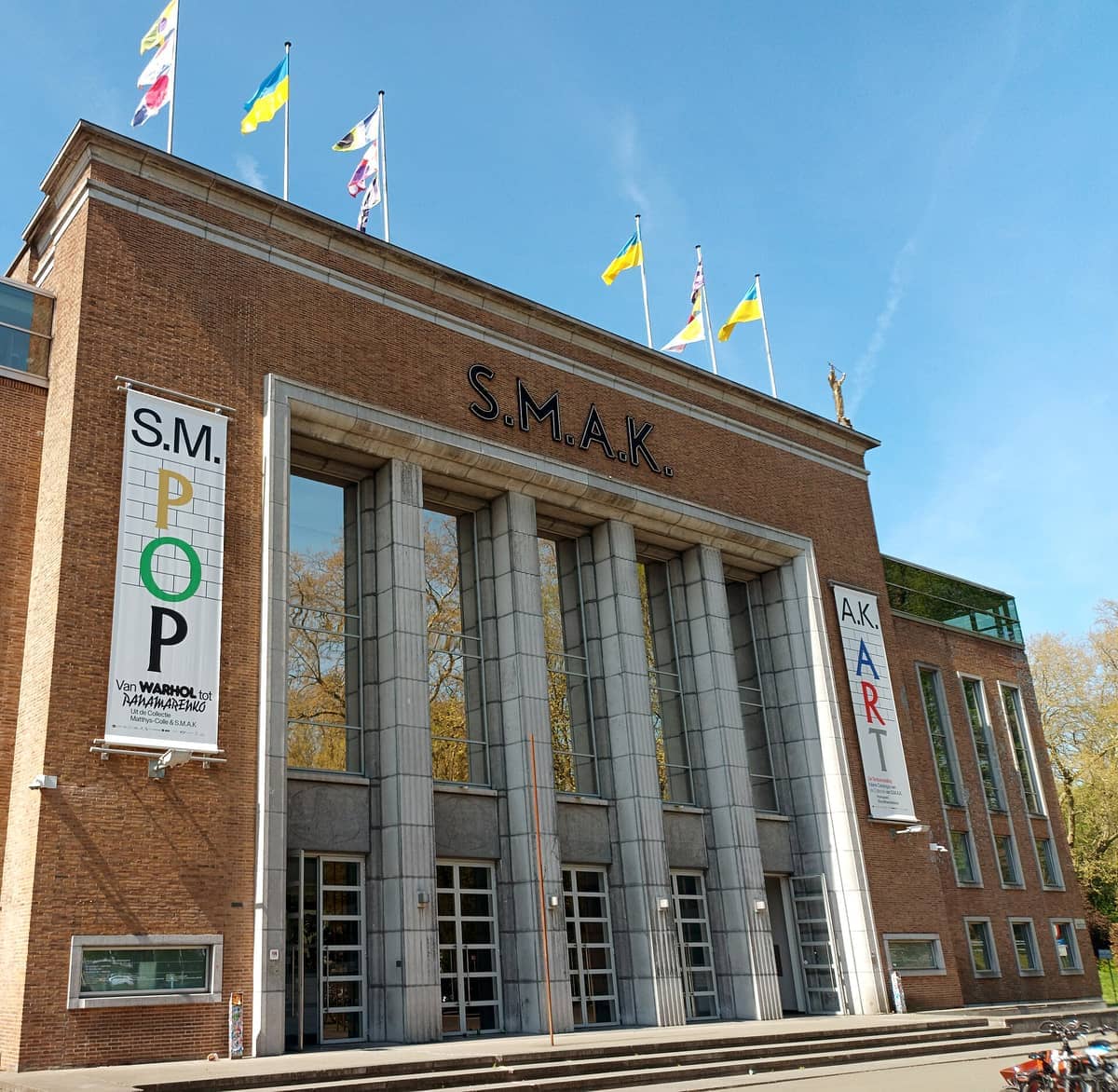
S.M.A.K., short for Stedelijk Museum voor Actuele Kunst, is Ghent's principal museum dedicated to art made from the postwar period to the present. It occupies a purpose-converted building on Jan Hoetplein, a square named after Jan Hoet, the curator whose vision turned a provincial institution into one with genuine international standing. That name above the entrance is not decorative: Hoet's aggressive acquisitions policy and his role as artistic director of Documenta 9 in 1992 gave the collection a credibility that smaller Belgian cities rarely achieve.
The permanent collection spans painting, sculpture, video installation, and performance documentation, with particular depth in Belgian and German postwar work and in Arte Povera. Alongside the permanent galleries, S.M.A.K. runs a serious program of temporary exhibitions, typically two or three simultaneously, often featuring artists with no prior major institutional exposure in Belgium. The exhibition program changes several times a year, so a visit from one trip to the next rarely looks the same.
ℹ️ Good to know
S.M.A.K. sits directly beside MSK (Museum of Fine Arts Ghent) in Citadelpark. The two buildings face each other across a shared plaza. If you plan to visit both on the same day, budget a full day rather than an afternoon.
The Building and Its Setting
The museum occupies what was originally the Casino building in Citadelpark, a 19th-century public park laid out for the 1913 World's Fair. The conversion from a leisure venue to a contemporary art space was never entirely seamless, and the building wears that history: ceiling heights vary between galleries, some rooms feel intimate while others open into double-height spaces suited to large-scale installation. That variation is actually useful. It means curators can move between different registers of scale without everything feeling uniformly white-cube.
The park setting matters. Arriving on foot from Gent-Sint-Pieters station, you pass through a canopy of mature trees before the building comes into view. In spring and early summer the approach is genuinely pleasant. In winter, the park is quiet and the walk takes on a different character: colder, emptier, with the museum's facade lit against a grey sky. For a broader map of this part of the city, the Citadelpark and Museum Quarter area guide covers what else is within walking distance.
Tickets & tours
Hand-picked options from our booking partner. Prices are indicative; availability and final rates are confirmed when you complete your booking.
Historic Ghent city exploration game
From 10 €Instant confirmationFree cancellationBelgian waffle making workshop and beer tasting in Ghent
From 45 €Instant confirmationFree cancellationTaste of Ghent private chocolate walking tour
From 256 €Instant confirmationFree cancellationSips and stories, a private beer tour in Ghent
From 373 €Instant confirmationFree cancellation
Inside the Galleries: What to Expect
The permanent collection at S.M.A.K. is not arranged chronologically, which can disorient first-time visitors. Works are grouped thematically or by curatorial argument rather than period. You might turn a corner and find a Francis Bacon alongside a recent video piece, or encounter a full room of Joseph Beuys documentation flanked by contemporary Belgian painters. This approach rewards slow looking but frustrates anyone expecting a linear survey of postwar art history.
The light in the upper-floor galleries in the morning, before the midday crowds arrive, is noticeably better than the afternoon. Natural light enters from above in some rooms, and the works read differently under it than under the supplemental artificial lighting that dominates by mid-afternoon. If you have a preference for seeing paintings in natural light, aim to arrive at opening.
The temporary exhibition spaces are on the ground floor and the basement level. The basement galleries, used for large installations, can feel deliberately oppressive or enveloping depending on what is showing. This is intentional: S.M.A.K. is one of the few Belgian museums willing to give a single large-scale work an entire room without explanation, trusting visitors to sit with the discomfort or the silence. Not everyone responds well to that. If you prefer narrative-heavy museum experiences with extensive wall text, parts of S.M.A.K. may feel withholding.
💡 Local tip
Pick up the free floor map at the ticket desk. The internal layout is not intuitive, and without it you can easily exit a wing without realizing you missed a section. The map also lists the current temporary exhibitions by room number.
When to Visit
S.M.A.K. is open Tuesday through Sunday, with weekday hours typically from 9:30 to 17:30 and weekend, public holiday, and school-vacation hours from 10:00 to 18:00, and the museum schedules a longer opening until 22:00 on the first Thursday of each month. That late opening is significantly quieter than a typical weekend afternoon and has a different atmosphere: fewer families, more adults who came specifically for the art, and occasionally a bar service running in the foyer. It is one of the better ways to experience the museum if your schedule allows.
Weekend afternoons between 13:00 and 16:00 are the busiest periods, particularly when a high-profile temporary exhibition is running. Tuesday and Wednesday mornings are the most reliably quiet. The museum is closed on Mondays, on Christmas Day and Boxing Day (25–26 December), and on New Year's Day and 2 January. It closes early at 16:00 on 24 and 31 December. On public holidays that fall on a weekday, the weekend schedule (10:00–18:00) applies.
⚠️ What to skip
Hours and admission prices are subject to change. Always verify the current schedule on smak.be before visiting, especially around public holidays and during major exhibition changeovers.
Getting There
The most straightforward approach is by tram to Gent-Sint-Pieters station, Ghent's main rail hub, and then a 10-minute walk through Citadelpark. De Lijn operates tram and bus services across the city; a single ride costs approximately €3 with contactless payment accepted directly on board. Ghent is reached from Brussels via direct train from Brussels-Midi in around 30 minutes, making S.M.A.K. very accessible as part of a day trip.
Visitors arriving by car should note that Ghent's historic centre has significant car restrictions. Citadelpark is outside the pedestrian zone but parking in the immediate area is limited. The walk from Sint-Pieters is easy and signposted. For a full overview of moving around the city, the getting around Ghent guide covers tram lines, ticketing, and cycling options in detail.
Tickets, Passes, and Value
Standard adult admission is €17. Visitors under 26 pay €8.50, and under-19s enter free. Ghent residents pay a reduced rate of €12. Groups of 15 or more pay €14.50 per person. Companions of visitors with disabilities are admitted free, as are visitors using the CityCard Gent, the city's multi-attraction pass. Temporary exhibitions may carry a slightly higher admission between €17 and €20 depending on the show.
The CityCard is worth calculating against your itinerary. If you are visiting S.M.A.K. alongside the Museum of Fine Arts (MSK) and several other Ghent attractions in two or three days, the card frequently pays for itself. Check current CityCard pricing through Visit Gent before purchasing, as rates update periodically.
Photography and Practical Logistics
Photography rules at S.M.A.K. follow the standard Belgian museum convention: personal, non-commercial photography without flash is generally permitted in permanent collection areas, but individual temporary exhibitions sometimes restrict photography based on artist agreements. Look for signage at the entrance to each temporary exhibition space, or ask at the desk. The camera icon with a line through it appears clearly where restrictions apply.
The museum is fully accessible for wheelchair users, with a step-free entrance and lifts between floors. Assistance dogs are welcome. Large bags must be checked in at the cloakroom near the entrance, which is free of charge. The café on the ground floor is a reasonable place to pause mid-visit, though it fills quickly during peak weekend hours.
S.M.A.K. sits within a broader cluster of cultural institutions worth combining. The Design Museum Gent is in the historic centre rather than Citadelpark, but both can be covered in a single culture-focused day if you move efficiently. Ghent's museum landscape is dense enough that it rewards planning. For a structured approach to the city's collections, the best museums in Ghent guide organizes them by type and interest.
Who Will Get the Most Out of S.M.A.K.
S.M.A.K. rewards visitors who are already comfortable with contemporary art and don't need every work explained in three paragraphs. The curatorial voice is confident and occasionally opaque. That is a strength for engaged visitors and a source of frustration for others. If your interest in contemporary art is primarily social, the first-Thursday evening openings offer a lively atmosphere that makes the experience more accessible.
Families with young children can visit, and under-19s enter free, but the museum does not have extensive child-directed programming in the permanent galleries on a standard visit. Parents should check the website for specific family programming tied to exhibitions. Visitors primarily interested in Ghent's medieval architecture and Flemish painting heritage may find the museum tangential to their main interests. For that audience, the Museum of Fine Arts next door is a more direct match.
Insider Tips
- The first Thursday of each month S.M.A.K. stays open until 22:00. Attendance is a fraction of the weekend crowds, the pace is slower, and the experience of sitting with a large installation in near-silence is qualitatively different from a busy afternoon visit.
- The museum shop near the exit carries a well-curated selection of exhibition catalogues, including out-of-print editions from past S.M.A.K. shows. These are harder to find elsewhere and worth browsing even if you don't buy.
- If the permanent collection has been partially rehung since your last visit, the floor map will show the current configuration. Don't rely on memory or previous trip reports: the arrangement changes more frequently than at most museums of this size.
- Combine S.M.A.K. with the MSK directly next door rather than treating them as separate itinerary items. The contrast between the two collections in the same afternoon is one of the more interesting ways to spend time in Ghent's museum quarter.
- The CityCard Gent makes S.M.A.K. free to enter and includes a public transport ticket. If you are also planning to visit other paid attractions in Ghent during your stay, calculate the card cost against individual admission prices before you buy it at Gent-Sint-Pieters or the tourist office.
Who Is S.M.A.K. – Municipal Museum of Contemporary Art For?
- Contemporary art followers who want to see a serious permanent collection outside the major capital museums
- Travelers on rainy days looking for a full half-day indoor cultural experience
- Visitors combining S.M.A.K. with the adjacent Museum of Fine Arts for a contrasting double-museum day
- Students and under-26 travelers, who benefit from significantly reduced admission
- Anyone attending Ghent during a major temporary exhibition run, which often brings works not seen elsewhere in Belgium
Nearby Attractions
Other things to see while in Citadelpark & Museum Quarter:
- Citadelpark
Citadelpark is Ghent's largest urban park, covering roughly 15-16 hectares of public green space between the historic centre and Gent-Sint-Pieters railway station. Free to enter at any hour, it serves as both a neighbourhood garden and a cultural anchor, flanked by two of Belgium's most significant contemporary and fine art museums.
- Ghent University Botanic Garden
The Ghent University Botanic Garden at Ledeganckstraat 35 is one of the city's most accessible green spaces, free to enter and open most days of the week. Part of the Ghent University Museum (GUM) and located near Citadel Park, it combines outdoor beds with a series of historic greenhouses spanning tropical, subtropical, and succulent collections.
- GUM – Ghent University Museum
GUM, Ghent University's science museum at Ledeganckstraat 35, brings together natural history collections, scientific instruments, and a living botanical garden in the Citadelpark museum quarter. It rewards curious visitors of almost any age, from school groups to adults who want to understand the science behind the city.
- Museum of Fine Arts Ghent (MSK Gent)
The Museum of Fine Arts Ghent, known locally as MSK Gent, is Flanders' oldest public art museum and home to a sweeping collection spanning medieval altarpieces to 20th-century Belgian modernism. Set inside a grand neoclassical building in Citadelpark, it rewards visitors who take their time and rewards them again on a second visit.