Ghent University Botanic Garden: A Free Green Escape in the Museum Quarter
The Ghent University Botanic Garden at Ledeganckstraat 35 is one of the city's most accessible green spaces, free to enter and open most days of the week. Part of the Ghent University Museum (GUM) and located near Citadel Park, it combines outdoor beds with a series of historic greenhouses spanning tropical, subtropical, and succulent collections.
Quick Facts
- Location
- Ledeganckstraat 35, 9000 Ghent (corner of K.L. Ledeganckstraat and E. Clauslaan)
- Getting There
- Short walk (around 10 minutes) from Gent-Sint-Pieters railway station; adjacent to Citadel Park
- Time Needed
- 1 to 2 hours
- Cost
- Free (outdoor garden and greenhouses; occasional special events may have separate ticketing)
- Best for
- Nature lovers, plant enthusiasts, families, anyone needing a quiet pause between museums
- Official website
- www.gum.gent/en/ghent-botanical-garden
What Is the Ghent University Botanic Garden?
The Ghent University Botanic Garden is a working scientific garden maintained by Ghent University, tucked into the museum and university quarter south of the city centre. It sits on the same site as the Ghent University Museum (GUM), and the two have formally collaborated since 2020 at a shared location near Gent-Sint-Pieters station and Citadel Park, meaning a visit to the garden can flow naturally into exploring the museum's natural history and scientific collections.
The garden is entered from the corner of K.L. Ledeganckstraat and E. Clauslaan, a quiet residential-academic street that gives no real hint of what lies behind the wall. Once inside, the scale opens up: structured outdoor beds organized by plant family and geographic origin, pathways lined with specimen trees, and several greenhouse structures of varying ages and climatic zones.
Admission is free for both the outdoor garden and the greenhouses, which makes it one of the most low-pressure green spaces in the city. It draws a genuinely mixed crowd: university students cutting through on lunch breaks, families with strollers, older visitors doing slow laps, and the occasional photographer. If you are already spending time in the Citadel Park and museum quarter, the botanic garden fits naturally into a half-day route without any additional cost or planning effort.
⚠️ What to skip
The greenhouses close daily at 4:30 p.m., even when the outdoor garden remains open until 5:30 p.m. (weekdays) or 6:00 p.m. (weekends); note that exceptional event periods may briefly alter greenhouse opening times, so check current information before your visit. Plan accordingly if the greenhouses are your priority.
The Greenhouses: Climate Zones Under Glass
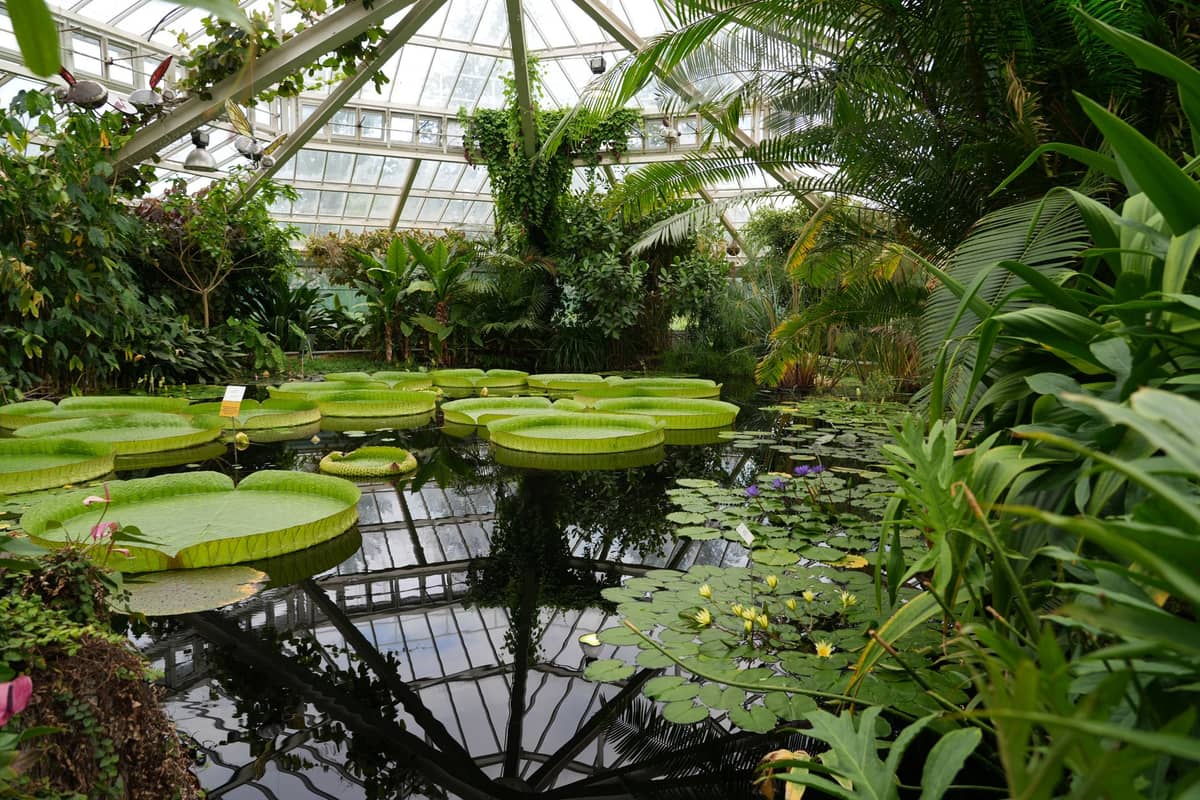
The greenhouses are where most visitors spend the bulk of their time, and rightly so. There are several distinct structures, each maintaining a different climate and housing a different plant community. The Victoria Greenhouse is the most architecturally striking: a classic iron-and-glass structure built around the giant Amazonian water lily Victoria amazonica, whose circular floating leaves can reach over two metres in diameter during the summer growing season. The lily's brief nocturnal flowering is a spectacle in late summer, though the timing is unpredictable.
The Subtropical Greenhouse holds plants from Mediterranean-type climates and warm-temperate zones, including citrus trees, palms, and cycads. On a cool grey Ghent morning, stepping inside registers immediately: the temperature lifts by several degrees, the air carries a faint earthy sweetness from the damp soil, and the light changes quality as it filters through the glass panels above. It is a sensory shift that feels disproportionately restorative.
The Succulent Greenhouse is smaller and drier, maintained at lower humidity, with a dense collection of cacti, agaves, and succulents from arid regions. The Tropical Greenhouse houses the collection requiring the highest heat and humidity. Visitors with mobility needs should note that the Tropical Greenhouse requires advance coordination with the garden's hortulana or staff for side-door access, while the Victoria, Subtropical, and Succulent Greenhouses are generally accessible by wheelchair.
💡 Local tip
On the first Thursday of every month (except January, July, August, and September), GUM and the Botanic Garden stay open until 10:00 p.m. as part of Late Thursday at Ghent Museums. The greenhouses at night, lit from below, offer an entirely different atmosphere worth seeking out.
Tickets & tours
Hand-picked options from our booking partner. Prices are indicative; availability and final rates are confirmed when you complete your booking.
Historic Ghent city exploration game
From 10 €Instant confirmationFree cancellationBelgian waffle making workshop and beer tasting in Ghent
From 45 €Instant confirmationFree cancellationTaste of Ghent private chocolate walking tour
From 256 €Instant confirmationFree cancellationSips and stories, a private beer tour in Ghent
From 373 €Instant confirmationFree cancellation
The Outdoor Garden: Beds, Trees, and Seasonal Rhythm
The outdoor sections are laid out with scientific logic rather than ornamental romanticism. Beds are grouped by taxonomic family or ecological origin, which gives the garden a reference-collection quality rather than the purely decorative feel of a city park. Labels are generally present, though their condition and detail level can vary by section.
The specimen trees are among the garden's understated attractions. Several mature trees, planted when the garden was in an earlier configuration, now provide genuine canopy cover. In spring, the flowering trees and the first emergence of the herbaceous beds bring colour and a fair amount of insect activity. In autumn, the garden turns quieter and more contemplative, with leaf fall softening the paths and the greenhouse contrast with the outside air becoming even more pronounced.
Winter is the least rewarding season for the outdoor beds, which are largely dormant. However, the greenhouses remain open and actually feel more worthwhile on a cold or wet day, when the contrast between outside and inside is sharpest. Given Ghent's temperate maritime climate with rainfall distributed across all months, a waterproof layer is worth having regardless of season.
Opening Hours, Getting There, and Practical Details
The garden is open Monday, Tuesday, Thursday, and Friday from 9:30 a.m. to 5:30 p.m. On Saturdays, Sundays, public holidays, and school holidays, hours extend to 10:00 a.m. to 6:00 p.m. Note that while GUM itself is closed on Wednesdays, the Botanic Garden remains open on Wednesdays. Greenhouses close at 4:30 p.m. daily regardless of season, with occasional exceptions during special events.
The address is Ledeganckstraat 35, 9000 Ghent, with the main entrance at the corner of K.L. Ledeganckstraat and E. Clauslaan. The garden is a walkable distance (around 10 minutes) from Gent-Sint-Pieters railway station, Ghent's main rail hub, which connects to Brussels in approximately 30 minutes and receives direct trains to Brussels Airport roughly once per hour. Trams operated by De Lijn run from Gent-Sint-Pieters to the city centre; the garden sits between the station and the historic centre, making it easy to include in either direction. A single De Lijn ride costs approximately €3, though fares should be verified with current De Lijn information before travel.
The garden is directly adjacent to Citadel Park, Ghent's largest urban park, and is within easy walking distance of the city's main museum cluster. Visitors combining a museum day with the garden can structure the route efficiently: cross through Citadel Park, enter the botanic garden, then continue toward the historic centre on foot.
ℹ️ Good to know
Accessibility: Wheelchair users can visit the Victoria Greenhouse, Subtropical Greenhouse, Succulent Greenhouse, and large parts of the outdoor garden without prior arrangement. For the Tropical Greenhouse, contact the hortulana or GUM staff in advance via the GUM website to arrange side-door access.
How the Experience Changes by Time of Day
Early morning on weekdays, around 9:30 to 10:30 a.m., the garden is at its quietest. The light is low and oblique, particularly useful for photographing the greenhouses from the outside, where condensation on the glass panels creates texture. University students and researchers may be passing through, but the visitor density is minimal. This is the time to move slowly through the succulent and subtropical houses without navigating around other people.
By late morning and midday, particularly on weekends, family groups and couples arrive in larger numbers. The outdoor paths see the most foot traffic around 11:00 a.m. to 1:00 p.m. on Saturdays. If you are visiting primarily for the greenhouses, arriving just after opening or in the mid-afternoon window between 2:30 and 4:00 p.m. tends to offer a better balance of good light and manageable crowds.
Late afternoon on weekdays, in the final hour before the outdoor garden closes, the visitor numbers drop again and the angle of the sun through the greenhouse glass can produce interesting photographic conditions. The risk is that the greenhouses have already closed at 4:30 p.m., so arriving much after 4:00 p.m. on a weekday means only the outdoor section remains accessible.
Who Will Get the Most From This Garden (And Who Might Not)
Visitors with a genuine interest in botany, ecology, or natural history will find the garden's scientific organization rewarding. It works well as a complement to GUM, the Ghent University Museum, whose collections engage with the same scientific traditions. Photographers working with natural subjects will find the greenhouses particularly productive, especially in the lower light of morning or during the Late Thursday evening openings.
Families with young children generally do well here: the scale is manageable, there is no admission fee to stress over, and the Victoria lily's oversized leaves tend to produce reliable amazement in children. The garden is calm enough that kids who are tired of city walking can decompress without the intensity of a major museum.
Visitors looking primarily for dramatic landscapes, formal ornamental gardens, or a major horticultural spectacle may find the scale modest. This is not a grand estate garden or a sprawling arboretum. It is a working university collection that happens to be beautifully maintained and free. If you are doing a tight one-day itinerary focused entirely on Ghent's medieval highlights, the botanic garden may not be the best use of your time, though it pairs well with a morning walk through Citadel Park if you are staying near Gent-Sint-Pieters.
For photography enthusiasts, the garden is worth cross-referencing with the broader Ghent photography guide, which covers the city's most visually productive locations and the light conditions that work best for each.
Insider Tips
- The first Thursday of every month, except in January, July, August, and September, both GUM and the Botanic Garden open until 10:00 p.m. for Late Thursday at Ghent Museums. The greenhouses are lit from within and the evening atmosphere is markedly different from a daytime visit.
- The giant Victoria amazonica lily typically reaches its most impressive size in mid to late summer. If this is a specific reason for your visit, check the GUM social channels before going, as the lily's development depends on seasonal conditions.
- The Tropical Greenhouse requires advance coordination for wheelchair users. Contact the hortulana or GUM staff via the GUM website before your visit to arrange side-door access.
- The garden is open on Wednesdays even though GUM itself is closed that day, making Wednesday one of the quieter days to visit the outdoor section and greenhouses.
- The entrance corner at K.L. Ledeganckstraat and E. Clauslaan is not prominently signposted from the main road. If you are approaching from Citadel Park, aim for the Ledeganckstraat side and follow the wall to the corner entrance.
Who Is Ghent University Botanic Garden For?
- Plant enthusiasts and botany students looking for a serious scientific collection
- Families with young children wanting free, low-pressure outdoor time
- Photographers seeking natural subjects and greenhouse light conditions
- Museum-quarter visitors needing a green break between GUM, SMAK, and MSK
- Visitors staying near Gent-Sint-Pieters who want a peaceful morning walk before the city crowds build
Nearby Attractions
Other things to see while in Citadelpark & Museum Quarter:
- Citadelpark
Citadelpark is Ghent's largest urban park, covering roughly 15-16 hectares of public green space between the historic centre and Gent-Sint-Pieters railway station. Free to enter at any hour, it serves as both a neighbourhood garden and a cultural anchor, flanked by two of Belgium's most significant contemporary and fine art museums.
- GUM – Ghent University Museum
GUM, Ghent University's science museum at Ledeganckstraat 35, brings together natural history collections, scientific instruments, and a living botanical garden in the Citadelpark museum quarter. It rewards curious visitors of almost any age, from school groups to adults who want to understand the science behind the city.
- Museum of Fine Arts Ghent (MSK Gent)
The Museum of Fine Arts Ghent, known locally as MSK Gent, is Flanders' oldest public art museum and home to a sweeping collection spanning medieval altarpieces to 20th-century Belgian modernism. Set inside a grand neoclassical building in Citadelpark, it rewards visitors who take their time and rewards them again on a second visit.
- S.M.A.K. – Municipal Museum of Contemporary Art
S.M.A.K., the Stedelijk Museum voor Actuele Kunst, is Ghent's flagship institution for contemporary art. Set in Citadelpark alongside the Museum of Fine Arts, it holds a permanent collection of international scope and rotating exhibitions that regularly reshape how Belgian audiences encounter living art.