Citadelpark: Ghent's 150-Year-Old Urban Sanctuary
Citadelpark is Ghent's largest urban park, covering roughly 15-16 hectares of public green space between the historic centre and Gent-Sint-Pieters railway station. Free to enter at any hour, it serves as both a neighbourhood garden and a cultural anchor, flanked by two of Belgium's most significant contemporary and fine art museums.
Quick Facts
- Location
- Citadelpark, 9000 Gent (Museum Quarter, near Charles de Kerchovelaan)
- Getting There
- Gent-Sint-Pieters station (10-min walk); multiple De Lijn tram and bus lines stop nearby
- Time Needed
- 45 minutes for a walk-through; 3-4 hours if visiting S.M.A.K. and MSK Gent
- Cost
- Free to enter the park; museums inside have separate admission fees
- Best for
- Families, museum-goers, joggers, picnickers, and anyone needing a break from cobblestones
- Official website
- visit.gent.be/en/see-do/citadelpark
What Is Citadelpark, and Why Does It Matter?
Citadelpark is Ghent's largest urban park, a roughly 16-hectare spread of lawns, mature tree canopy, ornamental ponds, and winding paths that has served the city for over 150 years. In 2025, the City of Ghent marked the park's 150th anniversary, underscoring its role not as a decorative afterthought but as a genuine civic institution. For residents of the surrounding Museum Quarter, it functions as a daily green corridor. For visitors, it provides something rarer in a medieval city: open sky, flat ground, and room to breathe.
The park sits in a strategically useful position between the dense historic core and Gent-Sint-Pieters station, Ghent's main rail gateway. That location makes it a natural pause point, somewhere to decompress after a morning at the Gravensteen or to gather yourself before catching a train. It also places it directly adjacent to two of Belgium's most serious art institutions: S.M.A.K. (Stedelijk Museum voor Actuele Kunst) and MSK Gent (Museum of Fine Arts). These are not gift-shop museums. S.M.A.K. holds one of Europe's strongest collections of post-war and contemporary art; MSK Gent covers Flemish masters through to the nineteenth century. The park connects them both.
ℹ️ Good to know
Citadelpark is open 24 hours a day, every day of the year, with no admission charge and no booking required. The museums within and beside the park have their own opening hours and ticket prices — check each institution before you visit.
The Park Through the Day: How the Atmosphere Shifts
Early mornings in Citadelpark belong to joggers, dog walkers, and the occasional cyclist cutting through from the station. Before 9am, the light filters low through the plane trees that line the main allée, and the pond near the centre of the park sits almost perfectly still. The smell at this hour is damp grass and turned earth, particularly after overnight rain, which is a realistic prospect given Ghent's temperate maritime climate. There is a particular quality of quiet here that the historic centre, with its tourist foot traffic from mid-morning onward, rarely offers.
By mid-morning on weekends, especially in late spring and summer, the park fills out considerably. Families arrive with children; groups of students spread out on the grass; the benches along the main paths fill with people eating takeaway from nearby Overpoortstraat. On warm weekday afternoons during university term, the student presence is noticeable — Ghent is home to one of Belgium's largest universities, and the Museum Quarter sits close to the student corridor. This is not a drawback. The park has enough space that density rarely feels oppressive, and the atmosphere stays relaxed rather than crowded.
In winter, Citadelpark quiets considerably. The deciduous trees drop their leaves by November, opening up long sightlines across the park that are invisible in summer. The park becomes a different kind of beautiful: stark, grey-green, and free of the tourist rhythms that govern the rest of the city. Bring a waterproof layer. Ghent receives regular rainfall year-round with no true dry season, and winter visits without preparation are uncomfortable rather than atmospheric.
Tickets & tours
Hand-picked options from our booking partner. Prices are indicative; availability and final rates are confirmed when you complete your booking.
Historic Ghent city exploration game
From 10 €Instant confirmationFree cancellationBelgian waffle making workshop and beer tasting in Ghent
From 45 €Instant confirmationFree cancellationTaste of Ghent private chocolate walking tour
From 256 €Instant confirmationFree cancellationSips and stories, a private beer tour in Ghent
From 373 €Instant confirmationFree cancellation
Layout and What You Will Actually See
The park's path network is fine-meshed enough that there is no single prescribed route. The main entrance on the Charles de Kerchovelaan side opens onto a broad allée that functions as the park's spine. From this central axis, smaller paths branch off toward the pond, the bandstand area, ornamental plantings, and the museum buildings at the park's edges. The ICC Ghent congress centre borders the park to the north, which adds a low-level architectural framing that some find intrusive and others barely notice.
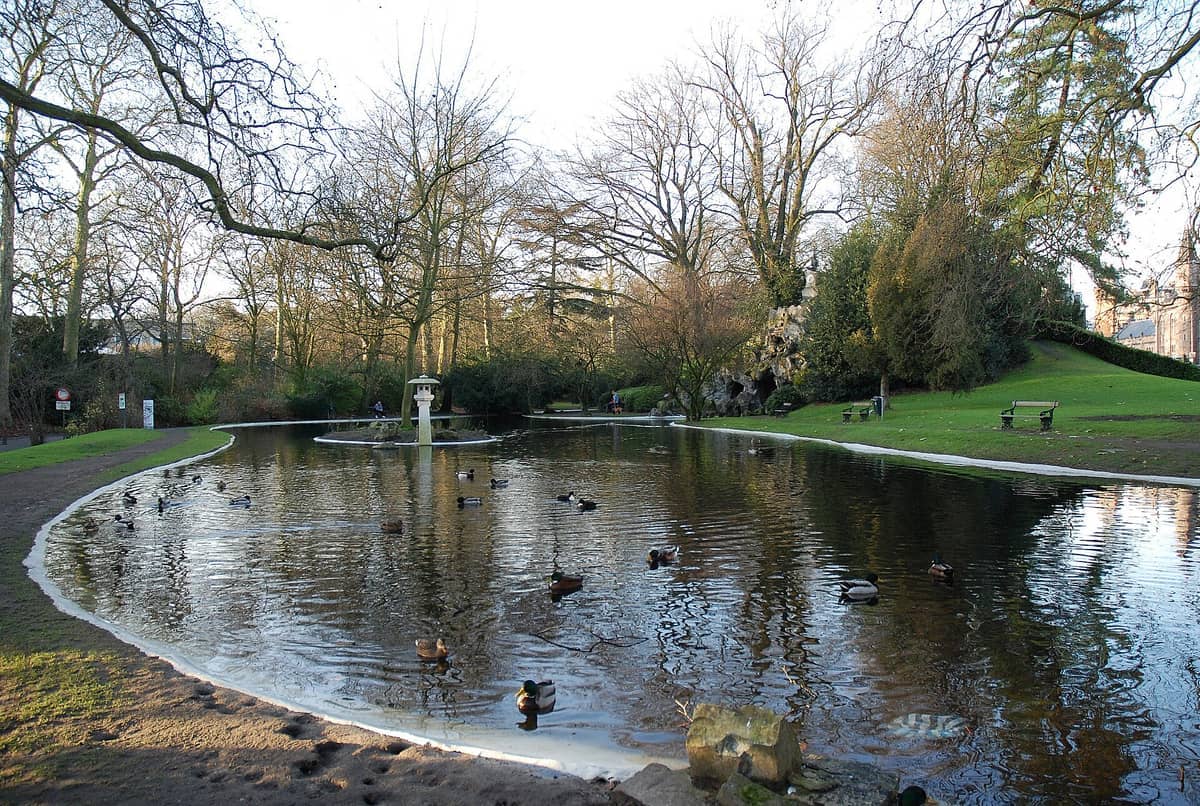
The ornamental pond is the park's visual anchor. Ducks are a permanent fixture, and the water reflects the surrounding trees in a way that reads well in photographs without requiring any particular technique. Around the pond, the grass is well-maintained and frequently used as informal seating. There are benches throughout the park, though they fill quickly on sunny afternoons — arriving with something to sit on is not a bad idea if you plan to stay a while.
At the park's southern edge, S.M.A.K. and MSK Gent face each other across a wide open plaza. This arrangement is deliberate — the pairing of contemporary and historical art in the same campus reflects Ghent's approach to its cultural institutions as a connected ecosystem rather than isolated venues. If you are visiting both museums in a single day, the park walk between them is genuinely pleasant rather than a functional slog.
Historical Context: 150 Years of Urban Greenery
Citadelpark was laid out on the site of a former military citadel, a fortification that was demolished to make way for the park in the latter half of the nineteenth century. The choice to convert military land into public green space reflects a broader European urban planning impulse of that era, the idea that industrial cities owed their residents accessible nature as a counterweight to dense housing and factory work. Ghent in the 1870s was a major industrial centre, one of the most important textile manufacturing cities in continental Europe, and the park's creation was partly a civic health response to that context.
The park's landscape design follows the English naturalistic tradition, favouring curving paths, informal plantings, and varied topography over the strict geometry of French formal gardens. This approach produces a park that feels discovered rather than imposed, where turning a corner reveals a new section rather than offering a complete view from the entrance. Over 150 years, the tree canopy has matured into something that a landscape architect cannot engineer from scratch — the oldest specimens provide a sense of scale and permanence that newer parks simply do not have.
💡 Local tip
The park's 150th-anniversary celebrations in 2025 prompted the City of Ghent to release updated information and restoration plans. Check stad.gent for any temporary closures of specific sections during ongoing maintenance work.
Getting There and Getting Around
Citadelpark sits roughly ten minutes on foot from Gent-Sint-Pieters station, Ghent's main rail hub. From the station, head northwest along the main boulevard and the park's boundary becomes visible within a few minutes of walking. Multiple De Lijn tram and bus lines also serve the area; the city's transport network is described as offering smooth connections to the park, though specific line numbers change periodically and the current De Lijn route map should be checked before travel. A single De Lijn ride costs €3, valid for 60 minutes across buses and trams, with contactless payment accepted.
Visitors arriving from the historic centre on foot will find the park about 15-20 minutes' walk from the Korenmarkt area, passing through neighbourhoods that transition gradually from medieval to nineteenth-century architecture. This walk is part of the experience and is covered in detail in the Ghent walking tour guide. The Museum Quarter around the park also rewards exploration beyond the park boundaries, with a concentration of cultural venues that makes it Ghent's most institutionally dense neighbourhood outside the historic core.
The park's internal path network is accessible and well-maintained, and it is listed by the Flemish accessibility platform Drempelvrij as an accessible site in East Flanders. Visitors with mobility considerations should note that while paths are generally good, some areas have uneven surfaces, particularly near older planted sections. Checking the Drempelvrij listing directly will give the most current detailed grading.
Photography, Practical Notes, and What to Bring
Citadelpark is a strong photography location in spring, when the flowering trees along the main allée are at their peak, and in autumn, when the canopy turns amber and copper before the leaves fall. The ornamental pond photographs best in early morning, when surface reflections are undisturbed by wind and foot traffic. The museum plaza at the southern edge offers clean architectural lines and is best shot on overcast days, which reduce harsh shadows and are, conveniently, a realistic prospect in Ghent for much of the year.
For a broader sense of Ghent's photographic landscape, the Ghent photography guide covers the city's most rewarding visual corners across all neighbourhoods and lighting conditions.
Bring layers regardless of season. Ghent's maritime climate means that a warm morning can give way to a cold, wet afternoon without warning. There are no large sheltered areas within the park itself, so if the sky looks threatening, timing your visit for mid-morning when showers are statistically less frequent is a reasonable approach. The park has no on-site café as of writing, though several independent cafés and sandwich shops are within a few minutes' walk on the surrounding streets.
⚠️ What to skip
There is no admission gate or ticket check for the park itself, but the museums (S.M.A.K. and MSK Gent) have independent entry systems and are not included with any general city pass without checking current terms. Verify before arrival.
Who Should Skip Citadelpark
Travelers on a very tight single-day itinerary focused purely on medieval Ghent — the Gravensteen, St Bavo's Cathedral, the Graslei waterfront — may find that the walk to Citadelpark pulls them too far from the historic core to justify the round trip. The park is beautiful, but it is not irreplaceable in the way that the Ghent Altarpiece or the three towers skyline is. If your time in Ghent is under six hours and your primary interest is the medieval city, stay in the historic centre and save the park for a longer visit.
Visitors who are primarily after museum experiences and want to maximise time inside should note that both S.M.A.K. and MSK Gent are serious, collection-heavy institutions that each warrant two hours minimum. The park walk between them is pleasant but not necessary. For guidance on planning a full museum day in Ghent, see the best museums in Ghent guide.
Insider Tips
- The park's northeastern corner, furthest from the museum plaza, sees considerably fewer visitors and has some of the oldest and most impressive tree specimens. It is worth a detour for the canopy alone.
- If you are visiting S.M.A.K. or MSK Gent, arrive at the park first rather than after. Museum fatigue is real, and a 20-minute walk through the park before entering a gallery sharpens attention considerably.
- The ICC Ghent congress centre adjoins the park and occasionally hosts public events, exhibitions, and food markets that spill into the park's northern edge. Check the ICC calendar before your visit — you may arrive to something unexpected and worthwhile.
- Ghent's temperate maritime climate means the park in late April and early May can deliver unexpectedly warm days with full blossom and none of the summer crowds. This is arguably the best week-by-week window in the entire calendar for a park visit.
- Street food and takeaway options on Overpoortstraat, the student strip a short walk north of the park, are significantly cheaper and more varied than anything in the tourist core. It is a practical lunch solution if you are spending a half-day in the Museum Quarter.
Who Is Citadelpark For?
- Families with children who need open space between museum visits
- Joggers and cyclists looking for a flat, traffic-free route near the station
- Photographers targeting autumn foliage or spring blossom in an urban setting
- Visitors pairing a full day of contemporary and classical art at S.M.A.K. and MSK Gent
- Travelers on a budget who want quality green space without any admission cost
Nearby Attractions
Other things to see while in Citadelpark & Museum Quarter:
- Ghent University Botanic Garden
The Ghent University Botanic Garden at Ledeganckstraat 35 is one of the city's most accessible green spaces, free to enter and open most days of the week. Part of the Ghent University Museum (GUM) and located near Citadel Park, it combines outdoor beds with a series of historic greenhouses spanning tropical, subtropical, and succulent collections.
- GUM – Ghent University Museum
GUM, Ghent University's science museum at Ledeganckstraat 35, brings together natural history collections, scientific instruments, and a living botanical garden in the Citadelpark museum quarter. It rewards curious visitors of almost any age, from school groups to adults who want to understand the science behind the city.
- Museum of Fine Arts Ghent (MSK Gent)
The Museum of Fine Arts Ghent, known locally as MSK Gent, is Flanders' oldest public art museum and home to a sweeping collection spanning medieval altarpieces to 20th-century Belgian modernism. Set inside a grand neoclassical building in Citadelpark, it rewards visitors who take their time and rewards them again on a second visit.
- S.M.A.K. – Municipal Museum of Contemporary Art
S.M.A.K., the Stedelijk Museum voor Actuele Kunst, is Ghent's flagship institution for contemporary art. Set in Citadelpark alongside the Museum of Fine Arts, it holds a permanent collection of international scope and rotating exhibitions that regularly reshape how Belgian audiences encounter living art.