Wat Phra Singh Woramahawihan: Chiang Mai's Most Revered Temple
Wat Phra Singh Woramahawihan anchors the western end of the Old City and stands as the finest surviving example of Lanna temple architecture in northern Thailand. Traditionally dated to 1345, it houses one of the city's most venerated Buddha images and draws both devout worshippers and curious visitors every day of the year.
Quick Facts
- Location
- Singharat Road, Old City, Chiang Mai
- Getting There
- 15–20-min walk from Tha Phae Gate; Red songthaew or tuk-tuk from Nimman area (~15 min)
- Time Needed
- 45 minutes to 1.5 hours
- Cost
- 20 THB entrance donation for foreigners to enter Viharn Lai Kham; temple grounds otherwise free
- Best for
- Temple architecture, Lanna history, photography, cultural immersion
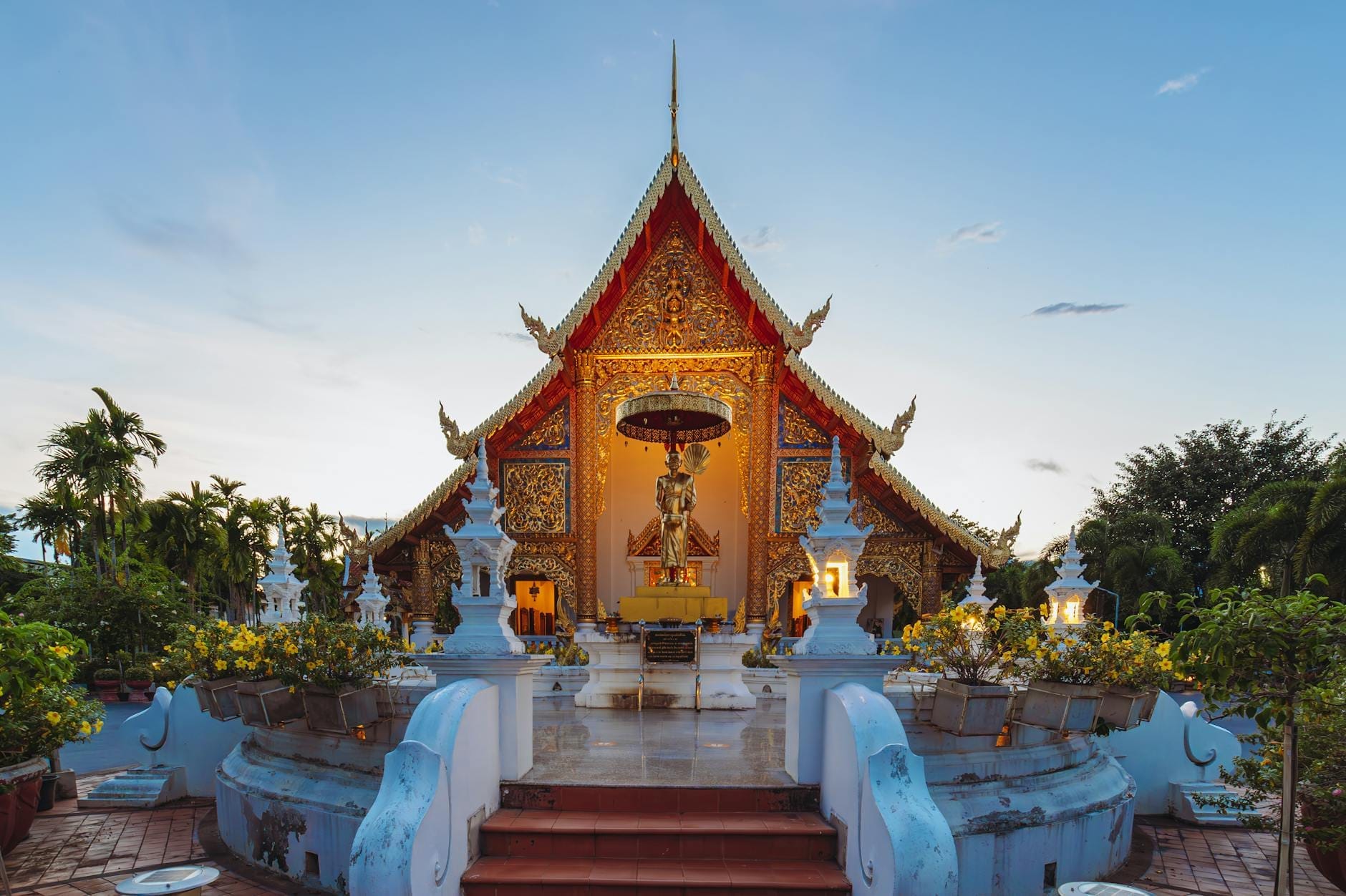
Why Wat Phra Singh Stands Apart
Chiang Mai has over 300 temples, so the question every traveler asks is a fair one: why this one? Wat Phra Singh Woramahawihan earns its status not through a single dramatic feature but through the rare coherence of its entire compound. The temple's various structures were built across different centuries, yet they feel unified in scale, material, and intention. Cream-colored walls, tiered red-and-gold rooflines, and carved wooden facades repeat across the compound with quiet consistency. It is the kind of place that rewards a slow walk rather than a quick snapshot.
The temple also sits at a symbolic center of civic life. Each year during Songkran, the sacred Phra Singh Buddha image is carried in procession from this compound through the streets of the Old City so residents can pour scented water over it as a blessing. To understand that ritual is to understand why this is not merely a tourist attraction but an active, living religious site.
ℹ️ Good to know
Opening hours: approximately 6:00 AM to 5:00 PM daily for the main compounds. A 20 THB donation is requested from foreign visitors to enter Viharn Lai Kham, collected at a small booth near that chapel. Keep your ticket — staff occasionally check inside the compound.
History: From Royal Cemetery to Royal Temple
Wat Phra Singh is traditionally considered to have been founded in 1345 by King Phayu, the fifth ruler of the Mangrai (Lan Na) dynasty, to enshrine the ashes of his father, King Kham Fu. At that point it was a modest cremation temple. Over the following two centuries, successive Lanna kings expanded and embellished it, adding the main viharn, the library, and eventually the Lai Kham chapel that houses the celebrated Phra Singh image.
The name 'Phra Singh' derives from 'Sihing', a legendary lion-form Buddha image said to have originated in Sri Lanka and arrived in northern Thailand via Sukhothai. The image's true origins are debated by art historians, but what is not debated is its age: it dates to at least the 13th or 14th century and represents a distinct regional style, with a rounded face, broad shoulders, and flame-shaped ushnisha that set it apart from central Thai Buddha iconography.
The temple received its royal designation 'Woramahawihan' (meaning 'great royal monastery of the first rank') in the modern era, a classification reserved for only the most significant Buddhist temples in Thailand. This is one of a relatively small number of temples in the country to hold this distinction.
For broader context on the temple network across the Old City and Chiang Mai's Lanna heritage, the Chiang Mai temples guide covers over a dozen sites with practical comparisons.
Tickets & tours
Live prices and dates from our booking partner. If you book, we may earn a commission at no extra cost to you.
Doi Inthanon National Park small group guided tour
From 34 €Instant confirmationFree cancellationHalf-day tour to admire elephants and enjoy Thai nature
From 48 €Instant confirmationFree cancellationChiang Mai - Chiang Dao Cave and 5 Hill Tribe villages
From 42 €Instant confirmationFree cancellationArt in Paradise Chiang Mai 3D Art Museum entrance tickets
From 8 €Instant confirmationFree cancellation
What You'll Actually See Inside the Compound
The entrance gate faces east from the western end of Ratchadamnoen Road, close to Singharat Road, flanked by a pair of guardian lions. Pass through and the compound opens into a broad, shaded courtyard with mature trees providing real relief from midday heat. The layout is more spacious than most Old City temples, giving each structure room to breathe and making it easier to photograph individual buildings without crowding from the others.
Viharn Lai Kham
This is the most important structure in the compound and the one that draws the deepest attention from visitors and worshippers alike. Dating back to the 15th century, Viharn Lai Kham is a small, low-roofed chapel with a three-tiered roof finished in orange and green ceramic tiles. The exterior woodwork is exceptional: intricate gilded stucco panels depicting scenes from the Sang Thong and Suwannasam tales from Thai Buddhist literature cover the lower façade, and every panel rewards close inspection. The interior houses the Phra Singh Buddha, attended by monks and surrounded by offerings of flowers, incense, and gold leaf. Photography inside the chapel is generally permitted but should be done discreetly and without flash.
Wihan Luang (Main Assembly Hall)
The larger main viharn sits on a raised platform and dates to a 19th-century reconstruction. It has a broader, more assertive presence than Viharn Lai Kham and houses several large Buddha images in both seated and standing positions. The interior murals, painted during the reign of Chao Kawila, depict scenes from the Jataka tales and daily life in 19th-century Lanna, including details of dress, architecture, and social customs that have significant historical value.
The Chedi and the Ho Trai (Scripture Library)
The principal chedi is a large, bell-shaped structure with a whitewashed base and gilded upper spire. It is believed to enshrine relics as well as the ashes of King Kham Fu. The Ho Trai, or scripture library, stands on a raised plinth above a pond, a design intended to protect palm-leaf manuscripts from insects and moisture. This small pavilion is among the best-preserved examples of traditional Lanna library architecture in the region.
💡 Local tip
Walk the full perimeter of the compound before entering any structure. Smaller shrines, spirit houses, and carved boundary stones along the outer walls often go unnoticed but are worth a few minutes of attention.
How the Temple Changes by Time of Day
Early morning, between 6:30 and 8:30 AM, is when the compound feels most authentic. Monks in saffron robes move between the viharn and the monks' quarters; a few residents light incense at the small shrines near the library; and the low light angles sharply across the carved façades of Viharn Lai Kham. Crowds are thin. The air smells of jasmine garlands left as offerings and the faint smoke of incense sticks.
By mid-morning, tour groups begin arriving. Between 10:00 AM and noon the compound is at its most crowded, with tour buses occasionally depositing 20-30 people at a time near the main gate. The atmosphere remains respectful, but patience is required if you want unobstructed photography. Afternoon light from around 3:00 PM onward gives the gilded surfaces a warmer tone, and the compound thins out again as the day cools.
During Buddhist holy days (Wan Phra, which follows the lunar calendar), the temple fills with local worshippers, and the sound of chanting from inside the viharn carries across the courtyard. If your timing aligns with a Wan Phra, it is worth pausing at the edge of the viharn entrance to listen, even briefly.
For the single best photography window across multiple Old City temples in one morning, the Chiang Mai photography guide outlines a walking route that starts here and continues east.
Practical Walkthrough: How to Visit
Dress code is enforced: shoulders and knees must be covered. Sarongs are available to borrow at the entrance gate if needed, though many visitors find it more comfortable to wear appropriate clothing from the start given the heat inside the buildings. Shoes are removed before entering any viharn or chapel.
The temple is most easily reached on foot from anywhere within the Old City. From Tha Phae Gate, it is roughly a 15-minute walk west along Ratchadamnoen Road. From the Nimman area, a red songthaew heading toward the Old City will drop you near the Suan Dok Gate, from which Wat Phra Singh is about a 10-minute walk north. Parking is available on Singharat Road for those arriving by private vehicle or rented scooter.
Budget a minimum of 45 minutes for a focused visit covering the three main structures. An hour to 90 minutes allows time to sit, observe, and take in the murals and exterior carvings without rushing. There are no official audio guides available on-site, so independent research or a guided tour adds considerably to the experience.
⚠️ What to skip
Avoid visiting during the Songkran period (mid-April) if crowds are not your preference. The Phra Singh image is paraded through the city during this time, which means the chapel may be temporarily empty of its most sacred occupant, and the temple itself becomes extremely crowded.
Wat Phra Singh is a natural anchor for a full Old City temple morning. Combine it with Wat Chedi Luang and Wat Phan Tao, both within easy walking distance, for a comprehensive Lanna temple circuit.
Who Should Visit, and Who Might Not Connect
Wat Phra Singh rewards travelers who come with some preparation: knowing the basic story of the Phra Singh image, understanding what Lanna architecture represents, or having already visited a few other temples in the city for comparison. Without context, it risks blending into the background of Chiang Mai's broader temple landscape.
Visitors with very limited time, or those who have already visited several major northern Thai temples, may find the compound familiar enough that it does not demand a dedicated trip. That said, as a single introduction to Lanna religious art and architecture, no other temple in the city covers as much ground with as much consistency of quality.
If you are planning your time carefully, the 3-day Chiang Mai itinerary slots Wat Phra Singh into a morning that also covers the City Arts and Cultural Centre and the surrounding moat walk.
Insider Tips
- The gilded stucco panels on Viharn Lai Kham are best viewed in direct morning light. Stand roughly 3 meters back from the facade to take in the full narrative sequence without distortion.
- The Ho Trai library pavilion is frequently overlooked by visitors heading straight to the main chapel. The reflection in the surrounding pond makes for one of the compound's best photographs, especially in flat light.
- If you are visiting on a Buddhist holy day, bring a small offering of flowers or incense from the vendors at the temple gate. It costs 20-30 THB and is a meaningful way to participate rather than observe.
- The monks' quarters are in the rear section of the compound. This area is generally off-limits to visitors, but the boundary gives you a sense of the temple as a working monastery rather than a museum.
- Combine this visit with the Lanna Folklife Museum, located about 700–800 meters east on Phra Pokklao Road, to give the architectural and religious context a concrete cultural grounding.
Who Is Wat Phra Singh Woramahawihan For?
- First-time visitors to Chiang Mai who want a single introduction to Lanna temple architecture
- History and art enthusiasts interested in Lanna murals, woodcarving, and Buddhist iconography
- Photographers seeking early-morning golden light on gilded Lanna facades
- Travelers building a walking temple circuit through the Old City
- Anyone visiting during Songkran who wants to understand the procession ritual at its source
Nearby Attractions
Other things to see while in Old City (Chiang Mai Old Town):
- Chang Phuak Night Market (North Gate Food Market)
Chang Phuak Night Market, known to locals as the North Gate Food Market, is a compact open-air street food gathering outside Chiang Mai's ancient city walls. Night after night, it draws a faithful crowd of students, office workers, and savvy travelers in search of authentic northern Thai cooking at prices that haven't caught up with the tourist economy.
- Chiang Mai City Arts and Cultural Centre
Housed in a beautifully restored colonial-era building on the edge of the Old City's Three Kings Monument plaza, the Chiang Mai City Arts and Cultural Centre offers one of the most accessible and well-curated introductions to Lanna history and northern Thai culture. It rewards both first-time visitors and those who want genuine context before exploring the city's temples and neighborhoods.
- Chiang Mai City Walls and Moat
The rectangular moat and surviving brick walls of Chiang Mai's Old City are the physical outline of a 700-year-old Lanna capital. Free to explore at any hour, they offer one of the most atmospheric walks in northern Thailand, framing temples, corner bastions, and four ceremonial gates.
- Chiang Mai National Museum
The Chiang Mai National Museum offers one of the clearest introductions to northern Thailand's Lanna Kingdom, covering 700 years of history through royal artifacts, Buddhist sculpture, ceramics, and ethnographic collections. It's calm, well-organized, and genuinely undervisited compared to the temples nearby.
Planning a trip? Discover personalized activities with the Nomado app.