Wat Chedi Luang: Chiang Mai's Ancient Giant
Wat Chedi Luang Varavihara anchors the heart of Chiang Mai's Old City with a 15th-century chedi that once stood over 80 metres tall. Partially collapsed by earthquake, it remains the most architecturally striking temple complex in the city, and one of the few where monks actively invite conversation with visitors.
Quick Facts
- Location
- 103 Phra Pokklao Rd, Old City, Chiang Mai
- Getting There
- 10-minute walk from Tha Phae Gate; songthaew or tuk-tuk from Nimman area (~20 min)
- Time Needed
- 45 minutes to 1.5 hours
- Cost
- 40 THB entry fee
- Best for
- History lovers, architecture enthusiasts, solo travelers open to monk chat
What Wat Chedi Luang Actually Is
Wat Chedi Luang Varavihara sits on Phra Pokklao Road, roughly at the geographic center of the Old City moat square. It is not a quiet meditation retreat or a polished tourist showcase. It is a working royal temple with a ruined 600-year-old chedi at its core, monks living and studying on the grounds, and a steady but manageable flow of visitors throughout the day.
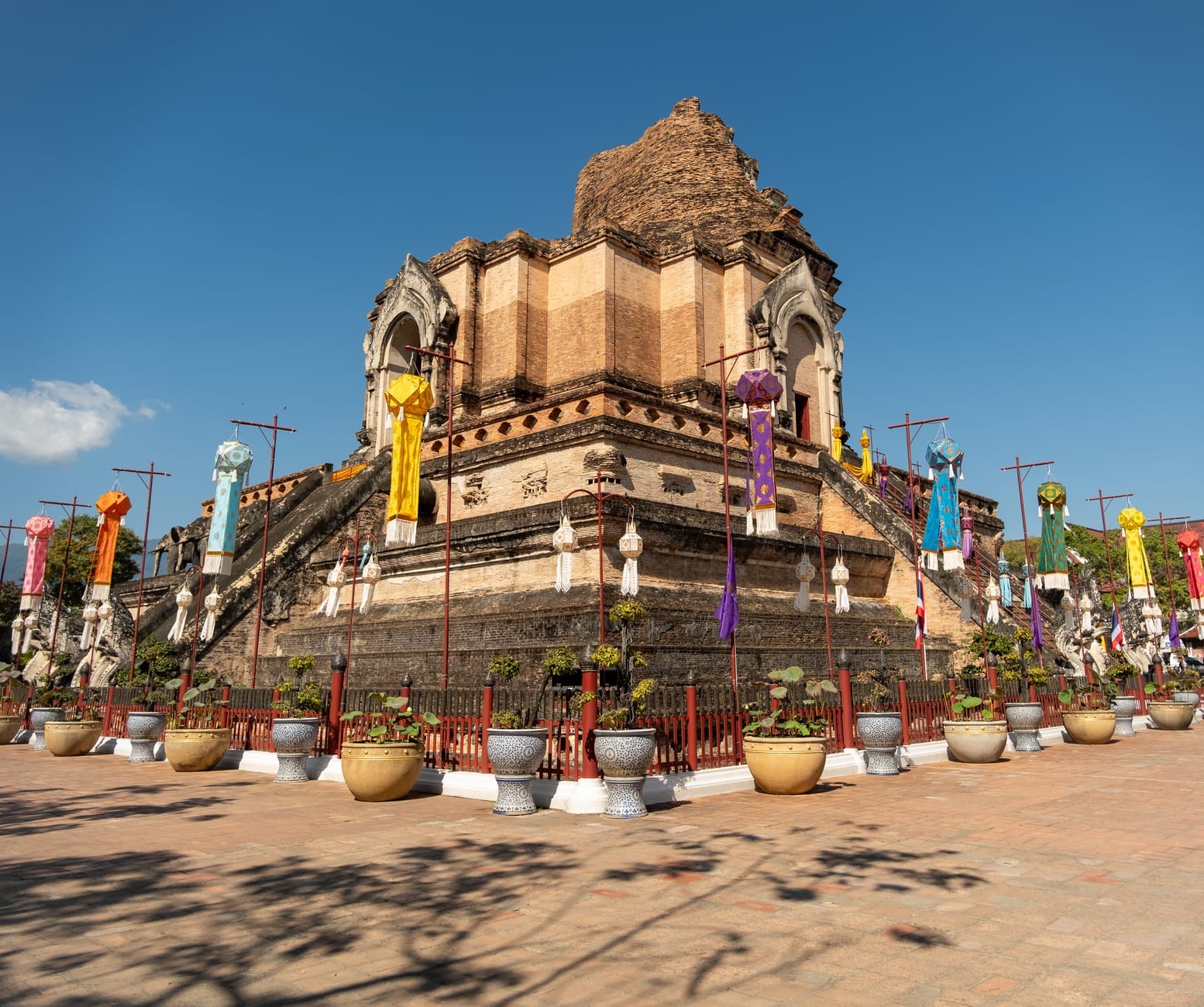
The chedi itself is the reason to come. Construction began in the 14th century under King Saen Muang Ma, and the tower was expanded to its peak height, reportedly over 80 metres, in the early 15th century. A major earthquake in 1545 collapsed the upper third, and it has never been fully restored. What stands today is a truncated, moss-edged mass of ancient brick and laterite, flanked by four staircase-access niches holding naga serpent balustrades. The scale is startling even by Thai temple standards.
ℹ️ Good to know
A replica of the Phra Kaew Morakot (Emerald Buddha) sits in the eastern niche of the chedi. The original resided here from 1468 until 1552, before eventually being moved to Bangkok's Wat Phra Kaew. The replica was placed here in 1995 to mark Chiang Mai's 700th anniversary.
The Chedi Up Close: What You See and Feel
Standing directly beneath the south face, the scale recalibrates your sense of proportion. The base alone spans roughly 60 metres on each side. The brickwork is uneven and deeply weathered, patched in places with lighter-colored restoration mortar that makes the age of the original sections more obvious by contrast. Aerial roots from Bodhi trees grip sections of the upper walls. Elephant statues, partially restored and some still fragmentary, line the lower terrace.
In the morning, when mist sometimes still clings to the upper walls and monks are finishing their alms rounds, the place feels genuinely ancient. By midday the light is harsh and flat, and tour groups move through in focused clusters. Late afternoon, particularly between 4pm and 6pm, brings the best combination of warm light and relative quiet. The chedi's upper brickwork glows amber at that hour, and resident monks begin evening prayers in the main viharn, which you can often hear from the courtyard.
The grounds extend well beyond the chedi. The main viharn houses a large golden Buddha image in the Chiang Saen style. The City Pillar, or Sao Inthakin, is enshrined in a smaller building on the western side of the compound. This pillar is considered the spiritual foundation of Chiang Mai itself and draws significant Thai devotional traffic, particularly during the Inthakin Festival in late May or early June.
Tickets & tours
Live prices and dates from our booking partner. If you book, we may earn a commission at no extra cost to you.
Doi Inthanon National Park small group guided tour
From 34 €Instant confirmationFree cancellationHalf-day tour to admire elephants and enjoy Thai nature
From 48 €Instant confirmationFree cancellationChiang Mai - Chiang Dao Cave and 5 Hill Tribe villages
From 42 €Instant confirmationFree cancellationArt in Paradise Chiang Mai 3D Art Museum entrance tickets
From 8 €Instant confirmationFree cancellation
The Monk Chat Program
Wat Chedi Luang runs one of northern Thailand's longest-established monk chat programs, held daily under a large tree near the northern end of the complex. Novice and senior monks sit at simple tables, available to speak with visitors in English as a language practice exercise. The conversations are genuine rather than scripted. Topics range from Buddhism and temple life to Thai culture, the monks' home regions, and visitors' home countries.
This is worth your time even if you have visited many Thai temples. The program is low-pressure and informal. There is no queue, no timer, and no obligation to discuss religion. Some visitors spend fifteen minutes; others stay for over an hour. The monks are often university students completing religious education, not elderly recluses, which makes the exchange more dynamic than most visitors expect.
💡 Local tip
Monk chat typically runs from around 9am to 6pm, though availability depends on the monks' own schedule and study commitments. Mornings on weekdays tend to be quieter and more relaxed for conversation.
Historical Context and Cultural Weight
Understanding what Wat Chedi Luang meant to the Lanna Kingdom helps explain why it occupies such a central place, literally and symbolically, in Chiang Mai. The temple was the royal temple of Lanna's ruling family. The chedi was expanded by successive kings as an expression of dynastic power and Buddhist merit-making. At its completed height it was among the tallest structures in Lanna, visible from much of the surrounding plain.
The 1545 earthquake that brought down the spire struck during a period when the Lanna Kingdom was already weakening under pressure from Burma. The collapsed tower was never rebuilt, and the temple passed through Burmese, Siamese, and later Thai administrative control over the following centuries. It remains a royal temple under Thai law. For broader context on Chiang Mai's temple landscape, the Chiang Mai temples guide covers the city's major and lesser-known wats in detail.
Practical Walkthrough: How to Move Through the Site
The main entrance is on Phra Pokklao Road. Pay the 40 THB fee at the ticket booth just inside the gate. Modest dress is required: shoulders and knees must be covered. Sarongs are available to borrow at the entrance if needed. Remove shoes before entering any of the indoor shrine buildings, though the chedi terrace itself is open-air and shoes can remain on.
A logical route starts at the chedi, circling its base to examine the naga staircases and elephant figures from all sides. Then move to the main viharn to see the central Buddha image. Cross to the western shrine for the Sao Inthakin City Pillar. If monk chat is operating, the area under the trees is clearly signposted near the north side. Allow extra time if you intend to sit for a conversation.
Wat Chedi Luang is open daily from approximately 6am to 6:30pm, though the ticket booth may close earlier in the evening. The complex is a short walk from the Three Kings Monument and the Lanna Folklife Museum, making the area easy to combine into a single Old City morning or afternoon.
Photography, Crowds, and Honest Expectations
The chedi photographs well in the late afternoon when the sun comes from the west. Early morning works for mist-effect shots and empty foregrounds, but requires arriving before 8am. Midday light is unflattering and the courtyard fills with large tour groups between 10am and 1pm. A polarizing filter is useful for cutting the glare off the pale restoration mortar sections.
For those planning serious photography across multiple Chiang Mai sites, the Chiang Mai photography guide includes recommended light windows and angles for the Old City temples.
On the question of honest expectations: Wat Chedi Luang is not overhyped in the way some major Thai temples are. The ruined chedi is genuinely impressive, and the monk chat program is a real engagement rather than a performance. The complex does get crowded, particularly on weekends and during tour season from November through February. It is not a place for quiet contemplative temple-sitting at those times. But the sheer physical presence of the chedi, and the fact that it has stood in this state since the mid-16th century without full restoration, gives it a weight that more polished temples lack.
⚠️ What to skip
Visitors wearing shorts or sleeveless tops will be asked to change or borrow a sarong at the entrance. Factor this into your time if you plan to visit multiple temples in sequence.
Who Should Consider Skipping
Travelers who prefer immaculate, ornate temple complexes may find the partially collapsed chedi anticlimactic. If decorative Lanna craftsmanship is the priority, Wat Phra Singh or Wat Phan Tao (directly adjacent to Wat Chedi Luang and included in the same ticket zone) offer more visually complete interiors. Those traveling with young children who struggle with slow-paced historical sites may find the visit short unless the monk chat engages them.
Insider Tips
- Wat Phan Tao, the teak-pillared viharn directly next door to the north, is accessible with the same area ticket and almost always quieter. Its interior, built from 28 giant teak pillars with stained glass panels, is architecturally unique and easy to miss if you do not know to look for it.
- The City Pillar shrine on the western side of the compound is a center of active Thai devotional practice. Arrive when Thai worshippers are present (often early morning or late afternoon) and the contrast between local ritual life and tourist observation is most apparent.
- If you want monk chat without the weekend crowd, visit on a Tuesday or Wednesday morning. The monks are present but the visitor numbers are low enough that conversations feel more personal.
- The chedi's east-facing niche with the Emerald Buddha replica gets direct morning light between roughly 8am and 10am. This is the best window for a clear photograph of the niche without shadow interference.
- The Inthakin Festival, held annually at the temple in late May or early June, transforms the grounds with ceremonial decoration and draws large numbers of Thai devotees. It is one of the most locally significant festivals in the city calendar and receives far less international attention than Songkran or Yi Peng.
Who Is Wat Chedi Luang Varavihara For?
- History and archaeology travelers interested in Lanna Kingdom heritage
- Architecture-focused visitors who appreciate ruins over reconstructions
- Solo travelers curious about the monk chat program
- Photographers looking for textured, weathered subjects in golden hour light
- First-time visitors to Chiang Mai wanting a single site that captures the city's historical core
Nearby Attractions
Other things to see while in Old City (Chiang Mai Old Town):
- Chang Phuak Night Market (North Gate Food Market)
Chang Phuak Night Market, known to locals as the North Gate Food Market, is a compact open-air street food gathering outside Chiang Mai's ancient city walls. Night after night, it draws a faithful crowd of students, office workers, and savvy travelers in search of authentic northern Thai cooking at prices that haven't caught up with the tourist economy.
- Chiang Mai City Arts and Cultural Centre
Housed in a beautifully restored colonial-era building on the edge of the Old City's Three Kings Monument plaza, the Chiang Mai City Arts and Cultural Centre offers one of the most accessible and well-curated introductions to Lanna history and northern Thai culture. It rewards both first-time visitors and those who want genuine context before exploring the city's temples and neighborhoods.
- Chiang Mai City Walls and Moat
The rectangular moat and surviving brick walls of Chiang Mai's Old City are the physical outline of a 700-year-old Lanna capital. Free to explore at any hour, they offer one of the most atmospheric walks in northern Thailand, framing temples, corner bastions, and four ceremonial gates.
- Chiang Mai National Museum
The Chiang Mai National Museum offers one of the clearest introductions to northern Thailand's Lanna Kingdom, covering 700 years of history through royal artifacts, Buddhist sculpture, ceramics, and ethnographic collections. It's calm, well-organized, and genuinely undervisited compared to the temples nearby.
Planning a trip? Discover personalized activities with the Nomado app.