Three Kings Monument: The Civic Heart of Chiang Mai's Old City
Standing at the center of the Old City, the Three Kings Monument commemorates the three rulers who founded Chiang Mai in 1296. It is one of the most historically significant and photographed public spaces in northern Thailand, surrounded by major cultural institutions and framed by the Lanna architectural backdrop of the City Arts and Cultural Centre.
Quick Facts
- Location
- Phra Pokklao Road, Old City, Chiang Mai
- Getting There
- 10-min walk from Tha Phae Gate; songthaew or tuk-tuk to Old City centre
- Time Needed
- 20–40 minutes for the monument and square; 1–2 hours if visiting adjacent museums
- Cost
- Free to visit the monument and square
- Best for
- History enthusiasts, photographers, first-time visitors orienting themselves to the Old City
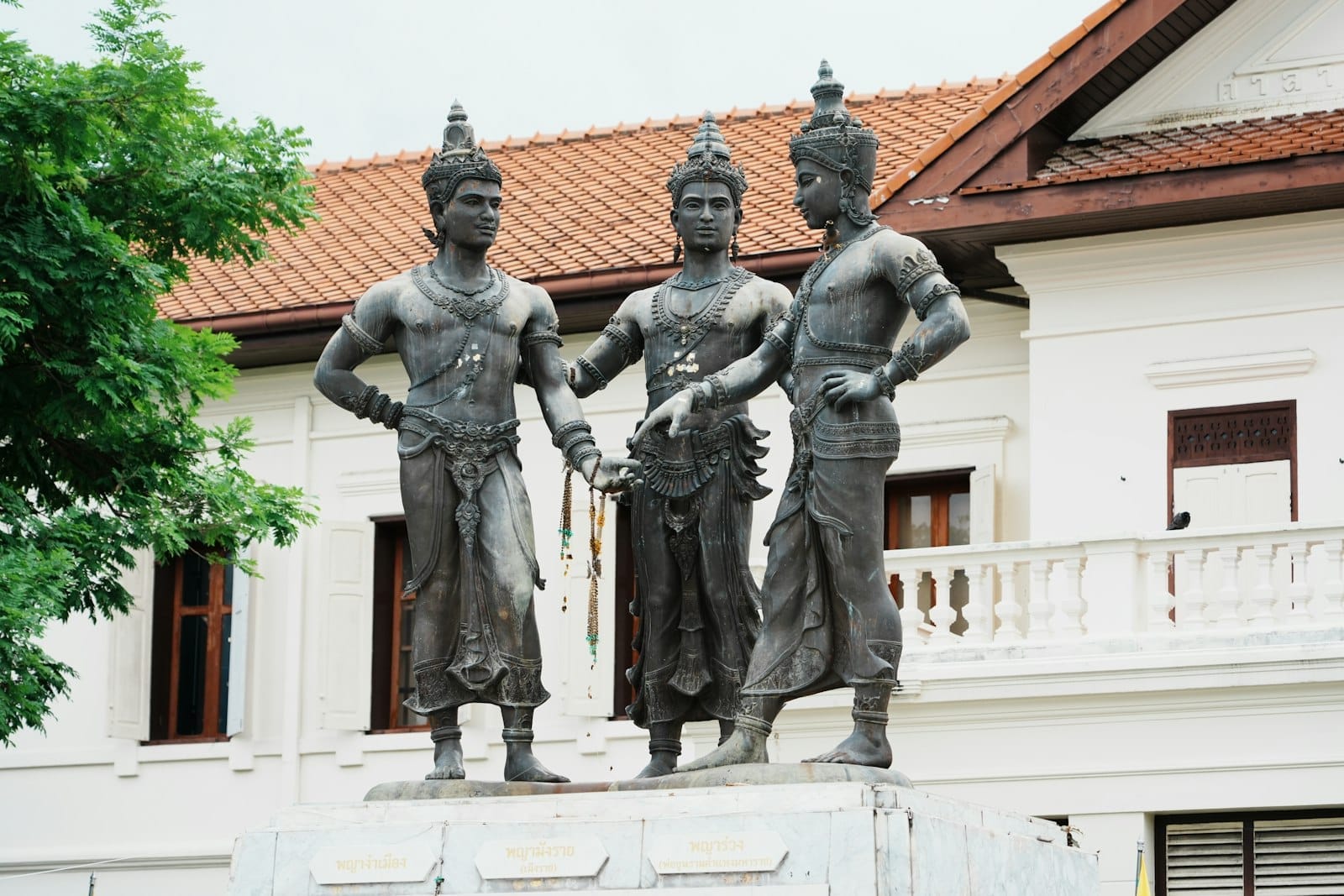
What Is the Three Kings Monument?
The Three Kings Monument is a bronze sculpture group depicting the three rulers credited with founding Chiang Mai in 1296: King Mengrai of Lanna, King Ngam Mueang of Phayao, and King Ramkhamhaeng of Sukhothai. The three figures stand side by side in full royal regalia, gazing southeast from a raised plinth at the center of a wide open plaza on Phra Pokklao Road. The monument is not ancient: it was cast and installed in the 20th century as a civic tribute. But the site it marks carries genuine historical weight as the heart of a city that has been continuously inhabited for over seven centuries.
First-time visitors to Chiang Mai often arrive here early in their trip as a geographic and cultural anchor point. The square is large enough to take in properly, surrounded by colonial-era administrative buildings repurposed as museums, mature trees providing pockets of shade, and a constant low-level stream of locals, monks, school groups, and tourists throughout the day.
ℹ️ Good to know
The monument is fully outdoors and accessible at all hours. There is no admission fee. The surrounding plaza is publicly owned and open 24 hours.
The Historical Context Behind the Founding Trio
The founding of Chiang Mai was a deliberate act of political alliance. King Mengrai, who had already unified much of the Lanna region, consulted his two powerful allies before selecting the site on the flat plains below Doi Suthep. The location was chosen for its fertile land, access to the Ping River, and defensible position. The city was formally established in 1296, and the date is still marked locally as Chiang Mai's founding year.
King Ngam Mueang and King Ramkhamhaeng were not Lanna rulers: they represented neighboring kingdoms to the south and east. Their presence in the monument reflects a broader narrative of regional cooperation, the idea that Chiang Mai was built through consensus rather than conquest. Whether or not this interpretation is historically complete, it has become central to how Chiang Mai presents its civic identity. The three figures shown together symbolize unity, and the monument is regularly the site of ceremonial offerings, flower garlands, and incense left by residents.
For a deeper understanding of how the Old City was physically designed around this founding, the nearby Chiang Mai City Arts and Cultural Centre directly faces the monument and provides multilingual exhibits tracing Lanna history from pre-founding settlements to the present day.
Tickets & tours
Live prices and dates from our booking partner. If you book, we may earn a commission at no extra cost to you.
Hiking Experience to the Highest Spot in Chiang Mai
From 89 €Instant confirmationFree cancellationDoi Suthep and Wat Pha Lat temples hiking tour
From 16 €Instant confirmationFree cancellationDoi Inthanon National Park small group guided tour
From 34 €Instant confirmationFree cancellationHalf-day tour to admire elephants and enjoy Thai nature
From 48 €Instant confirmationFree cancellation
What the Square Looks Like at Different Times of Day
Early morning, before 8am, the plaza belongs almost entirely to locals. Monks from nearby temples cross the square on alms rounds, their saffron robes catching the low light. A few residents do stretching exercises near the trees. The bronze figures are sharper in the cooler morning air, and the absence of tour groups makes it the best time for photography without interruption.
Between 9am and noon, tour groups and independent travellers arrive steadily. This is when the square becomes the social hub it was designed to be. School excursions are common on weekday mornings, and you may hear teachers explaining the history to students gathered around the plinth. The volume of selfie sticks increases noticeably, but the space is generous enough that it rarely feels crowded.
Late afternoon light hits the bronze figures from the west, casting warmer tones that make the 4pm to 5:30pm window arguably the most photogenic period of the day. By early evening, the square quietens again. It is not a nightlife space, but the area around it remains active as visitors move toward the nearby walking streets and night food stalls.
💡 Local tip
For photography, shoot from slightly south of the monument looking northwest: you get the statues in foreground with the red-and-white facade of the City Arts and Cultural Centre behind them. Early morning gives softer shadows; late afternoon gives warmer colour.
The Architecture and Buildings That Frame the Square
The Three Kings Monument does not stand in isolation. The square is bracketed by two significant heritage buildings. The Chiang Mai City Arts and Cultural Centre occupies the former provincial hall to the north, a 1920s-era building constructed under early-20th-century Siamese administrative influence with a colonnaded red-and-white facade that photographs well from the monument's south side.
The Lanna Folklife Museum sits in a similarly preserved colonial-era building across the square to the east. It houses detailed dioramas, traditional household objects, and explanations of northern Thai ceremonies and spiritual practices. Together with the Arts Centre, it forms a walkable cultural cluster that can occupy two to three hours if you enter both.
A short walk south brings you to Wat Chedi Luang, one of Chiang Mai's most architecturally significant temples, and to the east lies Tha Phae Gate, the most recognizable entry point into the Old City. The Three Kings Monument effectively sits at the crossroads of the Old City's most walkable cultural route.
Practical Notes for Visiting
The monument is on Phra Pokklao Road, roughly at the center of the Old City grid. Coming from Tha Phae Gate, walk west along Ratchadamnoen Road for about 10 minutes and turn right onto Phra Pokklao Road: the plaza opens on your left. From the Nimman area, a songthaew (shared red truck) heading toward the Old City center will drop you nearby for 30 to 40 baht. There is no dedicated parking lot for the square itself, but the surrounding Old City roads allow motorbike parking along the edges.
No dress code is required to visit the open-air monument. If you plan to enter either of the adjacent museums, modest clothing covering shoulders and knees is appropriate. Both museums charge a small admission fee: confirm current prices at the entrance as they are periodically revised.
⚠️ What to skip
During Chiang Mai's burning season (roughly February to April), haze can reduce the quality of outdoor photography significantly and make spending extended time in open plazas uncomfortable. Plan accordingly.
If you are building a one-day Old City route, the Three Kings Monument is a logical midpoint. See our 3-day Chiang Mai itinerary for a suggested sequence that connects the monument with the Old City's temples, walls, and markets.
Who Will Get the Most From This Stop
The monument itself takes about 20 minutes to observe properly, read the plaques, and photograph. Visitors who come only for the sculpture and move on are not missing anything. The real value is in combining it with the two flanking museums, which reward travellers who want to understand why Chiang Mai looks and feels different from central Thailand. For those on a tighter schedule, even a 20-minute visit gives useful spatial orientation: you leave understanding how the Old City is structured and where its major landmarks sit in relation to each other.
Families with young children will find the open plaza easy to navigate, with space to move around freely. Travellers who are only interested in temples or food markets and have no particular interest in civic history may find this stop unnecessary: there are richer visual experiences within walking distance. That is an honest assessment, not a criticism of the monument.
Photographers with a specific interest in Lanna architectural heritage should also consider Wat Phan Tao nearby, which offers some of the most photographically interesting teak and gilded structures in the Old City.
Insider Tips
- On Chiang Mai Founding Day (around April 12), the square hosts ceremonial offerings and local officials make merit at the monument. The atmosphere is notably different from a typical day and worth timing a visit around if you happen to be in the city.
- The small food stalls that set up along Phra Pokklao Road in the late afternoon serve khao man gai and other northern Thai dishes at local prices: eat here before walking south toward Wat Chedi Luang.
- The plinth beneath the statues often has fresh flower garlands and incense placed by residents. This is not organized by the tourism authority: it is a genuine act of local reverence, and photographing it respectfully is appropriate.
- Both the City Arts and Cultural Centre and the Lanna Folklife Museum are run under the same institution and offer a combined ticket that is more cost-effective than paying separately. Ask at either entrance.
- If you visit during the Saturday Walking Street, the route along Wualai Road is about a 15-minute walk south. The area around the monument itself is not part of the walking street zone, so it stays calm while the rest of the Old City fills with market crowds.
Who Is Three Kings Monument For?
- First-time visitors to Chiang Mai wanting historical context for the city
- History and culture travellers building a walking route through the Old City
- Photographers targeting the late afternoon golden-hour window
- Families who need open outdoor space that is easy to manage with children
- Travellers combining the monument with the adjacent museums for a half-day cultural circuit
Nearby Attractions
Other things to see while in Old City (Chiang Mai Old Town):
- Chang Phuak Night Market (North Gate Food Market)
Chang Phuak Night Market, known to locals as the North Gate Food Market, is a compact open-air street food gathering outside Chiang Mai's ancient city walls. Night after night, it draws a faithful crowd of students, office workers, and savvy travelers in search of authentic northern Thai cooking at prices that haven't caught up with the tourist economy.
- Chiang Mai City Arts and Cultural Centre
Housed in a beautifully restored colonial-era building on the edge of the Old City's Three Kings Monument plaza, the Chiang Mai City Arts and Cultural Centre offers one of the most accessible and well-curated introductions to Lanna history and northern Thai culture. It rewards both first-time visitors and those who want genuine context before exploring the city's temples and neighborhoods.
- Chiang Mai City Walls and Moat
The rectangular moat and surviving brick walls of Chiang Mai's Old City are the physical outline of a 700-year-old Lanna capital. Free to explore at any hour, they offer one of the most atmospheric walks in northern Thailand, framing temples, corner bastions, and four ceremonial gates.
- Chiang Mai National Museum
The Chiang Mai National Museum offers one of the clearest introductions to northern Thailand's Lanna Kingdom, covering 700 years of history through royal artifacts, Buddhist sculpture, ceramics, and ethnographic collections. It's calm, well-organized, and genuinely undervisited compared to the temples nearby.
Planning a trip? Discover personalized activities with the Nomado app.