Tha Phae Gate: Chiang Mai's Ancient Eastern Entrance
Tha Phae Gate is the most recognizable section of Chiang Mai's city wall. More than a photo stop, it anchors the Old City's eastern edge and serves as the social heart of the historic quarter, especially during festivals and evening markets.
Quick Facts
- Location
- East side of Chiang Mai Old City, at the end of Tha Phae Road
- Getting There
- Songthaew or tuk-tuk to Tha Phae Gate; roughly 20 minutes from Nimman Road. Many guesthouses in the Old City are walkable.
- Time Needed
- 20–40 minutes at the gate itself; longer if combining with nearby temples or the moat walk
- Cost
- Free, open at all hours
- Best for
- History lovers, first-time visitors to Chiang Mai, festival-goers, evening walkers
What Is Tha Phae Gate?
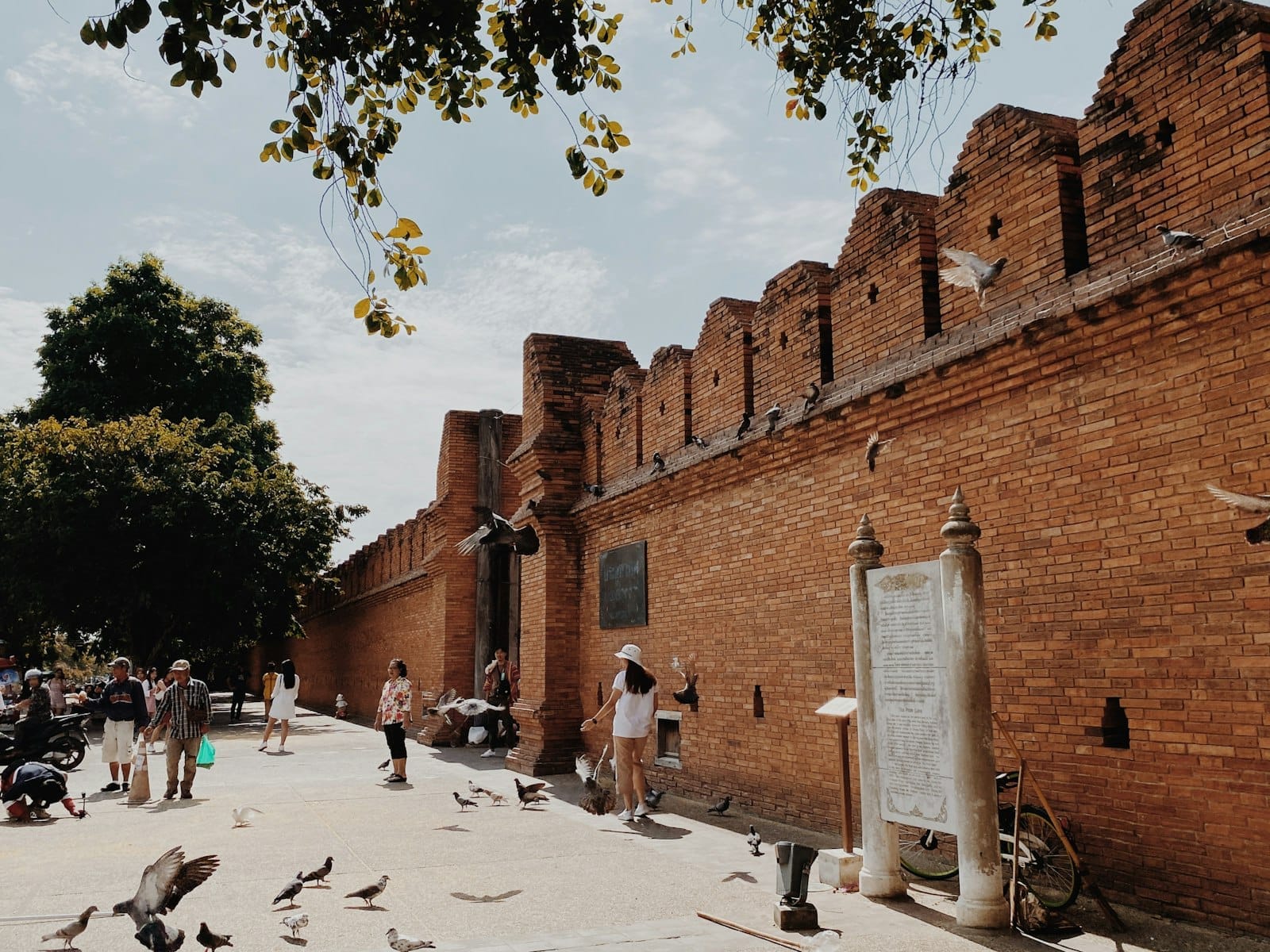
Tha Phae Gate is the eastern gateway of Chiang Mai's original city wall, built in 1296 CE when King Mengrai founded the Lanna capital. Of the four original gates in the rectangular fortification, Tha Phae is the eastern gateway of Chiang Mai's original city wall and is unmistakably recognizable: a broad, crenellated brick structure rising above a wide ceremonial plaza. The gate faces due east toward the Ping River, roughly 700 meters away, which is why this road and gate took the name 'Tha Phae,' meaning 'raft landing' in Thai, referencing the river trade that once defined this approach to the city.
The wall and gate you see today are not original 13th-century stonework. Chiang Mai's fortifications were rebuilt, damaged, and reconstructed multiple times over the centuries, including a major reconstruction in 1985–1987 that gave the gate its current form. Historians and architectural purists sometimes note that the reconstruction prioritized visual impact over strict historical accuracy, which is worth understanding before you arrive expecting medieval authenticity. What the gate does offer, genuinely, is a sense of scale and place: standing beneath it, you get a tangible feel for how the Lanna city was organized and defended.
ℹ️ Good to know
The gate plaza is fully open 24 hours a day and costs nothing to visit. The structure itself cannot be climbed or entered.
The Gate at Different Times of Day
Early morning is the quietest time to visit, particularly between 6:30 and 8:00 AM. The brick takes on a warm, reddish-orange tone in the low eastern light, and the plaza is nearly empty apart from monks from nearby temples making their alms rounds and a few vendors setting up coffee carts along Tha Phae Road. This is the best window for unobstructed photographs and for simply absorbing the geometry of the structure without distraction.
By mid-morning, tour groups begin arriving and the plaza fills with tuk-tuks idling at the curb. The gate becomes more of a transit hub than a contemplative space: tour guides huddle groups in front of it, and the surrounding area gets noisy with engine sounds and rapid-fire shutterstops. If you arrive during this window, use the gate as an orientation point and push quickly into the Old City streets rather than lingering on the plaza.
Evenings are a different experience entirely. As daylight fades, floodlights illuminate the brickwork from below, giving the gate a theatrical, amber glow. Local families gather on the steps of nearby buildings, street food vendors set up along the road's edges, and the whole area takes on a loose, social atmosphere. During major festivals, including Yi Peng and Songkran, the plaza in front of Tha Phae Gate becomes one of the main gathering points for the entire city, with large crowds.
💡 Local tip
For photography, golden hour before sunset (roughly 5:00–6:30 PM) gives the brick a deep amber tone and softer shadows than midday. Position yourself along the moat promenade to the north or south for a wider frame that includes the moat and surrounding trees.
Tickets & tours
Live prices and dates from our booking partner. If you book, we may earn a commission at no extra cost to you.
Doi Inthanon National Park small group guided tour
From 34 €Instant confirmationFree cancellationHalf-day tour to admire elephants and enjoy Thai nature
From 48 €Instant confirmationFree cancellationThapae Muay Thai Boxing Stadium tickets
From 18 €Instant confirmationFree cancellationTraditional northern Thai dinner with cultural show
From 79 €Instant confirmationFree cancellation
The City Wall and Moat: Context That Makes the Gate Make Sense
Tha Phae Gate only fully makes sense once you understand what it was part of. The original Lanna city was laid out as a near-perfect rectangle, roughly 1.6 kilometers by 1.6 kilometers, enclosed by a brick wall and surrounded by a square moat. Today, that moat is intact and has become one of Chiang Mai's most pleasant walking corridors. Starting from Tha Phae Gate and walking either north or south along the inner moat road, you encounter the other restored gate sections, crumbling original wall fragments, and ficus trees whose roots have reclaimed portions of the old fortification. The full moat perimeter is about 6 kilometers and is a manageable walk or easy bicycle loop. For more on this area's layout and what surrounds it, see the Chiang Mai city walls and moat guide.
The stretch of wall immediately flanking Tha Phae Gate is the most complete and photogenic section. Moving further along the wall toward the other gates, the structure becomes more fragmentary, with newer buildings occasionally interrupting its line. This patchwork character is actually more historically honest than the gate itself, showing how the fortification was adapted and partially dismantled over centuries of urban growth.
The Plaza and Surrounding Area
The broad paved plaza on the outer (eastern) side of Tha Phae Gate is where most visitor activity concentrates. It functions as an informal public square: a place for orientation, meetings, performances during festivals, and the starting point for Chiang Mai's Sunday Walking Street, which runs along Ratchadamnoen Road and draws large crowds every week. The plaza itself is flat, fully paved, and accessible for wheelchairs and strollers, though the surrounding streets can be uneven.
On the inner (western) side of the gate, you enter the Old City proper. The first blocks of Ratchadamnoen Road run straight toward the historic core, passing guesthouses, small coffee shops, and traditional shophouses. Within a 10-minute walk of the gate you will find several of Chiang Mai's most significant temples, making Tha Phae a natural starting point for any temple circuit.
The closest temples to the gate include Wat Chiang Man to the north, which is the oldest temple in the city, and Wat Chedi Luang a few blocks west, home to one of Chiang Mai's largest ruined chedis. Both are within easy walking distance and together with Tha Phae Gate form a natural half-day itinerary of the Old City's Lanna heritage.
Festivals: When the Gate Becomes the Center of Everything
During Yi Peng, the Lanna lantern festival held in November, Tha Phae Gate plaza is one of the main gathering points in the Old City for festival crowds and street celebrations. Mass sky-lantern releases, however, are restricted to designated zones outside Chiang Mai city limits — check the current rules in our Yi Peng festival guide covers timing, crowd management, and how to secure a good position.
Songkran, the Thai New Year water festival in April, also centers substantially on the moat and Tha Phae Gate area. The moat becomes a water-fight zone for several days, and the gate plaza is a staging point for ceremonial processions. The Chiang Mai Songkran guide explains how to navigate the festivities without getting completely soaked unless you intend to be.
Practical Notes for Visitors
There are no entry fees, no queues, no guided tours specific to the gate, and no indoor areas to access. The experience is entirely about the exterior architecture, the plaza, and the surrounding streetscape. Dress is casual; there is no temple etiquette required here since it is a civic monument rather than a religious site.
The area around Tha Phae Gate has reliable food and drink options at most hours. Several cafes on Tha Phae Road open early and stay open past midnight, and the nearby Warorot Market area to the northeast adds a local market dimension to any visit. Tuk-tuks and red songthaews congregate near the gate and are easy to flag down for onward travel anywhere in the city.
⚠️ What to skip
During Songkran (mid-April), the moat road and gate area is effectively a water fight zone for several days. Leave camera gear at your accommodation unless it is fully waterproofed, and expect transport to be significantly slower due to crowd control closures.
Visitors who struggle in heat should plan their gate visit for early morning or after 5:00 PM. The plaza has no shade structures, and midday temperatures in the dry season (March through May) regularly exceed 36°C. The burning season, running roughly February through early April, can also reduce visibility and add an acrid quality to the air on bad days, which affects the pleasantness of any outdoor time in the city.
Insider Tips
- The northern interior wall of the gate has a small section of exposed original brick that was not refaced during the 1980s restoration. It is visually distinct from the smoother modern restoration work and gives a better sense of the original construction technique.
- Sunday evenings, when the Walking Street is running, bring the gate plaza to life with performers, monks, and vendors gathering from around 4:00 PM onward. Arrive by 4:30 PM to find a position before the crowds peak.
- The moat promenade immediately north of the gate is quieter and better shaded than the main plaza. It offers a longer sightline along the wall and is where locals go for evening walks rather than the tourist-heavy plaza.
- If you are combining the gate with a temple walk, go north to Wat Chiang Man first, then west toward Wat Chedi Luang and Wat Phra Singh. This route follows the quieter inner streets before arriving at the busier temple zones.
- At night during non-festival periods, the lit gate makes for long-exposure photography with minimal equipment. Set your phone or camera on the low wall bordering the moat side for a stable base without needing a tripod.
Who Is Tha Phae Gate For?
- First-time visitors to Chiang Mai who want a clear, central orientation point for the Old City
- History and architecture enthusiasts interested in Lanna-era urban planning and fortification
- Festival travelers: Tha Phae Gate is ground zero for Yi Peng and Songkran celebrations
- Evening walkers and casual explorers who want a scenic, free outdoor landmark
- Photographers looking for a well-lit, structurally interesting subject at multiple times of day
Nearby Attractions
Other things to see while in Old City (Chiang Mai Old Town):
- Chang Phuak Night Market (North Gate Food Market)
Chang Phuak Night Market, known to locals as the North Gate Food Market, is a compact open-air street food gathering outside Chiang Mai's ancient city walls. Night after night, it draws a faithful crowd of students, office workers, and savvy travelers in search of authentic northern Thai cooking at prices that haven't caught up with the tourist economy.
- Chiang Mai City Arts and Cultural Centre
Housed in a beautifully restored colonial-era building on the edge of the Old City's Three Kings Monument plaza, the Chiang Mai City Arts and Cultural Centre offers one of the most accessible and well-curated introductions to Lanna history and northern Thai culture. It rewards both first-time visitors and those who want genuine context before exploring the city's temples and neighborhoods.
- Chiang Mai City Walls and Moat
The rectangular moat and surviving brick walls of Chiang Mai's Old City are the physical outline of a 700-year-old Lanna capital. Free to explore at any hour, they offer one of the most atmospheric walks in northern Thailand, framing temples, corner bastions, and four ceremonial gates.
- Chiang Mai National Museum
The Chiang Mai National Museum offers one of the clearest introductions to northern Thailand's Lanna Kingdom, covering 700 years of history through royal artifacts, Buddhist sculpture, ceramics, and ethnographic collections. It's calm, well-organized, and genuinely undervisited compared to the temples nearby.
Planning a trip? Discover personalized activities with the Nomado app.