Chang Phuak Night Market: Chiang Mai's Best Local Street Food Spot
Chang Phuak Night Market, known to locals as the North Gate Food Market, is a compact open-air street food gathering outside Chiang Mai's ancient city walls. Night after night, it draws a faithful crowd of students, office workers, and savvy travelers in search of authentic northern Thai cooking at prices that haven't caught up with the tourist economy.
Quick Facts
- Location
- Mani Nopparat Road, just outside the North Gate (Pratu Chang Phuak), Chiang Mai Old City
- Getting There
- 10-min walk from Tha Phae Gate; red songthaew from Nimman or the Night Bazaar area; no direct public bus
- Time Needed
- 45–90 minutes
- Cost
- Free entry; dishes typically 50–120 THB
- Best for
- Budget diners, solo travelers, northern Thai food lovers, late-evening meals
What Chang Phuak Night Market Actually Is
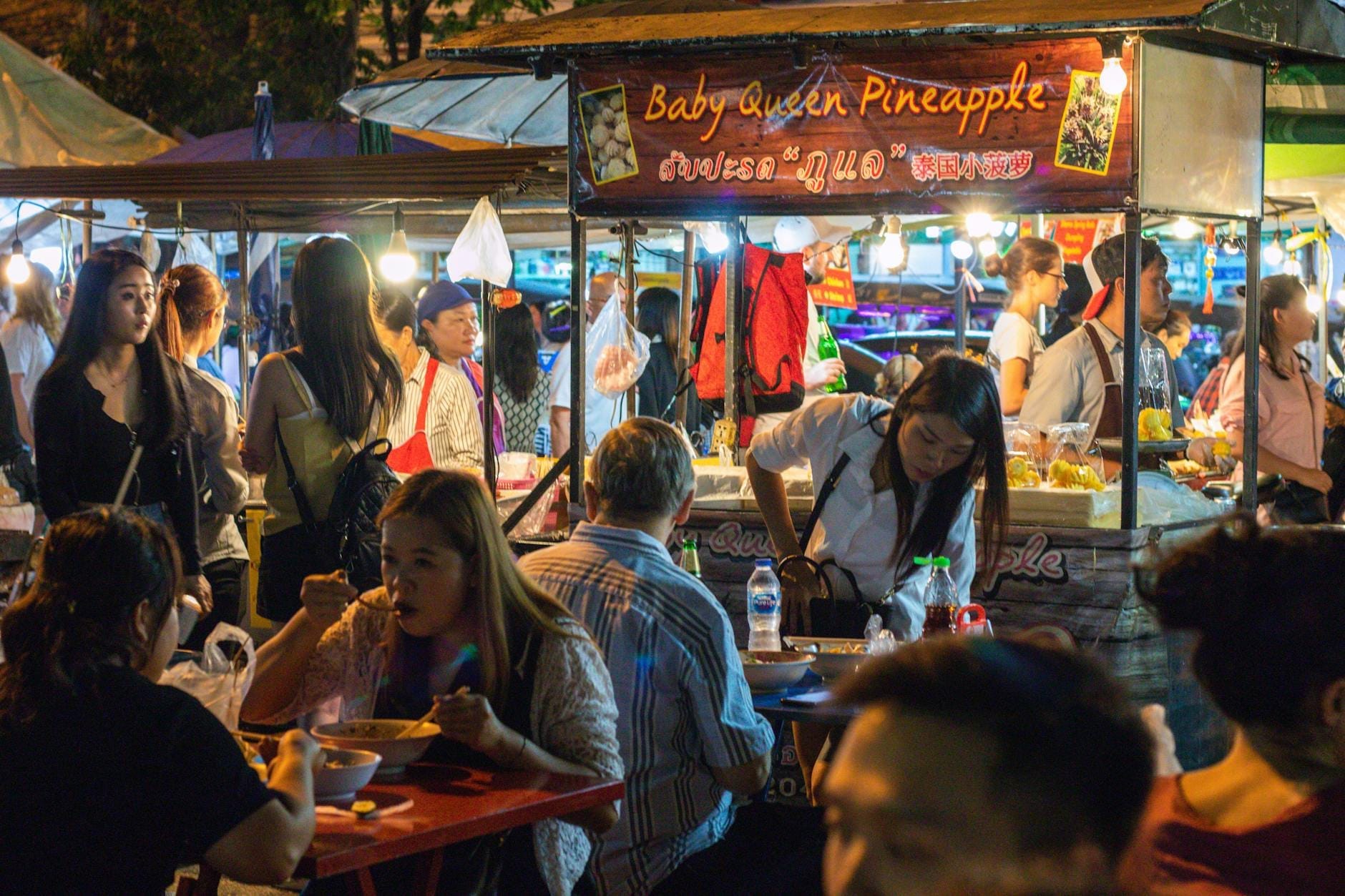
Chang Phuak Night Market is not a walking street or a curated tourist experience. It is a working street food market: a cluster of wheeled carts, fold-out stalls, and plastic-table setups that assembles each evening on Mani Nopparat Road, just north of the historic city wall. The market takes its informal name from the gate it sits beside, Pratu Chang Phuak, the White Elephant Gate, one of the four original portals in Chiang Mai's moat-and-wall perimeter.
The atmosphere here is resolutely local. On any given night the crowd is roughly 70 percent Thai, a mix of university students from nearby Rajabhat University, families from the Old City neighborhoods, and workers finishing late shifts. Farang faces are not uncommon, but they are not the target audience. That asymmetry is exactly what makes the food worth seeking out: vendors are cooking to local standards, not adjusted to outside palates.
💡 Local tip
Arrive between 6:30 PM and 7:30 PM for the fullest selection before popular items sell out. The market runs roughly 6 PM to midnight, but the energy peaks in the first two hours.
The Food: What to Eat and Who to Look For
The market's single most famous vendor is the khao kha moo lady, an elderly woman who has been braising pork trotters over a slow fire at the same corner cart for decades. Her stall, recognizable by the gleaming brass pot and the queue that forms before sunset, sells khao kha moo: stewed pork leg over rice, with a hard-boiled egg, pickled mustard greens, and a drizzle of dark braising liquid. It costs around 60 THB and is considered by many Chiang Mai regulars to be the single best version in the city. Arrive after 8 PM and it may be sold out entirely.
Beyond the headliner, the market offers a concentrated cross-section of northern Thai street cooking. Look for sai ua, the coarse, herb-packed Chiang Mai sausage grilled on charcoal skewers with a crisp, lemongrass-scented casing. Laab khua, the dry-fried minced pork version distinct to northern Thailand, appears at several stalls alongside nam prik ong, a tomato-and-minced-pork chili dip served with fresh vegetables and sticky rice. There are also vendors doing pad thai and fried rice for the less adventurous, but the real value is in the dishes you will not find on most restaurant menus.
Dessert options cluster toward the south end of the stall arrangement. Khao niao mamuang (mango sticky rice) is seasonal but superb when available. Look also for khanom krok, small coconut-rice pancakes cooked in a cast-iron mold, sold warm in sets of six for around 20 THB. The smell of coconut milk hitting hot iron is one of the reliable sensory markers of the market.
ℹ️ Good to know
Most vendors accept cash only. There are ATMs on Mani Nopparat Road within a two-minute walk. Small bills (20 and 50 THB notes) make transactions easier at busy stalls.
Tickets & tours
Live prices and dates from our booking partner. If you book, we may earn a commission at no extra cost to you.
Chiang Mai temples and night market tuk-tuk tour
From 23 €Instant confirmationFree cancellationChiang Mai street food experience tuk-tuk night tour
From 159 €Instant confirmationFree cancellationChiang Mai private van day trip to Changthong Heritage Park and Hidden Village
From 119 €Instant confirmationFree cancellationDoi Inthanon National Park small group guided tour
From 34 €Instant confirmationFree cancellation
The Atmosphere at Different Hours
At 5:30 PM, the market is still assembling. Vendors wheel carts into position, charcoal fires are lit, and the smell of smoke and rendered fat begins to build. If you arrive this early you can watch the setup process and sometimes chat with vendors before service begins, a window that disappears once the dinner crowd arrives.
By 7 PM the scene is at full intensity. Plastic stools are occupied, the drone of a generator competes with Thai pop from a phone speaker, and the narrow corridor between stalls requires some patience to navigate. The light is a warm, imprecise mix of bare bulbs, phone screens, and the orange glow of charcoal grills. Steam rises from brass pots. The air carries layers: pork fat, fish sauce, lemongrass, and the faintly sweet smell of sticky rice steaming in bamboo baskets.
After 9 PM the crowd thins noticeably. Some stalls begin running low on key items. The energy shifts from dinner rush to late-night snacking, and the remaining patrons tend to linger longer over their food. This later window is quieter and easier to navigate, though choice is reduced.
Getting There and Getting Around
Chang Phuak Night Market sits on Mani Nopparat Road, just outside Chiang Mai's Old City,northern edge of the Chiang Mai Old City, directly outside the North Gate moat crossing. From the center of the Old City, the walk takes around 10 to 12 minutes along Ratchaphakhinai Road heading north. From Nimman, a red songthaew heading toward Pratu Chang Phuak costs 30–40 THB per person. From the Chiang Mai Night Bazaar on the east side of the Old City, the walk is approximately 20 minutes or a short songthaew ride.
Parking is difficult on weekends. If you are on a motorbike, the road shoulder near the moat fills early. The North Gate area has limited formal parking; walking or arriving by songthaew is the practical choice for most visitors.
⚠️ What to skip
The market operates outdoors with no covered seating. During the rainy season (roughly June through October), afternoon downpours can delay the market's setup or reduce attendance significantly. Check the sky before heading out and bring a light jacket or packable rain cover.
How Chang Phuak Fits Into the Old City Food Scene
Chiang Mai's Old City has no shortage of night food options. The Sunday Walking Street on Wualai Road and the Saturday Walking Street on Wualai and Tha Phae are larger, more photogenic, and more tourist-forward. Chang Phuak is different in character: smaller, faster, and oriented almost entirely around eating rather than shopping or sightseeing.
It also runs every night of the week, which makes it a reliable fallback when the walking streets are closed. For travelers staying in or near the Old City, it quickly becomes a default dinner option that rewards repeat visits, partly because the rotating stock of daily specials means the menu effectively changes.
If you are building a broader understanding of Chiang Mai's food culture, pairing a visit here with a morning trip to Warorot Market gives a useful contrast between the wholesale ingredient economy and the cooked street food scene. For a curated introduction to northern Thai flavors before you arrive, the what to eat in Chiang Mai guide provides useful context on regional dishes.
Photography, Accessibility, and Honest Limitations
The market photographs well in the first hour after dark, when the combination of ambient daylight and artificial warmth creates layered light around the grill smoke. A phone camera handles this adequately; the compressed space means you are always close to your subject. Ask permission before photographing vendors directly, particularly the khao kha moo stall, where the vendor has been photographed thousands of times and a brief smile and gesture of the camera goes a long way toward a gracious response.
Accessibility is limited. The market occupies a road shoulder and sidewalk area with uneven surfaces, narrow gaps between stalls, and no formal seating layout. Wheelchair navigation would be genuinely difficult. The ground is occasionally wet from cooking runoff, so footwear with a sole that grips is worth considering. There are no public restrooms within the market; the nearest facilities are at nearby convenience stores on Mani Nopparat Road.
Travelers expecting a polished, Instagram-curated night market experience may find Chang Phuak underwhelming at first glance. It is small, slightly chaotic, and not designed for spectacle. The payoff is in the food itself, and that payoff is genuine. Anyone who approaches it primarily as a photography location or a tick on a sightseeing list rather than a place to sit down and eat is likely to miss the point entirely.
Insider Tips
- The khao kha moo cart is at the northern end of the stall cluster, closest to the moat. It runs out before most other vendors — get there by 7 PM if this is your primary reason for visiting.
- Order one dish at a time rather than loading up immediately. Space is tight, stalls are independent, and you will likely want to sample from three or four different vendors across the evening.
- Tuesday and Wednesday nights are noticeably less crowded than Thursday through Sunday. If you want a more relaxed experience with shorter queues, mid-week visits reward patience.
- Several vendors offer no written menu or English signage. Pointing at what neighbors are eating, or at the food displayed, is entirely normal and generally produces good results. Vendors are accustomed to it.
- The plastic stools and low tables are communal. Sitting next to strangers is standard practice, not an imposition. Brief nods and shared condiment dishes are the social currency of the place.
Who Is Chang Phuak Night Market (North Gate Food Market) For?
- Budget travelers who want to eat well without paying restaurant prices
- Solo diners comfortable navigating a local-crowd environment
- Food-focused visitors specifically interested in northern Thai regional dishes
- Travelers staying in or near the Old City looking for a reliable nightly dinner option
- Anyone curious about how Chiang Mai residents actually eat on weekday evenings
Nearby Attractions
Other things to see while in Old City (Chiang Mai Old Town):
- Chiang Mai City Arts and Cultural Centre
Housed in a beautifully restored colonial-era building on the edge of the Old City's Three Kings Monument plaza, the Chiang Mai City Arts and Cultural Centre offers one of the most accessible and well-curated introductions to Lanna history and northern Thai culture. It rewards both first-time visitors and those who want genuine context before exploring the city's temples and neighborhoods.
- Chiang Mai City Walls and Moat
The rectangular moat and surviving brick walls of Chiang Mai's Old City are the physical outline of a 700-year-old Lanna capital. Free to explore at any hour, they offer one of the most atmospheric walks in northern Thailand, framing temples, corner bastions, and four ceremonial gates.
- Chiang Mai National Museum
The Chiang Mai National Museum offers one of the clearest introductions to northern Thailand's Lanna Kingdom, covering 700 years of history through royal artifacts, Buddhist sculpture, ceramics, and ethnographic collections. It's calm, well-organized, and genuinely undervisited compared to the temples nearby.
- Lanna Folklife Museum
Housed in a beautifully restored colonial-era courthouse in Chiang Mai's Old City, the Lanna Folklife Museum offers one of the clearest windows into northern Thailand's distinct culture, traditions, and belief systems. If you want context before visiting the region's temples and villages, this is where to start.
Planning a trip? Discover personalized activities with the Nomado app.