Saturday Walking Street (Wua Lai Road): Chiang Mai's Silver Street After Dark
Every Saturday evening, Wua Lai Road transforms into one of Chiang Mai's most atmospheric night markets. Known historically as the city's silversmith district, the street fills with handcrafted goods, northern Thai street food, and the glow of temple lanterns — all with noticeably fewer tourists than its Sunday counterpart.
Quick Facts
- Location
- Wua Lai Road, south of the Old City moat, Chiang Mai
- Getting There
- 10-min walk south of Chiang Mai Gate; songthaew or tuk-tuk from Nimman or Night Bazaar area
- Time Needed
- 1.5 to 3 hours depending on pace
- Cost
- Free to enter; budget 100–400 THB for food and browsing
- Best for
- Craft shoppers, street food lovers, photographers, slow travelers
What Is the Saturday Walking Street?
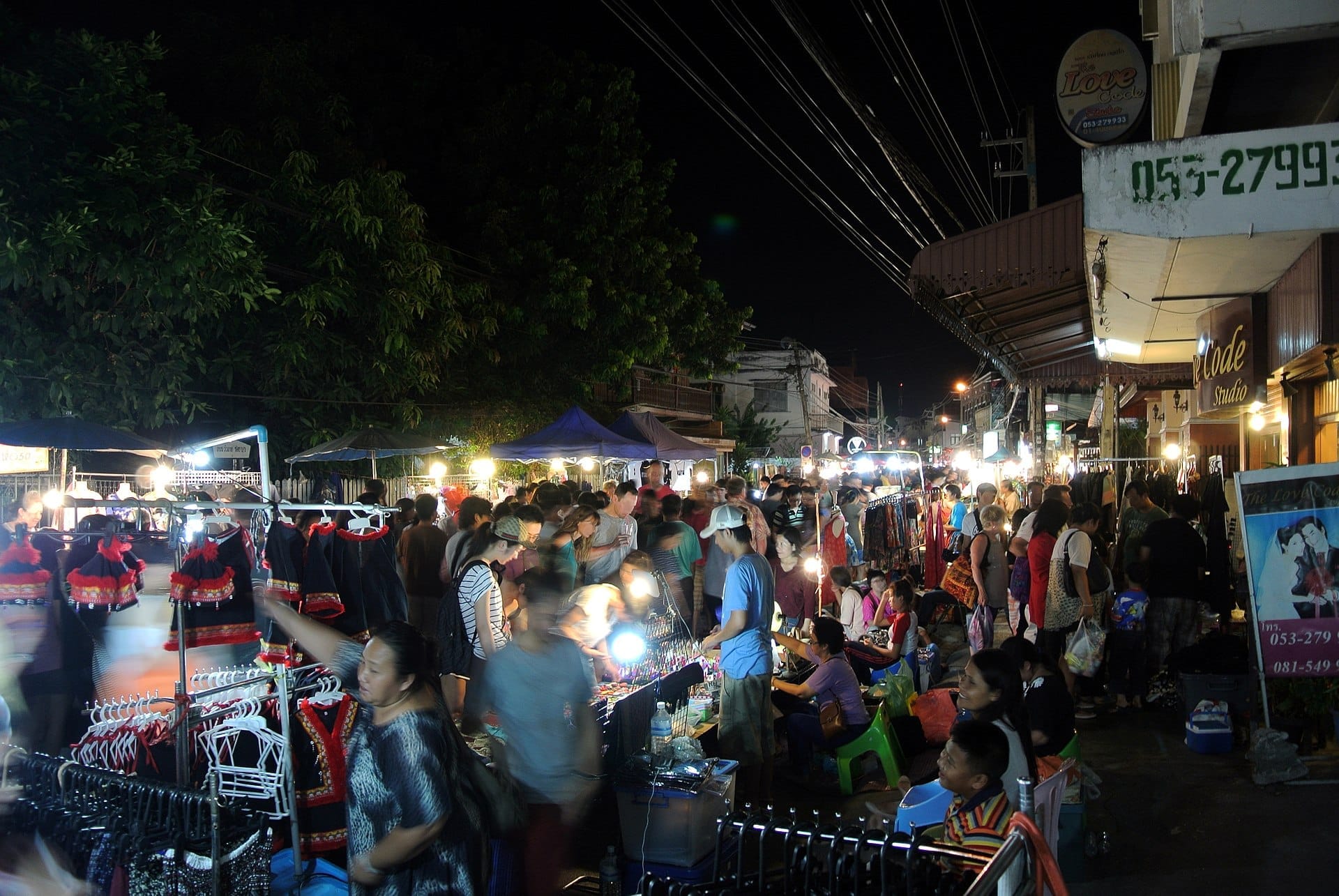
The Saturday Walking Street on Wua Lai Road is a weekly pedestrian night market that runs every Saturday evening along a stretch of road south of the Old City's Chiang Mai Gate. Unlike the more commercially polished Sunday Walking Street on Tha Phae Road, Wua Lai has held onto a grittier, more neighborhood feel. The street is closed to traffic from around 4:00 PM, and stalls begin setting up in the late afternoon, though the market reaches its full energy after 6:00 PM.
The road has historical roots as Chiang Mai's silversmithing district. Families from the silver-working tradition have operated workshops here for generations, and even on non-market days you can hear the faint tap of hammers against metal from open-fronted shophouses. On Saturdays, that craft identity comes to the surface: silver jewelry, engraved bowls, and decorative pieces made in the workshops just steps away from the stalls.
💡 Local tip
Arrive by 5:30 PM to walk the street before it gets congested and while the light is still warm. You'll also have first pick of handmade goods before the evening rush.
The Silversmith Heritage: Why This Street Is Different
Wua Lai Road's identity as a silversmith district predates the walking market by centuries. Under the old Lanna kingdom, artisans — many of Shan descent — settled south of the city walls to practice metalwork. The techniques they developed, including repoussé (hammering designs from the reverse of a metal sheet), became foundational to northern Thai decorative arts. Several working silver workshops still operate behind storefront doors along Wua Lai, and some welcome visitors who want to watch the process.
This context matters when you're shopping. Silver items sold here are more likely to be made within a few hundred meters of where you're standing, not imported or mass-produced. It's worth asking vendors about their process. For travelers interested in the broader craft tradition of the region, the Lanna Folklife Museum near the Three Kings Monument provides excellent background on northern Thai decorative arts, including silverwork.
Tickets & tours
Live prices and dates from our booking partner. If you book, we may earn a commission at no extra cost to you.
Doi Inthanon National Park small group guided tour
From 34 €Instant confirmationFree cancellationHalf-day tour to admire elephants and enjoy Thai nature
From 48 €Instant confirmationFree cancellationChiang Mai - Chiang Dao Cave and 5 Hill Tribe villages
From 42 €Instant confirmationFree cancellationArt in Paradise Chiang Mai 3D Art Museum entrance tickets
From 8 €Instant confirmationFree cancellation
What to Expect as You Walk the Street
The market stretches roughly from the intersection near Chiang Mai Gate southward, with stalls lining both sides of the road and spilling into temple courtyards. The ground underfoot is uneven in places, a mix of old paving stones and the raised edges of tarpaulins, so watch your step. The smell shifts as you move: incense from temple grounds, then grilled corn, then the faint sweetness of mango sticky rice, then garlic hitting a hot wok.
Craft stalls dominate the first section nearest Chiang Mai Gate: silver jewelry, hand-painted fans, woven textiles, lacquerware, and woodcarvings. The quality here is genuinely higher on average than at tourist-focused markets, partly because many vendors are the makers. Prices are negotiable but not dramatically flexible — these are craftspeople, not importers. Approaching with respect and a specific question about the work tends to go further than aggressive bargaining.
Moving deeper into the market, food stalls become more frequent. Look for khao niao mamuang (mango sticky rice) served in small banana leaf portions, grilled skewers of pork and chicken, kanom krok (coconut pancakes cooked in a cast-iron mold), and cups of sweet chrysanthemum tea that cost about 20 THB. The food at Saturday Walking Street skews more local than the Sunday market, with fewer stalls catering exclusively to foreign palates.
The Temples Along the Route
Several temples sit directly along or adjacent to Wua Lai Road, and the market wraps around them rather than replacing them. Wat Sri Suphan, commonly called the Silver Temple, is the most significant. Its ordination hall (ubosot) is covered in silver and aluminum reliefs, making it one of the most visually striking temple interiors in Chiang Mai. On Saturday nights, the temple is lit from below and the effect is genuinely striking against a dark sky.
Note that women are not permitted inside the main ordination hall of Wat Sri Suphan as a matter of religious tradition, though the outer grounds and other structures are open to everyone. The temple typically charges a modest entrance fee for visitors during evening hours. If you time your evening walk to pass the temple between 7:00 PM and 8:00 PM, you'll often find monks in the grounds and the silver surfaces glowing at their best.
How the Atmosphere Changes Through the Evening
Between 5:00 PM and 6:30 PM, the market is still assembling and the light is golden. Locals outnumber tourists at this hour, and the street has a calm, neighborhood quality. This is the best time to photograph without crowds in the frame, to talk to vendors before they are occupied, and to get a read on prices before the evening energy sets in.
From 7:00 PM to 9:00 PM is peak time. The street becomes crowded but not uncomfortably so by major Bangkok market standards. People move slowly, which is partly the Thai market pace and partly the narrow channel between stalls. There is background music from street performers at intervals — usually traditional Thai instruments or gentle acoustic sets, not amplified pop. The smell of cooked food is now everywhere.
By 9:30 PM, stalls begin packing down. The food vendors are usually the last to close, and this is a good time to pick up discounted craft items from sellers who don't want to carry inventory home. The street is usually cleared and traffic resumes by around 10:00–10:30 PM.
ℹ️ Good to know
The market runs in all but the most severe rain. Light rain is manageable since many stalls have overhead coverings, but a heavy downpour will reduce vendors significantly. Check the forecast during rainy season (June through October).
Practical Information: Getting There, Getting Around
Wua Lai Road runs south from Chiang Mai Gate, which is on the southern wall of the Old City. On foot from the southern edge of the Old City it's about a 10-minute walk. Red songthaews (shared pickup trucks) run along the main roads nearby and can drop you at or near Chiang Mai Gate for around 30–40 THB per person. From the Night Bazaar area on the east side, a tuk-tuk ride takes about 10 minutes. From Nimman, allow 15–20 minutes by songthaew or rideshare app.
Parking is extremely limited on and around Wua Lai Road during market hours. Do not attempt to drive unless you know the side streets well. Rideshare apps (Grab or Bolt) work well for drop-off and pickup, though traffic slows considerably in the immediate area after 7:00 PM. Arriving and leaving on foot or by songthaew is significantly easier.
Wear comfortable footwear with grip — sandals with thin soles on uneven paving will tire quickly. A small bag worn across the body is practical for keeping hands free while browsing. Bring cash in small denominations; most vendors don't accept cards and the nearest ATM is back toward Chiang Mai Gate.
⚠️ What to skip
Pickpocketing is not a major issue here, but the market does get congested at peak hours. Keep your bag in front of you and avoid keeping your phone in a back pocket during the busiest stretch of the evening.
Saturday vs. Sunday Walking Street: Which One to Choose?
If you can only attend one, your choice depends on what you're after. The Sunday Walking Street on Tha Phae Road is longer, louder, and more diverse in its range of goods and food — but it is also significantly more crowded with tourists and the craft quality is more uneven. Wua Lai on Saturday is shorter, more focused on silver and traditional northern crafts, and retains a stronger connection to the neighborhood that surrounds it.
Serious craft shoppers, photographers wanting more intimate street scenes, and travelers who find large markets exhausting will generally prefer Saturday. Travelers who want maximum variety of food and goods in one place, or who are visiting with children who need stimulation and space, may find Sunday the better fit. Some travelers who spend a full week in Chiang Mai do both — the two markets are distinct enough to justify attending each.
For travelers interested in exploring the broader market scene in Chiang Mai, the Chiang Mai night markets guide covers the full range of options across the city, from the weekend walking streets to the daily food markets like Chang Phuak.
Insider Tips
- The silver workshops behind the shophouses on Wua Lai are often open during the market. Look for open doorways with interior lights and the sound of metalwork — if someone is present, a polite greeting and genuine curiosity usually results in a brief look inside.
- The intersection closest to Chiang Mai Gate has the highest stall density and the most foot traffic. If you want a quieter browse, start at the far southern end of the market and work back toward the gate.
- Street food near the temple courtyard of Wat Sri Suphan tends to be cheaper than at stalls near the main entrance. Temple-adjacent vendors price closer to what locals pay.
- If you're buying silver, ask for the silver content percentage. Genuine Thai silver is typically 92.5% (sterling) or 95–99% for handcrafted traditional pieces. Vendors who know their product will answer without hesitation.
- The market is significantly quieter during the low season months of September and October due to both the rainy season and fewer tourists. Vendors are more relaxed, willing to talk, and occasionally more flexible on price.
Who Is Saturday Walking Street (Wua Lai Road) For?
- Craft and jewelry shoppers who want items made locally rather than sourced wholesale
- Food explorers interested in northern Thai street snacks with a more local-oriented vendor mix
- Photographers working with available light who want architecture, craft, and people in one compact location
- Travelers who find large, busy markets overstimulating and want a more walkable, less chaotic version
- Couples looking for a relaxed weekend evening activity close to the Old City
Nearby Attractions
Other things to see while in Riverside (Ping River Area):
- Art in Paradise Chiang Mai (3D Art Museum)
Art in Paradise Chiang Mai is a large-format interactive 3D art museum located near the Riverside district. Visitors pose inside trompe-l'oeil paintings to create optical illusion photographs. It suits families, couples, and anyone looking for a lighthearted few hours indoors.
- Chiang Mai Night Bazaar
The Chiang Mai Night Bazaar is a sprawling commercial market district along Chang Khlan Road, drawing both tourists and locals with stalls selling handicrafts, clothing, street food, and souvenirs. It's well-organized and easy to navigate, but knowing what to expect prevents disappointment.
- Mae Ping River Cruises
The Mae Ping River has shaped Chiang Mai since the city's founding in 1296, and a river cruise remains one of the few ways to see the city from a genuinely different angle. Longboat and converted rice-barge tours depart from piers near Nawarat Bridge, passing riverside temples, colonial-era trading houses, and fruit orchards that survive within the city limits.
- Nawarat Bridge
Nawarat Bridge is one of Chiang Mai's most significant bridges across the Ping River, connecting the Old City to the eastern riverfront. More than just infrastructure, it serves as a daily gathering point, a photography landmark, and a quiet window into how the city actually moves.
Planning a trip? Discover personalized activities with the Nomado app.